
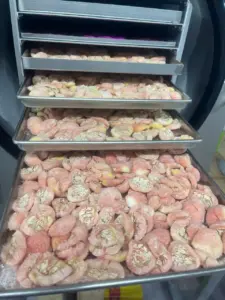
What moisture, water activity and microbial limits should freeze-dried rambutan meet?
Write moisture ≤5.0% and water activity ≤0.30 into your contract, with TPC ≤10⁴ CFU/g, yeasts and moulds ≤10² CFU/g, E. coli <10 CFU/g and Salmonella not detected in 25 g. Those six lines decide whether your customer bites into a half that snaps clean and melts, or into one with a chewy core that sticks to the teeth.
Rambutan needs this spec more than most fruit. It carries about 81 g of natural sugar per 100 g of finished product, so it pulls humidity out of the air faster than mango, jackfruit or banana. Everything below is built around that one fact.
Which limits belong in the contract, and which are release ranges?
The contract carries the limits you reject a lot against. The release range is where our partner facilities actually pack, and the gap between the two is what protects the crisp bite through 30–40 days at sea.
| Parameter | Contract limit | Packing-room release range | Where it is checked |
|---|---|---|---|
| Water activity | ≤0.30 | 0.20–0.26 | Lot COA; your own meter on arrival |
| Moisture | ≤5.0% | 3.0–4.2% | Lot COA |
| Total plate count | ≤10⁴ CFU/g | <10³ CFU/g | Lot COA |
| Yeasts & moulds | ≤10² CFU/g | ≤10² CFU/g | Lot COA |
| E. coli | <10 CFU/g | <10 CFU/g | Lot COA |
| Salmonella | Not detected / 25 g | Not detected / 25 g | Lot COA |
| Lead, arsenic, aflatoxin | Destination law | Not detected | Periodic surveillance report |
| Fines / broken (halves) | Agreed per contract | <5% | Pre-shipment sample |
Copy the contract column straight into your specification. Keep the release column on file: a supplier who cannot quote it is running the dryer by feel.
The buffer is the point. A lot packed at aw 0.24 can pick up a little moisture at a transhipment port and still arrive at 0.27, inside your limit and still crisp. A lot packed at 0.29 has nowhere to go. TPC works the same way: washed fruit and deep freezing straight after peeling put routine lots an order of magnitude under the contract limit.
Why does high-sugar rambutan pick up moisture faster than other fruit?
Freeze-drying leaves rambutan’s sugar as a glassy, crisp solid. That glass holds only while the fruit stays dry. Past about aw 0.30 the sugar softens at room temperature, the surface turns tacky, and pieces fuse.
The Vietnamese harvest makes this a daily discipline. Rambutan comes in from May to August, in the wet season, when outside air in the Mekong Delta and Southeast Vietnam sits at 75–85% RH. Left on an open table in that air, freshly dried aril starts to feel tacky to the touch within 15–20 minutes. So our partner facilities unload the dryer and pack in a cool, dehumidified room held below 50% RH, and the bag is sealed before the fruit has time to notice the weather.
At your end, the cost of getting this wrong shows up on the packing line before it shows up on the shelf. Tacky pieces cling to the vibrating pans and buckets of a multi-head weigher, pack weights drift, and the line stops while someone scrapes it down. Most specs lead with moisture because it is the familiar number. On rambutan, aw tells you more: a lot can read 4.5% moisture and still sit at 0.33 aw if it was packed in humid air.
How do moisture and drying affect colour and bite?
Right-sized moisture is what buyers taste. At 3.0–4.2%, a rambutan half gives a dry, clean snap and dissolves on the tongue, releasing the floral sweetness of Rongrien or Java fruit at 18–22° Brix. Pull it out of the dryer early, at 4.8–5.0%, and the outside feels dry while the core stays chewy. Customers read that as stale product.
Colour follows the same logic. With 81% natural sugar, rambutan browns if a rushed supplier pushes heat in the final drying stage to hit the moisture target faster. The aril shifts from pale blush to dull yellow or light tan and looks like old stock in a clear retail window. A low-temperature cycle that reaches aw below 0.26 without forcing it keeps the pale blush colour your customer sees when the pouch opens.
The bag then holds what the dryer achieved. Every bulk bag is aluminium-foil PE, soft-vacuumed so it lies flat, with a food-grade silica gel sachet inside. Nitrogen flushing is not used: an inflated bag creases under stacking, the foil cracks at the fold, and on a fruit this hungry for water a hairline crack is enough to lose the lot.
Which tests travel with every container?
Every full-container lot ships with a third-party COA from an ISO/IEC 17025 accredited laboratory covering moisture, water activity, total plate count, yeasts and moulds, E. coli and Salmonella. Water activity is measured to ISO 18787. Those six cover the two ways freeze-dried fruit fails in practice: it takes up water, or it was handled in a way that brought in contamination.
Trial and LCL orders receive the in-house release QC log for the batch (moisture, water activity, sensory) plus the latest surveillance report. If your QA team needs an independent lab on a trial volume, FruitBuys arranges it before dispatch at net lab cost and credits the fee in full against your first container. Allow 3–5 working days in your timeline.
Going into ready-to-eat products? If the rambutan goes straight into children’s cereal, yogurt or ice cream with no further heat step, upgrade the lot panel with Listeria monocytogenes and a multi-residue pesticide screen for your market. It costs a few days and protects your brand where a recall would hurt most. Extended panels are coordinated per contract before container stuffing; tell us your market and application at the RFQ and the plan is built in from the first lot. Market-by-market panels are listed on the freeze-dried rambutan product page.
Why do heavy metals and aflatoxin come back clean?
They are controlled at the orchard, not the dryer, which is why they are tested on periodic surveillance batches rather than every container. Rambutan grows high on the tree and never touches soil the way root crops do. Fallen fruit is rejected at buying, and the aril goes into deep freezing within hours of peeling, so the moulds that produce aflatoxin get no time to grow.
Heavy metals and aflatoxin are monitored through routine third-party surveillance at an ISO/IEC 17025 accredited laboratory, and results sit below EU and US limits. Reference results from that programme:
| Parameter | Result | Limit of quantification |
|---|---|---|
| Lead (Pb) | Not detected | 0.05 mg/kg |
| Arsenic (As) | Not detected | 0.03 mg/kg |
| Aflatoxin total | Not detected | 2 µg/kg |
| Aflatoxin B1 | Not detected | 0.5 µg/kg |
| E. coli | <10 CFU/g | — |
| Salmonella | Not detected / 25 g | — |
EU Regulation (EU) 2023/915 sets lead in fruit at 0.10 mg/kg and aflatoxin in dried fruit at 2.0 µg/kg B1 and 4.0 µg/kg total. These results sit below every one of those figures before any adjustment for drying. The full report is available on request.
What should QA check when the container arrives?
Three checks, in this order, catch almost every problem before stock enters your system.
- Inspect the bags before you open them. Flat, intact foil with the desiccant outline visible means the barrier held. A bag that feels soft and full of air, or a crease that has turned white, is the one to open first.
- Read water activity on three bags from different pallet positions, fast. Cut the foil, take the sample and close the meter chamber within 60 seconds. Rambutan left on the bench for two minutes in a humid lab, or straight out of a cold store, will read 0.32–0.34 on a lot that was perfectly dry in the bag. Most false claims start right here. A reading takes 10–15 minutes; at or below 0.30, the lot held.
- Split ten halves and look into the seed cavity. Rambutan is peeled and seeded by hand. A woody seed fragment is the defect your customers will mention first, and no lab report will show it. The thin, silky, edible membrane that lines every cavity is the fruit’s own inner seed skin, not a defect.
Keep the second sealed pouch from the pre-shipment sample unopened. It is your reference if a dispute ever needs a lab.
FAQ
What water activity should freeze-dried rambutan have?
Write ≤0.30 in the contract. Our partner facilities pack at 0.20–0.26, which leaves room for transit without losing the crisp bite.
Is moisture or water activity more important for freeze-dried rambutan?
Water activity. Moisture can pass while aw drifts upward, and aw is what predicts sticking in a high-sugar fruit.
Does every container come with a COA?
Yes. Every full-container lot ships with a third-party COA for moisture, water activity, TPC, yeasts and moulds, E. coli and Salmonella.
Are heavy metals tested on every lot?
No. Lead, arsenic and aflatoxin depend on the orchard and raw fruit, so they are monitored through routine third-party surveillance. Reports are available on request, and lot-specific heavy-metal testing can be added to any container.
My lab read aw above 0.30. What now?
Re-test three bags from different pallet positions, sealing the meter chamber within 60 seconds of cutting the foil. If the reading holds, compare it against the COA and the retained sample from that lot before raising a claim.
Lock the spec before the sample
Send us your current specification sheet, or ask for ours. We mark each line against the release range our partner facilities pack to, so your QA team signs the first container instead of opening a claim on it. The wider sourcing checklist is in what to check before buying freeze-dried rambutan in bulk.



