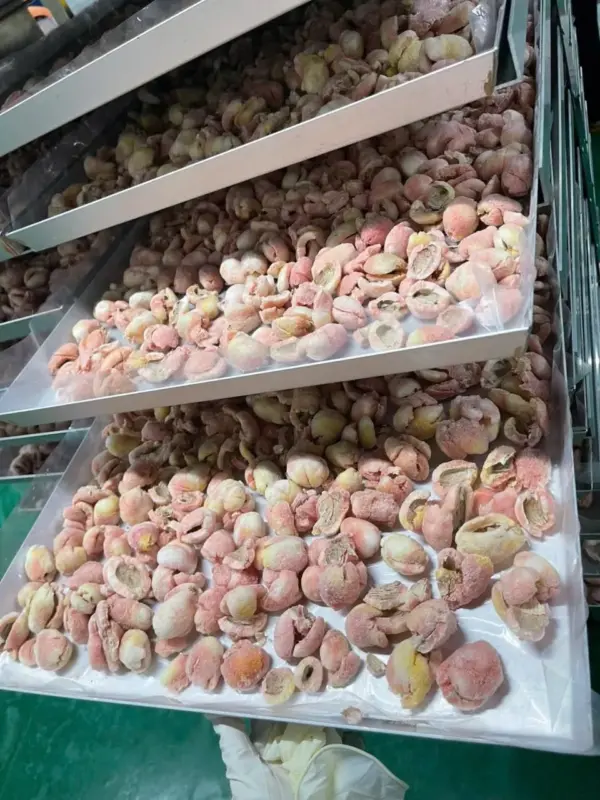
Freeze-Dried Rambutan for Bulk and Private-Label Buyers
Freeze-dried rambutan is the hand-peeled, seedless aril of Nephelium lappaceum L., dried under vacuum to 3–5% moisture and water activity below 0.30. It comes out crisp and pale blush, sweet-tart with a floral, lychee-like flavour that is still new on Western shelves, and travels without a cold chain. FruitBuys sources Thai (Rongrien) and Java rambutan from the Mekong Delta and Dong Nai, processes it in one locked partner facility per contract, and ships every container lot with a third-party COA.
Rambutan is one of the harder fruits to freeze-dry well. It is peeled and seeded by hand, it carries more sugar than mango or jackfruit, and it punishes a weak bag. The figures below are the operating targets our partner facilities run to. The full buyer checklist is in what to check before buying freeze-dried rambutan in bulk.
Product specification
| Parameter | Specification |
|---|---|
| Ingredient | 100% Rambutan (Nephelium lappaceum L.); no added sugar, preservatives or sulfites |
| Raw fruit | Rongrien and Java varieties, fresh Brix 18–22° |
| Halves | Whole half-aril, broken pieces and fines <5% |
| Pieces | 8–12 mm or 10–15 mm cut |
| Moisture | 3–5% (release max 5.0%) |
| Water activity | <0.30 (release limit) |
| Seed fragments | Absent on visual inspection at the sorting line; a thin, edible silky membrane lining the cavity is natural |
| Colour / taste | Pale blush to light peach; sweet, mildly tart |
| Total plate count | ≤10⁴ CFU/g |
| Yeasts & moulds | ≤10² CFU/g |
| E. coli | <10 CFU/g |
| Salmonella | Not detected / 25 g |
| Foreign matter | Visual sorting plus metal detection |
| Shelf life | 12 months standard (≤25 °C, RH ≤60%); 18–24 months in cool storage (≤18 °C, RH ≤50%) |
| HS code | 0813.40, other dried fruit: EU CN 0813 40 95 (0% duty with Form EUR.1), US 0813.40.90; your broker confirms the national line |
Water activity is the number that decides whether your product arrives crisp. Rambutan carries about 81 g of natural sugar per 100 g. Sugar this concentrated pulls humidity out of the air faster than lower-sugar fruit, and once aw climbs past 0.30 the surface turns tacky and pieces fuse into a block. A lot can pass on moisture while aw drifts, so release is set on aw. Write it into your contract the same way, and the QA team at your end signs off the first container instead of opening a claim on it.
The sorting line is where rambutan is won or lost. Every aril is peeled and seeded by hand. The defects QA teams fear most are a sliver of woody seed left in the cavity, and fibres from the hairy peel. Sorting teams inspect every aril visually before freezing, followed by metal detection after packing. On your pre-shipment sample, split ten halves and check the cavity yourself.
Yield: why rambutan costs what it costs
It takes 6–7 kg of peeled, seeded aril to make 1 kg of freeze-dried rambutan. Peel and seed are close to half the whole fruit, so on the farm scale that is roughly 13–17 kg of whole rambutan per finished kilo, before any culls.
Use the aril figure to test a quote. Multiply the local aril price by 6–7, then add drying and packing. An offer that lands well below that floor is buying wetter product, a higher share of fines, or a lower Brix fruit.
Nutrition (per 100 g)
| Nutrient | Amount | % DV* |
|---|---|---|
| Calories | 380 kcal | |
| Total fat | 0.5 g | 1% |
| Saturated fat | 0 g | 0% |
| Sodium | 15 mg | 1% |
| Potassium | 800 mg | 17% |
| Vitamin C | 30 mg | 33% |
| Total carbohydrate | 88 g | 32% |
| Dietary fibre | 6 g | 21% |
| Total sugars | 81 g (0 g added) | |
| Protein | 5 g | 10% |
Typical values for 100% freeze-dried rambutan; natural variation by origin, season and ripeness applies. Lot nutrition panel available for label artwork.
Cost and formulate on this table. For your printed label, FruitBuys samples your commercial lot and arranges the nutrition panel at an ISO/IEC 17025 accredited laboratory, in the format your market requires.
Formats and applications
| Format | Best for | Working note |
|---|---|---|
| Halves | Retail snack packs, trail mixes, high-visibility toppings | Whole aril shape sells the product on shelf; fines held below 5% |
| Pieces 8–12 mm | Cereal, granola, yogurt and smoothie-bowl toppings | Even spread per spoon; the size most cereal lines dose cleanly |
| Pieces 10–15 mm | Confectionery inclusions, bakery decoration | Visible bite after coating |
| Rehydrated | Desserts, fillings, drinks | Pieces recover in 3–5 minutes in cold water, halves in 5–10, with a firm, springy bite |
Any base wetter than the fruit will soften it on the shelf. In a yogurt or a moist filling, coat the pieces or add them at the point of serving. Run a 4-week test in your real base before you lock the formula.
Rambutan powder
Rambutan powder is cold-milled from the same freeze-dried aril to 60–80 mesh. With 81% natural sugar it is strongly hygroscopic, so it is milled and packed in a dehumidified room and goes straight into a foil bag with desiccant. Pure powder suits drink mixes, smoothie bases and bakery blends. If you fill it on a high-speed sachet line, ask for the free-flowing version with 1–2% silicon dioxide or 5–10% maltodextrin or tapioca starch; pure fruit powder will cake in a humid hopper. Full specification, versions and trial orders from 50 kg are on the freeze-dried rambutan powder page, with a buyer’s guide on what to specify for rambutan powder.
Packaging
| Item | Detail |
|---|---|
| Bulk | 1–5 kg aluminium-foil PE bags, soft-vacuumed with a food-grade silica gel sachet, in 5-ply cartons |
| Carton | 58 × 28 × 34 cm: halves 7–8 kg (2 × 3.5–4 kg bags), pieces 9–10 kg (2 × 4.5–5 kg bags), powder 15–20 kg |
| Retail (OEM) | 30 g / 50 g / 100 g / 500 g foil zip pouches or custom |
| Shelf life | 12 months from production in the unopened bulk bag at ≤25 °C, RH ≤60%; up to 18 months by contract; 18–24 months in cool storage at ≤18 °C, RH ≤50% |
Bulk bags are soft-vacuumed instead of nitrogen-flushed. An inflated bag takes up carton space, so you pay to ship air, and under stacking the foil creases and cracks. On rambutan that crack is fatal: the sugar pulls in humidity through it within days.
Commercial terms and container planning
| Term | Detail |
|---|---|
| Production capacity | 100 tons/year |
| 20ft, floor-loaded | About 550 cartons (8 across × 10 deep × 7 layers, 560 max); 3.9–5.5 tonnes |
| 40ft HC, floor-loaded | 1,100–1,120 cartons (8 across × 20 deep × 7 layers); 7.7–11.2 tonnes |
| Palletised option (ISPM 15) | About 360 cartons per 20ft, 760–840 per 40ft HC |
| Container type | Standard dry container; no reefer needed |
| Main crop | May–August, with a smaller off-season crop December–March |
| Production lead time | 20–30 days per 20ft after deposit |
| Samples | Prepared in 3–5 working days; express courier to the US, EU and UK in 3–5 working days |
| OEM / ODM | MOQ 500 kg |
| Payment | T/T 40% deposit, 60% before shipment or against copy B/L; L/C at sight |
| Incoterms | FOB, CIF, DDP |
| Port of loading | Cat Lai Port or Tan Son Nhat Airport |
Carton counts are standard column loading with a 5 cm wall gap; tonnage depends on carton weight.
Carton weight sets your freight cost per kilo. The same 560 cartons carry 3.9 tonnes at 7 kg or 5.6 tonnes at 10 kg, so the heavier pack cuts freight per kilo by about 30%. For a full year’s programme, a 40ft HC doubles the payload for well under double the freight. Book your annual volume before May and your containers run on main-crop fruit: fuller Brix, steadier colour, and the strongest raw-material position of the year.
Quality and documents
- Every full-container lot: third-party COA for moisture, water activity, total plate count, yeasts & moulds, E. coli and Salmonella.
- Routine surveillance: heavy metals (lead, arsenic) and aflatoxin (total and B1) are monitored through routine third-party surveillance at an ISO/IEC 17025 accredited laboratory; results sit below EU and US limits. Lot-specific testing is available on request.
- Trial and LCL orders: in-house release QC log (moisture, water activity, sensory) plus the surveillance report. Independent third-party testing is arranged at net lab cost and credited in full against your first container order.
- Retained sample: kept from every container lot for its full shelf life.
- Facility control: one qualified processing facility is locked per contract. Any change needs prior written notice and re-approval of the pre-shipment sample. You have audit access.
- Facility compliance & certifications: HACCP, ISO 22000, BRC (qualified processing facility) and US FDA Facility Registration; Halal certification available on request.
- Shipment documents: commercial invoice, packing list, bill of lading, COA, Certificate of Origin Form EUR.1 for EU and UK preferential duty or Form CEPA for the UAE, and a phytosanitary certificate with every shipment.
- Private-label ingredient line: “100% Rambutan (Nephelium lappaceum L.)”.
Import and labeling
Freeze-dried rambutan is classified as other dried fruit under HS 0813.40. In the EU it enters under CN 0813 40 95, where a Form EUR.1 under the EU–Vietnam trade agreement takes the duty to 0%, against the 2.4% MFN rate; the line can be checked in the EU TARIC tariff database. Rambutan is not on the list of Vietnamese foods under increased EU border checks set by the EU import-controls regulation, so it clears under routine controls. For the US the reference line is 0813.40.90 in the US Harmonized Tariff Schedule; for the UAE, a Form CEPA travels with every shipment. Your customs broker confirms the national line on entry.
Every shipment carries the same dossier: commercial invoice, packing list, bill of lading, COA, certificate of origin and a phytosanitary certificate, so your broker clears it without chasing paper. The pack label is simple: one ingredient, “Rambutan”, no added sugar. Duty references, residue panels and market checks are in what freeze-dried rambutan needs to clear US, EU, UK and UAE customs.
Verify the sample in three steps
- Open and weigh. Check bag integrity, desiccant and net weight against the packing list. Weigh out the broken pieces and fines; halves should hold below 5%.
- Check the cavity and the aw. Split ten halves and look for hard seed fragments; the thin silky membrane lining each cavity is natural. Measure water activity; at or below 0.30 the lot was dried and sealed right. Keep the second sealed pouch for your own lab.
- Test in your product. Run the storage test in your real base, and the rehydration test if you use it wet. Approve the pre-shipment sample in writing; it becomes the reference for your container.
Comparing several suppliers? Line up their answers with what to check before buying freeze-dried rambutan in bulk.
FAQ
Is sugar added to freeze-dried rambutan?
No. It is 100% rambutan; the 81 g of sugar per 100 g is the fruit’s own, concentrated by drying.
How much fits in a container?
About 550 cartons in a 20ft (560 max on the 8 × 10 × 7 layout) and 1,100–1,120 in a 40ft HC, floor-loaded. At 7–8 kg (halves) to 9–10 kg (pieces) per carton that is 3.9–5.5 tonnes or 7.7–11.2 tonnes.
When should I order?
Contract before May to run on the May–August main crop. Off-season fruit from December to March is available in smaller volumes.
What is the minimum order for private label?
500 kg for OEM, ODM and private-label packing.
Do you provide a COA and phytosanitary certificate?
Yes. Every full-container lot ships with a third-party COA, and every shipment carries a phytosanitary certificate as part of our standard export dossier.
How does rambutan compare with lychee?
It shares lychee’s floral sweetness with a lighter acidity, and freeze-dried it has a firmer, crisper bite. A side-by-side comparison of lychee, longan and rambutan is in longan vs lychee.
Can you provide a nutrition panel for my label?
Yes. On a commercial run we sample your lot and arrange the panel at an ISO/IEC 17025 laboratory, formatted for your market.
How long does it keep?
12 months from production in the unopened bulk bag at ≤25 °C and RH ≤60%. Cool storage at ≤18 °C and RH ≤50% stretches that to 18–24 months.
Request a sample and quote
Send these 12 details and we return a specification, sample and terms in one reply:
- Destination country and port
- Application: ready-to-eat retail or ingredient for re-processing
- Format: halves, pieces (8–12 or 10–15 mm) or powder
- Grade: retail-visible halves or industrial pieces, and your fines limit
- Moisture / aw target, if tighter than standard
- First-order volume: trial, LCL, 20ft or 40ft HC
- Annual volume and preferred delivery months
- Packaging: bulk bag size or retail pouch size
- Private label: artwork status and labelling market
- Extra tests required by your market or customer
- Preferred Incoterm and payment term
- Target delivery date