
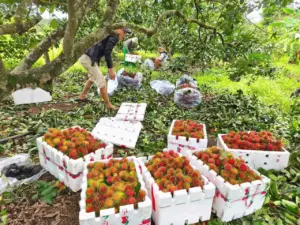
When is freeze-dried rambutan available, and where does the fruit come from?
Freeze-dried rambutan ships all year, because the finished product keeps 12 months or more. The fruit does not. Vietnam’s main crop runs May to August, with a smaller off-season crop from December to March, and the months you produce in decide the thickness, sweetness and cost of what lands in your warehouse.
The practical answer for a distributor is simple: contract your annual volume before May, produce the bulk of it on main-crop fruit, and draw it down through the year.
When is the main season, and is there off-season fruit?
| Months | Fruit | What it means for your product |
|---|---|---|
| May–August | Main crop. Full-sized fruit, 18–22° Brix | Thick, crisp halves with a deep floral sweetness; about 6.0 kg of aril per finished kilo |
| September–November | Tail of the season, then little fresh fruit | Drying continues from main-crop aril held frozen at ≤ −18 °C, so contract shipments keep main-crop quality |
| December–March | Smaller off-season crop, 15–16° Brix | Same pale blush, crisp product, thinner and more tart; 7.0–7.5 kg of aril per kilo |
| April | Pre-season | Final window to book main-crop production |
The main crop also falls in the wet season, when outside air sits at 75–85% RH. That is why the partner facilities unload and pack in cool, dehumidified rooms below 50% RH: the fruit is at its best exactly when the weather is at its worst for a sugary dried product.
How did the 2026 crop run, and what did off-season fruit cost?
The 2026 main crop was heavy. Harvests across the Mekong Delta came in at the same time, most fruit went to the domestic market, and farm-gate prices for both Java and Thai rambutan fell through July. For a freeze-dried programme that is the strongest possible position: full-Brix fruit, plenty of it, at the lowest raw-material cost of the year.
Off-season fruit tells the opposite story. Growers trigger off-season flowering by covering trees with tarpaulins and holding back water to create an artificial dry spell, which roughly doubles the cost of growing the crop. In November 2026, off-season Java rambutan traded at about three times its main-crop farm-gate level, and fruit contracted to exporters at up to four and a half times. The lower Brix of 15–16° then adds the extra 1.0–1.5 kg of aril per finished kilo.
The commercial reading is simple: main-crop aril frozen at ≤ −18 °C in June and dried for a February call-off costs far less than off-season fruit picked in February, and it tastes sweeter.
Which provinces and varieties supply it?
Freeze-dried rambutan from FruitBuys comes from two growing belts: the Mekong Delta, around Ben Tre, Vinh Long and Tien Giang, and Southeast Vietnam, around Dong Nai. The belt takes in Vietnam’s two best-known rambutan districts: Long Khanh in Dong Nai, home of the traditional Java rambutan, and Cho Lach in Ben Tre. Fruit is bought from contracted growing areas and reaches the processing facility in 2–4 hours by truck. It is peeled, seeded and in the freezer within 12–24 hours of picking.
That speed is visible in the bag. Rambutan’s hairy peel loses water fast once the fruit leaves the branch. Left 24–48 hours in tropical heat, the peel blackens, the aril sweats inside it, sugar starts to ferment at the edges and a faint alcoholic note creeps in. Dried, that fruit comes out dull and flat. Peeled the same day, it keeps its natural pale blush colour and the floral scent of fruit just off the tree.
Two varieties carry most of the volume:
- Rongrien, sold in Vietnam as Thai rambutan: originally from Thailand, now widely grown in the Mekong Delta. Thick, crisp aril that comes away cleanly from the seed. It gives the most consistent halves.
- Java: the traditional rambutan of Southeast Vietnam, grown on the red basalt soils of Dong Nai. The seed releases less cleanly, so more arils tear at seeding and fewer come out as whole halves, but the aroma is noticeably stronger.
Use that difference. Rongrien gives the whole, even halves that sell a retail pouch. Java, cut into 8–15 mm pieces or milled into 60–80 mesh powder, puts a bolder tropical note into chocolate, cereal or a drink base, and costs 15–25% less in raw material than halves because you are not paying for the shape. Both reach the same specification once dried. Tell us your application at the RFQ and we weight production by variety.
Can you contract annual volume?
Yes, and it is the best way to buy rambutan. Partner facility capacity for freeze-dried rambutan is 100 tonnes a year. That is roughly 18 containers of pieces or 22 of halves in 20ft equivalents, so an annual contract reserves a real share of a limited supply.
An annual contract typically sets:
- Total volume and format split (halves, pieces, powder)
- Shipment schedule, for example quarterly or bi-monthly call-offs spread across the year
- A named processing facility, with change-control and audit access
- Main-crop and off-season reference samples, so each lot is judged against the right standard
Production for each 20ft runs 20–30 days after deposit. On a scheduled programme, those dates are fixed in advance, so your containers do not wait behind spot orders at peak season.
How does the season change yield and quality?
Yield follows the Brix. Main-crop fruit at 18–22° carries more sugar and less water, so it takes about 6.0 kg of aril to make a kilo of finished product. Off-season fruit at 15–16° needs 7.0–7.5 kg, and because the arils are thinner, more whole fruit and more peeling labour too. The detail is in how many kilos of fresh rambutan make 1 kg of freeze-dried.
Quality follows the same line. Main-crop halves are thick-walled with a rounded sweetness. Off-season halves are equally crisp and pale, but thinner and sharper on the finish. Both meet the same moisture, aw and microbiology limits; the difference is in the bite and the taste.
When should you book to secure the main crop?
Before May. By the time the main crop is on the trees, facility time for May to August is already being allocated. Booking in March or April gets your volume onto main-crop fruit at the strongest raw-material position of the year.
Booking early does not mean taking a year of stock in July. There are two ways to hold main-crop quality, and an annual contract can use either or both:
- Frozen aril buffer. During the May–August peak, the partner facilities buy main-crop fruit at 18–22° Brix, peel it the same day and hold the aril deep-frozen at ≤ −18 °C. That frozen aril is then freeze-dried to your call-off schedule, quarterly or every two months, so each container is freshly dried from main-crop fruit and your cash and warehouse are not tied up in a single delivery.
- Finished-goods storage. Freeze-dried rambutan keeps 12 months from production in the unopened bulk bag at ≤25 °C and RH ≤60%, and 18–24 months in cool storage at ≤18 °C and RH ≤50%. Buyers with cool storage can take larger main-crop shipments and draw them down. How to pack and store it for that is covered in how freeze-dried rambutan should be packed and loaded for export.
How do you keep one variety and one quality all year?
It depends on how you buy. Spot orders placed between December and March run on whatever off-season fruit is available, so variety and Brix move with the season. That suits buyers who want flexibility and can accept the off-season profile.
Annual contracts signed before May work differently. If your retail halves need 100% Rongrien fruit all year, that volume is secured in the May–August peak and held either as frozen aril waiting for its drying slot or as finished product in cool storage. Every call-off then ships the same main-crop Rongrien halves, in January as in July.
FAQ
When is rambutan season in Vietnam?
The main crop runs May to August. A smaller off-season crop comes in from December to March.
Can I buy freeze-dried rambutan all year?
Yes. Annual contracts ship on a quarterly or bi-monthly schedule from main-crop aril held frozen at ≤ −18 °C, and finished product keeps 12 months in standard storage and 18–24 months in cool storage.
Which rambutan varieties are used?
Mainly Rongrien from the Mekong Delta and Java from Southeast Vietnam.
How much freeze-dried rambutan can be supplied per year?
Partner facility capacity is 100 tonnes a year, about 18–22 containers of 20ft depending on format.
Is fresh Vietnamese rambutan sold in the US?
Yes, since 2011, but only irradiated and pre-cleared by APHIS inspectors in Vietnam, and usually flown. Freeze-dried rambutan is a processed food: it needs no quarantine irradiation and ships by sea. The detail is in what freeze-dried rambutan needs to clear US, EU, UK and UAE customs.
How is rambutan different from lychee and longan?
Rambutan is floral and sweet-tart like lychee, with a lighter acidity and a firmer aril. The three fruits are compared side by side in longan vs lychee.
When should I place an annual order?
Before May, to run your volume on main-crop fruit at 18–22° Brix.
Book next season’s volume
Send us your annual volume, format split and preferred shipment months. We return a production calendar set against the main crop, with reference samples for each season. The full sourcing checklist is in what to check before buying freeze-dried rambutan in bulk.



