
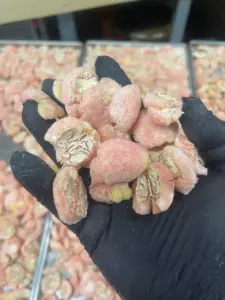
What should you specify before buying freeze-dried rambutan powder in bulk?
Specify five things: what is in the powder (100% rambutan, or rambutan plus an anti-caking agent or carrier), moisture ≤5.0% and water activity ≤0.30, 60–80 mesh with ≥95% passing, how it is milled and packed, and the lot COA. Those five lines decide whether the powder pours into your mixer as a fine, pale peach-cream dust or arrives as a yellowed brick.
Rambutan powder is unforgiving. The dried fruit carries about 81 g of natural sugar per 100 g, and milling multiplies its surface area many times over. The powder pulls water out of humid air in minutes, and heat from the mill can turn its sugar sticky. Every line below is there to stop one of those two things.
Freeze-dried or spray-dried: what are you actually comparing?
Most low quotes for “rambutan powder” are spray-dried. That process presses the juice, blends it with 30–50% maltodextrin as a carrier and sprays it through a tower at 150–180 °C. The fibre stays behind with the pulp, and much of the floral aroma leaves with the hot air. You are buying flavoured maltodextrin.
Freeze-dried rambutan powder is the whole aril, freeze-dried and milled cold. It keeps the fruit’s 6 g of natural fibre per 100 g and the fresh floral note of 18–22° Brix fruit, and it can be 100% rambutan with no carrier at all. Compare quotes by fruit content first; a cheaper spray-dried powder at 50% fruit costs more per kilo of rambutan than it looks.
How it behaves in water. Because it is whole fruit, the sugars and aroma dissolve at once, but the fine fibre stays suspended as a soft, natural pulp. In smoothies, milk tea, gelato, yogurt, fillings and white chocolate that pulp gives a full, real-fruit mouthfeel no flavouring can copy. For a crystal-clear bottled drink, filter it or use a cloudy base.
Pure, free-flowing or carrier: what should be in the bag?
Decide this first, because it sets your ingredient line and how the powder behaves on your equipment.
| Version | Composition | Choose it when |
|---|---|---|
| Pure | 100% rambutan | You want “Rambutan” as the only ingredient and you stir or blend the powder into a batch |
| Free-flowing | + 1–2% silicon dioxide (E551) | The powder feeds an auger filler on a sachet or stick-pack line |
| Carrier | + 5–10% maltodextrin or tapioca starch | You make instant drink powders or dusting blends and prefer a food ingredient to an additive |
Pure rambutan powder forms soft, friable lumps that break under light finger pressure or the first turn of a mixer. That is normal for a fruit this sweet. What is not acceptable in any version is hard caking: a lump that needs a knife. Write that distinction into the specification so nobody argues about it on arrival.
What moisture and water activity should it meet?
Write moisture ≤5.0% and aw ≤0.30 into the contract, the same limits as for the dried fruit. Ask the supplier for the range the powder is actually packed at. FruitBuys partner facilities release at 3.0–4.5% moisture and aw 0.20–0.28, with TPC below 10³ CFU/g.
A buyer might expect powder to be drier than the pieces it comes from. It cannot be: powder is milled from fruit that has already left the dryer, so it can only gain moisture during milling, never lose it. That is why the milling room, not the dryer, decides the quality of the powder.
How should it be milled and packed?
This is the question that separates suppliers who make rambutan powder from those who simply grind it.
- Chilled milling. A pin or hammer mill heats the product. Above about 40 °C, rambutan’s sugar softens, smears onto the 60–80 mesh screen and starts to brown. The result is a yellow powder with a caramel note instead of fresh floral rambutan.
- A very dry room. Milling and packing run in a cool, dehumidified room at 22–25 °C and below 35–40% RH, drier than the room used for pieces, because fine powder takes up humidity far faster than whole fruit.
- Straight into foil. The powder goes directly into 5 kg or 10 kg aluminium-foil bags, gently de-aerated, with a food-grade silica gel sachet. No nitrogen and no iron-based oxygen absorbers, which release moisture and cause caking.
The 5 kg bag is sized for your mixer, not ours. At a 3–8% dose, one 5 kg bag suits a batch of around 100 kg: an operator cuts it, tips it all in within 30 seconds, and never weighs out part of a bag or ties up a half-used one. The other three bags in a 20 kg carton stay sealed at aw 0.20–0.28 until their own batch.
Ask to see the milling room and its RH log. A supplier who mills rambutan in an ordinary production hall will ship you a powder that cakes before it reaches your plant.
Which particle size and density should you write in?
60–80 mesh, with at least 95% passing, suits drinks, dairy, fillings and confectionery. The pale peach-cream colour sits softly in pale bases, so white chocolate, vanilla ice cream, cream cheese and yogurt coatings keep their colour while gaining a light, floral, sweet-tart tropical note. Paired with beetroot or red dragon fruit powder for a natural pastel pink, or with matcha, oolong or coconut, it adds a natural sweetness that lets you cut refined sugar. Bulk density runs 0.35–0.45 g/cm³, two and a half to three times denser than halves. That density packs 15–20 kg into a standard 58 × 28 × 34 cm carton, so freight per kilo is far lower than for whole fruit.
On arrival, sieve 100 g through an 80-mesh screen in a dry room below 50% RH, and work quickly; rambutan powder left on a screen in humid lab air picks up moisture and clogs the mesh, which looks like a milling fault but is not. Brush soft static clusters gently with a soft brush and they pass. At least 95 g should go through. Anything hard and gritty left behind, or a woody seed fragment, is a genuine fault. For water activity, seal the meter chamber within 60 seconds of cutting the bag.
Which tests and documents should come with it?
The same set as the dried fruit:
- A third-party lot COA on every full container for moisture, aw, TPC, yeasts and moulds, E. coli and Salmonella
- Periodic third-party surveillance for lead, arsenic and aflatoxin
- HS 1106.30, flour and powder of Chapter 8 fruit (reference heading, confirmed by your customs broker), a different heading from the dried pieces; Form EUR.1 claims the EVFTA or UKVFTA preference, so confirm the rate on your entry
- Form EUR.1 (EU and UK) or Form CEPA (UAE), and a phytosanitary certificate with every shipment
Residue panels and market checks follow the same logic as for the pieces, set out in what freeze-dried rambutan needs to clear US, EU, UK and UAE customs. For a carrier or free-flowing version, the declared ingredients and the nutrition panel change with the addition; ask for the panel on your exact version.
How much do you need, and what does it cost against halves?
At a typical dose of 3–8%, powder goes a long way. A 50–100 kg trial is enough for a full production run on your line: 100 kg makes about 1.3–3.3 tonnes of finished product. Standard bulk orders run from 200–500 kg, and private-label retail packs start at 500 kg.
Powder is made from main-crop Java fruit from Dong Nai, with its strong tropical aroma, Rongrien fruit from the Mekong Delta, and clean aril fragments screened from the pieces line. Because none of it pays for the whole-dome shape of halves, it costs 15–25% less than buying halves to mill yourself, with identical nutrition. Duty points the other way: powder enters under 1106.30, which carries a higher third-country rate than dried pieces in the US and, without a Form EUR.1, in the EU. If your plant already runs a chilled mill and a dry room below 40% RH, price both routes, importing pieces and milling on site or buying powder with a Form EUR.1 into the EU. The reference rates are in what freeze-dried rambutan needs to clear US, EU, UK and UAE customs.
When to use powder alone, and when to pair it with pieces
Use powder alone where the flavour should be everywhere and the fruit invisible: drinks, ice cream, fillings and coatings. Where the consumer should also see and bite the fruit, pair the two. Chocolate and cereal makers do this well: 3–5% powder in a white chocolate or yogurt coating carries rambutan through every bite, and 8–12 mm pieces scattered through it add the crisp, visible bite. How to choose the pieces is covered in which freeze-dried rambutan format fits your product.
The specification to send your supplier
| Line | Write into the contract |
|---|---|
| Composition | Pure / + 1–2% SiO₂ / + 5–10% maltodextrin or tapioca |
| Moisture | ≤5.0% |
| Water activity | ≤0.30 |
| Particle size | 60–80 mesh, ≥95% passing |
| Caking | Soft lumps only; no hard caking |
| Colour and aroma | Pale peach-cream; floral rambutan; no burnt-sugar note |
| Microbiology | TPC ≤10⁴, yeasts & moulds ≤10², E. coli <10 CFU/g, Salmonella ND/25 g |
| Milling | Chilled, in a room at 22–25 °C and <35–40% RH |
| Packing | 5 or 10 kg foil bags, de-aerated, silica gel; 15–20 kg cartons |
| Documents | Lot COA, surveillance report, EUR.1, phytosanitary certificate |
FAQ
What is the HS code for freeze-dried rambutan powder?
1106.30, flour, meal and powder of Chapter 8 fruit, as a reference heading your broker confirms on entry.
How is it different from spray-dried rambutan powder?
Spray-dried powder is juice with 30–50% maltodextrin, dried hot. Freeze-dried powder is the whole aril milled cold: up to 100% fruit, with its fibre and floral aroma.
Is freeze-dried rambutan powder 100% fruit?
The pure version is. Free-flowing and carrier versions add 1–2% silicon dioxide or 5–10% maltodextrin or tapioca starch.
Why does my rambutan powder turn yellow or cake?
It was milled warm or in humid air. Rambutan’s 81% sugar softens with heat and moisture; chilled milling below 40% RH prevents it.
What is the minimum order?
Trials from 50–100 kg, bulk from 200–500 kg, private label from 500 kg.
How much powder do I need in a recipe?
Usually 3–8% of the recipe.
Can rambutan powder be used in bubble tea or milk tea?
Yes. Dose the pure powder at 3–8% of the drink base; it pairs naturally with jasmine and oolong tea, and the fine fruit pulp stays suspended for a real-fruit mouthfeel.
Request a powder sample
Tell us your application, dose and filling equipment. We send the pure and free-flowing versions side by side, with the specification above filled in. Full product details are on the freeze-dried rambutan powder product page, and the whole-fruit buyer guide is what to check before buying freeze-dried rambutan in bulk.



