
Can you private-label freeze-dried rambutan from Vietnam?
Yes, from 500 kg. FruitBuys packs freeze-dried rambutan under your brand in 30 g, 50 g, 100 g or 500 g stand-up foil pouches, or a size you specify, with a one-word ingredient line, a laboratory nutrition panel from your own lot and labels checked for your market.
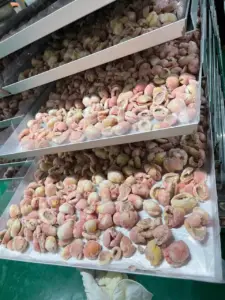
Rambutan is an easy story to tell on shelf. Most shoppers in the US, Europe and the Gulf have never bitten into a freeze-dried rambutan half: pale blush, crisp, floral and sweet with no added sugar. A 30 g pouch is about 110 kcal, a number most snack brands would gladly print on the front. The work is in getting pack, label and supply right before the first pallet reaches a store.
What is the MOQ, and why 500 kg?
500 kg is the minimum for OEM, ODM and private-label packing. It is large enough to run a full printed-pouch job and one production batch, and small enough to test a market before you commit to a container.
What 500 kg means on shelf:
| Pouch size | Pouches from 500 kg |
|---|---|
| 30 g | about 16,600 |
| 50 g | 10,000 |
| 100 g | 5,000 |
That is enough for a regional launch, a retailer trial or a full season online. When the line sells through, the next order moves to a 20ft container and to the pricing and freight per kilo that come with it.
Below 500 kg, buy bulk bags and pack locally. You lose the retail-ready pouch from Vietnam, but you keep your launch on schedule while volume builds.
Which retail pouch sizes and formats work?
| Pouch | Typical use | Format inside |
|---|---|---|
| 30 g | Single-serve snack, impulse, lunchbox | Halves, 10–12 per pouch |
| 50 g | Snack sharing, online | Halves |
| 100 g | Pantry, baking, topping | Halves or pieces |
| 500 g | Food service, club stores, bakery | Pieces |
Retail pouches are built differently from bulk bags. A bulk bag is soft-vacuumed flat for shipping; a retail pouch should stand up and look full on a shelf. So retail packs use a thick stand-up aluminium-foil laminate of 100–130 microns, filled in a dehumidified room below 50% RH, with a food-grade silica gel sachet and a light air cushion. The domes stay whole, the pouch stands upright, and when the shopper tears the zip, the floral scent comes straight out.
Skip the clear window. Many first-time brands want a transparent window to show the pale blush fruit. On rambutan it backfires. A clear PET or PE window lets through far more moisture and light than foil, and fruit carrying 81% natural sugar turns tacky and yellow behind it within weeks under warm store lighting, in full view of the shopper. Use a full-foil pouch and print a sharp photograph of a rambutan half on the front instead.
Weight and seal are checked on every pouch. A rambutan half weighs about 2.5–3.0 g, so a 30 g pouch holds 10–12 pieces and one half more or less moves the weight by 10%. The filling line targets 31–32 g for a 30 g pouch, so no pouch falls short under US or EU net-weight rules. Sugar dust on the seal area causes micro-leaks that soften the fruit on shelf, so the seal above the zipper is kept clean and every batch is seal-tested before cartoning.
Master cartons. Retail pouches are packed 40–100 per 5-ply export carton, about 2–4 kg net depending on pouch size, or into shelf-ready display trays first if your retailer asks. A 500 kg first order fills roughly 125–250 cartons, about 7–14 m³, which ships comfortably as LCL before you move to a 20ft. Bulk cartons, container loading and shelf life are covered in how freeze-dried rambutan should be packed and loaded for export.
What goes on the ingredient line and the front of pack?
The ingredient line is one item: “100% Rambutan (Nephelium lappaceum L.)”, or simply “Rambutan” where your market allows. No sugar, no preservatives, no sulfites, nothing to explain.
That clean line supports the front-of-pack messages that sell:
- No added sugar. In the EU and UK, “with no added sugars” applies, with the statement “contains naturally occurring sugars”. In the US, “no sugar added” applies because the dried fruit it replaces is normally sweetened; add “not a low calorie food” unless the pack meets low-calorie criteria.
- 100% fruit, freeze-dried. Freeze-drying at low temperature keeps the colour, aroma and heat-sensitive vitamins that hot-air drying loses.
- About 110 kcal per 30 g pouch.
- High in vitamin C, once your lot panel confirms it. Typical values sit at 30 mg per 100 g, above the EU “high” threshold.
- One ingredient, ready for the next US labels. A fruit-only product is the simplest case for FDA’s updated “healthy” claim, and it would read Low for saturated fat, sodium and added sugars under the proposed front-of-pack format.
The numbers behind the nutrition panel, and how to print them correctly for each market, are set out in freeze-dried rambutan nutrition facts.
How are label approval and UAE Arabic labelling handled?
FruitBuys checks your artwork line by line against the specification and the destination rules before anything is printed:
- Nutrition panel: on your commercial lot, we arrange a full nutrition panel at an ISO/IEC 17025 accredited laboratory, formatted per serving for the US or per 100 g for the EU, UK and GCC.
- United States: a 30 g or 50 g pouch is a single-serving container, so the panel declares the whole pouch as one serving.
- EU and UK: energy in kJ and kcal per 100 g, ingredient line, net weight, best-before date and your EU or UK operator address.
- UAE: Arabic text, production and expiry dates in DD/MM/YYYY order matching the COA, and product registration by your importer before the first shipment, through Dubai Municipality’s Montaji system in Dubai. A Form CEPA travels with every UAE shipment for the preferential duty.
The best-before date is set on the specification’s 12-month shelf life. For a longer retail date, FruitBuys can run an accelerated shelf-life study on your finished pouch, so the date you print is supported by data on your actual pack.
Canned rambutan or freeze-dried for your private label?
They sell on different shelves. Canned rambutan is fruit in syrup: it ships at the weight of the can and the liquid, and it lists sugar or syrup on the ingredient line. Freeze-dried rambutan needs no syrup, no can and no cold chain, and it carries a one-word ingredient line, so it fits snack, cereal-topping and gifting shelves where canned fruit does not.
| Canned rambutan | Freeze-dried rambutan | |
|---|---|---|
| Ingredient line | Rambutan, water, sugar or syrup | Rambutan |
| Texture | Soft and wet | Crisp, melts in the mouth |
| Freight | Pays for the can and the syrup | 18–22 g replaces 100 g of fresh aril |
| Shelf | Canned fruit aisle, desserts | Snacks, cereal toppings, gifting, travel packs |
| After opening | Refrigerate, use within days | Reseal and eat from the pouch |
If your range needs rambutan in syrup, that is a canning partner’s product, not one FruitBuys supplies. If you want the same fruit as a clean-label snack, a 500 kg private-label run is the way in.
Who owns the specification?
You do. The product specification, artwork and brand are yours. FruitBuys coordinates production to that specification at one qualified processing facility named in your contract, which cannot be changed without prior written notice and your re-approval of a pre-shipment sample. You have audit access to the facility, and every lot ships with a third-party COA.
That arrangement matters most in private label, because the product carries your name. If a retailer asks where the fruit comes from and how it is controlled, the answer is in your file: growing areas in the Mekong Delta and Dong Nai, a named facility certified to HACCP, ISO 22000 and BRC (qualified processing facility), with US FDA Facility Registration; Halal certification available on request.
What is the path from artwork to container?
| Step | What happens | Timing |
|---|---|---|
| 1. Brief and samples | Pouch size, format and market agreed; development samples sent | Samples prepared in 3–5 working days |
| 2. Specification and artwork | Your spec signed; artwork checked against labelling rules for your market | Set by your design team |
| 3. Pouch printing | Printed stand-up pouches produced, running in parallel with fruit preparation | 15–20 working days after artwork sign-off |
| 4. Production and packing | Fruit dried, packed into your pouches, cartoned | 20–30 days after deposit |
| 5. Pre-shipment sample and COA | Composite sample from your packed lot, third-party COA, nutrition panel | Lab work in 3–5 working days |
| 6. Shipment | Full export dossier, including phytosanitary certificate | Per sailing |
Because printing runs alongside fruit preparation and drying, a first order is typically ready 25–35 days after deposit.
Printed or labelled? Two routes fit a 500 kg launch. Rotogravure printing directly on the foil gives the sharpest colour and the lowest cost per pouch; the printing cylinders are a one-time cost that repeat orders reuse, so it suits a single SKU you plan to keep, such as a 30 g pouch at around 16,600 units. Digital printing, or plain matte foil pouches with a printed label, carry no cylinder cost and suit a 5,000-pouch trial or a launch split across several designs. Many brands start labelled and move to rotogravure once the SKU proves itself.
Retail details, documents and container options are on the freeze-dried rambutan product page.
FAQ
What is the minimum order for private-label freeze-dried rambutan?
500 kg, about 16,600 pouches of 30 g or 5,000 pouches of 100 g.
Which pouch sizes are available?
30 g, 50 g, 100 g and 500 g stand-up aluminium-foil pouches, or a custom size. Printed pouches take 15–20 working days, alongside production.
What is the ingredient list?
One ingredient: 100% Rambutan (Nephelium lappaceum L.). No added sugar, preservatives or sulfites.
Can I claim “no added sugar”?
Yes, in the EU, UK and US, with the market-specific wording described above.
Do you provide the nutrition panel for my label?
Yes. We arrange it on your commercial lot at an ISO/IEC 17025 laboratory, formatted for your market.
Can you support UAE labelling?
Yes. We check Arabic text and DD/MM/YYYY dates against the COA; your importer registers the product before the first shipment.
Launch your rambutan line
Send us your brand, target market, pouch size and first-order volume. We return a specification, development samples and a launch timeline built around your artwork. Product details are on the freeze-dried rambutan product page, and the full sourcing checklist is in what to check before buying freeze-dried rambutan in bulk.



