
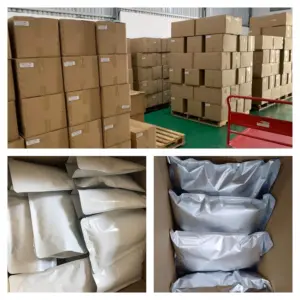
How should freeze-dried rambutan be packed and loaded for export?
Pack it in aluminium-foil PE bags of 1–5 kg, soft-vacuumed with a silica gel sachet, inside 5-ply cartons of 58 × 28 × 34 cm. Load about 550 cartons in a 20ft (560 on a full 8 × 10 × 7 layout) or 1,100–1,120 in a 40ft HC, floor-loaded in straight columns. Store it sealed at ≤25 °C and ≤60% RH and it holds spec for 12 months from production.
Every one of those choices protects the same thing. Rambutan carries about 81 g of natural sugar per 100 g, which makes it pull humidity out of the air faster than almost any other freeze-dried fruit. The pack is the only thing standing between a crisp half and a sticky block after six weeks at sea.
Which bag and carton protect a fruit this hygroscopic?
The bag is the barrier. Aluminium-foil laminate stops water vapour and light; a clear or metallised film does not stop enough on a fruit this sugary. Inside each bag goes a food-grade silica gel sachet in a dust-proof pouch, to soak up the small amount of humidity trapped at sealing. Iron-based oxygen absorbers have no place in freeze-dried fruit: they release moisture and cause caking.
Soft vacuum, not nitrogen. The bag is gently vacuumed so it lies flat in the carton. Nitrogen flushing sounds safer and does the opposite here. An inflated 5 kg bag does not fit the carton cleanly, so you pay to ship air. Under stacking, the inflated foil creases, the crease whitens and cracks, and through that hairline crack the fruit’s sugar pulls in humidity within days. A flat, soft-vacuumed bag has no crease to fail.
The carton is 5-ply corrugated board, 58 × 28 × 34 cm. That size is chosen to fit the container to the centimetre, as the loading plan below shows.
Two bags per carton, not one. A halves carton holds 2 bags of 3.5–4 kg; a pieces carton holds 2 bags of 4.5–5 kg. Splitting the load keeps the halves at the bottom from being crushed under their own weight. It also matters on your line: one bag tipped into the hopper runs out in about 15–20 minutes, before it has time to pick up humidity, while the second bag stays vacuum-sealed at aw 0.20–0.26, crisp and fragrant for the next fill. Why that aw figure matters is set out in moisture, water activity and microbial limits for freeze-dried rambutan.
Retail pouches work the other way round. A 30–100 g OEM pouch on a shelf should stand up and look full, so it is not vacuumed tight: a hard vacuum wrinkles the pouch and crushes the domes. Retail packs use a thick stand-up aluminium-foil laminate of 100–130 microns, filled in a dehumidified room below 50% RH with a food-grade silica gel sachet and a light air cushion. The pouch stands upright, the pale blush halves stay whole, and when the consumer tears the zip the floral scent comes straight out.
7 kg or 10 kg cartons: what does it do to freight per kilo?
Carton weight depends on the format, because a hollow half takes more space than a solid piece:
| Format | Net per carton | 20ft (560 cartons) | 40ft HC (1,120 cartons) |
|---|---|---|---|
| Halves | 7–8 kg | 3.9–4.5 t | 7.8–9.0 t |
| Pieces 8–15 mm | 9–10 kg | 5.0–5.6 t | 10.1–11.2 t |
| Powder | 15–20 kg (2 × 10 kg or 4 × 5 kg bags) | Up to 8.4–11.2 t at 560 cartons; loaded to order size | Loaded to order size |
Freight is charged per container, not per kilo, so every extra kilo in the box is free transport. Freight per kg = container freight ÷ (cartons × kg per carton).
As an illustration only, take a 20ft rate of USD 2,000. Halves at 7 kg per carton carry 3.92 t, so freight works out to USD 0.51 per kg. Pieces at 10 kg carry 5.6 t: USD 0.36 per kg. Same container, same route, about 30% less freight on every kilo. Put your own rate into the formula; the gap stays the same.
If your product can use pieces, the saving starts at the grading stage, where pieces cost 15–25% less in raw material, and carries on all the way to your warehouse. Which format suits which product is covered in which freeze-dried rambutan format fits your product.
Powder cartons are heavy but compact. Even a full 20ft of powder stays well below the container’s weight limit; the load is simply set by your order size, and the 5 kg and 10 kg inner bags are sized for one person to lift and tip into a hopper.
How much fits in a container, and how is it loaded?
Cartons go in floor-loaded, lengthwise, the 58 cm side along the container, the 28 cm side across it, in straight columns. Same-size cartons do not need staggering; straight columns are stronger and faster to check.
| Container | Layout | Cartons |
|---|---|---|
| 20ft, 7 layers | 8 across × 10 deep × 7 high | 560 |
| 20ft, 6 layers | 8 across × 10 deep × 6 high | 480 |
| 40ft HC, 7 layers | 8 across × 20 deep × 7 high | 1,120 |
Seven layers in a 20ft reach the roof. Six layers leave about 35 cm of air under the roof, which is the safer choice on long, hot routes, for the reason in the next section. Either way, a 5 cm gap or a kraft-paper lining keeps cartons off the steel walls.
Floor-loaded or palletised? Floor-loading is the default, because pallets take height and floor space that cartons would otherwise fill. Palletised loading on ISPM 15 heat-treated pallets is available on request, and the trade-off is easy to price:
| Floor-loaded | Palletised | |
|---|---|---|
| 20ft | 560 cartons | About 360 cartons (10 pallets) |
| 40ft HC | 1,120 cartons | About 760–840 cartons (20–21 pallets) |
| Freight per kg | Lowest | About 30–35% higher |
| Unloading at destination | Hand-unloading, typically 2–3 staff for 3–4 hours | Forklift, about 30 minutes |
If labour at your warehouse is expensive and freight is cheap on your lane, pallets can win. If the lane is long and freight is the bigger number, floor-load. Tell us at the RFQ and we build the plan around your answer.
How do port heat and container rain affect it?
A steel container in the tropics heats by day and cools by night. Moisture in the air inside condenses on the cold roof at night and drips onto the top layer: container rain. On a dry product in sealed foil it usually does no harm, but it soaks the top cartons, weakens the board and, if a bag was nicked during loading, reaches the fruit.
Four things keep it out of the product. The bags are sealed foil, not film. Cartons are kept off the walls with a gap or kraft lining. Calcium chloride desiccant strips hung inside the container pull moisture out of the air before it can condense on the roof. And on long or hot routes, such as summer sailings into the Gulf or the Red Sea, loading six layers instead of seven leaves a roof gap where any drip lands on air, not cartons. Done together, the cartons come out at Rotterdam or Los Angeles square-edged and dry.
None of this needs refrigeration. At aw below 0.30 freeze-dried rambutan ships in a standard dry container, at a fraction of reefer freight and with no plug-in charges at either port. That is one of the quiet cost advantages of freeze-dried fruit over frozen IQF.
At the destination port, customs may open bags for inspection. Ask your broker to have opened bags resealed or taped flat at once and moved to the front of your stock rotation.
How long does it keep, and where?
| Storage | Shelf life |
|---|---|
| Unopened bulk bag, ≤25 °C, RH ≤60% | 12 months from production (standard) |
| Same conditions, agreed in the contract | Up to 18 months |
| Cool store ≤18 °C, RH ≤50%, unopened | 18–24 months (storage guidance) |
The standard specification covers 12 months, and every quality claim and best-before date is set on that basis. Cool storage stretches it, which suits distributors who buy a year’s volume in the main crop and draw down slowly.
The clock changes once a bag is opened or the product is repacked. From that point, humidity in your plant or your customer’s kitchen decides how long the fruit stays crisp, so retail pouches need their own shelf-life test in the final pack. For private-label programmes, FruitBuys can run an accelerated shelf-life study on your finished pouch.
FAQ
How is freeze-dried rambutan packed for export?
In 1–5 kg aluminium-foil PE bags, soft-vacuumed with a food-grade silica gel sachet, inside 5-ply cartons of 58 × 28 × 34 cm.
Why not nitrogen-flush the bags?
Inflated bags waste carton space and crease under stacking. The creases crack the foil and let humidity in.
How many cartons fit in a container?
560 in a 20ft and 1,120 in a 40ft HC at seven layers; 480 in a 20ft at six layers for hot routes.
How much does a carton weigh?
7–8 kg for halves, 9–10 kg for pieces and 15–20 kg for powder.
What is the shelf life of freeze-dried rambutan?
12 months from production in the unopened bag at ≤25 °C and RH ≤60%; up to 18 months by contract; 18–24 months in cool storage.
Does it need a reefer container?
No. It ships in a standard dry container. On long, hot routes, use the six-layer plan and container desiccant strips.
Can it be shipped on pallets?
Yes, on ISPM 15 pallets: about 360 cartons per 20ft and 760–840 per 40ft HC, against 560 and 1,120 floor-loaded.
How long does rambutan last?
Fresh rambutan lasts only days: the hairy peel blackens within 24–48 hours in tropical heat. Peeled aril frozen at ≤ −18 °C holds for months, and freeze-dried rambutan keeps 12 months at ≤25 °C and RH ≤60%, or 18–24 months in cool storage.
Can rambutan be frozen?
Yes. Main-crop aril is peeled and frozen at ≤ −18 °C within 12–24 hours of picking, then freeze-dried to the buyer’s call-off schedule. That is how freeze-dried rambutan ships all year on main-crop quality.
Plan your container before you book
Send us your format, destination port and sailing month. We return the carton weight, loading plan and tonnage for your container, so your freight quote is built on real numbers. Product details are on the freeze-dried rambutan product page, and the full sourcing checklist is in what to check before buying freeze-dried rambutan in bulk.



