
Freeze-Dried Passion Fruit Cubes vs Powder: Which Format Fits?
Freeze-dried passion fruit cubes vs powder is not a cosmetic choice. It decides how the product behaves in a pouch, a cereal blend, a chocolate inclusion, a beverage premix, a bakery formula, or a private label launch. A cube must survive handling, retain visible fruit identity and stay crisp. A powder must flow, blend, disperse and resist caking. If the buyer approves both formats under one loose specification, the bulk order will expose the gap.
Seed content, particle size, moisture, Aw, packaging and COA requirements do not move in the same way across cubes and powder. The right format protects the buyer’s application before the product reaches production scale. FruitBuys treats cubes and powder as separate product decisions, then aligns sample, specification, QC release and documentation around the selected format.
Cubes and Powder Are Different Product Specifications
Freeze-dried passion fruit cubes and powder require separate specifications.
Cubes need controls for size, breakage, fines and seed distribution, while powder needs controls for mesh, carrier status, flow, bulk density and caking.
Buyers should select the format by application before requesting samples or bulk documentation.
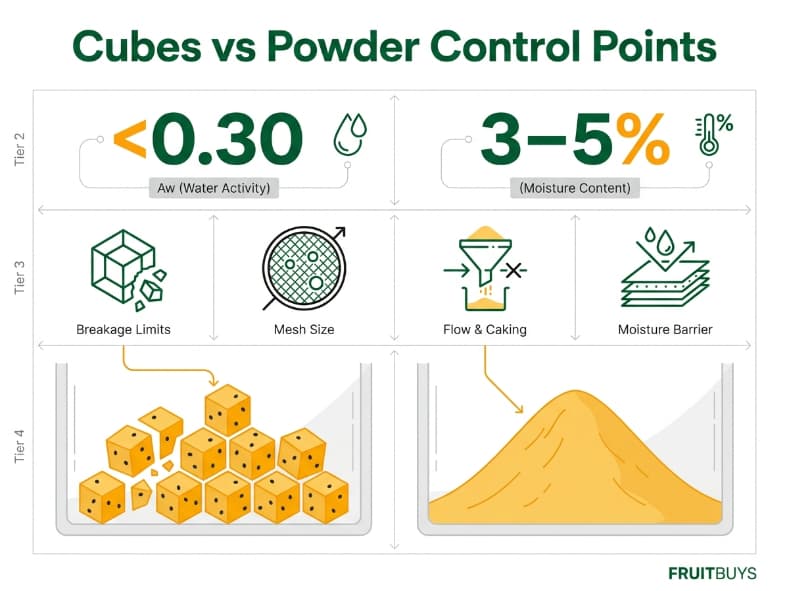
A buyer cannot approve “freeze-dried passion fruit” as one broad item and expect both cubes and powder to perform the same way. Cubes behave as visible fruit pieces. Powder behaves as an ingredient system. Each format needs its own acceptance criteria.
For cubes, the buyer should define size, tolerance, broken-piece allowance, fines level, seed visibility, crispness and visual range. The product shown in the supplied images supports a seed-on cube concept, with yellow-orange porous pieces and black seed particles. Image review confirms appearance, not composition, moisture, Aw, or lot safety.
For powder, the buyer should define mesh range, particle distribution, carrier status, seed particles, loose density, tapped density, flow, caking behavior and application performance. Powder requires tighter handling because fine particles expose more surface area to air and moisture.
This article connects to the broader freeze-dried passion fruit B2B guide, the seed-on and seedless passion fruit formats, and the passion-fruit powder specification.
Freeze-Dried Passion Fruit Cubes: When Visible Fruit Identity Matters
Freeze-dried passion fruit cubes fit buyers who need the product to remain visible. The cube gives the final product a clear tropical-fruit signal. It works when the buyer wants a crisp bite, visible seeds, concentrated acidity and a recognizable inclusion.
Cubes suit:
- Retail fruit snack pouches
- Granola and cereal inclusions
- Chocolate inclusions
- Yogurt toppings
- Dessert toppings
- Bakery decoration
- Mixed freeze-dried fruit assortments
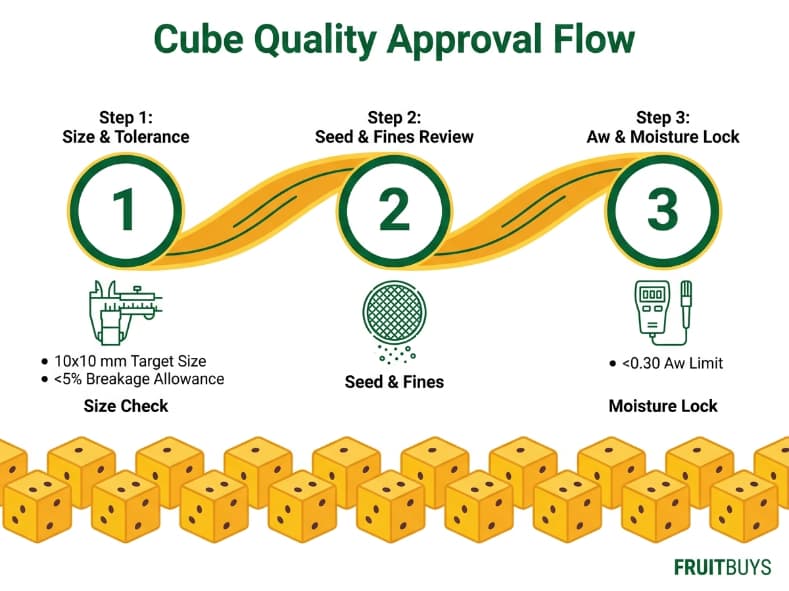
The buyer should not stop at visual approval. A cube sample can look acceptable while the bulk lot fails on size distribution, seed concentration, edge breakage or moisture pickup. The written specification must define what the approved cube means.
For cubes, the buyer should lock these criteria:
| Control Point | Why It Matters |
|---|---|
| Cube size | Controls appearance, bite and distribution in blends |
| Size tolerance | Prevents irregular pieces from changing application performance |
| Breakage | Protects retail pouch appearance and ingredient consistency |
| Fines | Limits powder residue in cereal, chocolate or snack applications |
| Seed distribution | Controls appearance, texture and possible nutrition variation |
| Moisture | Protects crispness and texture |
| Aw | Supports stability review and storage control |
| Packaging | Reduces breakage and moisture exposure |
Cubes connect strongly to passion-fruit food and beverage applications because application decides whether visible pieces add value or create problems.
Freeze-Dried Passion Fruit Powder: When Blending and Dosing Matter
Freeze-dried passion fruit powder fits buyers who need flavor distribution, formula blending and controlled dosing. Beverage developers, bakery teams, dairy formulators and ingredient distributors often prefer powder because it enters a formula more evenly than cubes.
Powder suits:
- Beverage premixes
- Smoothie blends
- Bakery fillings
- Cream systems
- Dairy applications
- Dessert powders
- Seasoning-style fruit blends
- Ingredient distribution
Powder raises different risks. It can cake, clump, dust, segregate, absorb moisture and show visible seed particles if the product uses seed-on material. It may also contain a carrier or anti-caking ingredient, depending on the formulation. Buyer must not assume a powder is 100% passion fruit unless the ingredient statement confirms it.
Published research on freeze-dried passion-fruit juice evaluated water sorption and hygroscopic behavior, which supports the need to control moisture exposure in freeze-dried passion-fruit systems. Powder usually faces higher exposure risk than large pieces because it presents greater surface area during milling, packing and use. (Wiley Online Library)
A proper powder brief should include:
| Powder Requirement | Buyer Question |
|---|---|
| Mesh range | How fine must the powder be? |
| Particle distribution | What percentage may sit above or below the target range? |
| Seed particle status | Are black specks acceptable? |
| Carrier status | Is the product carrier-free or formulated? |
| Bulk density | Will the powder fill accurately? |
| Flow | Can the buyer dose it in the intended process? |
| Caking behavior | Does it remain usable after opening? |
| Moisture and Aw | Does the lot meet release limits? |
Powder decisions should link to powder mesh and carrier requirements, moisture and Aw requirements, and packaging and shelf-life controls.
Cubes vs Powder by Application
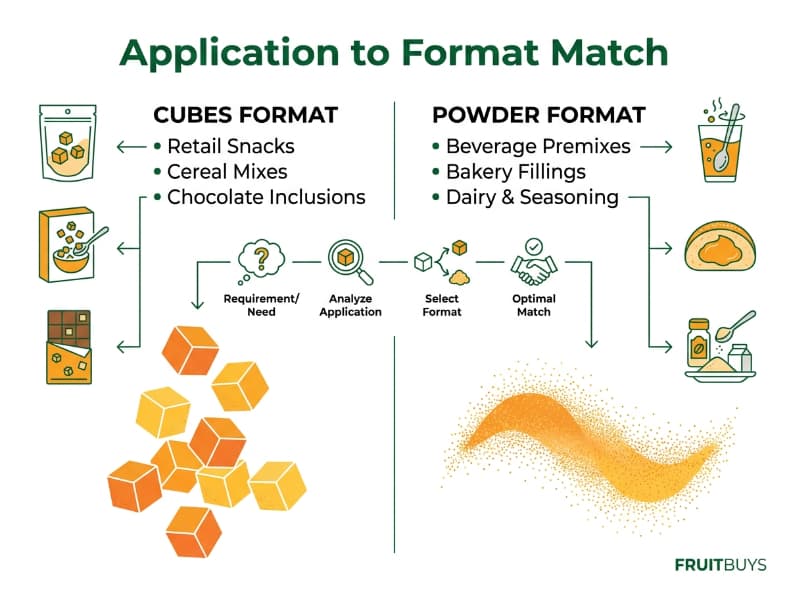
The strongest format decision starts with the buyer’s finished product. A snack buyer needs visible fruit and bite. A beverage buyer needs dispersion. A bakery buyer may need either flavor distribution or visible inclusions. A distributor may need both formats, but not under the same release criteria.
| Buyer Application | Better First Format | Main Reason | Required Proof |
|---|---|---|---|
| Retail snack pouch | Cubes | Visible fruit identity and crisp bite | Cube size, breakage, Aw |
| Granola or cereal | Cubes | Inclusion visibility and texture contrast | Size tolerance, fines, moisture |
| Chocolate inclusion | Small cubes | Visual contrast and acidic fruit note | Moisture, size, migration test |
| Beverage premix | Powder | Blending and dosing | Mesh, dispersibility, seed particles |
| Bakery filling | Powder | More even flavor distribution | Mesh, heat test, moisture behavior |
| Bakery topping | Cubes | Visible fruit pieces | Cube size, breakage |
| Yogurt topping | Cubes or powder | Depends on topping or blended use | Hydration and sensory test |
| Ingredient resale | Cubes and powder | Buyer serves multiple applications | Separate COA and specifications |
| Private label pouch | Cubes | Consumer-facing fruit format | Packaging, Nutrition Facts, shelf-life evidence |
The application path should connect to R&D application guide, while the release path should connect to COA and laboratory testing requirements.
Moisture and Aw Control Both Formats, But Not the Same Way
Moisture and Aw matter for both cubes and powder, but the failure mode differs.
Cubes lose crispness and visual value, while powder cakes, clumps and becomes harder to dose.
Buyers should require format-specific limits and lot-based COA review.
The supplied target for freeze-dried passion fruit is 3–5% moisture and Aw below 0.30. The buyer should keep these as separate control points. FDA explains that water activity affects food stability and must stay within a suitable range after drying and during storage. (U.S. Food and Drug Administration)
Moisture and Aw do not replace each other. Moisture tells the buyer how much water the product contains. Aw tells the buyer how available that water is for reactions and microbial growth. A buyer who only checks moisture may miss stability risk. A buyer who only checks Aw may miss texture, weight or formulation risk.
Low Aw also does not prove the product contains no pathogens. FDA guidance for low-moisture foods notes that Salmonella heat resistance can increase in lower-water-activity food systems, which means low Aw must sit inside a full food-safety and microbiology control program. (U.S. Food and Drug Administration)
For cubes, moisture and Aw mainly protect crispness, bite, breakage behavior and shelf stability. For powder, they also affect flow, caking, dosing and mixing. The buyer should link this review to water-activity control for freeze-dried passion fruit.
Packaging Requirements Are Not the Same
Cubes and powder both need moisture protection, but packaging must solve different problems. Cubes need protection against breakage. Large inner packs can increase compression damage during handling if the cube structure is fragile. Carton loading, inner-pack size, headspace and filling method all affect the percentage of broken pieces when the buyer opens the carton.
Powder needs protection against moisture pickup and caking. It also needs packaging that matches dosing behavior. A large inner bag may expose the powder to humid air each time the user opens it. A smaller inner-pack format can reduce repeated exposure, but the buyer must confirm operational fit.
Packaging decisions should not rely on a generic shelf-life statement. A shelf-life range only has value when it connects to product format, package barrier, seal integrity, Aw, moisture and storage condition. This belongs inside moisture-barrier packaging requirements.
Key packaging questions:
| Question | Cubes | Powder |
|---|---|---|
| Does the format break easily? | High relevance | Low relevance |
| Does the format cake after opening? | Lower relevance | High relevance |
| Does the inner pack limit humidity exposure? | Relevant | Critical |
| Does the pack support shelf-life evidence? | Required | Required |
| Does the carton protect physical structure? | Critical | Moderate |
| Does the pack support retail label needs? | Required for private label | Required for private label |
COA and Documentation Must Follow the Format
A COA for cubes should not look identical to a COA for powder if the release criteria differ. Both formats should include core food-safety and technical results, but each format needs its own physical controls.
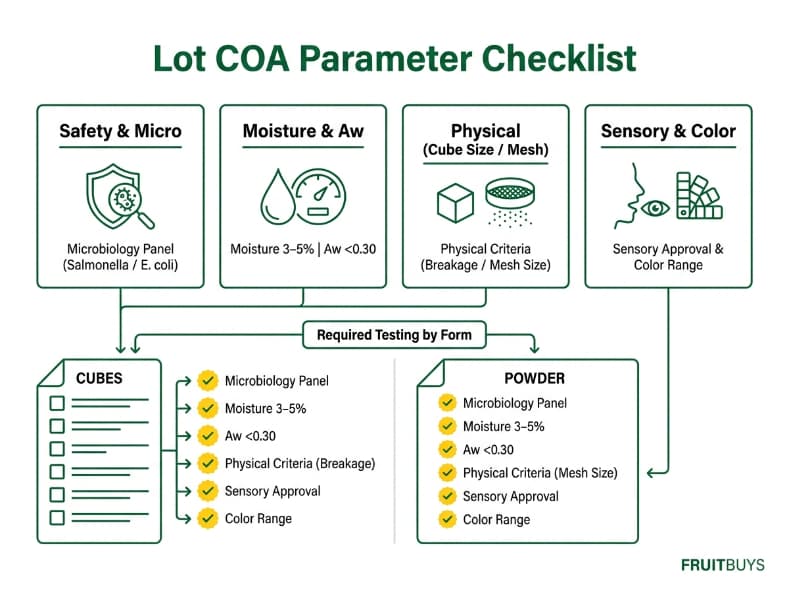
For cubes, the COA or release record may need:
- Moisture
- Aw
- Cube size
- Breakage
- Fines
- Sensory approval
- Foreign matter
- Microbiology panel
- Contaminant panel where required
For powder, the COA or release record may need:
- Moisture
- Aw
- Mesh or sieve distribution
- Bulk density where required
- Sensory approval
- Carrier statement
- Microbiology panel
- Contaminant panel where required
Certification does not replace lot testing. A certificate may support a site or system scope. It does not prove the moisture, Aw, mesh, breakage or microbiology result for the exact production lot. The buyer should link format selection to lot-based laboratory documentation.
This matters even more for OEM. A private label buyer cannot build a label, pouch file and repeat-order specification on a format that has not been technically locked. The OEM route should connect to freeze-dried passion fruit private label.
Sample Approval Is the Highest-Risk Point
The highest-risk mistake is approving a sample without format-specific release criteria.
A good sample can still fail bulk production if cube size, powder mesh, seed status, moisture, Aw or packaging changes.
Buyers should approve the sample only after locking the written specification and retained reference.
A cube sample should not define powder quality. A powder sample should not define cube quality. Each format needs its own approved sample, written specification, retained reference and COA structure.
For cubes, sample approval should capture:
- Cube size range
- Acceptable broken pieces
- Acceptable fines
- Seed distribution
- Color range
- Aroma
- Acidity
- Crispness
- Moisture
- Aw
- Pack condition
For powder, sample approval should capture:
- Mesh range
- Visible seed specks
- Carrier status
- Color
- Aroma
- Acidity
- Flow
- Caking tendency
- Dispersion behavior
- Moisture
- Aw
- Pack condition
This section should link directly to sample-to-bulk consistency. The buyer’s risk begins when the supplier treats the sample as a sales object instead of a production reference. FruitBuys treats the approved sample as a release control tied to Quality Control and Documentation.
Application Mapping
| Buyer Type | Application | Required Format | Proof Needed | FruitBuys Delivery |
|---|---|---|---|---|
| Snack brand | Retail fruit snack pouch | Cubes | Cube size, breakage, Aw, packaging | OEM/Private Label Delivery |
| Granola manufacturer | Inclusion in cereal mix | Cubes | Size tolerance, fines, moisture | Quality Control and sample alignment |
| Chocolate producer | Fruit inclusion | Small cubes | Moisture, piece size, sensory test | Application-matched specification |
| Beverage developer | Premix or smoothie powder | Powder | Mesh, carrier status, dispersibility | Product configuration and documentation |
| Bakery R&D team | Filling, cream, dough, topping | Powder or cubes | Heat, hydration and particle behavior | Application sample support |
| Dairy developer | Yogurt topping or blended system | Cubes or powder | Hydration, color, acidity | Format-specific sample release |
| Ingredient distributor | Multi-application resale | Cubes and powder | Separate COA and specifications | Lot-based documentation |
| Private label owner | Retail pouch or powder blend | Cubes or powder | Label data, packaging, COA | OEM/Private Label Delivery |
Why FruitBuys Locks Cubes and Powder Separately
FruitBuys supplies freeze-dried passion fruit as a configured product, not as an undefined category name. Cubes and powder move through different buyer decisions, so FruitBuys locks each format under its own specification.
Quality Control covers moisture, Aw, sensory criteria and physical release points such as breakage or mesh. Documentation links the product name, ingredient statement, COA, laboratory report and lot identity to the exact format. OEM/Private Label Delivery aligns pack size, label inputs, artwork data and retained sample. Export Logistics Coordination protects the selected format through carton planning, handling control and document handover.
This model gives the buyer one accountable product route. The buyer does not need separate explanations from raw material, processing, packaging and documentation parties. FruitBuys supplies the finished product under one commercial relationship and one approved specification.
Buyer Checklist
Before choosing freeze-dried passion fruit cubes or powder, confirm:
- Does the final product need visible fruit identity?
- Does the application need crisp bite or even flavor distribution?
- Are visible black seed particles acceptable?
- Does the powder need to be seedless?
- Does the powder contain a carrier or anti-caking ingredient?
- What cube size or powder mesh does the application require?
- What moisture and Aw limits must appear on the COA?
- What breakage level can the buyer accept for cubes?
- What caking behavior can the buyer accept for powder?
- What packaging structure protects the selected format?
- Does the sample represent the intended bulk lot?
- Does the RFQ separate cubes and powder into different specifications?
Use freeze-dried passion fruit RFQ checklist before requesting samples.
Summary
Freeze-dried passion fruit cubes and powder serve different B2B applications. Cubes suit visible inclusions, snack pouches, granola, chocolate and toppings because they preserve piece identity and crisp texture. Powder suits beverages, bakery, dairy and blending applications because it supports mixing and dosing.
Buyers should lock seed status, cube size, powder mesh, moisture, Aw, packaging and COA criteria separately. FruitBuys supplies each format under a controlled specification, sample approval and lot-documentation route.
FAQ
Are freeze-dried passion fruit cubes and powder the same product?
No. Cubes and powder require different specifications, samples, packaging controls and release criteria. The buyer should approve each format separately.
Which format works better for retail snacks?
Cubes work better for retail snack pouches because they show visible fruit identity and deliver crisp texture. Buyers still need cube-size, breakage, moisture and Aw controls.
Which format works better for beverages?
Powder usually works better for beverages because it blends and doses more easily. The buyer must confirm mesh, seed particles, carrier status and dispersion behavior.
Does passion-fruit powder always contain a carrier?
No. The buyer must verify the ingredient statement. Powder can be carrier-free or formulated, depending on process and application.
Can cubes be milled into powder?
Yes, but milling creates a new specification. Powder needs mesh, particle distribution, flow, bulk density, caking and packaging controls.
Do cubes and powder need the same COA?
They may share some safety tests, but their physical release criteria differ. Cubes need breakage and size controls. Powder needs mesh, carrier and caking-related controls.
When should a buyer approve the sample?
Approve the sample only after locking the written specification, retained reference, moisture, Aw, physical criteria, packaging and COA requirements.
Conclusion
Request the format specification after defining whether the product must stay visible, disperse, blend, or deliver a crisp inclusion.
References
- U.S. Food and Drug Administration. Water Activity (aw) in Foods. Inspection Technical Guide. (U.S. Food and Drug Administration)
- U.S. Food and Drug Administration. Guidance for Industry: Measures to Address the Risk for Contamination by Salmonella Species in Food Containing a Peanut-Derived Product as an Ingredient. (U.S. Food and Drug Administration)
- Cal-Vidal, J.; Falcone, M. Processing Conditions Affecting the Hygroscopic Behavior of Freeze-Dried Passion Fruit Juice. Journal of Food Science, 1985. DOI: 10.1111/j.1365-2621.1985.tb10451.x. (Wiley Online Library)