
Seed-On vs Seedless Freeze-Dried Passion Fruit for B2B Applications
Seed-on vs seedless freeze-dried passion fruit is a product decision, not a cosmetic preference. Seeds change yield, texture, mouthfeel, visible identity, powder behavior, Nutrition Facts and sample-to-bulk consistency. A buyer who approves “passion fruit” without seed direction leaves the supplier free to deliver a product that may taste similar but behave differently in granola, chocolate, beverages, bakery systems, dairy toppings or private label pouches.
Seed-on cubes can show real fruit character and a crisp bite. Seedless powder can suit smoother formulations and cleaner visual systems. The wrong seed decision turns a good sample into a weak production reference. FruitBuys treats seed status as a specification point that must connect to raw material intake, conversion ratio, format selection, COA scope and bulk-release criteria.
What Is the Difference Between Seed-On and Seedless Freeze-Dried Passion Fruit?
Seed-on freeze-dried passion fruit keeps passion-fruit pulp and seeds in the product system.
Seedless freeze-dried passion fruit removes or filters seed material before drying, milling or forming.
Buyers should choose the format by application, not by sample appearance alone.
Seed-on products keep the natural seed particles visible in cubes or detectable in powder. This format gives the product stronger visual identity. It also changes texture because passion-fruit seeds create a different bite and particle structure.
Seedless products remove seed material before drying or before the final ingredient system is finished. This can create a smoother powder or cleaner-looking application, but it changes yield and processing loss. Seedless does not automatically mean “better.” It means the buyer has chosen a different technical route.
This decision should link to the freeze-dried passion fruit B2B guide, because seed status belongs inside the full product identity. It also connects to passion fruit cubes and powder, because seed behavior changes differently in cubes and powder. FruitBuys does not treat seed-on and seedless as loose options. FruitBuys locks the selected route into the product specification, sample approval file and release documents.
How Seed Removal Changes Conversion Yield
The locked working range for this cluster is clear: about 6–7 kg of peeled passion-fruit pulp with seeds produces 1 kg of freeze-dried passion fruit. That range starts from pulp with seeds, not whole fruit.
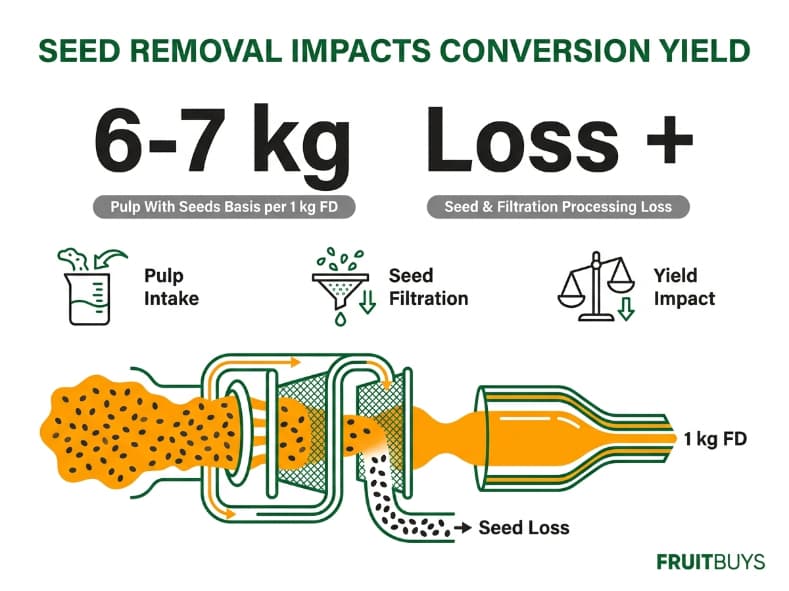
Seedless production should not inherit that ratio without proof. Removing seeds removes solids. Filtration can also trap pulp around seeds and screens. That creates additional loss before drying even begins.
| Route | Conversion Logic | Current Status |
|---|---|---|
| Pulp with seeds to dried product | 6–7 kg pulp with seeds for 1 kg finished product | User-supplied planning range |
| Whole fruit to dried product | Requires peel and pulp-recovery data | [DATA NEEDED] |
| Filtered pulp to seedless dried product | Requires seed-removal and filtration-loss data | [DATA NEEDED] |
This is why the buyer must connect seed status to the pulp-to-dry conversion ratio. A supplier cannot claim one ratio for all seed routes unless production records support each route. Published data on Passiflora edulis seeds shows that seeds contain lipids, protein and dietary fiber, so removing seeds can change the dry-matter contribution of the product system.
A review of passion-fruit seed extract reports that P. edulis seeds contain higher lipid and protein percentages than pulp and peel fractions, and that seeds are rich in dietary fiber (PMC). The buyer’s key question should be direct: “Does your conversion ratio start from pulp with seeds, filtered pulp, or whole fruit?” Anything less precise invites a swamp of false comparisons.
Texture, Appearance and Sensory Differences
Seed-on freeze-dried passion fruit carries visible black seed particles. In cubes, those particles create a clear fruit identity and a sharper texture. This matters for retail snack pouches, granola inclusions, chocolate pieces and toppings where the buyer wants the consumer to see passion fruit.
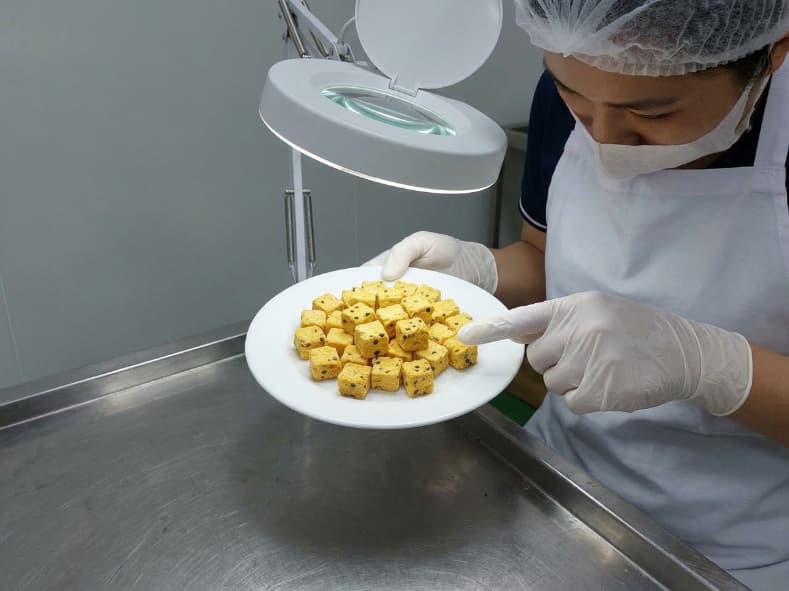
Seedless product creates a cleaner visual profile. This can suit powder blends, beverage systems, dairy applications and smooth fillings. It can also reduce the chance that black seed particles appear in a formulation where the buyer expects a uniform color or texture.
The practical comparison:
| Decision Point | Seed-On | Seedless |
|---|---|---|
| Visual identity | Stronger fruit signal | Cleaner, smoother appearance |
| Bite | Seed texture present | Smoother texture |
| Powder specks | More likely | Lower risk if filtration works |
| Yield | Usually stronger than seedless route | Usually lower due to removal loss |
| Beverage fit | Depends on particle tolerance | Stronger fit for smooth systems |
| Snack fit | Strong for visible cubes | Less necessary |
| Nutrition impact | Seed content may affect fat, fiber and protein | Needs separate analysis |
The buyer should avoid vague sensory words. “Crunchy,” “smooth,” “visible seed,” “low seed,” and “no visible seed” need internal criteria. A sample cannot control bulk if the buyer never defines the acceptable seed experience. This section should link to application specific passion fruit formats.
Nutrition and Label Implications
Seed status can change Nutrition Facts because seeds contribute solids, fiber, fat and protein.
A reference label cannot prove the nutrition profile of a new seed-on or seedless formula.
Buyers should run product-specific nutrition testing after locking formula and seed status.
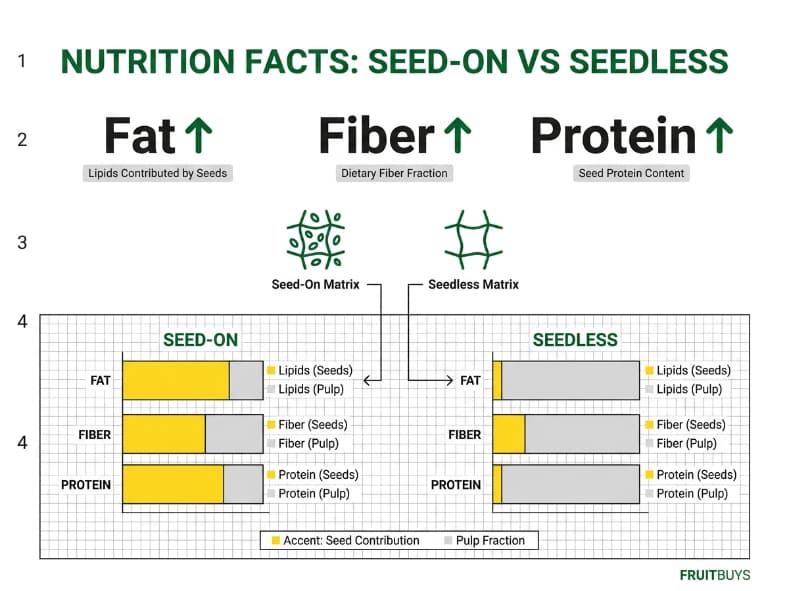
Seed-on and seedless products should not share Nutrition Facts unless the formula, seed ratio and laboratory result support that decision. Seed content changes the composition basis. Powder carrier status can change it again.
A seed-on cube made from passion-fruit pulp with seeds may show different fat, fiber and protein values from filtered pulp powder. The difference can matter for retail label development, product claims, R&D calculation and buyer QA review. Passion-fruit seed literature supports the technical point that seeds are compositionally meaningful, not inert decoration. (PMC)
The buyer should link this decision to freeze-dried passion fruit Nutrition Facts. The correct label route must start with the final product formula, not a copied reference label. For private label work, seed status should be locked before artwork, claims, Nutrition Facts and ingredient statements move forward. A late seed change can force label correction, new testing and fresh sample approval. That delay damages the launch path.
Which Applications Suit Seed-On Freeze-Dried Passion Fruit?
Seed-on format works best when visible fruit identity and texture add value.
Strong seed-on applications include:
- Retail fruit snack pouches
- Mixed freeze-dried fruit snack assortments
- Granola and cereal inclusions
- Chocolate inclusions
- Bakery toppings
- Yogurt toppings
- Dessert decorations
- Ingredient displays where visible passion-fruit character matters
Seed-on cubes give the buyer a more recognizable product. In a retail pouch, the black seed particles help communicate passion fruit without heavy explanation. In granola or chocolate, seed-on cubes bring texture contrast and visual identity.
The risk sits in control. Seed-on cubes need cube size, breakage, seed distribution, moisture and Aw limits. The buyer must not approve only by color or taste. Seed concentration can drift, and broken pieces can change the final product.
This application decision should connect to passion fruit cubes and powder, moisture and Aw requirements and sample-to-bulk consistency.
Which Applications Suit Seedless Freeze-Dried Passion Fruit?
Seedless format suits applications where smoothness, clean appearance, dispersion or dosing matters more than visible fruit identity.
Strong seedless applications include:
- Beverage premixes
- Smoothie powders
- Dairy blends
- Cream fillings
- Bakery fillings
- Fine dessert powders
- Applications with dosing equipment
- Formulations that reject visible black particles
Seedless powder can support cleaner visual systems. It can reduce the risk of dark seed specks in a drink mix or cream base. It can also improve mouthfeel in applications where consumers do not expect a crunchy particle.
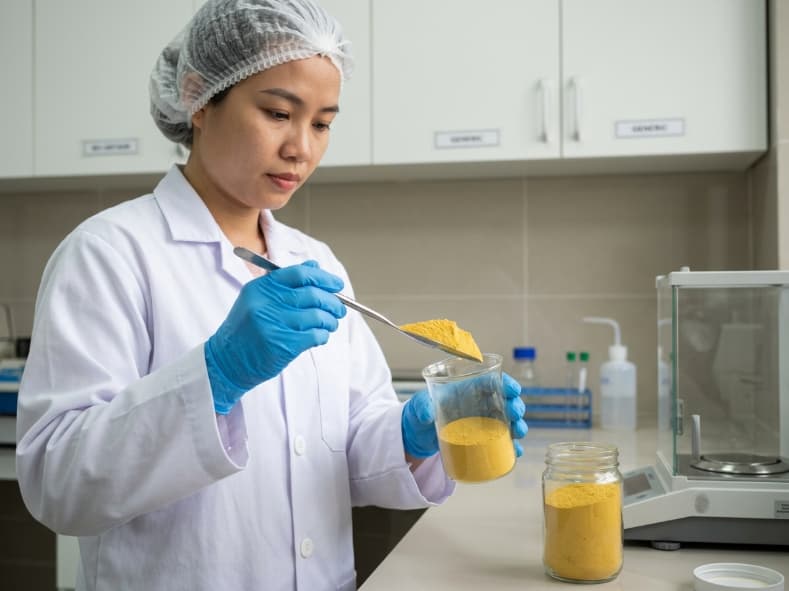
The trade-off is yield and proof. Seedless production should have its own mass-balance record. The buyer should not accept the seed-on 6–7:1 ratio as proof for seedless supply. Seed removal changes solids and loss.
Seedless powder should link to passion fruit powder specification. The buyer must define mesh, carrier status, caking behavior, moisture, Aw and dispersibility. Smoothness is not a specification. It needs measurable criteria.
Moisture, Aw and Food-Safety Review Apply to Both Routes
Seed-on and seedless products both need moisture and Aw control. The working target for this product cluster is 3–5% moisture and Aw below 0.30. FDA defines water activity as a ratio related to vapor pressure under the same conditions and explains that Aw affects food stability during storage (U.S. Food and Drug Administration). This supports the need to record Aw separately from moisture in both seed-on and seedless specifications.
The mistake is treating low Aw as a complete safety claim. It is not. FDA guidance on low-moisture foods states that Salmonella can become more heat-resistant in dry or low-water-activity foods, which means Aw does not replace microbiology review. (U.S. Food and Drug Administration)
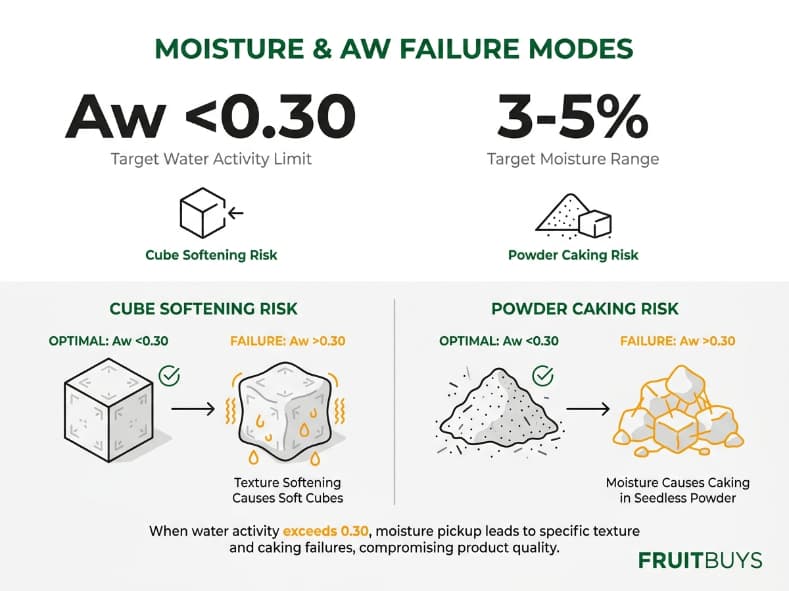
For seed-on cubes, moisture pickup can soften texture and increase breakage. For seedless powder, moisture pickup can cause caking and poor flow. These failure modes differ, but both routes need water-activity control for freeze-dried passion fruit and COA and laboratory testing requirements.
Required Proof Before Approving Seed-On or Seedless Product
The highest-risk mistake is approving seed status by visual inspection only.
A photo can show visible seeds, but it cannot prove seed ratio, filtration loss, Nutrition Facts, moisture, Aw, microbiology or bulk consistency.
Buyers should approve seed status only through a written specification and retained sample.

The buyer should request different proof depending on the route.
| Proof Required | Seed-On | Seedless |
|---|---|---|
| Ingredient statement | Required | Required |
| Seed status declaration | Required | Required |
| Seed ratio or visual tolerance | Required | Required as absence or maximum visible seed |
| Conversion basis | Pulp with seeds | Filtered pulp or defined seedless basis |
| Cube size or powder mesh | Required | Required |
| Moisture and Aw | Required | Required |
| Microbiology panel | Required | Required |
| Contaminant panel | Destination-specific | Destination-specific |
| Nutrition data | Formula-specific | Formula-specific |
| Retained sample | Required | Required |
| Change-control rules | Required | Required |
A buyer should treat any seed-status change as a new approval event. Moving from seed-on to seedless changes the product. Moving from seedless to seed-on also changes the product. The new route needs a new sample, new specification and updated document review. This proof structure links to approved sample and production lot comparison and buyer specification brief.
Application Mapping
| Buyer Type | Application | Required Format | Proof Needed | FruitBuys Delivery |
|---|---|---|---|---|
| Snack brand | Retail fruit snack pouch | Seed-on cubes | Cube size, seed visibility, breakage, Aw | OEM/Private Label Delivery |
| Granola manufacturer | Cereal inclusion | Seed-on cubes | Size tolerance, seed distribution, fines | Quality Control and retained sample |
| Chocolate producer | Fruit inclusion | Seed-on small cubes | Moisture, particle size, sensory approval | Application-matched specification |
| Beverage developer | Premix or smoothie powder | Seedless powder preferred | Mesh, visible seed limit, dispersion | Product configuration and documentation |
| Bakery R&D team | Filling or cream | Seedless powder or low-seed powder | Texture, mesh, hydration behavior | Format-specific sample support |
| Dairy developer | Yogurt topping | Seed-on cubes or seedless powder | Hydration, acidity, seed tolerance | Sample-to-bulk release alignment |
| Ingredient distributor | Industrial resale | Both routes possible | Separate specs and COA files | Lot-based documentation |
| Private label owner | Consumer SKU | Seed-on cubes or seedless powder | Label data, Nutrition Facts, retained sample | OEM/Private Label Delivery |
Why FruitBuys Delivers Seed Status as a Controlled Specification
FruitBuys supplies freeze-dried passion fruit as a finished product under one locked specification. Seed status sits inside that specification because it affects raw-material governance, conversion ratio, format behavior, Nutrition Facts, application fit and release criteria.
Raw Material Sourcing Governance aligns pulp suitability, maturity and seed direction before sample preparation. Quality Control ties seed status to cube size, powder mesh, moisture, Aw, sensory review and retained sample comparison. Documentation links ingredient statement, COA, laboratory reports and lot identity to the exact product. OEM/Private Label Delivery keeps seed status aligned with pouch design, label content, Nutrition Facts and buyer approval.
A weak supplier treats seeds as a visual detail. FruitBuys treats seeds as a control point. The buyer needs one product definition from sample to bulk, not a moving target between R&D, QA and packaging.
Buyer Checklist
Before selecting seed-on or seedless freeze-dried passion fruit, confirm:
- Does the product contain original passion-fruit seeds?
- Does the buyer allow visible black seed particles?
- Does the application require smooth texture?
- Does the product need cubes, powder, or both?
- Does the conversion ratio start from pulp with seeds or filtered pulp?
- Has the supplier provided seedless mass-balance data?
- Does the specification define seed ratio or visible seed tolerance?
- Does the Nutrition Facts file match the final seed status?
- Does the COA include moisture and Aw?
- Does the microbiology panel sit separately from Aw?
- Does the packaging protect cubes from softening or powder from caking?
- Does the retained sample represent the same seed route as bulk production?
- Does any seed-status change trigger new sample approval?
Use freeze-dried passion fruit RFQ checklist before requesting samples.
Summary
Seed-on freeze-dried passion fruit keeps pulp and seeds in the product, while seedless formats remove or filter seed material before drying or final formulation. Seed status changes yield, texture, visual appearance, powder behavior, Nutrition Facts and sample-to-bulk approval.
The current 6–7:1 conversion range applies to peeled pulp with seeds, not seedless material. Both routes still require moisture, Aw, microbiology and documentation review. FruitBuys locks seed status inside the product specification, retained sample and lot-release file.
FAQ
Is seed-on freeze-dried passion fruit better than seedless?
No. Seed-on works better when visible fruit identity and texture matter. Seedless works better when smoothness, clean appearance or dispersion matters.
Does seedless passion fruit need more raw material?
Usually yes, because seed removal takes out solids and creates filtration loss. The exact ratio needs production records.
Does seed status affect Nutrition Facts?
Yes. Seeds can affect fat, fiber and protein values. Buyers need formula-specific testing before using Nutrition Facts on retail labels.
Can seed-on powder work in beverages?
It can work only when visible seed particles and texture are acceptable. Smooth beverage systems usually need seedless or low-particle powder.
Should seed-on cubes have a seed-ratio specification?
Yes. Seed distribution affects appearance, texture and consistency. The buyer should define acceptable visible seed level or seed-ratio criteria.
Does Aw below 0.30 replace microbiology testing?
No. Aw supports stability control, but it does not prove the absence of contamination. Buyers still need a microbiology panel.
When should a new sample be required?
Require a new sample when seed status, cube size, powder mesh, carrier status, moisture target, packaging or COA scope changes.
Conclusion
Request separate seed-on and seedless samples after defining the application, acceptable seed visibility and texture requirement.
References
- U.S. Food and Drug Administration. Water Activity (aw) in Foods. Inspection Technical Guide. (U.S. Food and Drug Administration)
- U.S. Food and Drug Administration. Guidance for Industry: Measures to Address the Risk for Contamination by Salmonella Species in Food Containing a Peanut-Derived Product as an Ingredient. (U.S. Food and Drug Administration)
- Life / MDPI. Constituent Characteristics and Functional Properties of Passion Fruit Seed Extract. 2022. (MDPI)
- PubMed. Physical and chemical analysis of Passiflora seeds and seed oil from China. 2008. (PubMed)