Freeze-Dried Passion Fruit Market Readiness for Importers and Brands
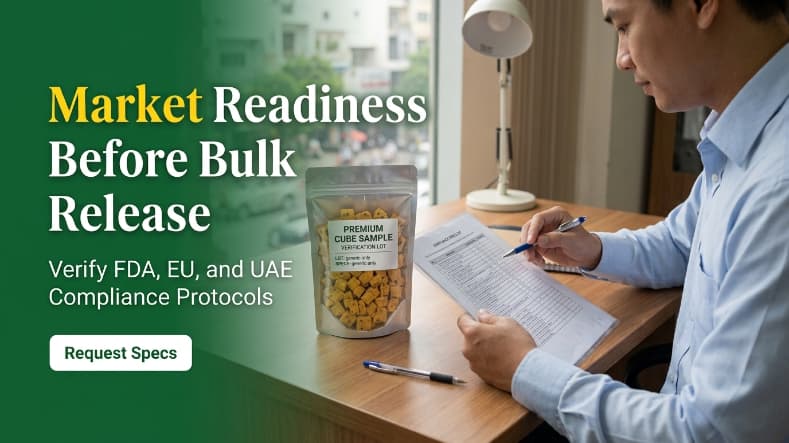
Freeze-dried passion fruit market readiness starts before the buyer approves the sample. A cube can look bright, a powder can smell strong, and the product can still fail documentation review when product identity, formula, HS classification, label data, COA scope, certificate validity, packaging evidence, or destination-market requirements remain unfinished.
Importers, distributors, QA teams and private label owners need to know whether the product is seed-on cubes, seedless powder, carrier-free powder, or a formulated retail SKU before they review compliance. Market readiness is not a certificate folder. It is the proof that the exact product can enter the buyer’s market under the correct identity. FruitBuys treats this stage as a documentation, QC, packaging and release-control process under one accountable supply relationship.
Market Readiness Starts With Product Identity
Freeze-dried passion fruit must be classified and documented according to its exact product identity.
Seed-on cubes, seedless powder, carrier-containing powder and retail pouches can trigger different label, testing, document and import questions.
Buyers should lock product identity before reviewing destination-market readiness.
A buyer cannot prepare market documents for “freeze-dried passion fruit” as a loose category. The product file must define the actual goods.
The identity file should confirm:
| Product Identity Point | Buyer Review |
|---|---|
| Format | Cubes or powder |
| Seed status | Seed-on, seedless, or visible seed particles accepted |
| Ingredient statement | Passion-fruit material only or formulated product |
| Carrier status | Required for powder review |
| Added ingredient status | Sugar, carrier, anti-caking agent, or none |
| Technical targets | Moisture 3–5%; Aw <0.30 |
| Application | Ingredient, snack, beverage, bakery, private label, resale |
| Label route | Bulk ingredient or consumer retail pack |
| Destination | U.S., EU, UAE, or other buyer market |
This stage should link to freeze-dried passion fruit B2B guide, seed-on and seedless passion fruit formats and passion fruit cubes and powder. FruitBuys does not build import readiness from slogans. FruitBuys starts with the product identity, then aligns the sample, specification, COA, label data, packing file and destination documents around that identity.
Core Product Documentation
The buyer should review the product file before market-specific requirements. If the core file is weak, the destination review becomes a patchwork of late corrections.
A basic freeze-dried passion fruit file should include:
| Document | Purpose |
|---|---|
| Product specification | Defines format, seed status, physical criteria and technical limits |
| Ingredient statement | Supports label and buyer QA review |
| Allergen statement | Supports customer and regulatory review |
| Process flow | Shows how the product is prepared and dried |
| COA template | Defines lot-release fields before production |
| Lot COA | Verifies released goods |
| Laboratory reports | Support microbiology, contaminants, nutrition, or other tests |
| Certificate copies | Support site or system scope where verified |
| Traceability file | Links raw material, production and lot identity |
| Packaging specification | Supports storage and shelf-life review |
| Retained sample file | Supports sample-to-bulk comparison |
| Packing file | Supports shipment and carton review |

This section should connect to COA and laboratory-testing requirements, sample-to-bulk consistency and packaging and shelf-life controls. A certificate cannot replace this file. A certificate supports a site, system, or process scope. It does not prove moisture, Aw, microbiology, pesticide residue, heavy metals, powder mesh, cube breakage, Nutrition Facts, or label readiness for the exact lot.
U.S. Readiness: FDA Import, Prior Notice, FSVP and Label Control
U.S. readiness requires product identity, facility and import documentation, Prior Notice, importer verification and label control where retail packaging applies.
FDA states that imported foods must meet U.S. food regulations and import procedures, including facility registration and Prior Notice where applicable.
Buyers should avoid “FDA approved” language for ordinary food products and focus on document readiness.
FDA states that food can be imported into the United States without prior sanction by FDA when the facilities that produce, store, or handle the products are registered as required and Prior Notice is submitted for incoming shipments. FDA also states that imported foods must meet U.S. food regulations and import procedures. (U.S. Food and Drug Administration)
For U.S. review, the buyer should confirm:
- Product identity
- Facility registration applicability
- Prior Notice route
- Importer FSVP responsibilities
- FDA product and manufacturer information for import filing
- Ingredient statement
- Allergen statement
- Nutrition Facts if retail-packed
- Serving-size review
- Lot COA
- Microbiology and contaminant panel
- Packaging and storage information
FDA states that it does not certify, license, or otherwise approve individual food importers, products, labels, or shipments before importation. That means a buyer should not ask FruitBuys for “FDA approval” of freeze-dried passion fruit as an ordinary food product. The buyer should request the documents needed for import and buyer QA review. (U.S. Food and Drug Administration)
FDA Prior Notice must be provided for human and animal food that is imported or offered for import into the U.S.; FDA uses this information to target inspections and evaluate risk before arrival. (U.S. Food and Drug Administration)
For covered food imports, the FSVP regulation makes the U.S. importer responsible for supplier verification under the rule’s definition of importer. The supplier document file should support that importer review instead of relying on generic claims. (U.S. Food and Drug Administration)

Retail labels require separate control. FDA’s Nutrition Facts resources state that serving size and servings per container appear prominently and that nutrition information is usually based on one serving, with some containers also showing per-package information. (U.S. Food and Drug Administration)
This U.S. section should link to freeze-dried passion fruit Nutrition Facts, COA and laboratory-testing requirements and freeze-dried passion fruit private label.
EU Readiness: Food Law, Hygiene, Food Information and Residue Review
EU readiness begins with traceability, food safety responsibility, hygiene controls, food information and contaminant or residue review. Regulation (EC) No 178/2002 sets the EU general food-law framework, including a high level of human-health and consumer protection, and requires food placed on the EU market to be labelled or identified to facilitate traceability through documentation or information. (EUR-Lex)
For EU review, buyers should prepare:
- Product specification
- Ingredient statement
- Traceability file
- Process flow
- Hygiene and food-safety system evidence
- COA and laboratory reports
- Pesticide-residue review
- Contaminant review
- Label information
- Language and importer review
- Packaging and storage statement
Regulation (EC) No 852/2004 covers hygiene of foodstuffs and states that relevant requirements for imported food include the requirements laid down in Articles 3 to 6 of that regulation (EUR-Lex). EU food information rules under Regulation (EU) No 1169/2011 aim to protect public health, prevent misleading practices and ensure transparency and consistency across the EU market. (Food Safety)

For agricultural products, EU pesticide MRL legislation under Regulation (EC) No 396/2005 sets maximum residue-level rules for food and feed of plant and animal origin, and the European Commission maintains current MRL legislation and control-program updates (EUR-Lex). Contaminant review should refer to Regulation (EU) 2023/915, which sets maximum levels for certain contaminants in food and replaced Regulation (EC) No 1881/2006. (EUR-Lex)
This EU section should link to lot-based laboratory documentation, moisture and aw requirements and destination-market documentation. The buyer should not treat EU readiness as a label translation job. If pesticide, contaminant, traceability, hygiene, ingredient, or importer-specific review fails, the product file remains unfinished.
UAE Readiness: Registration, Label Review and Import Release
UAE readiness requires product registration and local-market handling review before the product moves through the market. The UAE Government portal states that imported, locally produced, or label/ingredient/composition-modified food must be registered in the electronic ZAD system before being handled in UAE markets. (U.AE)
Dubai Municipality lists food-trader services that include food product registration and label assessment, imported food shipment release, re-export release and export health certificates. (Dubai Municipality)
For UAE review, buyers should confirm:
- UAE importer or distributor route
- Product registration path
- Label artwork
- Arabic and English label needs where required
- Ingredient statement
- Product image and pack image
- Shelf-life and date-marking route
- Storage statement
- Halal claim only when certificate scope supports it
- COA and laboratory documents
- Shipment-release document route
The UAE portal also states that national food-safety work covers controls and standards across the food chain through the Ministry of Climate Change & Environment and partners (UAE). This section should link to freeze-dried passion fruit private label, packaging and shelf-life controls and freeze-dried passion fruit RFQ checklist.
A UAE private label file should not move ahead on artwork before product registration, label information, shelf-life basis and document scope align. Label rework after sample approval wastes time and weakens buyer confidence.
HS Classification and Product Description
HS classification should follow the exact product composition and form.
Pure dried fruit, seed-on cubes, seedless powder, and formulated powder may require different review depending on the importing country’s interpretation.
Buyers should confirm classification before final document release.
WCO HS heading 0813.40 covers fruit dried, other than headings 08.01 to 08.06, and mixtures of nuts or dried fruits of Chapter 8. (WCO Trade Tools). The U.S. HTS heading 0813 covers dried fruit other than headings 0801 to 0806 and mixtures of nuts or dried fruits, and the notes also refer to treatments that preserve the character of dried fruit or dried nuts. (Harmonized Tariff Schedule)
For freeze-dried passion fruit, classification review should ask:
| Product Route | Classification Risk |
|---|---|
| Seed-on dried passion-fruit cubes | May align with dried-fruit identity, subject to market interpretation |
| Seedless dried fruit powder | Needs review because form and process may affect interpretation |
| Carrier-containing powder | Ingredient addition may change classification |
| Retail snack mix | Mixture rules may apply |
| Product with sweetener or coating | Needs classification review |
| Beverage premix | May fall outside simple dried-fruit treatment |

Do not use one HS code across every product form. Classification should match the exact ingredient statement, processing route, format and importing-country interpretation. This section should link to passion fruit cubes and powder, passion-fruit powder specification and buyer specification brief.
Certificates vs Product Compliance
Certificates can support market readiness only when the buyer checks scope. A logo on a website or label is not evidence. The buyer must inspect the document.
Review:
- Certificate holder
- Production site
- Process scope
- Product category
- Issuing body
- Validity period
- Applicable standard
- Exclusions
- Relationship to the supplied goods
For freeze-dried passion fruit, certificate review may involve HACCP, ISO 22000, BRCGS, Halal, or other buyer-required documents. Do not claim certification without exact scope and validity. Do not treat a certificate as proof that the current lot passed moisture, Aw, microbiology, contaminants, powder mesh, cube breakage, or Nutrition Facts review.
This should connect to COA and laboratory-testing requirements. A certificate answers: does the site or system claim have support? A COA answers: did the lot meet the release criteria? A label file answers: does the consumer or buyer-facing pack communicate the product correctly? Those are different controls.
Packaging and Label Readiness
Packaging and label readiness depend on the final market route. Bulk ingredient packs and retail private label pouches do not carry the same information load.
For bulk ingredient review, the buyer should confirm:
- Product name
- Lot code
- Net weight
- Ingredient statement
- Storage condition
- Pack date or production date where required
- Shelf-life basis
- Carton identity
- COA and packing list alignment
For retail private label review, the buyer should confirm:
- Product name
- Ingredient list
- Allergen statement
- Nutrition Facts or destination nutrition format
- Net quantity
- Country-of-origin statement
- Date marking
- Storage instructions
- Lot code
- Importer or distributor details where required
- Language route
- Claims review

This section links to freeze-dried passion fruit Nutrition Facts, packaging and shelf-life controls and freeze-dried passion fruit private label. A label should not claim what the product file cannot prove. Do not place Halal, no added sugar, clean label, high fiber, organic, or other claims on artwork until the formula, certification and regulatory basis support them.
Application Mapping
| Buyer Type | Application | Required Format | Proof Needed | FruitBuys Delivery |
|---|---|---|---|---|
| U.S. importer | Bulk ingredient or retail pouch | Cubes or powder | Facility/import file, Prior Notice data, FSVP support, COA | Documentation and export-readiness review |
| EU distributor | Ingredient resale | Cubes or powder | Traceability, food-information file, pesticide and contaminant review | Lot-based documentation |
| UAE distributor | Registered consumer or ingredient product | Cubes or powder | ZAD/product registration inputs, label file, COA, shelf-life basis | Documentation and packaging alignment |
| Private label owner | Consumer SKU | Cubes or powder | Label data, Nutrition Facts, pack artwork, retained sample | OEM / Private Label Delivery |
| QA manager | Supplier and lot approval | Cubes or powder | COA, lab reports, certificate scope, specification | Quality Control and Documentation |
| R&D developer | Application testing | Cubes or powder | Application sample, seed status, physical spec | Sample-to-bulk release alignment |
| Procurement manager | Market-ready supply route | Cubes or powder | RFQ brief, destination, product identity, document scope | Controlled product supply route |
Why FruitBuys Aligns Product and Documentation
FruitBuys supplies freeze-dried passion fruit as one configured product under one approved specification. Market readiness sits inside that product route, not in a disconnected document folder.
Documentation aligns product identity, ingredient statement, COA, laboratory reports, certificate scope, traceability, label file and packing records. Quality Control verifies moisture, Aw, microbiology, contaminants and physical criteria according to cubes or powder.
OEM/Private Label Delivery connects formula, pack size, label data, retained sample and destination review. Export Logistics Coordination aligns carton configuration, storage instructions and document handover.
A fragmented supply chain turns market readiness into detective work. One party sends a sample. Another sends a certificate. Another sends a label. Another provides shipment papers. Nobody proves that all files describe the same product. FruitBuys closes that gap by supplying the finished product and aligning the proof behind it.
Buyer Checklist
Before approving freeze-dried passion fruit for market readiness, confirm:
- Has the buyer selected cubes, powder, or both?
- Has seed-on or seedless status been locked?
- Does the ingredient statement match the final formula?
- Has carrier status been confirmed for powder?
- Does the classification review match the exact product?
- Does the specification list moisture 3–5%?
- Does the specification list Aw below 0.30?
- Does the COA identify the exact lot?
- Does the microbiology panel match the destination and application?
- Does the contaminant and pesticide review match the buyer’s market?
- Does the certificate scope match site, process and product?
- Does the label route match U.S., EU, UAE, or another destination?
- Does the packaging file support the shelf-life statement?
- Does any formula, format, label, or destination change trigger document review?
Use freeze-dried passion fruit RFQ checklist before requesting market-ready samples or documents.
Summary
Freeze-dried passion fruit market readiness requires product identity, format, seed status, formula, HS classification review, COA, lab reports, certificate scope, packaging data and destination-market label control. U.S. routes require FDA import procedures such as facility registration and Prior Notice where applicable, plus importer FSVP review.
EU routes require traceability, hygiene, food information and residue or contaminant review. UAE routes require product registration and label review through relevant systems. FruitBuys aligns these controls under one supplied product file.
FAQ
Does FDA approve freeze-dried passion fruit before import?
No. FDA states that it does not certify, license, or otherwise approve individual food importers, products, labels, or shipments before importation. Buyers should prepare import and compliance documents instead. (U.S. Food and Drug Administration)
What should U.S. buyers review first?
Review facility registration applicability, Prior Notice route, FSVP support, product identity, ingredient statement, COA, Nutrition Facts for retail packs and label claims.
What should EU buyers review first?
Review traceability, product specification, ingredient statement, hygiene controls, food information, pesticide residues, contaminants, COA and importer-specific requirements.
What should UAE buyers review first?
Review product registration route, label information, Arabic and English needs where required, shelf-life basis, COA, importer route and shipment-release requirements.
Is one HS code valid for every format?
No. Classification depends on exact composition, form and importing-country interpretation. Seed-on cubes, seedless powder and carrier-containing powder need separate review.
Does a certificate replace COA testing?
No. A certificate supports site or system scope. A COA verifies the exact lot against agreed release criteria.
When should market-readiness review happen?
Start before sample approval and finish before bulk release. Late review creates label rework, testing gaps, document delays and buyer approval friction.
Conclusion
Request a documentation-readiness review after defining destination, product format, formula and labeling route.
References
- U.S. Food and Drug Administration. Importing Food Products into the United States. Official FDA import guidance. (U.S. Food and Drug Administration)
- U.S. Food and Drug Administration. Importing Human Foods. Official FDA import information and pre-approval clarification. (U.S. Food and Drug Administration)
- U.S. Food and Drug Administration. Filing Prior Notice of Imported Foods. Official FDA Prior Notice information. (U.S. Food and Drug Administration)
- U.S. Food and Drug Administration. Foreign Supplier Verification Programs for Importers of Food for Humans and Animals: What You Need to Know. Guidance for Industry. (U.S. Food and Drug Administration)
- U.S. Food and Drug Administration. What’s on the Nutrition Facts Label and Serving Size on the Nutrition Facts Label. (U.S. Food and Drug Administration)
- European Union. Regulation (EC) No 178/2002, General Food Law. (EUR-Lex)
- European Union. Regulation (EC) No 852/2004 on the hygiene of foodstuffs. (EUR-Lex)
- European Commission. Food Information to Consumers legislation, Regulation (EU) No 1169/2011. (Food Safety)
- European Union and European Commission. Regulation (EC) No 396/2005 pesticide MRL framework and EU MRL legislation updates. (EUR-Lex)
- European Union. Commission Regulation (EU) 2023/915 on maximum levels for certain contaminants in food. (EUR-Lex)
- UAE Government Portal. National Food Accreditation and Registration System. (U.AE)
- Dubai Municipality. Food traders and food import services information. (Dubai Municipality)
- World Customs Organization and U.S. International Trade Commission. HS/HTS heading 0813.40 and dried-fruit classification context. (WCO Trade Tools)