
Freeze-Dried Passion Fruit Packaging and Shelf-Life Controls
Freeze-dried passion fruit packaging and shelf life must be treated as one technical decision. A 12-month or 24-month shelf-life statement has no value if the buyer does not know the format, moisture, Aw, pouch structure, seal condition, inner-pack size, storage route and COA scope. Cubes and powder do not fail in the same way. Cubes soften, break and create fines. Powder cakes, clumps and loses flow. Both formats can lose buyer confidence when packaging lets humidity reach the product.
Shelf life belongs to the product and package together, not to a claim printed on a file. FruitBuys controls this decision by aligning format, packaging direction, lot-based moisture and Aw verification, retained samples, storage instructions and export logistics coordination before release.
Shelf Life Depends on Product and Package Together
Freeze-dried passion fruit shelf life must be tied to format, moisture, Aw, packaging barrier, seal integrity and storage condition.
A shelf-life range should not be approved as a general claim without product and package evidence.
Buyers should review packaging before approving bulk production or private label artwork.
The working shelf-life target for freeze-dried passion fruit is 12–24 months. Treat that as a target range that needs product-specific support. Do not publish it as unconditional proof for every cube, powder, pouch, carton, market, warehouse and handling route.
The product target is 3–5% moisture and Aw below 0.30. These values help control dryness and storage behavior, but they do not replace packaging validation. FDA states that water activity affects food stability and must be brought to a suitable level after drying and maintained during storage. That language matters for freeze-dried passion fruit because packaging must protect the product after drying, not only during production. (U.S. Food and Drug Administration)
This section should connect to moisture and Aw requirements, because shelf-life review cannot proceed without technical release criteria. It should also connect to freeze-dried passion fruit B2B guide, because the buyer must understand the product identity before reviewing packaging.
Why Freeze-Dried Passion Fruit Needs Moisture Control
Freeze-dried passion fruit can carry strong acidity, aroma and color, but its dry porous structure also makes packaging discipline critical. The buyer should not confuse “freeze-dried” with “safe under any pouch.” Dry product can still absorb moisture when exposed to air, weak seals, repeated opening or unsuitable storage.
Published research on freeze-dried passion-fruit juice examined water sorption kinetics and hygroscopic equilibrium, including how processing conditions and anti-caking agents affect the material. That supports a practical procurement point: freeze-dried passion-fruit systems need moisture-control planning after drying. (Wiley Online Library)
Moisture exposure creates different failures:
| Format | Main Packaging Failure | Buyer Consequence |
|---|---|---|
| Cubes | Softening and breakage | Weak retail appearance and poor texture |
| Powder | Caking and clumping | Poor dosing, flow and blending |
| Retail pouch | Seal or barrier weakness | Shorter usable consumer experience |
| Bulk inner pack | Repeated opening exposure | Moisture pickup during production use |
| Export carton | Compression or handling stress | Broken pieces or damaged presentation |
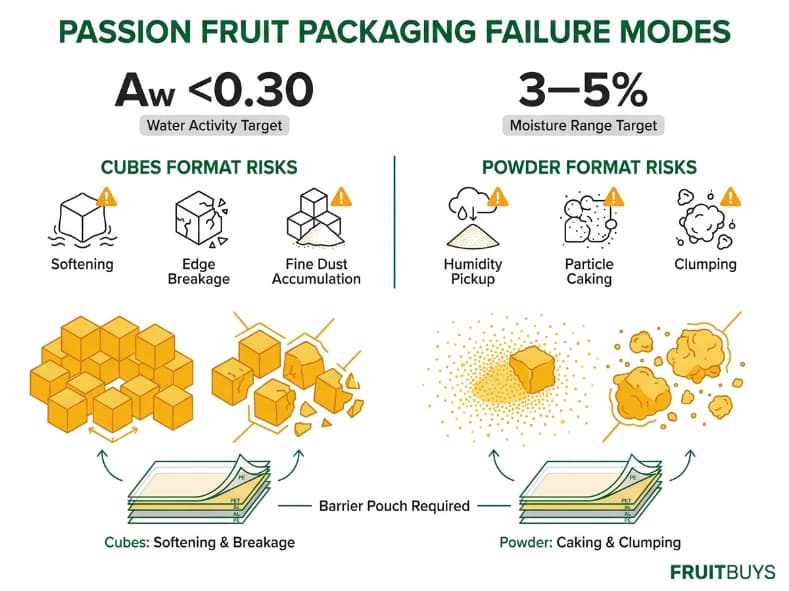
This article should link to passion fruit cubes and powder, because the packaging choice must follow the format. Cubes need protection from impact and humidity. Powder needs protection from humidity and repeated exposure.
Packaging Requirements for Cubes
Freeze-dried passion fruit cubes need packaging that protects both crispness and physical structure.
A cube can meet moisture and Aw at release but still fail if bulk packing creates breakage or humidity exposure.
Buyers should define inner-pack size, carton handling and breakage criteria before approval.
Cubes sell their identity through appearance. The buyer wants yellow to yellow-orange pieces, visible seed particles, light structure and crisp texture. Packaging must preserve those attributes through handling, storage and shipment preparation.
For cubes, the packaging specification should define:
- Inner-pack size
- Pouch or liner structure
- Seal requirement
- Carton configuration
- Headspace handling where relevant
- Broken-piece protection
- Maximum fines or breakage criteria
- Storage condition
- Retained sample pack condition
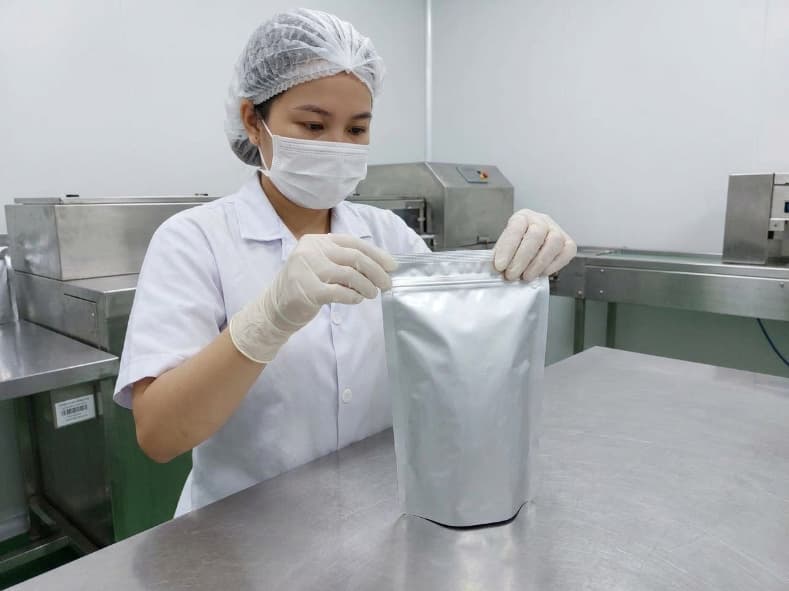
The current bulk carton data is 60 × 39 × 39 cm with 10 kg net. That is a useful starting point for carton planning, not proof of breakage performance. The buyer still needs a physical handling review. A cube that survives a small sample pouch can fail in a larger bulk inner pack if compression, vibration or loose movement breaks the pieces. This section should connect to approved sample and production-lot comparison. The approved sample must define what level of broken cubes remains acceptable in bulk.
Packaging Requirements for Powder
Powder packaging must control moisture exposure more aggressively because powder presents more surface area than cubes. A powder that absorbs humidity may cake, clump, bridge in dosing equipment, resist blending, or fail a private label consumer experience.
For powder, the packaging specification should define:
| Packaging Field | Buyer Reason |
|---|---|
| Inner-pack size | Controls repeated exposure after opening |
| Barrier structure | Protects against moisture pickup |
| Seal integrity | Reduces humidity entry |
| Resealing requirement | Supports use after opening |
| Caking expectation | Connects storage to application behavior |
| Bulk density support | Helps filling and dosing review |
| Handling instruction | Protects flow and usability |
| Retained sample pack | Supports comparison with bulk |
A beverage developer, bakery team or dry-mix buyer should not approve powder by taste alone. The powder must work inside the buyer’s process after storage and opening. This links to passion-fruit powder specification and application specific passion fruit formats. Powder also needs clear ingredient control. Carrier-free powder and formulated powder do not carry the same label, flow or caking profile. The packaging file should not outrun the formula.
Barrier and Seal Data Buyers Should Request
The buyer does not need ornamental packaging language. The buyer needs pack data that can protect the selected format.
Request these packaging details:
- Film or pouch structure
- Inner-pack size
- Net weight per inner pack
- Seal type
- Seal inspection method
- Carton configuration
- Lot coding method
- Storage statement
- Opening and resealing instructions
- Packaging date
- Retained sample condition
- Shelf-life support data
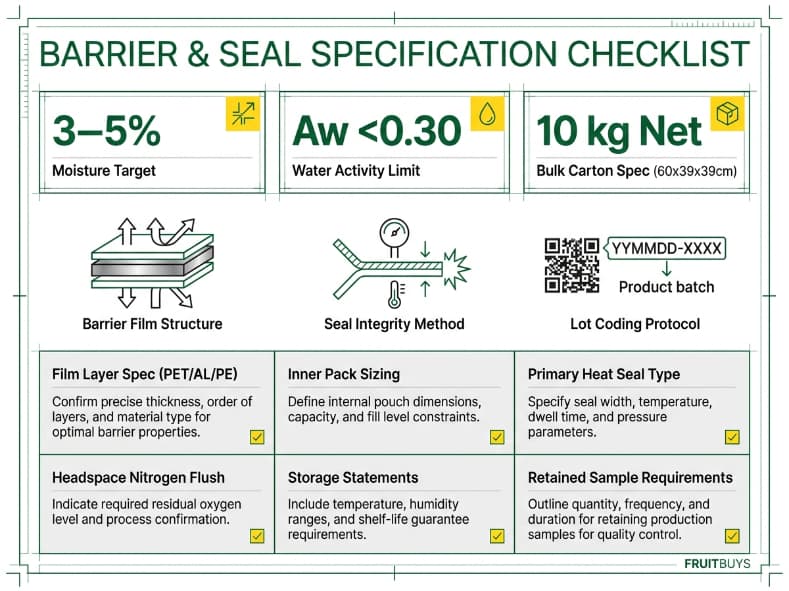
If the supplier claims moisture-barrier performance, ask for the evidence behind the claim. Do not invent WVTR, OTR, film thickness, residual oxygen or nitrogen-flush values unless the packaging specification and validation file support them.
This section should link to COA and laboratory-testing requirements, because packaging review must connect to lot-based moisture and Aw results. It should also link to freeze-dried passion fruit private label, because retail packaging claims require stronger label and shelf-life control. A pouch is not just a container. It is the final control surface between the product and humidity.
Storage and Handling Conditions
Storage instructions should match the product and pack. The basic direction is clear: keep the product dry, sealed, protected from direct moisture exposure and handled in a way that preserves texture and flow. The exact temperature, humidity and shelf-life wording must come from product-package validation, not guesswork.
For cubes, storage control protects:
- Crisp texture
- Visible piece quality
- Reduced clumping
- Reduced breakage during handling
- Consumer pouch appearance
For powder, storage control protects:
- Flow
- Dosing
- Lower caking risk
- Consistent blending
- Manageable scoop or hopper behavior
Repeated opening matters. A 1 kg or 5 kg bulk inner pack can perform differently from a small retail pouch because the user may open and close it several times. This makes inner-pack sizing an operational decision, not a decoration detail. This section should connect to freeze-dried passion fruit RFQ checklist, because the buyer must state storage and use pattern before FruitBuys configures the pack route.
Shelf-Life Validation: What Buyers Should Review
The highest-risk mistake is accepting a shelf-life statement without checking the product and package behind it.
Shelf life must connect format, moisture, Aw, packaging barrier, seal integrity, storage and retained sample evidence.
Buyers should request the shelf-life basis before private label artwork or bulk approval.
A shelf-life statement should answer: under which product, pack and storage conditions does this period apply?
A stronger shelf-life file may include:
| Shelf-Life Evidence | Buyer Review Point |
|---|---|
| Product format | Cubes and powder need separate review |
| Moisture result | Confirms water content at release |
| Aw result | Confirms water-availability control |
| Packaging structure | Shows how the product is protected |
| Seal condition | Supports barrier performance |
| Storage condition | Defines the claim environment |
| Retained samples | Supports ongoing comparison |
| Sensory checks | Tracks texture, color and aroma |
| Microbiology review | Confirms food-safety release route |
| Caking or breakage checks | Matches powder or cube risk |
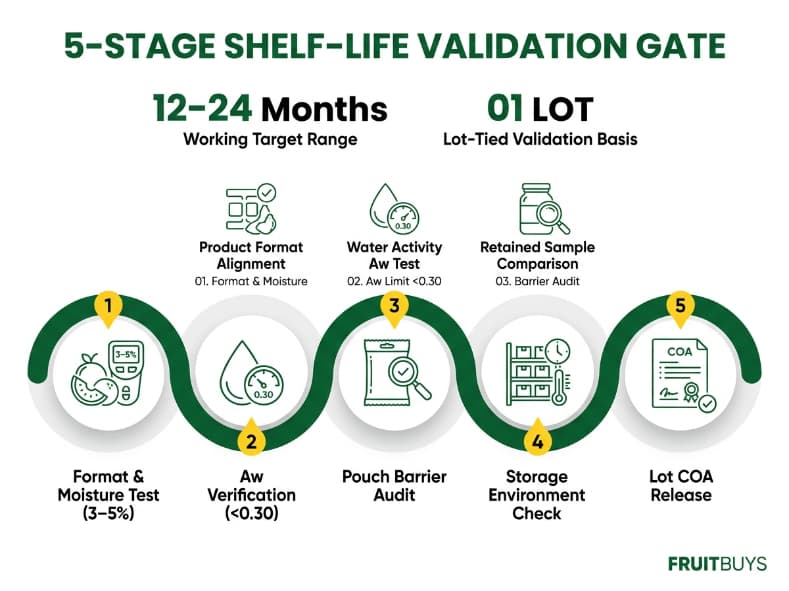
FDA’s water-activity guidance supports the idea that Aw must stay within an acceptable range during storage, which means packaging and storage must hold the post-drying condition, not merely record it once at production. (U.S. Food and Drug Administration). This section should link to lot-based laboratory documentation, water-activity control for freeze-dried passion fruit and sample-to-bulk consistency.
Low Aw Does Not Replace Microbiology Review
Aw below 0.30 supports storage and stability control, but it does not prove the product has no microbiology risk. Packaging cannot correct a food-safety gap that occurred before packing.
FDA guidance on low-moisture foods states that Salmonella can become more heat-resistant in dry food products or low-water-activity products. That reinforces a direct buyer rule: low Aw must sit beside sanitation, preventive controls and microbiology review, not replace them. (U.S. Food and Drug Administration)
For freeze-dried passion fruit, the buyer should define a microbiology panel according to application and destination. The packaging file should connect to the COA, not distract from it. Use microbiology and contaminant testing before approving shelf-life language. If the COA does not verify the lot, the shelf-life claim rests on sand.
Carton and Container Planning Without Overclaiming
The current planning input states a master carton of 60 × 39 × 39 cm with 10 kg net. That format supports bulk planning, but it does not prove maximum container capacity, breakage level, carton compression resistance, or shipment outcome.
Carton planning should review:
- Inner-pack count
- Net weight
- Gross weight
- Carton strength
- Cube breakage risk
- Powder caking risk
- Pallet or floor-loading route
- Humidity exposure before loading
- Storage before dispatch
- Lot separation
- Document match
Do not present geometric loading calculations as guaranteed capacity. Logistics planning must account for carton deformation, handling, inspection space, packaging protection, moisture-control materials and actual loading method. This section should link to freeze-dried passion fruit RFQ checklist, because the buyer should state bulk pack expectations inside the technical brief.
It also links to freeze-dried passion fruit private label when carton planning supports retail pack programs. FruitBuys handles this through Export Logistics Coordination. The goal is not only to fill cartons. The goal is to protect the released product until document handover and buyer receipt.
Application Mapping
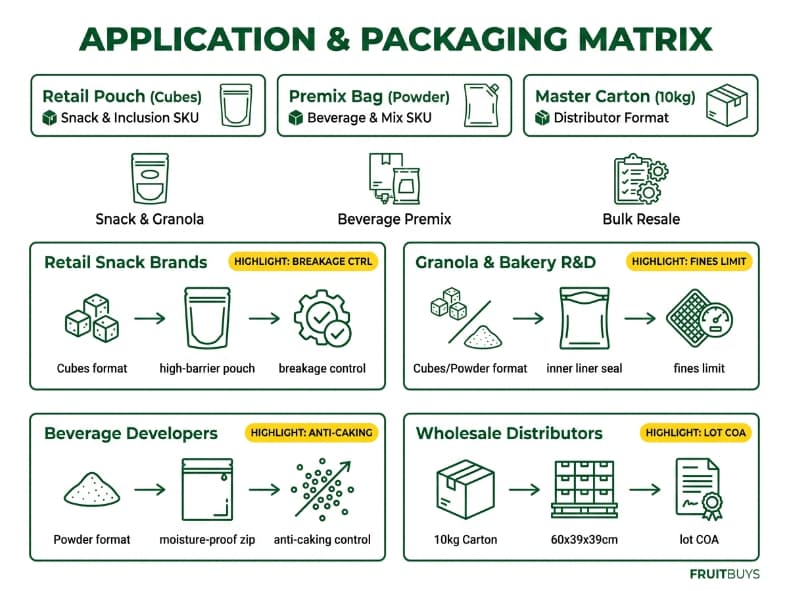
| Buyer Type | Application | Required Format | Proof Needed | FruitBuys Delivery |
|---|---|---|---|---|
| Snack brand | Retail fruit pouch | Cubes | Pouch barrier, breakage control, moisture, Aw | OEM/Private Label Delivery |
| Granola manufacturer | Inclusion ingredient | Cubes | Inner-pack condition, fines, shelf-life support | Quality Control and sample alignment |
| Beverage developer | Premix powder | Powder | Caking review, inner-pack size, Aw | Product configuration and packaging alignment |
| Bakery R&D team | Filling or dry mix | Powder | Flow, caking, storage after opening | Application-matched specification |
| Ingredient distributor | Bulk resale | Cubes or powder | Lot COA, storage statement, packing file | Lot-based Documentation |
| QA manager | Lot release | Cubes or powder | Moisture, Aw, microbiology, packaging inspection | Quality Control and Documentation |
| Private label owner | Consumer SKU | Cubes or powder | Retail pack file, label data, shelf-life basis | OEM/Private Label Delivery |
| Importer | Shipment approval | Cubes or powder | Packing list, lot identity, storage route | Export Logistics Coordination |
Why FruitBuys Aligns Product, Pack and Shipment
FruitBuys supplies freeze-dried passion fruit as a finished product under one approved specification. Packaging and shelf life sit inside that product file. They do not belong to a separate afterthought once production is finished.
Quality Control connects moisture, Aw, texture, breakage, caking and retained sample review. Documentation links COA, laboratory reports, shelf-life support, packaging specification, lot identity and packing file. OEM/Private Label Delivery aligns product format with pouch size, label data and artwork sequence. Export Logistics Coordination aligns carton configuration, storage instruction and document handover.
A fragmented project usually fails quietly. The sample looks crisp. The pouch looks attractive. The COA lists numbers. Then powder cakes during use, cubes soften in the retail pack, or the shelf-life claim cannot be supported. FruitBuys closes that gap by aligning product, package and release file before shipment preparation.
Buyer Checklist
Before approving packaging and shelf life for freeze-dried passion fruit, confirm:
- Does the product use cubes, powder, or both?
- Does the pack protect cubes from softening and breakage?
- Does the pack protect powder from caking and clumping?
- Does the specification list moisture 3–5%?
- Does the specification list Aw below 0.30?
- Does the COA verify moisture and Aw for the exact lot?
- Does the microbiology panel sit separately from Aw?
- Does the packaging file define pouch or liner structure?
- Does the seal inspection method exist?
- Does the shelf-life claim match the exact product and package?
- Does the storage statement match the validation basis?
- Does inner-pack size match the buyer’s use pattern?
- Does any packaging change trigger new sample review?
- Does the RFQ state retail or bulk packing requirements?
Use buyer specification brief before requesting packaging confirmation.
Summary
Freeze-dried passion fruit packaging and shelf life must be reviewed together. Cubes need protection against softening, breakage and fines. Powder needs protection against moisture pickup, caking and poor flow. The working targets are 3–5% moisture and Aw below 0.30, verified by lot documentation.
Shelf life should connect product format, packaging barrier, seal integrity, storage condition and retained-sample evidence. FruitBuys aligns specification, packaging direction, COA, storage control and shipment preparation under one product route.
FAQ
What shelf life can freeze-dried passion fruit target?
The working target is 12–24 months, but the claim must match the exact product format, packaging structure, moisture, Aw, seal condition and storage evidence.
Why do freeze-dried passion fruit cubes soften?
Cubes soften when they absorb moisture through air exposure, weak packaging, poor sealing, repeated opening, or unsuitable storage conditions.
Why does passion-fruit powder cake?
Powder cakes because fine particles expose more surface area to moisture. Packaging, inner-pack size, resealing and storage discipline control this risk.
Does Aw below 0.30 prove shelf life?
No. Aw supports stability review, but shelf life also needs packaging, seal, storage, sensory and lot evidence.
Should cubes and powder use the same packaging?
Not automatically. Cubes need breakage and crispness protection. Powder needs caking and flow protection. Each format needs its own packaging review.
What should buyers ask about packaging?
Ask for pouch or liner structure, inner-pack size, seal method, carton configuration, storage instructions, retained sample condition and shelf-life support.
Does packaging replace microbiology testing?
No. Packaging protects the released product, but it does not replace microbiology testing or preventive controls.
Conclusion
Request the packaging specification after confirming format, pack size, storage conditions and required shelf-life evidence.
References
- U.S. Food and Drug Administration. Water Activity (aw) in Foods. Inspection Technical Guide. (U.S. Food and Drug Administration)
- U.S. Food and Drug Administration. Measures to Address the Risk for Contamination by Salmonella Species in Food Containing a Peanut-Derived Product as an Ingredient. (U.S. Food and Drug Administration)
- Cal-Vidal, J.; Falcone, M. Processing Conditions Affecting the Hygroscopic Behavior of Freeze-Dried Passion Fruit Juice. Journal of Food Science, 1985. DOI: 10.1111/j.1365-2621.1985.tb10451.x. (Wiley Online Library)