
Freeze-Dried Banana Conversion Ratio: Why 5–6 kg Is Not a Fixed Constant
Freeze-dried banana conversion ratio looks simple until a buyer asks what the number actually measures. A claim such as “5–6 kg fresh banana makes 1 kg finished product” can mean whole fruit, peeled pulp, trimmed pulp, or saleable slices after broken pieces and fines have been removed. Each definition changes the result. For importers, QA managers, R&D teams and private label buyers, the ratio matters because it shapes specification control, sample approval and bulk-release expectations.
A conversion ratio without a calculation boundary gives the buyer a number, not proof. FruitBuys treats the ratio as a controlled technical record, not a marketing shortcut. The buyer should verify raw-material basis, moisture endpoint, Aw result, finished-product definition and saleable yield before approving a freeze-dried banana program.
What Does the 5–6:1 Ratio Mean?
The working ratio means approximately 5–6 kg of peeled banana pulp may produce 1 kg of freeze-dried banana.
The ratio changes with raw moisture, maturity, trimming, drying endpoint, breakage and the definition of saleable output.
Buyers should request batch mass-balance records rather than accept an unsupported fixed number.
For this dataset, the 5–6:1 ratio starts from peeled banana pulp, not whole fruit. That distinction matters. Whole banana includes peel. Peeled banana pulp excludes peel but may still include trimming loss, soft pieces, bruised sections and pieces removed before slicing.
A buyer who compares one supplier’s whole-fruit ratio with another supplier’s peeled-pulp ratio builds the wrong conclusion. The better question is not “What is the ratio?” The better question is: “Where does the ratio start, where does it end and what material does it exclude?”
The broader product qualification route sits in the freeze-dried banana wholesale guide. This article narrows the problem to yield definition, mass balance and buyer verification before sample approval.
Freeze-drying removes frozen water mainly through sublimation during primary drying under reduced pressure. That process can preserve a porous structure, but the final yield still depends on the starting solid content and the release standard for finished product. A food freeze-drying review describes primary drying as ice sublimation, most often under reduced pressure, and explains that process conditions affect the physical properties of food materials. (MDPI)
The Calculation Boundary Comes First
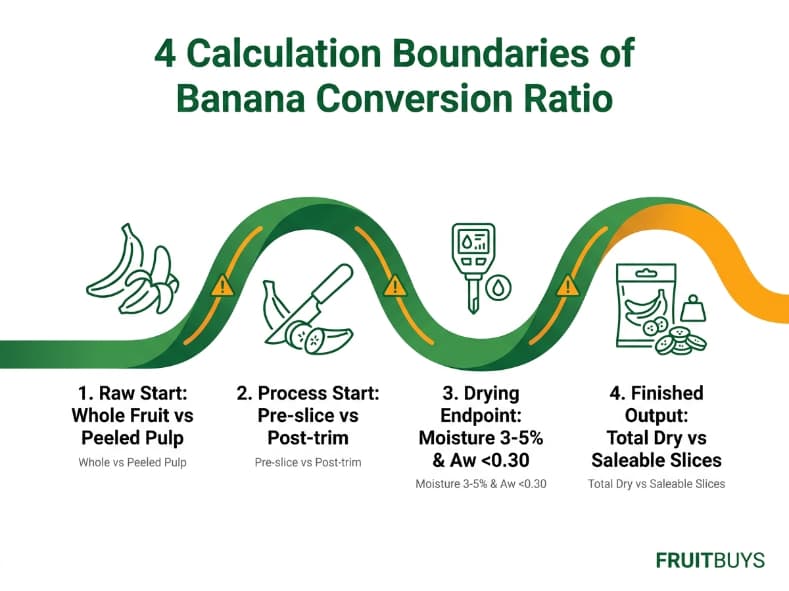
A conversion ratio must define four boundaries:
| Boundary | Buyer question | Why it matters |
|---|---|---|
| Raw material start point | Whole banana or peeled pulp? | Peel and trimming change the denominator |
| Processing start point | Before or after slicing and pretreatment? | Handling loss changes usable input |
| Drying endpoint | What moisture and Aw define completion? | Higher residual moisture can inflate apparent yield |
| Finished output | All dried material or saleable target format? | Broken pieces and fines may not match the buyer’s application |
The current FruitBuys working basis uses peeled pulp. That gives buyers a cleaner comparison than whole fruit because it removes peel weight from the conversion logic. It still does not remove every variable. Cultivar, maturity, raw moisture, slice thickness, pretreatment and sorting policy still move the actual batch result.
A supplier can state 5:1 while counting every dried piece, including broken slices and powder. Another supplier can state 6:1 while reporting only intact retail-grade slices. The second route may look less efficient, but it may give the buyer more usable product for a snack pouch. The number alone hides that difference.
This is why the buyer should connect yield review to banana browning and breakage control. Yield does not matter if the finished material fails the required visual or physical standard.
Why Raw Moisture Drives the Ratio
Fresh banana pulp contains a high water fraction. Freeze-drying removes most of that water, leaving concentrated solids in a light, porous structure. When raw banana contains more water, the processor needs more fresh pulp to reach one kilogram of finished product at the same final moisture level.
The buyer should not expect one universal ratio for every banana source. A firmer, less watery raw material can produce a tighter ratio. Softer, riper or higher-moisture banana can push the ratio upward. Bruising and trimming also reduce usable input before drying even begins.
The 5–6 kg peeled-pulp range fits a realistic B2B planning window when the finished product targets a low moisture level and when the saleable output excludes part of the damaged or nonconforming material. It should still remain a working range until batch records confirm it.
A procurement team that treats 5–6:1 as a fixed law will miss the real control point. The control point sits in the batch record: raw pulp weight, trimmed weight, finished dry weight, moisture result, Aw result, intact product, broken product, fines and retained samples.
Moisture and Aw Change the Meaning of Yield
Moisture and Aw measure different water-related controls in freeze-dried banana.
A batch with more residual moisture may show a better apparent yield but may not meet the intended crispness or stability target.
Buyers should review yield together with moisture, Aw and packaging evidence.
Moisture measures total water content. Aw measures water availability. FDA defines water activity as the ratio between vapor pressure of the food and vapor pressure of distilled water under identical conditions, and it notes that water activity increases with temperature. (U.S. Food and Drug Administration)
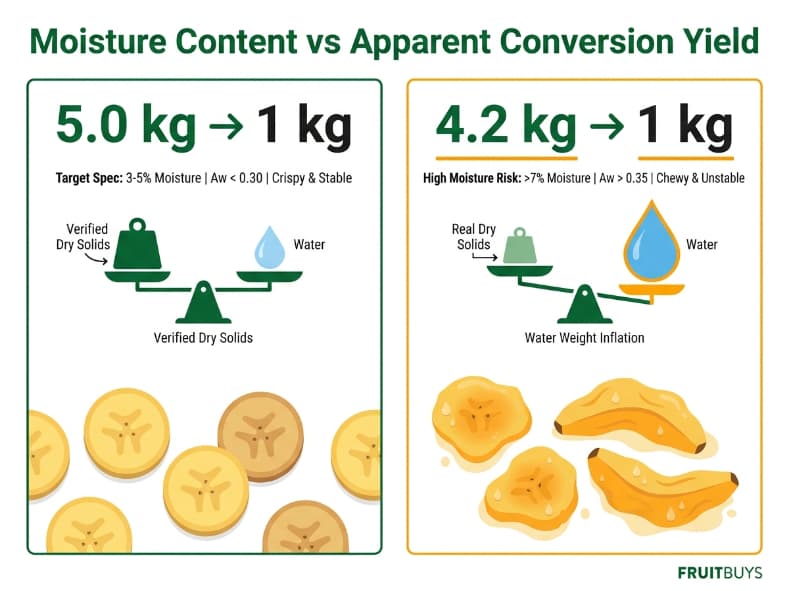
That distinction matters for conversion ratio. If one batch ends at a higher moisture level, it can weigh more. That may make the yield appear better, but it does not prove a better product. It may simply carry more residual water.
For this dataset, the working moisture target is 3–5% and the working Aw target is below 0.30. Those are release targets, not proof by themselves. Each lot still needs test results tied to the batch.
The buyer should connect this article with freeze-dried banana moisture and Aw. Without moisture and Aw data, the conversion ratio floats in the air like a number on a carton with no lot code.
FDA guidance also explains that water activity can be measured through equilibrium relative humidity and that temperature differences can change Aw readings. (U.S. Food and Drug Administration) A buyer should therefore request the method, instrument or laboratory route, sample condition and result, not only the final number.
Saleable Yield Is Not the Same as Dryer Output
Dryer output includes everything that leaves the freeze-drying step. Saleable yield includes the material that meets the approved commercial specification.
For freeze-dried banana slices, saleable yield may exclude:
- Excessive brown-centered slices
- Undersized or oversized pieces
- Slices outside thickness tolerance
- Broken slices beyond the agreed limit
- Fines generated during handling
- Retained QC samples
- Material removed for laboratory testing
- Pieces damaged during packing trials
This difference can change the buyer’s real supply picture. A batch may produce enough dry material by weight but fail the application because too much material falls outside the target format. For retail snack packs, intact slices matter. For cereal or granola, controlled bites or cubes may matter more than full slices. For powder, fines may be useful only when the product has been intentionally milled and specified as powder.
The buyer should link the conversion discussion to banana slices, cubes, bites and powder. Each format needs its own yield logic. A powder project should not borrow the saleable-yield expectation of a retail slice project.
Raw Material Governance Behind the Ratio
FruitBuys does not treat raw material as a loose purchasing input. Under Raw Material Sourcing Governance, FruitBuys aligns the raw-material route with the intended product format. That includes variety direction where available, maturity criteria, intake condition, trimming policy and suitability for slices, bites, cubes or powder.
For freeze-dried banana, raw material governance should address:
- Whether the project uses peeled pulp as the calculation basis
- How maturity affects softness and browning
- How quickly peeled banana moves into cutting, pretreatment or freezing
- Whether the buyer accepts natural brown centers
- Whether the final product prioritizes intact slices, small pieces or powder
- How raw-material loss appears in the batch record
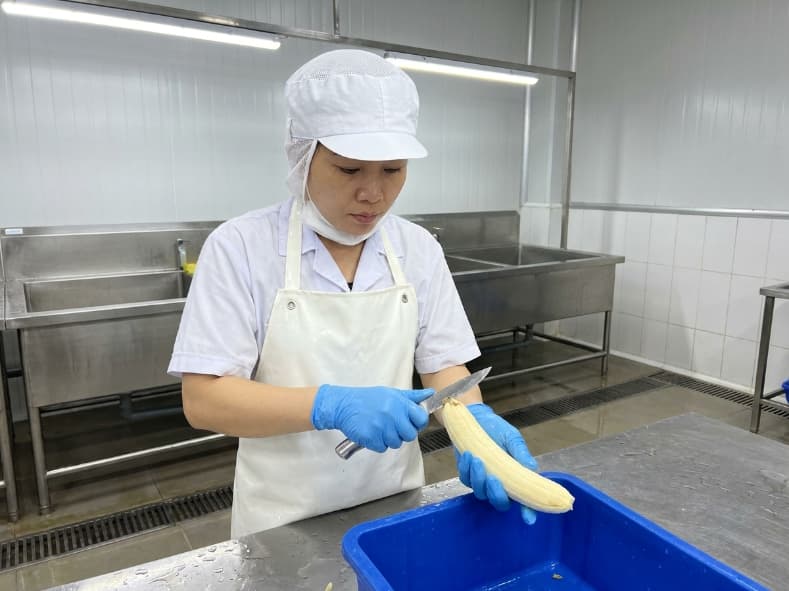
This is where weak supplier comparison collapses. One supplier may report a low input ratio because they accept more defects into the finished product. Another may report a higher ratio because they remove more material to protect appearance. The buyer should not reward the smaller number without checking the release standard.
Batch Mass Balance: The Buyer’s Core Proof
A reliable conversion review needs a batch mass-balance record. It should not rely on memory, verbal explanation or a polished product photo.
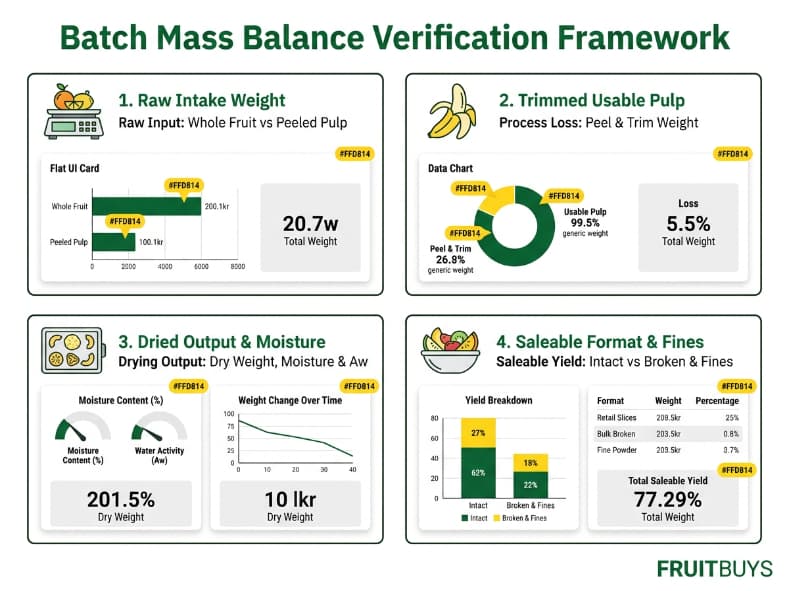
A practical batch record should include:
| Record field | Required detail |
|---|---|
| Whole banana received | Weight and lot/source identifier if used |
| Peeled pulp | Weight after peel removal |
| Trimmed usable pulp | Weight after defect removal |
| Raw-material condition | Maturity, visual quality, raw moisture where tested |
| Prepared product | Slice, cube, bite or powder route |
| Pre-freeze weight | Weight before freeze-drying |
| Finished dry weight | Weight after drying |
| Finished moisture | Test result and method |
| Finished Aw | Test result, method and temperature |
| Saleable target format | Intact slices, cubes, bites or powder |
| Broken pieces | Weight or percentage |
| Fines | Weight or percentage |
| QC samples | Weight removed |
| Rejected material | Weight and reason |
That table turns the ratio from a claim into a verifiable production record. It also protects the buyer from comparing fruit ghosts. The same 5–6:1 range can hide different operational realities unless every boundary is written down.
The proof file should connect to lot-specific COA and laboratory testing. A batch mass balance explains weight movement. A COA explains whether the lot met agreed release criteria.
How Slice Thickness and Browning Affect Yield
Banana slices do not behave like uniform metal washers. They vary in diameter, surface area, maturity, softness and exposure to oxygen. Slice thickness changes drying time and the chance that some pieces retain more water than others. Brown centers can also change the buyer’s acceptance decision.
Research on freeze-dried banana slices has examined pretreatments such as ascorbic acid and quince seed mucilage for effects on moisture, color and quality characteristics. The published abstract reports that pretreatment can reduce enzymatic browning and help maintain banana chip quality before drying. (PubMed)
That does not mean every FruitBuys lot uses that pretreatment. It means buyers must ask whether any pretreatment exists and whether it affects ingredient declaration. If the product is sold as banana only, the ingredient statement must match the real process. If a treatment is used, the label and specification route must reflect it.
A buyer who ignores slice thickness, color tolerance and breakage may approve a ratio that looks efficient but fails retail presentation. Yield only becomes useful when it supports the intended application.
Highest-Risk Conversion Claim
A supplier can report the same conversion ratio while using a different raw-material basis or finished-product definition.
That makes two apparently identical ratios technically incomparable.
The buyer should lock the calculation boundary before comparing production records.
The most dangerous conversion claim is not an obviously wrong number. The dangerous claim sounds reasonable but hides its boundary. “5 kg to 1 kg” may look stronger than “6 kg to 1 kg,” but that conclusion fails if the first number counts whole dryer output and the second number counts only saleable intact slices.
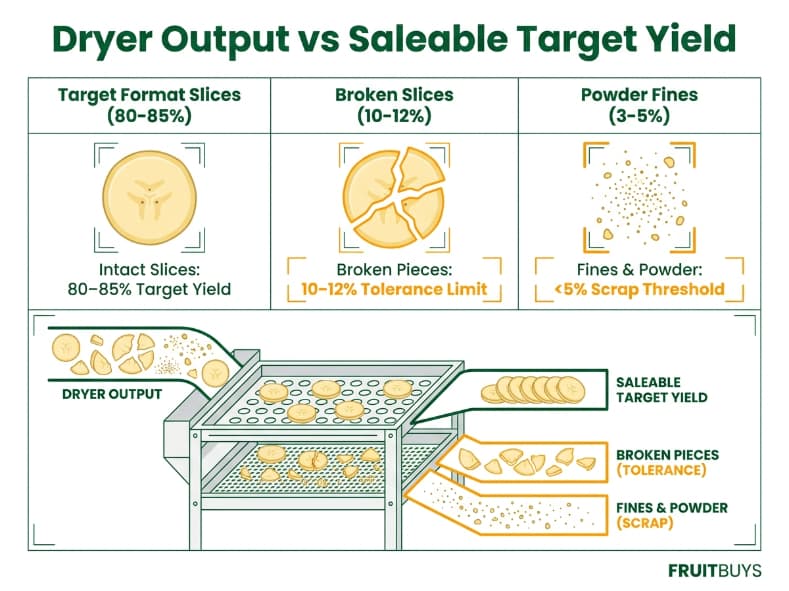
The buyer should ask three hard questions:
- Does the ratio start from whole fruit, peeled pulp or trimmed pulp?
- Does the ratio end at all dried output or saleable finished product?
- Which moisture and Aw results support that finished weight?
If the supplier cannot answer, the buyer should not use the ratio for supplier comparison. The hidden risk does not stay in the spreadsheet. It reaches the pouch, carton, release file and customer complaint desk.
The next control layer is sample-to-bulk consistency. Once a buyer approves a sample, the conversion ratio must support repeatable bulk release, not a one-time attractive sample.
Application Mapping
| Buyer Type | Application | Required Format | Proof Needed | FruitBuys Delivery |
|---|---|---|---|---|
| Importer | Bulk product qualification | Slices, bites, cubes or powder | Peeled-pulp ratio, moisture, Aw, saleable yield | Batch record and locked specification |
| QA manager | Lot release | Defined commercial format | COA, mass balance, breakage and fines record | Quality Control and Documentation |
| R&D developer | Ingredient trial | Cubes, bites or powder | Format-specific yield and functional sample | Application-matched sample route |
| Retail snack brand | Finished pouch | Slices or bites | Intact ratio, color tolerance, breakage limit | Sample-to-bulk release standard |
| Cereal manufacturer | Inclusion | Bites or cubes | Size distribution and fines control | Format control and packaging alignment |
| Private label buyer | Branded product | Slices, bites or powder | Product spec, packaging brief, nutrition file | OEM / Private Label Delivery |
This map shows why a single conversion ratio cannot answer every buyer question. A retail slice buyer needs intact visual yield. A powder buyer needs particle distribution, caking control and moisture protection. An importer needs mass-balance evidence that can survive QA review.
For application-level selection, connect this article with food and beverage applications.
How FruitBuys Uses the Ratio in Supplier Accountability
FruitBuys uses the conversion ratio as an operating checkpoint across the Integrated Product Supply Model. The buyer receives one supplied product under one accountable relationship, not a loose set of backend contacts. In a freeze-dried banana project, FruitBuys aligns the ratio through four controls.
First, Raw Material Sourcing Governance defines the raw-material basis. The project must identify whether the yield starts from peeled pulp and what trimming rules apply.
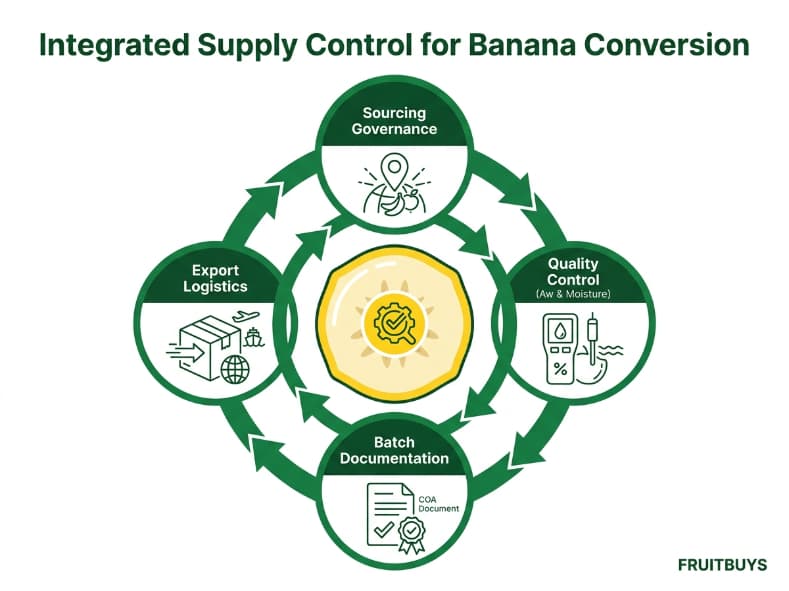
Second, Quality Control connects yield to moisture, Aw, appearance, thickness, breakage and saleable format. A ratio that improves only because the lot carries more residual moisture does not support buyer protection.
Third, Documentation turns the ratio into records. The buyer should see batch mass balance, specification, COA and release files where applicable.
Fourth, Export Logistics Coordination protects the finished product after drying. Freeze-dried banana can lose crispness if handling and packaging allow moisture uptake. The conversion ratio does not protect the product after packing. The packaging file and loading plan do that work. For the packaging connection, see freeze-dried banana packaging and shelf-life control.
Buyer Checklist
Before accepting a freeze-dried banana conversion ratio, the buyer should request:
- Raw-material basis: whole fruit, peeled pulp or trimmed pulp
- Cultivar or approved sourcing route where required
- Maturity criteria
- Raw-material moisture data where available
- Trimming and defect-removal policy
- Prepared format: slices, cubes, bites or powder
- Pre-drying weight
- Finished-product weight
- Finished moisture result
- Finished Aw result
- Saleable format definition
- Broken-piece limit
- Fines limit
- Retained sample weight
- Rejected material weight and reason
- COA linked to the same lot
- Release criteria linked to the approved sample
A thin RFQ creates room for interpretation. A structured RFQ forces every supplier to answer against the same technical boundary. Use the freeze-dried banana buyer RFQ checklist when preparing the request.
Summary
Freeze-dried banana conversion ratio should be defined by raw-material basis and finished-product criteria. For this FruitBuys dataset, the working range is 5–6 kg peeled banana pulp per 1 kg freeze-dried banana. The ratio varies with raw moisture, maturity, trimming, drying endpoint, breakage, fines and saleable-yield definition.
Buyers should not compare suppliers unless each ratio uses the same calculation boundary. FruitBuys ties conversion review to Raw Material Sourcing Governance, Quality Control, Documentation and sample-to-bulk release control.
FAQ
How many kilograms of banana make 1 kg freeze-dried banana?
For this dataset, the working range is 5–6 kg of peeled banana pulp for 1 kg finished freeze-dried banana. The ratio needs batch confirmation.
Does the 5–6:1 ratio include banana peel?
No. This dataset uses peeled banana pulp as the starting basis. Whole-fruit calculations require a separate peel-yield record.
Why can the ratio change between batches?
Raw moisture, maturity, trimming, slice thickness, drying endpoint, breakage, fines and saleable-yield rules can change the final ratio.
Can a supplier compare ratios without batch records?
No. A ratio without mass-balance records does not prove efficiency. It only gives an unsupported number.
Does higher finished weight mean better yield?
Not always. A higher finished weight may reflect higher residual moisture. Buyers must review moisture and Aw with the yield number.
Should broken pieces count in the finished yield?
Only if the buyer’s approved specification allows them. Retail slice projects need a separate intact-slice and breakage limit.
What should buyers request before sample approval?
Request the raw-material basis, batch mass balance, moisture result, Aw result, breakage record, fines record and saleable-output definition.
Conclusion
A freeze-dried banana conversion ratio can support buyer decisions only when the calculation boundary is clear. The 5–6:1 range works as a practical peeled-pulp planning range, but it cannot replace batch mass balance, moisture and Aw results, saleable-yield definition and sample-to-bulk release criteria. Buyers who approve the number without the records carry the mismatch into bulk production.
Request batch conversion records after confirming whether the ratio starts from whole banana, peeled pulp or trimmed pulp.
References
- Nowak, D.; Jakubczyk, E. The Freeze-Drying of Foods: The Characteristic of the Process Course and the Effect of Its Parameters on the Physical Properties of Food Materials. Foods, 2020. (MDPI)
- U.S. Food and Drug Administration. Water Activity (aw) in Foods. Content current as of 2014. (U.S. Food and Drug Administration)
- Beuchat, L. R. et al. Low-Water Activity Foods: Increased Concern as Vehicles of Foodborne Pathogens. Journal of Food Protection, 2013. (ScienceDirect)
- Milani, A. et al. Production and Characterization of Freeze-Dried Banana Slices Pretreated with Ascorbic Acid and Quince Seed Mucilage: Physical and Functional Properties. Food Science & Nutrition, 2020. (PubMed)
- Moraga, G. et al. Implication of Water Activity and Glass Transition on the Mechanical and Optical Properties of Freeze-Dried Apple and Banana Slices. Journal of Food Engineering, 2011. (ScienceDirect)