
Cubes or powder: which freeze-dried passion fruit format fits your product?
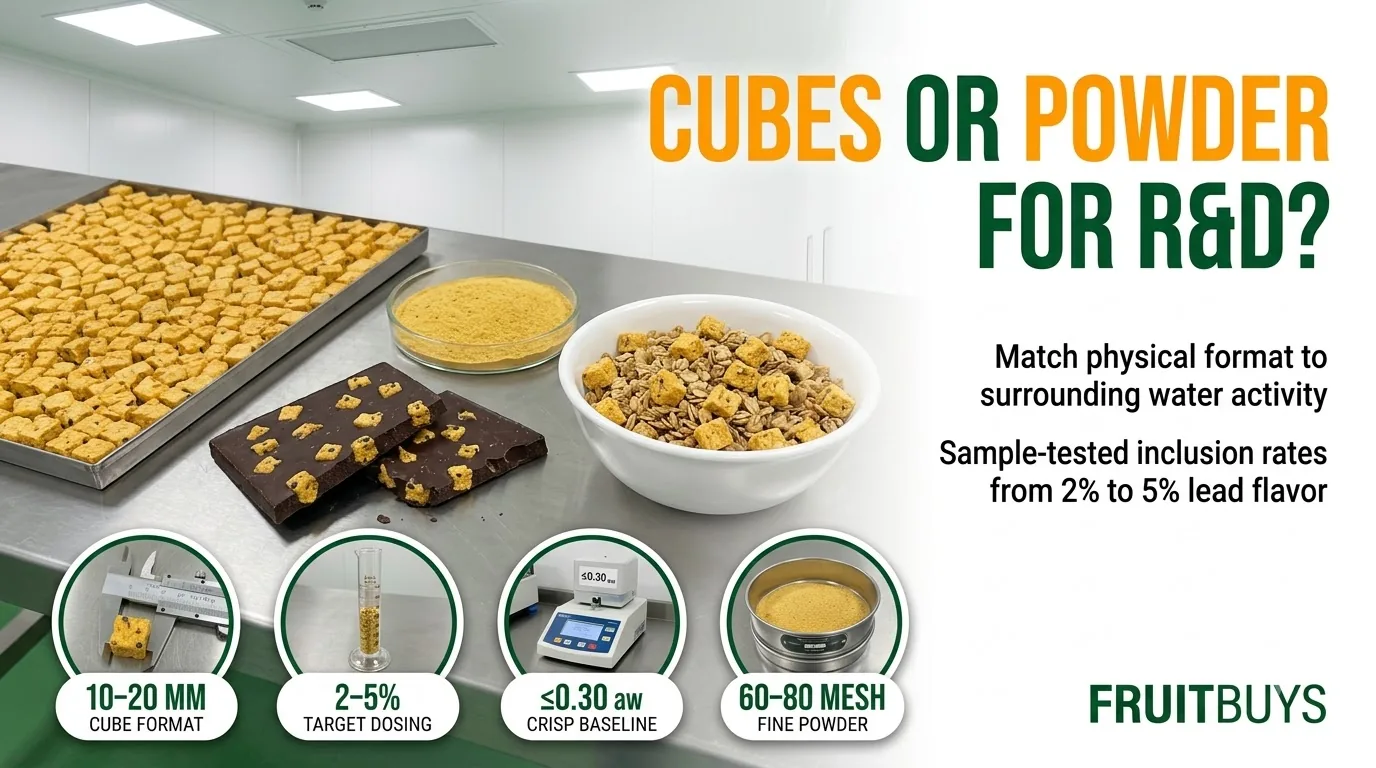
Pick by what the shopper should see and by how wet the base is. If the fruit has to be visible, a gold cube with black seeds through a window pouch or on the face of a chocolate bar, use cubes, sized to the spoon or the bite. If the fruit has to disappear into a coating, a filling or a premix, use powder. And if the base is wet and you cannot coat the cube or add it late, powder wins even where you wanted pieces, because a passion fruit cube left in yogurt overnight is no longer a cube.
Getting this right at the first sample saves your R&D team one or two rounds of reformulation, and saves procurement from a purchase order written against the wrong format.
Which format fits which food application?
| Application | Format | Size and dose | How to keep it right |
|---|---|---|---|
| Breakfast cereal, granola, clusters | Cubes, seed-in | 15 mm, 2–5% | Low-aw base and a good pack barrier; coat cubes that go inside clusters |
| Chocolate bars, bark, enrobed pieces | Cubes, seed-in | 15–20 mm, 2–5% | The fat base protects the cube; press into the back of the bar so the seeds show |
| Chewy snack and nutrition bars | Cubes coated in fat, or powder | 10–15 mm coated; powder 2–4% | Chewy bars usually run around aw 0.5–0.6, so uncoated cubes soften within weeks |
| Trail mix, snack mix, fruit mixes | Cubes, seed-in | 15–20 mm | Dry base; pair with mango or pineapple for a tropical mix |
| Yogurt topper, dual-compartment cup | Cubes, seed-in | 10 mm | Keep separate until the consumer mixes |
| Ice cream inclusions | Cubes, coated | 10–15 mm | A fat coating slows moisture pick-up through frozen storage |
| Bakery, baked into dough | Powder in the dough or filling | 2–4% | Cubes baked in soften and darken; use cubes as a post-bake topping |
| Icing, frosting, white chocolate coating | Powder, seedless | 2–3% | Even golden colour, natural sourness, no specks |
| Yogurt, ice cream, fillings, blended in | Powder | 2–4% | Flavour through the whole base, not in pockets |
| Retail snack pouch | Cubes, seed-in | 20 mm | Foil pouch with desiccant; the cube itself is the product |
Drinks, tea blends and cocktails follow their own rules and doses; they are set out in how to use freeze-dried passion fruit in drinks, tea and cocktails.
Which cube size fits cereal, yogurt or chocolate?
Cube size follows the size of the bite. A piece too large for the spoon gets left in the bowl; one too small for a chocolate bar disappears into it.
| Cube size | Best for | What to expect |
|---|---|---|
| 20 × 20 mm | Retail snack packs, chocolate bark, high-visibility toppings | The shape and black seeds sell the product on shelf; fines ≤3% |
| 15 × 15 mm | Breakfast cereal, granola, trail mix, ice cream inclusions | Doses cleanly on most cereal lines; one or two pieces per spoon |
| 10 × 10 mm | Yogurt and smoothie-bowl toppings, bakery decoration | Even spread across a cup or a cake; fines ≤5% |
The cubes are shaped in square moulds before they are frozen and dried, so they come out with full edges rather than cut faces. What fines there are come from splitting the few cubes that freeze together at the mould wall and from the knocks of packing and transport, which is why smaller cubes carry a slightly higher limit. Write the fines limit for your chosen size into the specification and weigh the bottom of the sample bag before you approve it. Dust at the base of a cereal box looks like a defect to the shopper, even though it is the same fruit.
Smaller cubes also pick up moisture faster on the line. A 10 mm cube exposes far more surface per kilo than a 20 mm cube, so in a mixing room or open hopper above about 50–55% RH it turns tacky and clings to the hopper walls roughly twice as fast. Keep each opened bag in the hopper for no more than 30–45 minutes, and size bag openings to that window.
How much passion fruit do you need per batch?
Less than most fruits. The acidity and aroma of Central Highlands passion fruit are concentrated by drying, so an inclusion rate of 2–5% is enough to make it the lead flavour in a cereal, granola or chocolate. Milder fruits such as mango or banana usually need a heavier dose to register in the same base. The sharp acidity also works as a palate cleanser: it cuts through the sweetness of milk chocolate or the richness of a nut-heavy granola, so the last bite tastes as good as the first.
That moves cost per finished pack more than price per kilo does. At 3% inclusion, a 10-tonne cereal run needs about 300 kg of cubes: within a single trial order, and small enough to test two cube sizes side by side before committing to a container. The natural acidity, around pH 3.0, often lets formulators cut back added citric acid and keep a shorter ingredient list.
If passion fruit is named on the front of the pack, EU labelling rules require its percentage in the ingredient list. Settle the inclusion rate in R&D with that declaration in mind; “with 3% passion fruit” reads very differently from “with 0.5%”.
How do you keep cubes crisp in a wet base?
Keep water away from the cube, or keep the cube away from the water until the last moment. Passion fruit pulls moisture faster than most freeze-dried fruits because it is acidic, high in soluble fibre and very porous, so any base wetter than the cube softens it within hours.
Three methods work in practice:
- Coat it. A thin film of cocoa butter or white chocolate seals the surface with a water-repellent barrier and does not mask the sour hit when the cube is bitten. This is the standard route for cereal clusters, chewy bars and ice cream inclusions.
- Add it late. Toppers, dual-compartment yogurt cups and “sprinkle before serving” sachets keep the cube dry until the consumer mixes it in.
- Keep the base dry. Granola, cereal and trail mix at low water activity keep the cube crisp through shelf life as long as the pack barrier holds.
Run a four-week storage test in your real base and real pack before you lock the formula, and check crispness at week one and week four. If the product will sit on shelves in a hot climate or through summer, run a parallel test at 35–38 °C and 75% RH to see how much moisture gets through your retail film. The release limits the cubes leave Vietnam at are explained in what moisture and water activity freeze-dried passion fruit should meet.
Seed-in or seedless for your format?
Seed-in is the standard and, for most cubes, the better choice. The seeds turn crisp and hollow when freeze-dried, give the cube its look and crunch, and carry much of the fibre and aroma. For a smooth drink, a pale cream, a fine powder or a product for small children, seedless is made to order at a higher price. The trade-off by application is in seed-in or seedless freeze-dried passion fruit.
When does powder win?
When the fruit must disperse or coat rather than be seen: icings and white chocolate, dough and fillings, blended yogurt and ice cream bases, premixes. One point to settle before the first sample: powder milled from seed-in fruit carries fine dark specks of ground seed. In a granola dusting or a rustic bakery cream that looks natural. In a white sauce, a milk tea or a pale icing, a QA team that was not warned may log the specks as burnt particles or foreign matter. If your product needs an even golden colour, specify seedless.
Powder is a separate product with its own specification, where particle size, flow and caking control matter more than cube size. See the freeze-dried passion fruit powder page, and for what it brings to a recipe, what are the benefits of passion fruit powder?
Can cubes replace frozen passion fruit pulp?
In anything dry or crunchy, yes, and they do it better. For sauces, fillings and desserts that need the fruit’s liquid, the cubes rehydrate: add roughly four to five parts water by weight and you are back near pulp strength, from an ingredient that sat in a dry store instead of a freezer. The full cost and handling comparison is in should you buy frozen or freeze-dried passion fruit cubes?
When is freeze-dried passion fruit the wrong choice?
When the cube must sit in a wet base for days without coating or separation and the shopper still expects a crisp piece. Drying alone cannot fix that. Use powder for the flavour, or a coated inclusion, and keep the cube for the places where it can stay dry. FruitBuys can send cubes and powder in one sample so your team can run both versions of the recipe.
Request an R&D sample in two cube sizes
Tell us your base, process and target inclusion rate. FruitBuys sends samples in two cube sizes, seed-in by default, plus powder if your recipe might need it, so your team can run the four-week test before writing the specification. Full product details are on the freeze-dried passion fruit cubes page, and the buyer checklist for a first container is in what to check before buying freeze-dried passion fruit in bulk.
FAQ
What can you make with freeze-dried passion fruit?
Cereal and granola, chocolate bars and bark, trail mix, yogurt toppers, ice cream, icing and frosting, bakery fillings, snack packs and drinks. Cubes go where the fruit should be seen; powder where it should blend in.
How do you use freeze-dried passion fruit in baking?
Use powder in the dough, filling or icing at 2–4%, and add cubes after baking as a topping. Cubes baked into dough soften and darken.
What size freeze-dried passion fruit cubes are available?
10 × 10, 15 × 15 and 20 × 20 mm, seed-in as standard, with seedless made to order.
How much freeze-dried passion fruit should I use in cereal or chocolate?
An inclusion rate of 2–5% is usually enough to make passion fruit the lead flavour.
Why do the cubes go soft in yogurt or chewy bars?
Both bases hold more water than the cube, and passion fruit is acidic, high in fibre and very porous, so it absorbs that water. Coat the cubes, add them at the point of serving, or switch to powder.
What fines should I accept?
About 3% or less on 20 mm cubes and up to 5% on 10 mm cubes.



