
Container Economics for Freeze-Dried Fruit: Density, Cartons, and Consolidation
A buyer orders one freeze-dried coconut SKU into a full 40-foot container and expects the freight to behave like the dried fruit contracts from other categories. The container closes, the weight tells a different story: 7.4 to 8.9 tonnes of product sit below half the payload a container of the same size carries for denser cargo.
The freight invoice prices the full volume the container occupied, so the cost per kilogram of product absorbs an entire layer of charges that denser commodities spread across three times the tonnage. Freeze-dried fruit ships on volume, not weight, and the procurement model that ignores that fact loses margin on every order.
This article builds the freight math from the carton up: the 60 by 39 by 39 cm carton, the container load table, the consolidation model that fixes the per-kilogram charge, and the moisture risk that rides inside every container.
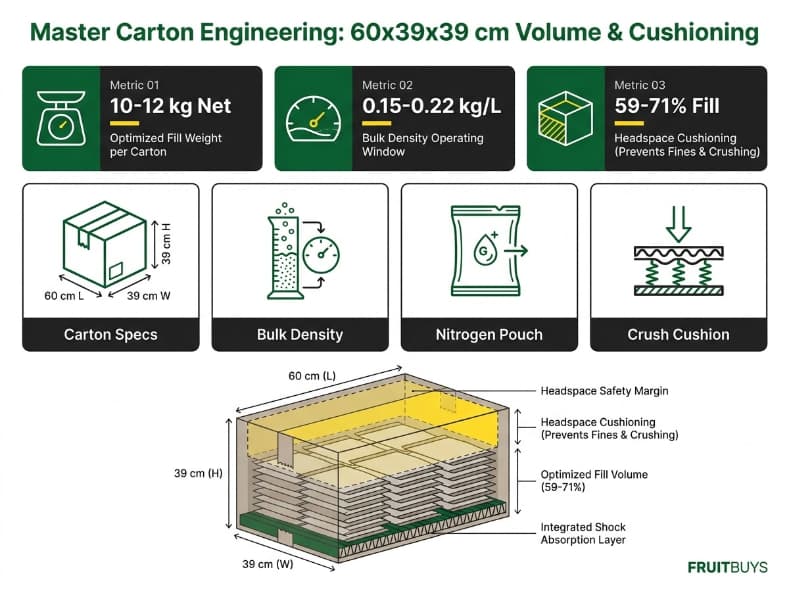
Answer Box: A 60 by 39 by 39 cm carton holds 10 to 12 kg net of freeze-dried coconut at 59 to 71% of its 91.3 liter internal volume, a fill level that protects the product from crush damage during stacking and transit vibration.
As a theoretical volume equivalent, a 20-foot container takes about 362 cartons carrying 3.6 to 4.3 tonnes, and a 40-foot container takes about 740 cartons carrying 7.4 to 8.9 tonnes, the actual load count needs a loading simulation or loading trial before the number binds a contract. Freeze-dried fruit reaches full container space long before it reaches full payload, which makes multi-SKU consolidation the freight model this category runs on.
The Carton: Why 10 to 12 kg and Not More
Bulk density of freeze-dried coconut runs between 0.15 and 0.22 kg per liter depending on cut form, which gives a 91.3 liter carton a theoretical maximum of 13.7 to 20.1 kg. Shippers fill the carton to 10 to 12 kg net instead, and the gap serves three functions at once.
The headspace keeps the nitrogen-flushed pouches from pressing against carton walls under stacking loads, the lower fill keeps the freeze-dried pieces from fracturing under their own weight during long stowage, and the cushion absorbs vibration that shatters the product along its dried cell walls.
The same physics that keeps the fines percentage below 5% at the factory carries through to the receiving dock, and the fines control at the cut stage follows the production sequence in the freeze-drying process article.
Freight density compounds the carton decision. At 0.15 to 0.22 kg per liter, freeze-dried coconut ships at one tenth the density of many bulk agricultural commodities, and volumetric freight charges do not forgive the difference.
The contract therefore names the carton standard explicitly: dimension, net fill, nitrogen flush, and inner pouch barrier, because every deviation from that standard changes what the freight rate per kilogram of product actually costs.
The Container Table: Volume Fills Before Weight
The load math starts from carton volume. A 60 by 39 by 39 cm carton occupies 91.3 liters, and dividing the container’s theoretical internal volume by that figure produces the counts below. Treat these rows as the theoretical volume equivalent: they assume perfect cube utilization and do not deduct door clearance, carton deformation, handling gaps, or orientation constraints, so a carton-loading simulation or a loading trial converts the equivalent into a binding load plan.
| Container | Theoretical internal volume | Cartons (theoretical volume equivalent) | Net product at 10 kg/carton | Net product at 12 kg/carton |
|---|---|---|---|---|
| 20-foot | about 33.1 m³ | about 362 | 3.6 tonnes | 4.3 tonnes |
| 40-foot | about 67.5 m³ | about 740 | 7.4 tonnes | 8.9 tonnes |
The 20-foot row also sets the annual capacity picture for a buyer sizing a supplier: at 3.6 to 4.3 tonnes per container, 100 tonnes of annual freeze-dried output equals roughly 23 to 28 full containers per year, about two containers per month if the entire capacity ships that product.
The payload contrast defines the category’s freight personality. A 20-foot container carries up to about 28 tonnes of payload, and a 40-foot container up to about 26 tonnes; freeze-dried coconut fills both containers with space well before it fills them with weight, at one fifth to one third of available payload.
A coconut shipment exits the port at a quarter of the tonnage a container of its size could carry, and the volumetric structure of the freight rate converts that unused tonnage into a per-kilogram surcharge on the product.
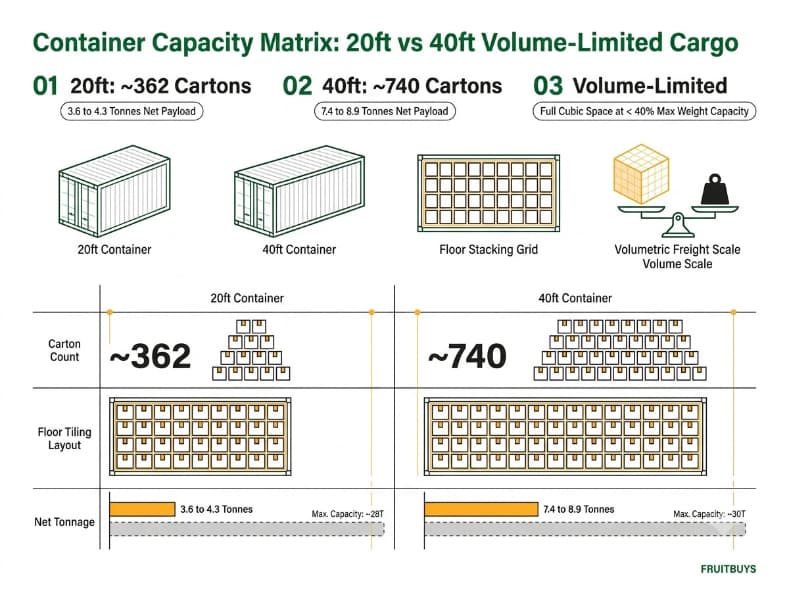
Buyers who price freeze-dried fruit against commodity dried fruit on a per-container basis discover the gap at settlement. Buyers who anchor the comparison to per-kilogram delivered cost build the model correctly from the start.
Consolidation: The Freight Model the Category Runs On
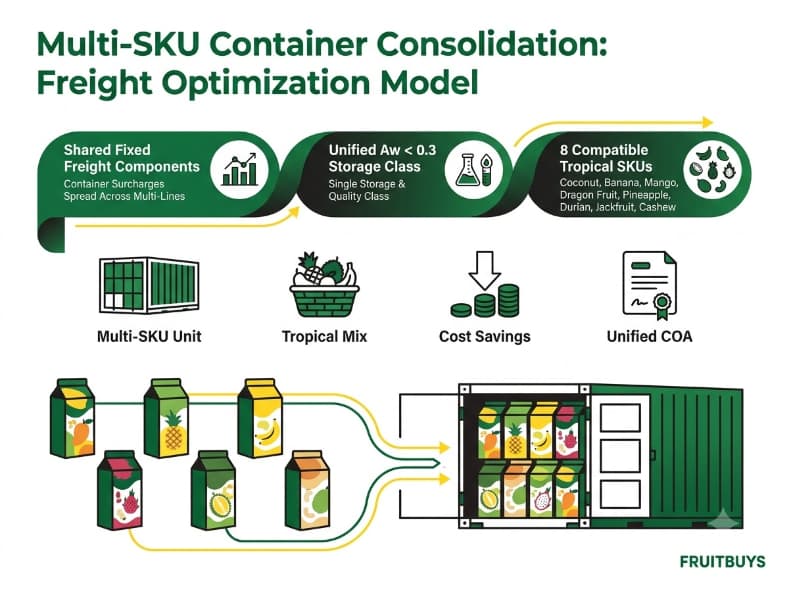
The volume-first structure favors one ordering pattern: consolidate multiple freeze-dried SKUs into a single container. Each SKU adds only its carton volume, not a new container fee, so the fixed freight components spread across the combined tonnage instead of charging each product individually. The 13-product freeze-dried range makes this practical for buyers holding a portfolio across the format.
| Consolidation partner | Shared container role |
|---|---|
| Freeze-dried banana | Topping turnover anchor; pairs with coconut on the same topping shelf |
| Freeze-dried mango | Snack pouch fill; tropical flavor pair with coconut |
| Freeze-dried dragon fruit | Color anchor for retail mix; shares aw below 0.3 storage class |
| Freeze-dried pineapple | Bar inclusion pair with coconut crumble |
| Freeze-dried strawberries | Color and acid balance in trail mixes |
| Freeze-dried durian | Southeast Asian line consolidation |
| Freeze-dried jackfruit | Southeast Asian line consolidation |
| freeze-dried mango | Trail mix and bar inclusion pair |
The full catalog spans the freeze-dried fruit category and the healthy indulgence snacks category, and the sourcing guide’s comparison of supplier structures explains how one audit stream across the consolidation matters for your compliance file.
One honest trade-off frames the model. Consolidation adds logistics complexity: each SKU carries its own specification file, its own lot-level COA, its own customs classification, and its own labeling set, and the importer of record manages that paperwork per destination.
A buyer who needs one SKU in one container should plan for a partial load or groupage shipment and accept the higher per-kilogram charge that single-SKU volume carries; the documentation chain that carries each SKU’s classification through customs appears in importing dried coconut: HS code, FDA, and EVFTA.
Container Moisture: The Risk That Rides Inside
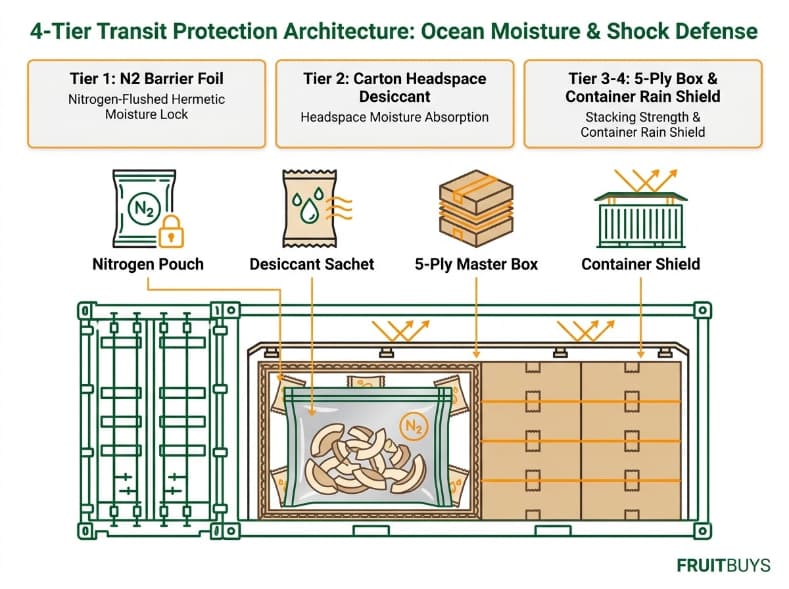
The container itself becomes a moisture environment. Day-night temperature cycles drive relative humidity swings inside the box, condensation forms on the steel roof in cold stretches, and the phenomenon known as container rain wets cartons that stayed dry at the factory. Freeze-dried coconut answers that environment directly: at aw below 0.3 the product pulls humidity from the air, and an opened pouch softens within hours of humid exposure.
Four controls keep the product inside its target 12 to 24 month shelf life across the voyage; note that a lipid-rich matrix like coconut can also end shelf life through oxidative rancidity before moisture re-entry, so a full shelf-life protocol reads moisture, water activity, sensory state, oxidation indicators, packaging barrier, and residual oxygen in the pouch, and the shelf-life claim should lock only after stability data on the actual packaging system.
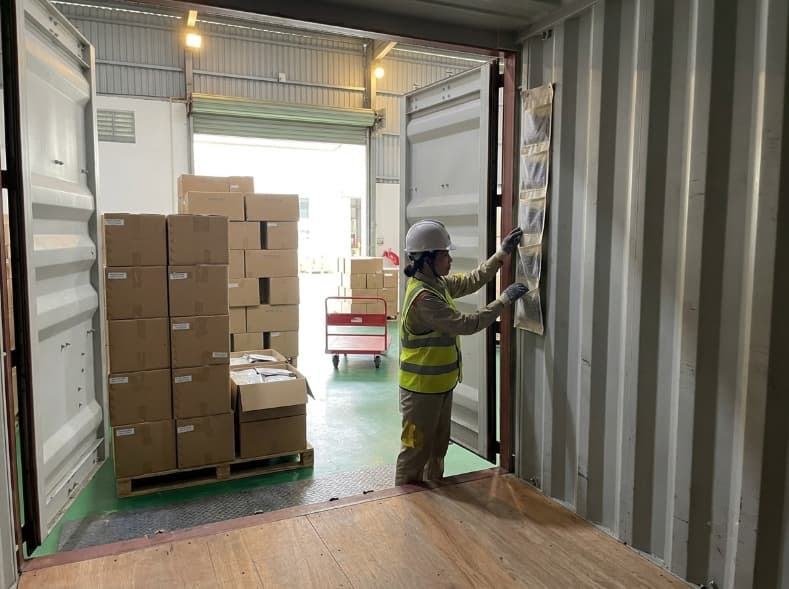
Nitrogen-flushed metallized pouches isolate each unit from the container atmosphere. Cartons carry desiccant packs sized to the headspace volume. Containers take container desiccants at the doors, and the loading condition stays dry: product boards on dry pallets, cartons sealed before loading, and no direct contact with container walls.
The receiver’s side completes the loop: cartons move to storage below 25 degrees Celsius at relative humidity under 65%, and the receiving check reads pouch integrity before the fine-damage check reads the fines percentage. The packaging specification behind these controls appears on the freeze-dried coconut meat product page.
Frequently Asked Questions
How much freeze-dried coconut fits a 40-foot container? The theoretical volume equivalent is about 740 cartons of 60 by 39 by 39 cm, carrying 7.4 to 8.9 tonnes at the 10 to 12 kg per carton standard; confirm the binding load count with a loading trial.
Why not fill cartons to capacity? Freeze-dried coconut at 10 to 12 kg per 91.3 liter carton keeps pouches cushioned from crush damage and limits fines from vibration fracture during long stowage.
Does the container reach weight capacity? No. The product reaches full space at 7.4 to 8.9 tonnes in a 40-foot container, below half the available payload; freight prices the volume.
How do buyers fix the per-kilogram freight charge? Multi-SKU consolidation spreads the fixed freight components across combined tonnage in one container.
What moisture risk rides in the container? Day-night temperature cycles drive humidity swings and container rain; nitrogen-flushed pouches, desiccant packs, and dry loading protect the product, and storage stays below 25 degrees Celsius at relative humidity under 65%.
Should I order one SKU per container? Single-SKU full containers leave most of the payload unused; plan consolidation across the freeze-dried range or accept the higher per-kilogram charge of a partial load.
Load the Container Against the Volume Reality
Take the container table into your next freight conversation and price the per-kilogram delivered cost, not the per-container rate. Consolidate across the freeze-dried range when your portfolio spans more than one SKU, and name the carton standard, the nitrogen flush, and the container desiccant load in the shipping specification. Request freeze-dried coconut samples with your cut form and destination market on the freeze-dried coconut meat product page, and a consolidation plan that matches your destination follows with the sample response.
*FruitBuys Vietnam operates freeze-drying, soft-drying, and veggie-chip lines in ISO/HACCP-certified facilities in Ho Chi Minh City and consolidates its full freeze-dried range into single-container shipments. Contact: support@fruitbuys.com. Export line: +84-919 739 589.
References
- Kerone Engineering, Freeze-Dried Coconut Drying Systems (bulk density 0.15 to 0.22 kg/L; packaging standards; 12 to 24 month shelf life): https://kerone.com/freeze-dried-coconut-drying-systems.php
- CBI, Dutch Ministry of Foreign Affairs trade agency, The European Market Potential for Desiccated Coconut (freight and consolidation dynamics for dried coconut trade ): https://www.cbi.eu/market-information/processed-fruit-vegetables-edible-nuts/desiccated-coconuts/market-potential
- University of Minnesota Extension, Freeze-Drying Your Own Food (aw range 0.08 to 0.33; hygroscopic softening; ambient storage below 25 degrees Celsius and 65% relative humidity ): https://extension.umn.edu/preserve-your-own-food/freeze-drying