HS Code, FDA, and EVFTA: The Compliance Chain for Importing Freeze-Dried Coconut
A container of freeze-dried coconut sits at the port, and the broker cannot move it. The commercial invoice carries a different HS code than the bill of lading, the supplier’s FDA registration expired in the even-numbered renewal year, or the Prior Notice confirmation never reached the file. The product itself passes every quality gate, yet the container waits while demurrage accumulates and the retail delivery date passes.
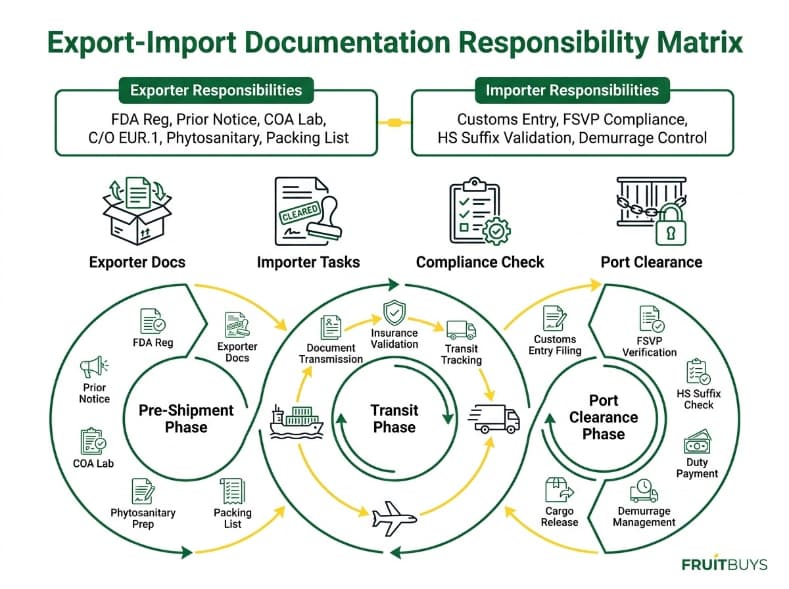
Import compliance for dried coconut resolves into four artifacts: a correct HS classification, a valid FDA registration with per-shipment Prior Notice, the phytosanitary rules of the destination, and a preferential certificate of origin where the trade agreement applies. This article walks each artifact with the exact code, the governing regulation, and the division of responsibility your contract should name.
Answer Box: Freeze-dried coconut classifies under HS 0801.11, the desiccated coconuts code; this is a preliminary classification, and your customs broker confirms the final country-specific subheading (US HTS 0801.11.00.00 carries MFN duty at 0%; EU CN 0801 11 carries 5.6% ).
Annex XII Part C of Regulation (EU) 2019/2072 exempts coconuts under CN 0801 12 00 and CN 0801 19 00, and a shipment classified under 0801.11 needs confirmation from the plant-health authority or broker, so classify and verify before quoting delivery terms. The US layer adds a valid FDA facility registration, a per-shipment Prior Notice, and FSVP support files for the importer.
HS Classification: One Code, Several Endpoints
The Harmonized System places dried coconut meat under 0801.11 regardless of the drying technology, because the classification follows the fruit and its dried state rather than the process behind it. Classification as 0801.11 for freeze-dried chunk and cube product remains preliminary until a customs broker confirms it for the destination schedule, because tariff schedules classify the specific product presented.
National tariff schedules then extend the code into market-specific subheadings, and the table below names the four endpoints buyers of Vietnamese product most often reach.
| Destination | Extended code | MFN duty | Preferential route |
|---|---|---|---|
| United States | HTS 0801.11.00.00 | 0% | No preferential agreement; MFN applies |
| European Union | CN 0801 11 | 5.6% | EVFTA preferential rates via correct C/O |
| GCC (UAE, Saudi Arabia) | 0801.11 extended to 12 digits | 5% | GCC common external tariff |
| Alternative read | 0813.40 (dried fruit other than 0801 to 0806) | Varies | Broker verification required if a schedule reads this way |
One tariff development demands honest framing rather than a flat statement. US executive actions from early 2025 introduced additional ad valorem duties on certain dried fruits, and the legal status of that coverage for HS 0801.11 moves with court rulings and administrative revisions.
The defensible position for a buyer: confirm the current Section 301 and Section 304 status for the specific subheading with your customs broker before signing a landed-cost commitment, and write the confirmation into the procurement file with a date attached.

FDA: Registration, Prior Notice, and the LMRTE Standard
US clearance turns on three mechanisms. First, the foreign facility that manufactures and packs the product must hold a valid FDA food facility registration, renewed biennially in even-numbered years; an expired registration invalidates the clearance chain regardless of product quality. Second, each shipment requires Prior Notice submitted before arrival, and the Prior Notice confirmation belongs in the same file as the bill of lading.
Third, the importer operates under FSMA preventive controls for human food, 21 CFR 117, and under the Foreign Supplier Verification Program: the US importer must verify that the foreign supplier controls hazards such as Salmonella in low-moisture foods, and the supplier’s documentation becomes the verification file.
Freeze-dried coconut sits inside the low-moisture ready-to-eat category. The FDA’s draft guidance for sanitation programs defines low-moisture foods as products at water activity at or below 0.85, and properly freeze-dried coconut at aw below 0.3 lands far inside that boundary.
The operational consequence: the lot-level microbiology results your supplier issues on the COA now feed directly into your FSMA documentation rather than sitting in a separate quality folder, and the freeze-drying process article shows where a validated pre-drying lethality treatment, executed under process validation and documented per lot, produces those results.
The practical file for a US shipment assembles six items: FDA registration number with renewal status, Prior Notice confirmation, commercial invoice, packing list, bill of lading, and accredited-laboratory microbiology results.
Common exporter failure points that land shipments on Import Alert appear in that file’s gaps: incomplete pest logs, CCP monitoring gaps, expired registration, and missing accredited-lab results.

Phytosanitary: The EU Exemption and the Markets That Still Ask
The EU exemption requires precise reading. Annex XII Part C of Regulation (EU) 2019/2072 exempts coconuts from the phytosanitary certificate requirement at Combined Nomenclature codes 0801 12 00 and 0801 19 00 only, the list does not name CN 0801 11 00.
A freeze-dried coconut shipment classified under 0801.11 therefore cannot assume the exemption applies, and the buyer confirms the applicable phytosanitary treatment for the declared code with the destination plant-health authority or the broker before the container sails.
Buyers should read the exemption narrowly in a second way as well: it applies to the EU, and other destinations keep the requirement in force. Vietnam’s Plant Protection Department issues phytosanitary certificates for markets that demand them, and Gulf, Asian, and African customs regularly request the document.
Destination-specific requirements extend beyond the certificate itself. China requires food manufacturing facility registration with GACC before shipments clear, Japan and Korea add pesticide residue testing to the phytosanitary package, Australia screens plant products at the border under the Biosecurity Act, the Gulf standardizes health certificates through NAFIQMPI under GSO frameworks. The procurement file therefore keeps one documentation list per destination, not one global list, and the contract names the destination’s list explicitly.

EVFTA: The Preferential Margin Your C/O Carries
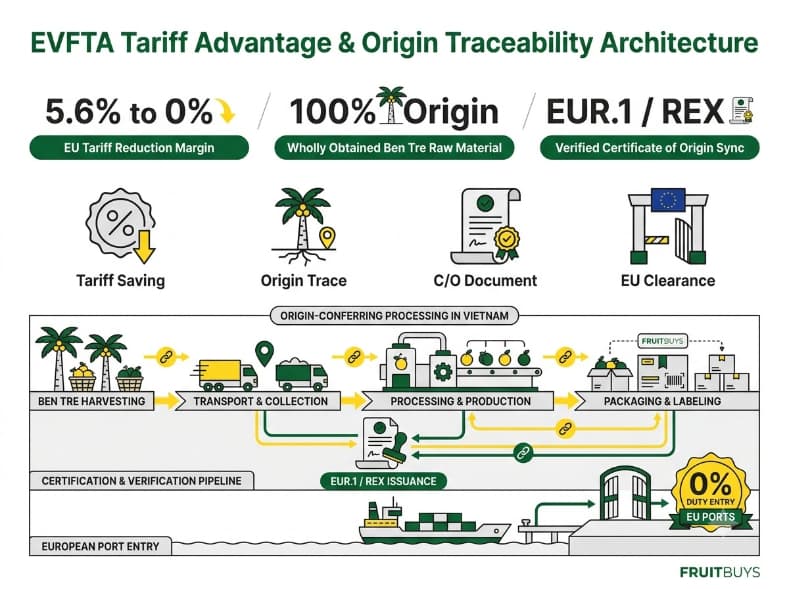
EU MFN duty at 5.6% on CN 0801 11 gives way to reduced rates under the EU-Vietnam Free Trade Agreement, and the rate difference multiplies across a full container. The mechanism is the certificate of origin: EUR.1 or the REX system, issued against rules of origin that require the product’s origin-conferring processes to occur in Vietnam.
Freeze-dried coconut from Ben Tre satisfies the origin condition because the transformation occurs entirely within Vietnam, from selection through drying and packing. Two disciplines protect the claim. First, the certificate must match the invoice, the bill of lading, and the lot codes on the cartons, mismatches surface at customs and erase the preferential rate the container carried out with.
Second, the origin zone recorded on the certificate traces to the harvest zones the lot codes already name, which connects this documentation stream to the traceability signal the Vietnam coconut supply article describes. The ASEAN Form E and VNAFTA documents serve parallel routes into Southeast Asia under the same logic.
One Honest Limitation: Certification Depth by Product Family
Vietnam’s dried coconut sector historically carried thinner certification depth than the Philippines and Sri Lanka in the commodity desiccated segment, because those origins built bulk certification for large-volume buyers decades earlier.
The freeze-dried niche changes the competitive shape: dedicated capacity, HACCP and ISO 22000 streams, and preferential tariff access position Vietnam against origins that compete on volume rather than specialty format.
Buyers who require GFSI-recognized schemes such as BRCGS or FSSC 22000 should ask for the current audit scope and the facility covered before contracting, because scheme coverage differs from HACCP coverage.
Frequently Asked Questions
What HS code does freeze-dried coconut use? 0801.11, the desiccated coconut code, used as a preliminary classification; the US tariff schedule lists 0801.11.00.00 at 0% MFN, and the EU lists CN 0801 11 at 5.6% before EVFTA preference, with the broker confirming the final code for the destination.
Does the EU require a phytosanitary certificate for coconut? The exemption in Annex XII Part C of Regulation (EU) 2019/2072 names CN 0801 12 00 and 0801 19 00 only; a shipment classified under 0801.11 needs confirmation from the broker or plant-health authority, and other markets keep the requirement.
What does FDA clearance require? A valid facility registration renewed biennially, Prior Notice per shipment, FSMA 21 CFR 117 alignment, and FSVP support documents for the importer.
What FSVP documents does the importer ask for? Lot-level COA with microbiology results, the kill-step validation summary for the pre-drying lethality treatment, and sanitation and environmental monitoring records; these form the importer’s supplier verification file.
Is freeze-dried coconut a low-moisture food under FDA guidance? Yes. The draft LMRTE guidance sets the boundary at aw 0.85, and freeze-dried coconut at aw below 0.3 sits well inside it.
How does EVFTA reduce EU duty? The agreement lowers the 5.6% MFN rate through a correct certificate of origin matching invoice, bill of lading, and lot codes.
What additional duties might apply to the US? Early 2025 executive actions added duties on certain dried fruits, confirm current Section 301/304 status for HS 0801.11 with your customs broker before committing landed cost.
Build the Documentation File Before the Container Sails
Take the four-artifact list into your next supplier negotiation and name the responsibility split for each item: who holds the FDA registration, who files Prior Notice, who issues the certificate of origin, and which phytosanitary document the destination requires.
We operate under FDA-registered facilities, hold current HACCP and ISO 22000 certification, and issue lot-level COA with microbiology results for every sample and production lot. Send your destination market with your sample request, and the response brings the matching documentation set, request freeze-dried coconut samples on the freeze-dried coconut meat product page.
*FruitBuys Vietnam operates freeze-drying, soft-drying, and veggie-chip lines in FDA-registered, HACCP/ISO 22000-certified facilities in Ho Chi Minh City. Contact: support@fruitbuys.com. Export line: +84-919 739 589.
References
- FreightAmigo, HS Code for Coconut Meat (2025 guide; 0801.11 heading classification; GCC 12-digit extension; market-scan source): https://www.freightamigo.com/en/blog/hs-code/hs-code-for-coconut-meat/
- U.S. International Trade Commission Harmonized Tariff Schedule, HTS 0801.11.00.00 (desiccated coconuts, general rate Free ): https://hts.usitc.gov/search?query=desiccated
- EUR-Lex, Regulation (EU ) 2019/2072, Annex XII Part C (phytosanitary exemption list: 0801 12 00 and 0801 19 00 only; CN 0801 11 00 not listed): https://eur-lex.europa.eu/eli/reg_impl/2019/2072/oj
- Congressional Research Service / trade policy tracking, Section 301 and Section 304 duties on certain dried fruits (2025 executive actions; legal status evolving ): https://crsreports.congress.gov/
- U.S. FDA, Food Imports and Exports: Importing Food Products into the United States (facility registration; Prior Notice; Import Alert failure points ): https://www.fda.gov/food/food-imports-exports/importing-food-products-united-states
- U.S. FDA, Draft Guidance for Industry: Establishing Sanitation Programs for Low-Moisture Ready-to-Eat Human Foods (January 2025; aw 0.85 boundary; 21 CFR 117 alignment ): https://www.fda.gov/regulatory-information/search-fda-guidance-documents/draft-guidance-industry-establishing-sanitation-programs-low-moisture-ready-to-eat-human-foods-and
- Vietnam Ministry of Agriculture and Rural Development / NAFIQMPI, export health certification for plant products (phytosanitary issuance; market-specific lists; Form E ): https://www.mard.gov.vn/
- CBI, Dutch Ministry of Foreign Affairs trade agency, The European Market Potential for Desiccated Coconut (EVFTA tariffs; Vietnam certification positioning ): https://www.cbi.eu/market-information/processed-fruit-vegetables-edible-nuts/desiccated-coconuts/market-potential