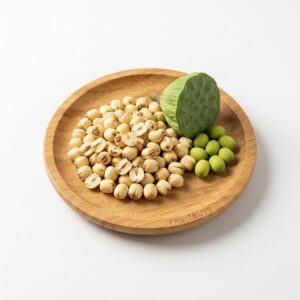

Freeze-Dried Coconut Meat
Buyers of dried coconut open containers every year to find the same three failures: meat that turned yellow instead of white, pieces that went soft because the contract never specified moisture, and blends that segregated because fines exceeded what the formulation could tolerate. Without lot-level documentation, the dispute ends in a write-off and a delayed selling season.

Freeze-dried coconut meat carries the same risks, yet each failure stays preventable when buyer and supplier agree on measurable numbers before the container ships. This page hands your team those numbers: water activity below 0.3, moisture between 3% and 5%, fines under 5%, and a Certificate of Analysis for every production lot. Your QA team verifies each figure on arrival, and no sales call explains it.
Answer Box: FruitBuys freeze-dried coconut meat comes from 100% Ben Tre coconut, dried by sublimation at low temperature so the product stays white, crisp, and sulfite-free, with water activity below 0.3.
Every lot ships with a Certificate of Analysis from an accredited laboratory, production under HACCP and ISO 22000, and standard 60 × 39 × 39 cm cartons holding 10 to 12 kg net. Samples arrive in 3 to 5 working days, and trial orders carry no MOQ requirement.
Product Facts: Every Line Your QA Can Test Independently
The table below states the working specification. Each line names a figure your QA team tests on arrival; figures outside these ranges give you grounds for a quality claim.
| Parameter | Specification | Verification method |
|---|---|---|
| Product name | Freeze-Dried Coconut Meat (Chunks, Cubes, Slices, Dices, Crumbles ) | Order confirmation |
| Ingredient | 100% coconut meat (Cocos nucifera L.), no sugar, no additives, no sulfites | Ingredient declaration on COA |
| Moisture | 3% to 5% (typical 4%) | Oven-dry test, per-lot COA [1] |
| Water activity (aw) | Below 0.3 (tightened to below 0.1 on request) | Aw meter, per-lot COA: roughly half the 0.6 threshold below which common bacteria cannot grow, and far below the 0.85 line FDA draws for low-moisture ready-to-eat foods [2] [3] |
| Color | Uniform ivory white, no brown testa spots | Visual grade check |
| Cut size | Per your drawing, tolerance ±2 mm | Sieve analysis |
| Fines | Below 5% by weight | Sieve analysis, per-lot COA |
| Bulk density | 0.15 to 0.22 kg/L (packed, metallized liner) | Measured per lot |
| Metal detection | Fe 1.5 mm, Non-Fe 2.0 mm, SUS 2.5 mm | Detector calibration log |
| Microbiology | Salmonella not detected per 25 g; E. coli below 10 CFU/g, total plate count below 1,000 CFU/g | ISO 17025 accredited laboratory [4] |
| Shelf life | 12 to 24 months in sealed nitrogen-flushed aluminum packaging [1] | Production date on label |
| Carton | 60 × 39 × 39 cm, 5-ply, 2 or 3 nitrogen-flushed aluminum bags inside | Packing list |
We cut the raw material from mature nuts harvested at 11 to 12 months, when the kernel reaches full thickness and its oil content stabilizes, immature nuts give thinner meat and inconsistent texture. Workers pare off the brown inner testa, and steam blanching at 85 to 88°C replaces sulfite treatment, which removes the sulfite declaration from your label. Coconut does not appear on the FDA list of major allergens, a fact that simplifies allergen statements for US-market formulations [4].

Why Freeze-Dried Rather Than Hot-Air Dried: Two Observable Differences
Hot-air drying at 60 to 80°C browns coconut through caramelization and leaves pieces chewy. Sublimation drying under vacuum, with shelf temperatures of +20 to +30°C, keeps the natural white color and a crisp structure, because moisture leaves as ice vapor without melting the fiber [1].
The trade-off is structural rather than cosmetic: freeze-drying consumes 10 to 25 times more energy per kilogram of water removed than hot-air drying, which places freeze-dried coconut at a higher price per kilogram than commodity desiccated coconut [1].
If your job is a low-cost flavor inclusion for baked goods, desiccated coconut remains the rational choice. If your job is a visible, crisp, white inclusion or topping, the measurable differences are color, texture, and the absence of sulfites. Our article freeze dried vs dehydrated coconut breaks the process physics down in full.
The raw material economics follow the chemistry directly. Fresh coconut meat holds 40 to 50% moisture, so roughly 2 kg of trimmed fresh meat yields 1 kg of freeze-dried product, and about 7 to 8 whole coconuts produce 1 kg. That figure matches the industry benchmark in which about 100 nuts yield 10 kg of dried coconut product [5] [6].
Origin and Harvest: Ben Tre, Vietnam, with Year-Round Supply
All raw material comes from the Mekong Delta, primarily Ben Tre, the coconut capital of Vietnam with more than 70,000 hectares of coconut groves and over 30 cultivars across Dwarf and Tall groups. Neighboring Tiền Giang supply zones support the base and spread regional weather risk [5] [7].
Harvest runs year-round, and the dry-season window from February through August forms the production peak. We schedule our 20 to 30 day lead time for a 20ft container (after deposit) against this window so lot dates align with the freshest kernel quality.
We state two limitations openly. Saline intrusion in the Mekong Delta can reduce raw-material availability in some years, so we source across zones rather than a single district.
Year-round availability also means lot character varies by season, so the per-lot COA, not a single annual spec, is the correct reference point. The article Vietnam coconut supply: Ben Tre source and seasonality covers the supply base in detail.

Nutrition: Per-100-Gram Benchmark from USDA Data
The values below come from the USDA FoodData Central benchmark for unsweetened dried coconut meat, the closest published proxy for a 3 to 5% moisture freeze-dried product [8]. Use them as the planning baseline for your label and marketing.
The operative values for each shipment are the lot-level COA results, and final label compliance follows your destination’s regulation: FDA 21 CFR 101 for the US and Regulation EU 1169/2011 for the EU, two systems that differ in %DV calculation and required declarations.
| Amount per 100 g (3.5 oz) | Value | % Daily Value* |
|---|---|---|
| Calories | 660 | |
| Total Fat | 64.5 g | 83% |
| Saturated Fat | 57.2 g | 286% |
| Trans Fat | 0 g | |
| Cholesterol | 0 mg | 0% |
| Sodium | 37 mg | 2% |
| Potassium | 543 mg | 12% |
| Total Carbohydrate | 23.6 g | 9% |
| Dietary Fiber | 16.3 g | 58% |
| Sugars | 7.3 g (Added Sugars 0 g) | |
| Protein | 6.9 g |
Percent Daily Values are based on a 2,000 calorie diet. Your daily values may be higher or lower depending on your calorie needs.
Low drying temperature concentrates the fat, fiber, and potassium of fresh coconut rather than destroying them: the same 100 g that delivers 283 kcal raw delivers 660 kcal after the water leaves.
The product contains no added sugar, qualifies as vegan, and coconut does not sit on the FDA major-allergen list [4] [8]. The article freeze-dried coconut nutrition facts from USDA data discusses the USDA dataset, lot-to-lot variation, and compliant label construction per market.
Certifications and Documentation: The Package Behind Each Shipment
Food safety for low-moisture foods demands a documented system, not a final inspection. The production facility operates under HACCP and ISO 22000. Export to the United States requires FDA facility registration, renewed biennially, plus Prior Notice filed for each shipment; we hold the registration and file the notices, and we supply the registration number for your FSVP file [3] [9].
Each container ships with a documentation pack your compliance team forwards internally without a sales call to interpret it: commercial invoice and packing list, bill of lading, per-lot COA from an accredited laboratory, Certificate of Origin (Form E for ASEAN, EUR.1 or EVFTA preferential where applicable), phytosanitary certificate where the destination requires it, and an allergen statement.
The EU exempts coconuts from phytosanitary certification under Annex XII Part C of Regulation (EU) 2019/2072, while Japan, Korea, Australia, and China require it, and China additionally requires GACC facility registration [10].
Halal certification with VIHA, JAKIM, and MUI recognition supports Middle East and Southeast Asian shipments. The article importing dried coconut: HS code, FDA, and EVFTA maps import compliance by market.

Forms, Pack Sizes, and Production Terms
| Item | Specification |
|---|---|
| Cut forms | Chunk 8 to 15 mm, Cube 10 to 20 mm, Slice 1 to 3 mm, Dice 5 to 8 mm, Crumble 2 to 5 mm, custom cut per your drawing |
| Bulk packing | 1 to 5 kg nitrogen-flushed aluminum bags in 60 × 39 × 39 cm 5-ply cartons (10 to 12 kg net per carton) |
| Retail packing | 50 g, 100 g, 500 g, or 1 kg zip metallized pouches, or per your artwork |
| MOQ | Not mandatory, trial quantities accepted |
| Sample lead time | 3 to 5 working days, with lot-level COA |
| Production lead time | 20 to 30 days for a 20ft container after deposit |
| Annual capacity | 100 tonnes (freeze-dried lines) |
| Payment terms | T/T with 40% deposit, 60% before shipment or against copy of B/L, L/C at sight |
| Loading port | Cat Lai Port (sea) or Tan Son Nhat Airport (air) |
| Incoterms | FOB, CIF, DDP |
| Services | OEM, ODM, and A&D, MOQ 500 kg |
The carton dimension deserves attention. At the product’s bulk density of 0.15 to 0.22 kg/L, a 20ft container carries roughly 362 cartons (3.6 to 4.3 tonnes net) and a 40ft roughly 740 cartons (7.4 to 8.9 tonnes net) when floor-loaded.
Freeze-dried product is volume-limited, not weight-limited [1]. That physics drives freight cost per kilogram, and the practical answer for multi-line buyers is consolidating several freeze-dried SKUs into one container, a calculation our article container economics: consolidating freeze-dried fruit shipments works through in detail.

Cut Form Selection: Match the Shape to the Application
| Application | Recommended form | Reason |
|---|---|---|
| Chocolate inclusion, pralines | Chunk 8 to 15 mm | White, crisp contrast inside enrobing; fines below 3% preferred |
| Muesli, granola, cold cereal | Dice 5 to 8 mm or Slice | Even distribution, visible in spoonfuls |
| Protein and energy bars | Crumble 2 to 5 mm | Low fines, survives bar compression, inclusion typically 10% to 25% of dry mass |
| Smoothie bowl and yogurt topping | Slice or Chunk | Crispness holds 15 to 30 minutes after liquid contact, test in your matrix first |
| Bubble tea topping | Dice 5 to 8 mm (sweetened version available) | Consistent size through dispensing |
| Trail mix, snack packs | Chunk or Cube | Pairs with nuts and other freeze-dried fruits |
| Baking (cookies, muffins) | Dice or Crumble | Does not bleed water into batter |
Formulators should request the particle size distribution and maximum fines in the spec sheet. Blend stability in your specific matrix is the test that matters, and we run it with you before the first full production lot. The article freeze-dried coconut for manufacturers: inclusions and R&D guide covers the application protocol.

Honest Limitations: Read These Before You Order
Two structural facts shape the economics, and we would rather you price them in than discover them on the first freight invoice. First, freeze-dried coconut is volume-limited cargo: a 20ft container carries about 4 tonnes against a 21.8-tonne payload, so freight cost per kilogram runs several times higher than dense commodities.
Consolidating multiple SKUs into one container is the standard mitigation. Second, freeze-dried coconut costs three to five times more per kilogram than hot-air desiccated coconut, so unit economics only work in applications where the white color, crispness, or sulfite-free clean label carries retail premium: snack pouches, premium inclusions, and clean-label formats [1].
If your formulation needs coconut flavor at commodity price, ask us for desiccated sourcing instead; pairing the wrong product to the job costs more than the price difference.
Storage and Handling
Store sealed cartons below 25°C at relative humidity under 65%, away from direct light and moisture sources. After opening an aluminum bag, press out the air and reseal immediately.
At 3 to 5% moisture the product attracts water strongly and begins to soften within hours of humid-air exposure [2]. Use opened product within 2 to 4 weeks. For retail repacking, nitrogen-flushed pouches with oxygen absorbers extend crispness.
Suggested Next Steps in the Catalog
Buyers building a tropical freeze-dried range typically pair coconut with freeze-dried banana, the highest-turnover topping SKU, freeze-dried mango for snack pouches and bar inclusions, and freeze-dried dragon fruit for smoothie bowl color contrast against coconut white.
Trail mix lines consolidate freeze-dried strawberries, freeze-dried pineapple, and freeze-dried cashew nuts into the same container because all carry the same aw below 0.3 standard and documentation set. Asian-market lines add freeze-dried durian and freeze-dried jackfruit. The freeze-dried fruit catalog lists the remaining SKUs.
Request Samples and Lot Documentation
Send your application and cut-form requirement; we dispatch samples with a lot-level COA within 3 to 5 working days, and trial orders carry no MOQ. Include the application (inclusion, topping, or bar), target cut size, and destination market, and the response brings the matching spec sheet and documentation checklist for that market.
Contact: support@fruitbuys.com. Export line: +84-919 739 589
References
- Kerone Engineering, Freeze-Dried Coconut Drying Systems (process parameters, energy ratio, shelf life, packaging): https://kerone.com/freeze-dried-coconut-drying-systems.php
- University of Minnesota Extension, Freeze-Drying Your Own Food (water activity 0.08 to 0.33; hermetic packaging ): https://extension.umn.edu/preserve-your-own-food/freeze-drying
- U.S. FDA, Draft Guidance: Sanitation Programs for Low-Moisture Ready-to-Eat Foods (aw 0.85 line; 21 CFR 117 ): https://www.fda.gov/regulatory-information/search-fda-guidance-documents/draft-guidance-industry-establishing-sanitation-programs-low-moisture-ready-to-eat-human-foods-and
- U.S. FDA, Major Food Allergens (nine major allergens; coconut not included ): https://www.fda.gov/food/food-labeling-nutrition/food-allergies-what-you-need-know
- TNAU Agritech, Coconut Processing (fruit composition: 50% husk, 15% shell, 25% meat, 10% water; meat moisture 40 to 50%; steam pasteurization ): http://www.agritech.tnau.ac.in/expert_system/coconut/coconut/coconut_processing.html
- CBI, Dutch Ministry of Foreign Affairs trade agency, The European Market Potential for Desiccated Coconut (~100 nuts yield 10 kg benchmark ): https://www.cbi.eu/market-information/processed-fruit-vegetables-edible-nuts/desiccated-coconuts/market-potential
- FreshPlaza, Demand for Vietnamese coconuts experiencing significant growth (Ben Tre supply base ): https://www.freshplaza.com/north-america/article/9618721/
- USDA FoodData Central, Coconut, meat, dried, unsweetened (NBD 12108 ) and raw (NBD 12104): https://fdc.nal.usda.gov/
- U.S. FDA, Importing Food Products into the United States (facility registration, Prior Notice ): https://www.fda.gov/food/food-imports-exports/importing-food-products-united-states
- European Commission Food Safety, Trade in plants and plant products from non-EU countries (phytosanitary exemption, Annex XII Part C, Regulation (EU ) 2019/2072): https://food.ec.europa.eu/plants/plant-health-and-biosecurity/trade-plants-plant-products-non-eu-countries_en
Published for FruitBuys Vietnam, an ISO/HACCP-certified freeze-dried fruit manufacturer in Ho Chi Minh City.