
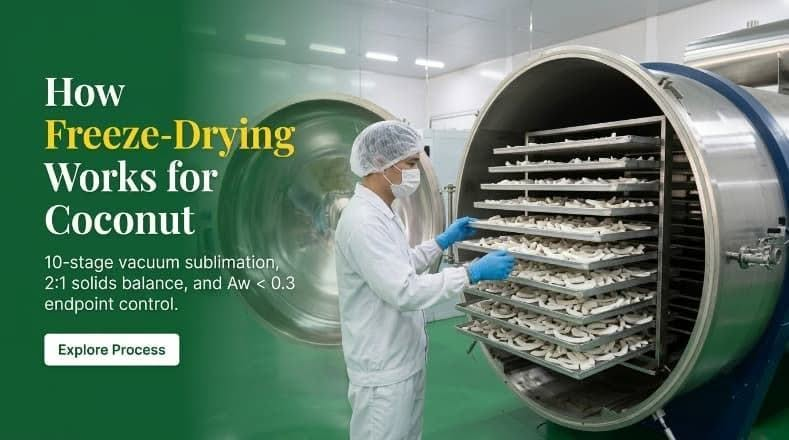
How is freeze-dried coconut made, and how much kernel goes into one kilo?
Every kilogram of freeze-dried coconut takes 2.0–2.4 kg of pared mature kernel, the white meat of 7–9 Ben Tre coconuts. The kernel is pared by hand, cut, steam-blanched, frozen and dried under vacuum for 24–44 hours per batch. That ratio is the most useful number a buyer has for reading quotes: every kilo you buy carries the cost of that much kernel, the hand labour to pare it and more than a day of chamber time. When a quote sits far below that arithmetic, the product inside the bag is different, and this guide shows you how to find out what.
Why does one kilo take 2.0–2.4 kg of kernel, not 2:1 or 8:1?
Because fresh mature kernel is about half water, and a working line loses more than water.
| Basis | Kernel per 1 kg freeze-dried | What it includes |
|---|---|---|
| Theory (dry matter only) | 1.8–2.1 kg | Water removed from kernel at 47–53% moisture down to 3–5%; nothing else lost |
| FruitBuys working ratio | 2.0–2.4 kg pared kernel | Trims from squaring cubes and slices, pieces sorted out for brown specks or yellowing, fines sieved off after drying |
| Whole nuts | 7–9 mature coconuts (11–12 months) | Husk, shell, coconut water and brown skin on top of the above |
The gap between 1.8 and 2.4 kg is the real line: paring and cutting by hand, sorting by eye and sieving out dust. The season moves the number too. Dry-season kernel (February to August) is thicker and sits at the low end. Rainy-season kernel is thinner, so it suits dice and flakes better than large chunks, and it sits nearer the top.
What 100 mature Ben Tre coconuts become:
| Stage | Weight | What happens |
|---|---|---|
| Kernel out of the shell | 30–35 kg | Husked and cracked; coconut water drained; brown skin still on |
| Pared, cut and sorted kernel on the trays | about 26–29 kg | Brown skin pared off by hand; cut to size; off-colour pieces removed |
| Water removed in the freeze-dryer | about −13 to −16 kg | Sublimed as vapour; nothing added |
| Freeze-dried coconut at 3–5% moisture | 11–14 kg | = 7–9 nuts and 2.0–2.4 kg pared kernel per kg |
Scale that to freight and one 40 ft high-cube container of freeze-dried coconut carries the kernel of roughly 55,000–100,000 coconuts, with no cold chain.
Why 8:1 is never a coconut number. Ratios of 8:1 to 10:1 belong to water-rich fruit such as strawberries and melons, which start at around 90% water. Coconut kernel starts at about 50%, so no drying route reaches 8:1. A coconut quote built on 8:1 has copied a generic fruit sheet, and the rest of that sheet deserves the same doubt.
What happens to the kernel between the grove and the freezer?
Most of what you see in the bag, the white colour, the clean taste and the Salmonella result, is decided before the kernel ever reaches the dryer.
| Stage | What happens | What it means for your lot |
|---|---|---|
| 1. Nut selection | Mature tall-type coconuts at 11–12 months, checked by tapping and shell before husking | Full kernel thickness and stable oil content; consistent piece size |
| 2. Husking and cracking | Husk and shell removed; coconut water drained | River and canal transport brings nuts to the cut house within hours |
| 3. Paring | The thin brown skin (testa) is pared off by hand | Testa specks are the most visible defect in a white product |
| 4. Washing and cutting | Kernel washed and cut to chips, slices, cubes or dice, ±2 mm | Even dosing on your line; less breakage in the bag |
| 5. Kill step | Steam blanch at 85–88 °C on 100% of the cut kernel | Controls Salmonella and other vegetative pathogens; stops the enzyme that turns coconut fat soapy; keeps the kernel white without sulfite |
| 6. Freezing | Kernel reaches freezing temperatures within 2 hours of cutting, then deep-frozen at −30 to −50 °C | No warm holding window; ice crystals set the open structure that makes the piece crisp |
| 7. Primary drying | Ice sublimes under vacuum at 0.1–0.2 mbar for 20–36 hours (10–15 mm pieces) | Shape and colour held; no cooking, no browning |
| 8. Secondary drying | 4–8 hours to remove the remaining bound water | Moisture 3–5%, water activity ≤0.30 |
| 9. Sieving and sorting | Fines sieved off; specked and off-colour pieces removed; metal detection on every carton | Fines ≤5%; clean pieces in your chocolate or granola |
| 10. Packing and release | Foil bags with light vacuum and silica gel in a dehumidified packing room; lot coded; released on the lot COA | Crisp on arrival; every carton traced to one lot |
Stage 5 carries the food-safety weight of the whole line. A 2018 US Salmonella outbreak traced to frozen shredded coconut showed what happens when kernel reaches the consumer without a heat step, and the freeze-drying chamber never reaches a temperature that kills bacteria. That is why the blanch sits before the freezer, on every piece. The limits it supports, and what each lot COA proves, are set out in what a freeze-dried coconut specification and lot COA should cover.
Why does a freeze-dried coconut batch take more than a day?
Because the ice leaves from the outside in. Under vacuum, the frozen water in each piece turns straight to vapour at the surface, and the drying front has to travel to the centre of every cube or chunk. A 10–15 mm piece needs 20–36 hours of primary drying alone; add loading, freezing and secondary drying, and each batch uses 24–44 hours of chamber time.
That physics sets your calendar. Freeze-dried coconut is made in batches, so lead time follows chamber capacity, not the port:
- Samples: 3–5 working days.
- Production: 20–30 days for a 20 ft container after deposit.
- Capacity: about 100 tonnes a year of freeze-dried coconut through the partner facility.
- Best window: book volume for the dry season, when the kernel is thickest and chamber slots fill fastest.
Coconut also behaves differently from fruit in the chamber. Its kernel is fat-rich, so it comes out denser than most freeze-dried fruits: more kilograms fit in each carton and each container, which lowers freight per kilogram.
How do you read a quote that promises more coconut per kilo?
A ratio on a quote is a claim about the product, and it can be checked with arithmetic. Take a quote that implies 1.5 kg of kernel per kilogram. At about 50% moisture, 1.5 kg of kernel holds 0.75 kg of solids. To make 1 kg of product from 0.75 kg of solids, the finished coconut has to carry about 25% water. That is soft, semi-dried coconut, not freeze-dried coconut at 3–5%.
When a ratio or a price looks too good, one of these is usually behind it:
| What the quote leaves out | How to check |
|---|---|
| Finished moisture well above 5% | Ask for moisture and water activity as measured results on the lot COA |
| Sugar infusion adding weight | Read the ingredient line: it should say “coconut” only |
| Brown skin left on | Count specked pieces in 200 g of the sample |
| Young or thin kernel | Compare thickness and bite with the approved sample; young coconut dries thin and soft (see young vs mature coconut meat) |
| Hot-air drying sold as freeze-drying | Snap a piece: freeze-dried kernel is light and porous; hot-air dried is dense, hard and often cream-coloured |
| No kill step | Ask for a written description of the heat step before drying, with temperature |
These are checks every buyer should run on every supplier, FruitBuys included. Three questions turn them into a two-minute screening call:
- What is your yield, and on what basis? An answer of about 2 kg of pared kernel per kilo, varying by season, shows a line that knows coconut. An answer of 8:1 shows a fruit template.
- How do you know a batch is dry? A line that releases each lot on measured water activity answers in seconds.
- What happens if the blanch runs below temperature? A recorded corrective action shows the kill step is a working procedure, not a promise.
When another coconut fits better. If you need the lowest cost per kilo for coconut flavour in baked goods, where crunch and white colour disappear in the oven, desiccated coconut does the job for less. FruitBuys can source it for you on order; the differences are laid out in desiccated, dehydrated or freeze-dried coconut.
Can you freeze-dry coconut milk, water or cream?
Yes, but the result is a different product. Coconut milk, cream and water are freeze-dried from a liquid and give a soluble powder that dissolves into a drink or sauce. Freeze-dried coconut kernel keeps the whole meat, fibre included, so its powder disperses rather than dissolves and brings real coconut texture and fat to bakery, ice cream and granola.
FruitBuys supplies freeze-dried coconut powder milled from 100% kernel with no carrier, and sources coconut milk and coconut water powders through its partner network for R&D and OEM orders. Coconut oil is the one form that cannot be freeze-dried: it holds no water to remove.
Can you freeze-dry coconut at home?
Yes. A home freeze-dryer will dry fresh coconut pieces. What a home unit does not give you is what an industrial buyer has to check: a validated heat step before drying and a measured water activity on every batch. Those two numbers, not the machine, decide whether coconut is safe to blend into a product that is never cooked again.
Send us your quote and your cut
Tell us the cut, the volume and the ratio or price you have been quoted elsewhere. FruitBuys puts its own ratio, moisture and water activity next to it on the same basis, and sends a sample from the line that would make your container.
FAQ
How many coconuts make 1 kg of freeze-dried coconut?
7–9 mature coconuts, or 2.0–2.4 kg of pared kernel. Thicker dry-season kernel sits at the low end.
What is the conversion ratio for freeze-dried coconut?
About 2.0–2.4 kg of pared kernel per kilogram. On dry matter alone it would be 1.8–2.1 kg; trims, sorting and fines add the rest.
Why is coconut blanched before freeze-drying?
A steam blanch at 85–88 °C is the kill step for Salmonella and other pathogens, which freeze-drying cannot provide. It also stops the enzyme that turns coconut fat soapy and keeps the kernel white without sulfite.
How long does it take to freeze-dry coconut?
24–44 hours of chamber time per batch: 20–36 hours of primary drying for 10–15 mm pieces plus 4–8 hours of secondary drying. A 20 ft container takes 20–30 days after deposit.
Does freeze-drying kill bacteria?
No. It removes water at low temperature. The heat step has to come before freezing.
Can you freeze-dry coconut milk?
Yes, into a soluble powder, which is a different product from freeze-dried kernel. FruitBuys sources coconut milk powder for R&D and OEM orders and supplies 100% kernel powder as standard.
Why is freeze-dried coconut heavier than other freeze-dried fruits?
Its kernel is fat-rich, so the pieces are denser. More kilograms fit in each carton, which lowers freight per kilogram.



