How many calories, fats and net carbs are in 100 g of freeze-dried coconut?
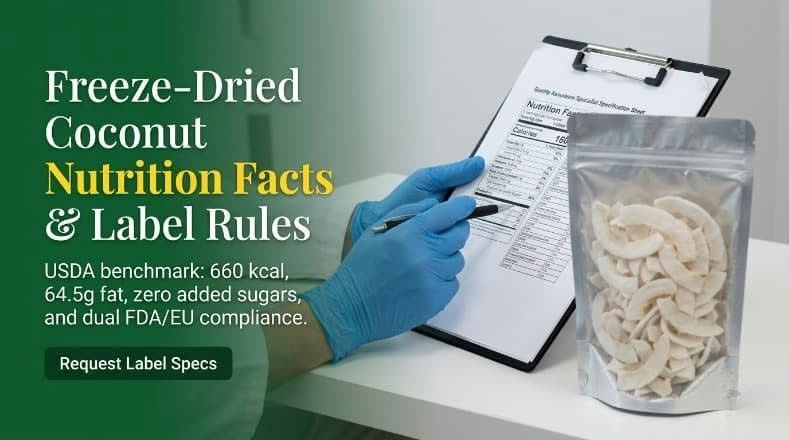
100 g of freeze-dried coconut carries 660 kcal, 64.5 g fat, 16.3 g fibre and about 7 g net carbohydrate, with no added sugar. A 28 g snack serving comes to 185 kcal and roughly 2 g net carbs. Those numbers put unsweetened coconut in a rare spot for a label: keto-friendly, high in fibre, vegan and gluten-free in one ingredient, with nothing to reformulate. This guide gives you the panel, what each number lets you claim, and the one claim it will not carry.
What is in 100 g of freeze-dried coconut?
The kernel of mature coconuts, with the water taken out and nothing added.
| Nutrient | Per 100 g | % DV | Per 28 g | % DV |
|---|---|---|---|---|
| Calories | 660 kcal | 185 kcal | ||
| Total fat | 64.5 g | 83% | 18.1 g | 23% |
| Saturated fat | 57.2 g | 286% | 16.0 g | 80% |
| Trans fat | 0 g | 0 g | ||
| Cholesterol | 0 mg | 0% | 0 mg | 0% |
| Sodium | 37 mg | 2% | 10 mg | 0% |
| Potassium | 543 mg | 12% | 152 mg | 3% |
| Total carbohydrate | 23.6 g | 9% | 6.6 g | 2% |
| Dietary fibre | 16.3 g | 58% | 4.6 g | 16% |
| Total sugars | 7.4 g (0 g added) | 2.1 g (0 g added) | ||
| Protein | 6.9 g | 1.9 g | ||
| Net carbohydrate (total carbs minus fibre) | 7 g | 2 g |
% Daily Value based on a 2,000 calorie diet. Typical values for 100% freeze-dried coconut; values typically move within ±5–10% with season, origin and kernel maturity. Lot nutrition panel available for label artwork.
Two practical notes for the artwork. On a US panel these per-serving values are rounded under FDA rules, so 185 kcal prints as 190 kcal and 4.6 g fibre as 5 g. On an EU label energy is worked out with EU conversion factors, which count fibre at 2 kcal per gram, giving about 2,760 kJ / 670 kcal per 100 g, declared in kilojoules first. Same coconut, two correct labels.
Serving size. Coconut chips sold as a snack usually carry a 1 oz (28–30 g) serving in the US. FDA’s reference amounts have no dedicated line for dried coconut pieces, so your label adviser confirms the category for your format; coconut flour, for comparison, has its own 15 g reference amount.
How does freeze-dried coconut compare with fresh kernel?
Gram for gram it is roughly twice as concentrated, because drying removes about half the kernel’s weight as water.
| Per 100 g | Fresh mature kernel | Freeze-dried coconut |
|---|---|---|
| Water | 47 g | 3–5 g |
| Calories | 354 kcal | 660 kcal |
| Fat | 33.5 g | 64.5 g |
| Carbohydrate | 15.2 g | 23.6 g |
| Fibre | 9.0 g | 16.3 g |
| Sugars | 6.2 g | 7.4 g |
| Protein | 3.3 g | 6.9 g |
| Potassium | 356 mg | 543 mg |
Nothing is added or taken away except water: the sugars on the label are the coconut’s own. Unsweetened desiccated coconut at a similar moisture lands close to these values per 100 g; sweetened flakes add sugar on top. The format differences that matter on a shelf, colour, crunch and what goes on the ingredient line, are in desiccated, dehydrated or freeze-dried coconut.
Is freeze-dried coconut keto?
Yes, it is one of the easiest keto ingredients to label. A 28 g serving carries about 2 g net carbohydrate against 18 g of fat, and 100 g carries about 7 g. No sugar is added, and the ingredient line reads one word: coconut.
That makes it a natural fit for keto snack packs, fat-forward granolas, low-sugar bars and toppings. Position it as keto-friendly or low in net carbs; “keto certified” needs a certification programme, and the ingredient alone does not carry it.
Is freeze-dried coconut healthy?
It is a whole-food ingredient with a clear profile: 100% coconut kernel, 16.3 g fibre per 100 g, 7.4 g of its own sugar and no additives. Two-thirds of it is fat, and most of that fat is saturated. That is the nature of coconut, not a processing effect, so build the label on what the numbers support:
| Claim | Fits freeze-dried coconut? |
|---|---|
| High fibre (EU: ≥6 g per 100 g) | Yes, 16.3 g |
| Good source of fibre (US: 10–19% DV per reference amount) | Yes at a 28–30 g serving, about 16–17% DV |
| No added sugar | Yes |
| Vegan, gluten-free, paleo, keto-friendly | Yes, as natural traits of unsweetened kernel |
| Low fat, low saturated fat, FDA “healthy” | No, saturated fat is high by nature |
Lauric acid. About half of coconut’s fat is lauric acid, roughly 29–30 g per 100 g, coconut’s signature medium-chain fatty acid. It is a composition fact your marketing can state plainly and a reason coconut fits sports nutrition and plant-based ranges; keep health-effect statements off the pack.
When another fruit fits better. If your SKU’s message is low fat or light, coconut is the wrong base. FruitBuys supplies low-fat freeze-dried fruits with the same water activity standard, and coconut can join the mix as a minority inclusion.
Is coconut a tree nut allergen?
Not on a US or EU label. Since FDA’s January 2025 allergen guidance, coconut is no longer listed as a tree nut for US labelling, so it does not need to appear in a “Contains: tree nuts” statement. Coconut is not one of the EU’s 14 allergen groups.
Two things still belong in your label review: check the destination market’s own allergen list rather than the source country’s, and note that freeze-dried coconut from FruitBuys is kernel only, with no sulfite added, so it does not bring a sulfite declaration onto an EU label.
Which numbers should go on your printed label?
The typical values above are the right starting point for artwork, product sheets and marketing. For the printed panel, most private-label buyers want numbers from their own commercial lot.
FruitBuys runs a nutrition panel on your commercial lot at an independent ISO/IEC 17025 accredited third-party laboratory, booked before the container is stuffed so the results travel with the shipment. Use it for the final artwork, and keep the typical values for planning and claims screening.
Three steps keep a label clean:
- Pick the market first. A US panel and an EU panel are built differently from the same data.
- Screen claims against the table above before the design team starts.
- Lock the panel on your lot, not on a sample from another season.
Fit by cut and application is in which freeze-dried coconut cut fits your product.
Get the specification and a lot panel for your label
Tell us your market, serving size and the claims you want on the front of the pack. We send the specification for freeze-dried coconut, the typical panel in your market’s format and a quote for the lot nutrition panel.
FAQ
How many calories are in 100 g of freeze-dried coconut?
660 kcal. A 28 g serving has 185 kcal, which prints as 190 kcal on a US label.
How many net carbs are in freeze-dried coconut?
About 7 g per 100 g (23.6 g carbohydrate minus 16.3 g fibre), or about 2 g in a 28 g serving.
Does freeze-dried coconut have added sugar?
No. The 7.4 g of sugars per 100 g are the coconut’s own.
Is freeze-dried coconut keto?
Yes. About 2 g net carbs per 28 g serving and no added sugar make it keto-friendly. “Keto certified” needs a separate certification programme.
Is coconut a tree nut?
Not for US labelling since FDA’s January 2025 allergen guidance, and it is not one of the EU’s 14 allergen groups.
Why is coconut so high in saturated fat?
Coconut fat is naturally about 90% saturated, mostly lauric acid. Drying concentrates it but does not change it.
Is freeze-dried coconut more nutritious than fresh coconut?
It has the same nutrients with the water removed, so per 100 g every value is roughly doubled. Per piece, it carries what the fresh kernel carried.