
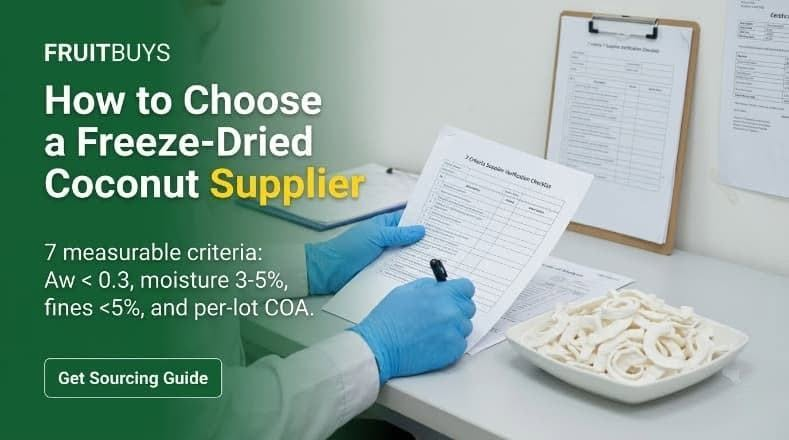
How do you choose a freeze-dried coconut supplier, and what goes into the RFQ?
Choose the supplier that can prove seven things on paper, starting with how it controls Salmonella, and send every shortlisted supplier the same 15-field RFQ. That turns a pile of quotes into a like-for-like comparison and turns the winning quote into a contract you can enforce when the container lands. This guide gives you the seven checks for buying freeze-dried coconut, the RFQ fields, the path from sample to full container and the timing for 2027 volume, written so you can run it on any coconut supplier, FruitBuys included.
Which seven checks separate a supplier you can contract from one you can’t?
Each check is a document or a number, not a promise.
| # | Check | What to ask for | Red flag |
|---|---|---|---|
| 1 | Salmonella control | Written description of the heat step before freezing, with temperature, and a Salmonella not detected in 25 g result on every lot COA | “Freeze-drying kills bacteria”; COA only on request |
| 2 | Moisture and water activity | ≤5.0% and aw ≤0.30 on each lot COA, with the methods named | Moisture only, no water activity |
| 3 | Yield realism | Kernel-to-product ratio on a stated basis: about 2.0–2.4 kg pared kernel per kg | 8:1, or a price that implies less kernel than physics allows |
| 4 | Raw material | Mature coconuts at 11–12 months, the harvest calendar, sourcing zones | No answer on maturity or season |
| 5 | Cut and fines | Cut size ±2 mm, fines ≤5% by sieve | “Mixed sizes”, no fines limit |
| 6 | One locked facility | One qualified facility locked to your contract, change-control in writing, audit access | Product “from our network” with no facility named |
| 7 | Documents and certifications | Commercial Invoice, Packing List, B/L, C/O, phytosanitary certificate and lot COA with every shipment; HACCP, ISO 22000, BRC, US FDA Facility Registration in the technical dossier; Halal certification available on request | Certificates sent only after deposit |
Check 1 comes first because it decides whether a US shipment clears. Coconut products sit under FDA Import Alert 23-12, and freeze-drying never reaches a temperature that kills bacteria, so the heat step has to happen before the freezer. The full test logic is in what a freeze-dried coconut specification and lot COA should cover, and how a realistic yield ratio exposes an unrealistic quote is in how freeze-dried coconut is made.
What should you ask a supplier in any origin?
The same questions work in Vietnam, the Philippines, Indonesia or Sri Lanka:
- Which coconuts, from where, at what age? And what happens to supply in the dry season or a drought year?
- Which facility makes my product, and will it be the same facility for every container?
- What is on every lot COA, and which tests run on a surveillance schedule instead?
- What do you do if a lot fails your arrival check, and how long do I have to claim?
- Which documents travel with the container, and which preference certificate does my market need?
- What is the lead time, from deposit to loaded container, in your peak and off-peak months?
A supplier who answers all six in writing before you send a deposit is one you can plan around.
What goes into a freeze-dried coconut RFQ?
Copy these 15 fields. Every answer becomes a contract term.
| # | Field | What to write | Why it matters |
|---|---|---|---|
| 1 | Product | Freeze-dried mature coconut kernel, 100% coconut | Rules out sweetened, desiccated or young-coconut substitutes |
| 2 | Cut | Chips, slices, dice, cubes, chunks, crumble or powder | Drives fill, freight and use on your line |
| 3 | Size and tolerance | e.g. dice 5–8 mm, ±2 mm | Even dosing |
| 4 | Application | Chocolate, granola, bar, topping, snack pack | Lets the supplier match the cut and grade |
| 5 | Moisture | ≤5.0% | Crispness and shelf life |
| 6 | Water activity | ≤0.30, or a tighter contract target | Microbial stability, release number |
| 7 | Microbiology grade | Standard (TPC ≤10⁴ CFU/g) or inclusion grade (TPC <1,000 CFU/g) | Grade for products not heated again |
| 8 | Salmonella | Not detected in 25 g on every lot, plus heat-step description | US entry and safety |
| 9 | Fines | ≤5% by sieve; tighter for chocolate | Clean coating, no dust |
| 10 | Colour and specks | Ivory white; brown-skin speck limit agreed on the sample | Retail appearance |
| 11 | Packaging | Bulk bag size (1–5 kg), nitrogen flush yes or no, standard carton or custom | Cost per kg, freight, handling |
| 12 | Volume and calendar | Kg per month, months of delivery | Lets the supplier plan cuts by season |
| 13 | Destination market | Country, HS line agreed with your broker | Documents and tests |
| 14 | Documents and test panels | EUR.1 or CEPA certificate of origin, phyto, lot COA; residue, Listeria or sulfite panels if your market needs them | No document chase at the port |
| 15 | Commercial terms | Incoterm (FOB, CIF, DDP), port, payment terms | Comparable quotes |
Send the same table to every supplier and you will see at a glance who answers in numbers and who answers in adjectives.
From approved sample to full container: how do you keep them matching?
By fixing each step in writing, before the deposit.
- Sample (3–5 working days). A sample of each cut you are considering, from the current season’s kernel.
- Trial on your line. Order 1–2 full export cartons (about 7–20 kg by cut) with no fixed MOQ, so you test real packaging and real pieces, not a courier sample. Trial orders ship with a free release QC log and our baseline reports; third-party testing on trial lots is arranged on request.
- Pre-shipment sample from the packed lot. 100–200 g in two sealed foil pouches, one for your sensory check and one sealed for your laboratory, couriered within 24–48 hours of packing. You approve it before the container is loaded.
- Release on the lot COA. The container leaves with its COA, phyto, certificate of origin and packing list.
- Arrival checks. 14 days from devanning for packaging, appearance, fines and water activity; 30 days for laboratory results.
Two things hold the chain together. FruitBuys keeps a retained sample from every container lot for its full shelf life, up to 24 months, so any dispute is tested on the same lot. And each contract runs at one locked partner facility, with written notice and a new sample approval before any change, so the product you approved is the product you keep receiving. Production runs 20–30 days per 20 ft container after deposit; packing and loading options are in how long freeze-dried coconut lasts, and documents and duty by market in the dried coconut HS code and import guide.
When should you book 2027 volume?
Now. Mature-coconut supply in the Mekong Delta is abundant in late 2026 after a sharp fall in farm-gate prices from their 2025 record, and market reports flag El Niño risk to Philippine and Indonesian output in 2027. Buyers who fix volume and a cut calendar now, with chunks and cubes in the February–August dry season when the kernel is thickest, lock both supply and consistency. Why Ben Tre coconuts suit freeze-drying, and how the season moves the kernel, is in Ben Tre coconut for freeze-drying.
When a different arrangement fits better. If you need coconut flavour for baked goods at the lowest cost per kilo, ask for desiccated coconut, which FruitBuys sources on order; the comparison is in desiccated, dehydrated or freeze-dried coconut. If you sell under your own brand, private-label packs start from 500 kg per SKU, and a digital print run can split across several artwork variants.
Send your RFQ
Fill in the 15 fields above, or as many as you know today. FruitBuys answers each one in numbers, sends samples of the cuts that fit and the full specification for freeze-dried coconut.
FAQ
How do I choose a freeze-dried coconut supplier?
Ask for proof of seven things: a heat step and per-lot Salmonella result, moisture and water activity on each COA, a realistic yield ratio, mature raw material, cut and fines limits, one locked facility and a full document set.
What should a freeze-dried coconut RFQ include?
Product, cut, size tolerance, application, moisture, water activity, microbiology grade, Salmonella, fines, colour, packaging, volume and calendar, destination, documents and test panels, and commercial terms.
What is a pre-shipment sample?
A 100–200 g sample taken from the packed lot before loading, in two sealed pouches: one for your sensory check, one for your laboratory.
Is there a minimum order for freeze-dried coconut?
Trial and R&D quantities start at 1–2 full export cartons without a fixed MOQ. Commercial orders start at 500 kg, and private-label packs at 500 kg per SKU.
How long does a container of freeze-dried coconut take?
Samples in 3–5 working days; production 20–30 days for a 20 ft container after deposit.
How do I make sure the container matches the sample?
Approve a pre-shipment sample from the packed lot, contract one locked facility with change-control, and keep claim windows of 14 days for appearance and 30 days for lab results, tested against the supplier’s retained sample.
What documents come with a freeze-dried coconut shipment?
Commercial Invoice, Packing List, Bill of Lading, certificate of origin (EUR.1 for the EU and UK, CEPA for the UAE), phytosanitary certificate and lot COA.



