
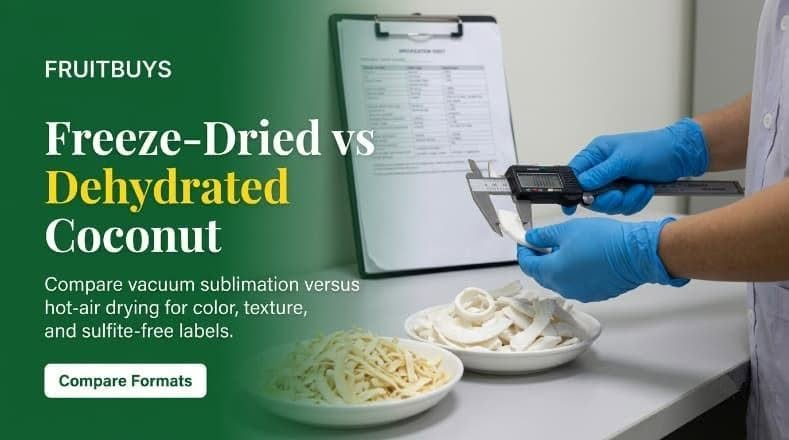
Desiccated, dehydrated or freeze-dried coconut: what is the difference, and which one fits your product?
All three start as the white kernel of a mature coconut; what separates them is how the water leaves. Desiccated coconut is shredded or grated kernel dried in hot air to a fine, dense, shelf-stable ingredient. Dehydrated coconut chips are thin slices dried or toasted with heat, often with sugar. Freeze-dried coconut is frozen kernel dried under vacuum, so it comes out light, porous, crisp and ivory white. Choose by the job the coconut does in your product, not by the price per kilo: where the coconut disappears into a batter, desiccated wins; where it has to be seen, crunched or kept white, freeze-dried does.
How do the three formats compare?
| Desiccated coconut | Dehydrated / toasted coconut chips | Freeze-dried coconut | |
|---|---|---|---|
| How it is dried | Hot air, a few hours | Hot air or oven, often toasted | Frozen, then dried under vacuum for 24–44 hours |
| Typical cuts | Fine, medium, flakes, long shreds | Thin slices | Chips, slices, cubes, chunks, dice, crumble, powder |
| Moisture | ≤3% (Codex CXS 177-1991) | Low, varies with toasting | 3–5%, water activity ≤0.30 |
| Texture | Dense, dry, slightly firm bite | Hard, crunchy, toasted | Light, porous, crisp, melts on the tongue |
| Colour | White to off-white | Golden to brown | Ivory white |
| Typical additions | Often sulfite to hold colour; sweetened grades | Often sugar, salt or oil | None: 100% kernel |
| Rehydrates in liquid | Slowly | Barely | Quickly; stays crisp 15–30 minutes on a wet base |
| Best job | Coconut flavour and body in baked goods, fillings, confectionery centres | Snack packs where a toasted taste sells | Visible white pieces, crunch, clean label |
Moisture alone does not tell them apart: desiccated coconut can be drier than freeze-dried and still eat dense rather than crisp. Texture follows the drying method, not the last percentage point of water. That is why an RFQ that names only “dried coconut, moisture ≤3%” can return compliant quotes for very different products.
Desiccated coconut vs coconut flakes vs shredded: is it the same product?
In the trade, mostly yes; on a shelf, often no.
- Desiccated coconut is the umbrella term for hot-air-dried kernel, sold by grade: fine and medium for bakery and confectionery, larger flakes and chips for toppings.
- Shredded coconut usually means long, thin desiccated strands, often sweetened for home baking.
- Coconut flakes in retail are wider, thin pieces, sweetened or unsweetened, and sometimes toasted.
- Freeze-dried coconut chips and flakes look similar in shape but eat completely differently: light and crisp rather than dense.
Read the ingredient line and the drying method, not the name on the bag. For the freeze-dried cut that fits your line, see which freeze-dried coconut cut fits your product.
What can your team see and test on the two samples?
Four checks settle it in an afternoon, with no lab:
- Colour against a white card. Freeze-dried kernel is ivory white without sulfite; desiccated ranges from white to off-white, and its label tells you whether sulfite helped.
- Bite. Freeze-dried snaps and melts; desiccated is dense and dry.
- Spoon in milk or yogurt. Freeze-dried softens slowly and holds a crunch for 15–30 minutes; desiccated stays firm and gritty.
- The ingredient line. One word, “coconut”, versus coconut plus sulfite, sugar or oil.
The sulfite point matters on EU labels. Above 10 mg/kg sulfite becomes a declared allergen in the EU. FruitBuys keeps freeze-dried kernel white with a steam blanch, so the label stays one ingredient long.
Why does freeze-dried coconut cost more, and when is it worth it?
Because the process is slower and heavier on equipment. Hot-air drying takes hours; a freeze-drying batch takes 24–44 hours of chamber time under deep vacuum. That shows up in the price per kilo, and it is only worth paying when your customer can see or feel the difference.
| Your product | The coconut has to… | Format that pays back |
|---|---|---|
| Cookies, cakes, muffins, macaroons, fillings | Add flavour and body; it browns in the oven anyway | Desiccated |
| Confectionery centres and coconut bars | Bind with sugar or fat into a dense centre | Desiccated |
| Chocolate inclusions and enrobed pieces | Stay white and crisp against dark chocolate | Freeze-dried |
| Granola, cereal and trail mix sold on looks | Show as clean white pieces in the bag | Freeze-dried |
| Smoothie bowls, yogurt and ice cream toppings | Stay crisp on a wet, cold base | Freeze-dried |
| Keto, clean-label and kids’ snack packs | Carry a one-word ingredient line, no sulfite or sugar | Freeze-dried |
| Toasted snack packs | Taste roasted and sweet | Toasted chips |
Cost-in-use, not cost per kilo. Freeze-dried coconut is light, so a kilo covers more surface as a topping than a kilo of desiccated, and pieces stay intact where desiccated would sink into a wet base. Run the comparison on grams per serving in your own recipe before you compare quotes.
When is desiccated the better buy?
Whenever the coconut is an ingredient rather than a feature. If it goes into a batter, a filling or a baked bar, the oven browns it, the crunch disappears and nobody sees the colour. Desiccated coconut does that job well and at a lower cost per kilo.
FruitBuys sources desiccated coconut on order for exactly those lines, and supplies freeze-dried coconut for the SKUs where the piece is the point. One supplier, both formats, one set of export documents.
It is also worth knowing where the desiccated market sits. The International Coconut Community reported that desiccated coconut prices eased through early 2026 but stayed above historical levels, with Philippine supply tight and US import demand rising. Buyers locking 2027 volumes are spreading origins, and Vietnam’s Mekong Delta is one of the deepest coconut belts to draw on.
Dried coconut vs fresh coconut: what stays, what goes?
Water goes; almost everything else stays. Fresh mature kernel is about 47% water. Drying it to 3–5% roughly doubles every nutrient per 100 g:
| Per 100 g | Fresh mature kernel | Freeze-dried coconut |
|---|---|---|
| Water | 47 g | 3–5 g |
| Calories | 354 kcal | 660 kcal |
| Fat | 33.5 g | 64.5 g |
| Fibre | 9.0 g | 16.3 g |
Fresh kernel keeps for days chilled; sealed freeze-dried coconut keeps 12 months at ≤25 °C with no cold chain. The full panel and the label claims it supports are in freeze-dried coconut nutrition facts. Young and makapuno coconut are a different raw material altogether, compared in young vs mature coconut meat.
Test both formats against your own recipe
Tell us the product, the cut and where the coconut sits in the recipe. FruitBuys sends freeze-dried coconut samples in the cuts that fit, and quotes desiccated coconut on order for the lines where it is the better buy.
FAQ
What is the difference between desiccated and freeze-dried coconut?
Desiccated coconut is dried with hot air into a dense, fine ingredient. Freeze-dried coconut is frozen and dried under vacuum, so it is light, crisp and white, with nothing added.
Is desiccated coconut the same as dried coconut?
Desiccated coconut is one type of dried coconut: hot-air-dried, shredded or grated kernel. Freeze-dried and toasted chips are other types.
Is desiccated coconut the same as coconut flakes?
In the trade, flakes are a larger grade of desiccated coconut. In retail, “flakes” can also mean wider, sometimes sweetened or toasted pieces.
Does freeze-dried coconut contain sulfites?
No. FruitBuys keeps the kernel white with a steam blanch instead of sulfite.
Which is healthier, freeze-dried or desiccated coconut?
Unsweetened, both carry nearly the same nutrients per 100 g. The difference is texture, colour and what else is on the ingredient line.
Can I replace desiccated coconut with freeze-dried coconut in baking?
You can, but in a baked product the oven browns it and the crunch is lost, so desiccated usually gives the same result for less.
Can FruitBuys supply desiccated coconut too?
Yes, on order, alongside freeze-dried coconut, so both formats travel under one supplier and one document set.



