Why do mature Ben Tre coconuts make the best freeze-dried kernel, and when should you book?
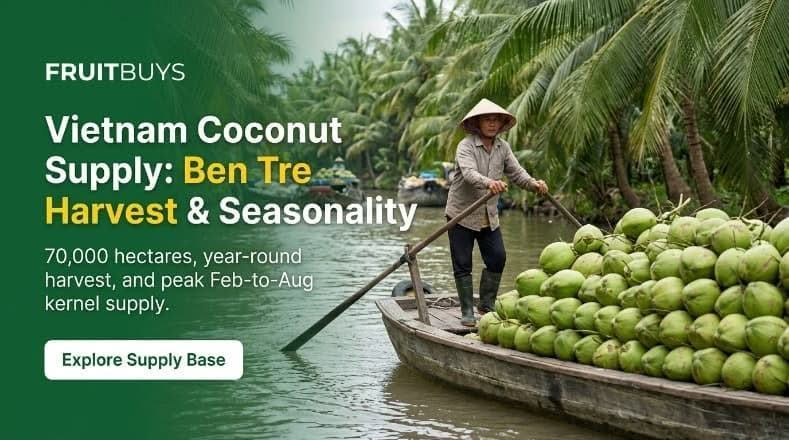
Because they are tall-type coconuts left on the palm for 11–12 months, until the kernel is at full thickness and its oil has settled, and they grow in Vietnam’s deepest coconut belt. Ben Tre, in the Mekong Delta, sits at the centre of more than half of Vietnam’s coconut area, harvests every month of the year and moves nuts by river to the cut house within hours. For a buyer of freeze-dried coconut, that means steady white kernel, a predictable season and, in 2026, an unusually good moment to lock next year’s volume. This guide covers what the belt grows, how much it can supply, when the kernel is best and how to plan your contract around it.
Drinking coconuts or processing coconuts: which ones become your kernel?
Two different palms, two different markets.
| Mature tall coconut (dừa ta) | Dwarf green coconut (dừa xiêm) | |
|---|---|---|
| Harvested at | 11–12 months | Young, for the water |
| What it is grown for | Thick white kernel and oil | Sweet drinking water |
| Where it goes | Processing: freeze-dried, desiccated, milk, oil | Fresh export and local drinking trade |
| What you get in freeze-dried coconut | Full-thickness, crisp, ivory pieces | Not used |
That split matters for supply security. Fresh drinking-coconut exports, including the official channel to China open since August 2024, draw on dwarf palms, not on the mature nuts that make your kernel. Freeze-dried orders do not compete with the fresh trade for raw material.
Before husking, each nut is checked by tapping and by its shell. A sample with even kernel thickness piece to piece is the sign that selection works; uneven thickness tells you it doesn’t. Thin, soft young kernel makes a very different product, compared in young vs mature coconut meat.
How much coconut can the Ben Tre belt supply in 2026–2027?
More than enough for any freeze-dried programme, and 2026 has made it easier to buy.
- Scale: Ben Tre sits at the centre of a coconut belt that, with neighbouring Tra Vinh and Vinh Long, covers roughly 120,000 ha, more than half of Vietnam’s coconut area.
- Sector strength: Vietnam’s coconut product exports passed US$1 billion for the first time in 2024, at about US$1.1 billion, so the processing, logistics and export paperwork around coconut are mature.
- The 2026 window: farm-gate prices for mature coconuts hit a record in mid-2025, then fell sharply by August 2026 as rainy-season supply grew and processors bought less. Raw material is abundant now, which makes late 2026 a good moment to fix 2027 volumes and calendar.
- FruitBuys capacity: about 100 tonnes a year of freeze-dried coconut through the partner facility, from the kernel of tens of thousands of nuts per container.
When is the kernel best, and how does the season change your order?
Coconuts are harvested every month, but the kernel is not the same every month.
| Months | Kernel | Best cuts | Ratio |
|---|---|---|---|
| February–August (dry season) | Thicker; more mature nuts reach processing | All cuts, including large chunks and cubes | Low end: about 2.0 kg pared kernel per kg freeze-dried |
| September–January (rainy season) | Thinner | Dice, flakes, crumble and chips | Toward 2.4 kg per kg |
Two practical rules follow. Book chunk and cube volume for the dry season, when the kernel is thickest. And if you need product all year, write the cut plan into an annual contract: thick cuts in the dry months, dice and flakes in the rainy months, one specification throughout. How the ratio works is set out in how freeze-dried coconut is made.
Saltwater intrusion in dry seasons cuts kernel availability in some districts. FruitBuys sources across several zones of the belt under one lot-code system, so a shortfall in one district does not stop your production.
How does the coconut get from the palm to the freezer so fast?
By water. The Mekong Delta’s rivers and canals carry nuts from the groves to the cut house within hours. At the cut house the kernel is pared by hand, cut, steam-blanched at 85–88 °C and reaches freezing temperatures within 2 hours of cutting.
That short clock is what keeps the kernel white and fresh-tasting without sulfite, and it is why the bag you open in your plant tastes of clean, fresh coconut rather than old nut.
Vietnam or the Philippines: what does a second coconut origin change?
Resilience. Most buyers of dried coconut have relied on the Philippines and Indonesia for years, and both remain major origins. But the International Coconut Community reported in mid-2026 that desiccated coconut prices, though easing since January, stayed above historical levels, with Philippine prices the highest on tight domestic supply, while US import demand kept rising. Market reports also flag El Niño risk to Philippine and Indonesian output in 2027.
A Vietnamese origin adds three things to that picture:
- A different weather and harvest system, so one drought does not hit all your supply at once.
- Freeze-drying capacity built around the kernel, with one locked partner facility per contract.
- Tariff access: freeze-dried coconut under CN 0801 11 00 enters the EU at 0% from any origin, with Form EUR.1 on every FruitBuys shipment; duty and documents by market are in the dried coconut HS code and import guide.
A practical start is to run Vietnam alongside your existing origin, then move volume as the lots prove out.
When another source fits better. If you need drinking coconuts or coconut water, the Ben Tre dwarf-palm trade is the place, but it is not a freeze-dried kernel source. If you need thick chunks every month of the year, an annual contract that allocates chunk volume to the dry season and switches to dice and flakes in the rainy months gives you a consistent product all year.
When should you book, and what should the contract say?
Book now for 2027, while raw material is abundant, and put four things in the contract:
- A cut calendar: which cuts in which months, with chunks and cubes in February–August.
- Multi-zone sourcing within the belt under one lot code, so one district’s shortfall does not reach you.
- One locked partner facility, with written notice and a new sample approval before any change.
- Lead times: samples in 3–5 working days; production 20–30 days per 20 ft container after deposit.
Start with a sample from this season
Tell us your cuts, volumes and the months you need them. FruitBuys sends a sample of freeze-dried coconut from the current season’s kernel and a 2027 supply calendar for your programme.
FAQ
Where does Vietnamese coconut come from?
Mostly from the Mekong Delta. Ben Tre sits at the centre of a belt that, with Tra Vinh and Vinh Long, covers more than half of Vietnam’s coconut area.
When is coconut season in Vietnam?
Coconuts are harvested year-round. The thickest kernel comes in the dry season, February to August.
Why are mature coconuts used for freeze-drying?
At 11–12 months the kernel is at full thickness with settled oil, which gives white, crisp, even pieces. Young coconut is too thin and soft.
Is Vietnamese coconut as good as Philippine coconut?
For freeze-dried kernel, mature Ben Tre coconuts give thick, white kernel, and Vietnam adds a second weather system and EU tariff access at 0% for coconut.
Do fresh coconut exports reduce supply for freeze-drying?
No. Fresh exports draw on dwarf drinking coconuts; freeze-dried kernel comes from mature tall-type coconuts.
How long does it take from harvest to freezing?
Nuts reach the cut house within hours by river, and cut kernel is frozen within 2 hours of cutting.
When should I book 2027 volume?
Now. Raw-material supply is abundant in late 2026, and chunk and cube volume is best placed in the February–August dry season.