
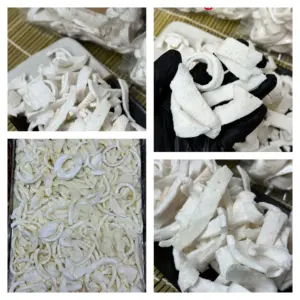
What should a freeze-dried coconut specification and lot COA cover?
A freeze-dried coconut specification needs five things: moisture ≤5.0%, water activity ≤0.30, a microbiology limit with Salmonella not detected in 25 g on every lot, a visual limit for brown skin specks and fines, and a clear list of which tests run per lot and which run on a schedule. Get those right and the container clears, stays crisp and matches the sample.
Coconut is not an ordinary dried fruit on a QA desk. Its kernel is fat-rich, it is handled by hand before drying, and coconut products sit under an FDA import alert in the United States. That changes which numbers carry the most weight. This guide sets out the limits we write into FruitBuys contracts for freeze-dried coconut meat, why each one is there, and what to check on arrival, with any supplier, including us.
Which numbers belong in the contract, and what does each one protect?
Write the limits your QA team can test, and tie each to the failure it prevents.
| Parameter | Contract limit | What FruitBuys ships to | What it protects |
|---|---|---|---|
| Moisture | ≤5.0% | 3–5% | Crispness through the voyage and on shelf |
| Water activity (aw) | ≤0.30 | ≤0.30; tighter targets by contract, confirmed by trial batch | No microbial growth, no cold chain |
| Total plate count | ≤10⁴ CFU/g standard; <1,000 CFU/g inclusion grade | Per lot COA | Hygiene of the whole chain |
| Yeasts and moulds | ≤10² CFU/g | Per lot COA | Storage stability |
| E. coli | <10 CFU/g | Per lot COA | Hygiene after the kill step |
| Salmonella | Not detected in 25 g | Per lot COA | US entry and consumer safety |
| Fines | ≤5% by weight (sieve) | ≤5%; lower for chocolate chunks by contract | Clean chocolate, even dosing, no dust in the bag |
| Cut size | Your drawing, ±2 mm | ±2 mm | Line dosing and look in pack |
| Colour | Uniform ivory white | No brown skin specks, no yellowing beyond contract limit | Retail appearance, no sulfite needed |
| Foreign matter | None | Metal detection on every carton (Fe 1.5 mm, non-Fe 2.0 mm, SUS 2.5 mm) | Consumer safety, recalls |
Two rules keep this table enforceable. First, name the test method next to each number, because two suppliers’ “aw 0.28” only compare if both were read the same way (ISO 18787 for water activity). Second, write the claim window into the contract: 14 days from devanning for packaging, appearance, fines and aw, and 30 days for laboratory results.
Standard or inclusion grade: which microbiology limit does your product need?
The standard limit fits most uses. Products that are not heated again after the coconut goes in deserve the tighter grade.
| Grade | TPC limit | Fits | Why |
|---|---|---|---|
| Standard | ≤10⁴ CFU/g | Granola, bakery, snack mixes, trail mix, retail snack pouches | The industry release limit; baked and dry-mixed products carry it comfortably |
| Inclusion grade | <1,000 CFU/g | Chocolate inclusions, yogurt toppings, ice cream, protein bars | No further heat step after mixing, and the finished product’s own specification is tight |
Both grades share the same Salmonella, E. coli and yeast-and-mould limits, and both are confirmed on each lot COA. Specify the grade in the RFQ so the lot is released against the right number. If your application needs water activity below the standard 0.30, for example a moisture-sensitive coating, a tighter target down to 0.10 is set by contract and confirmed on a trial batch first.
How does FruitBuys keep a coconut shipment clear of Salmonella holds?
By putting a heat step in front of the freezer and a Salmonella result on every lot.
Fresh coconut kernel is fat-rich and moist, and it is opened, pared and cut by hand. That is why US ports watch coconut closely: coconut meat and coconut milk products sit under FDA Import Alert 23-12, which lets ports hold shipments without examination when contamination is suspected, and a 2018 US outbreak traced to frozen shredded coconut showed what happens when no kill step is applied. A US importer’s first question about coconut is therefore how Salmonella is controlled.
The answer has to sit in the process, because freeze-drying itself never reaches a temperature that kills bacteria. FruitBuys builds it in at three points:
- Kill step on 100% of the kernel. The cut kernel is steam-blanched at 85–88 °C before deep freezing. This is a validated step against vegetative pathogens such as Salmonella, E. coli and Listeria, and it also stops the lipase enzyme that would otherwise turn coconut fat soapy.
- Fast to the freezer. Cut kernel reaches freezing temperatures within 2 hours of cutting, so there is no warm holding window.
- Per-lot proof. Every export lot ships with a COA from an independent ISO/IEC 17025 accredited laboratory showing Salmonella not detected in 25 g, the core document for your FSVP file.
Ask every coconut supplier, including us, for the kill-step description and a per-lot Salmonella result before you sign. If US release requires Listeria evidence, the test is booked through an LAAF-accredited laboratory, as FDA has required for Listeria release testing since December 2025. How the blanch fits into the full line is in how freeze-dried coconut is made.
What does each lot COA cover, and what runs on a surveillance schedule?
Three layers, each paid and timed differently.
| Layer | Tests | When | Method |
|---|---|---|---|
| Lot COA (every FCL container) | Moisture, water activity, total plate count, yeasts and moulds, E. coli, Salmonella; physical and sensory release check (colour, testa specks, fines, odour, foreign matter) | Every lot, before the container leaves | Oven drying · ISO 18787 · ISO 4833-1 · ISO 21527-2 · ISO 16649-2 · ISO 6579-1 |
| Baseline surveillance | Lead, arsenic, aflatoxin (total and B1) | Periodic rounds, reports available on request | Accredited laboratory methods |
| Market panels on request | Listeria monocytogenes (ISO 11290-1; LAAF lab for US release), Enterobacteriaceae, pesticide multi-residue, cadmium, sulfite, nutrition panel | Booked before stuffing so the result travels with the container | Accredited laboratory methods |
All testing runs at an independent ISO/IEC 17025 accredited third-party laboratory. Market panels are paid by the buyer or shared between both sides depending on order volume, agreed in the quotation. Trial orders ship with a free release QC log and our baseline reports; third-party testing on trial lots is arranged on request.
Why a sulfite test is worth adding for the EU. Desiccated coconut is often treated with sulfite to keep it white, and above 10 mg/kg sulfite becomes a declared allergen on an EU label. FruitBuys keeps the kernel white with the steam blanch instead, and a sulfite result below that line lets your label stay one ingredient long.
Which defects should QA look for on a freeze-dried coconut lot?
Four, and all of them can be checked on a tray in ten minutes.
- Brown skin specks (testa). The thin brown skin between shell and kernel is pared off by hand. Specks left behind are the most visible defect in a white product. Count specked pieces in 200 g against the contract limit.
- Yellowing. A cream or yellow cast points to slow handling or heat. Freeze-dried kernel that was blanched and frozen fast stays ivory.
- Glassy or hard pieces. Pieces that look translucent or feel hard rather than crisp did not dry through. They soften first in the pack.
- Fines. Shake 100 g over a 2 mm sieve. What passes counts as fines; the standard limit is 5%.
Agree the speck and fines limits on the approved pre-shipment sample, so both sides judge the container against the same reference. The sample is 100–200 g from the packed lot in two sealed foil pouches: one for your sensory check, one sealed for your laboratory.
Moisture or water activity: which number tells you more on a fat-rich kernel?
Water activity. On coconut, moisture percentage alone hides what matters.
About two-thirds of freeze-dried coconut is fat, and fat holds almost no water. The water sits in the fibre, protein and sugar that make up roughly a third of the kernel. So a lot at 4% moisture overall carries about 11–12% water in its non-fat part, which is why coconut at a “low” moisture figure can still pick up humidity quickly once a bag is open. Water activity measures how freely that water can move, which is what drives microbial growth and loss of crunch. At aw ≤0.30 neither happens.
In practice: keep moisture in the contract, because it is fast and cheap to check, and release on water activity. Read aw on a freshly opened sealed pouch, within minutes, because an open sample drifts upward. How packaging and storage hold these numbers through shipping is in how long freeze-dried coconut lasts.
What happens if a lot does not match the specification on arrival?
The contract decides, so write the path in before the first container ships.
- Claim windows: 14 days from devanning for packaging, appearance, fines and aw; 30 days for laboratory results.
- Retained sample: FruitBuys keeps a retained sample from every container lot for its full shelf life, up to 24 months, so any dispute is tested against the same lot.
- One locked facility: each contract runs at one qualified partner facility, and any change needs written notice and a fresh sample approval, so the lot you approved is the lot you keep receiving.
- Joint test: if your result and the lot COA disagree, both sides test the retained sample at an agreed accredited laboratory.
These terms are what make a specification worth signing. Documents, duty and border checks by market are covered in the dried coconut HS code and import guide.
Get the specification for your application
Tell us your product, the cut and the microbiology grade you need. We send the contract specification, a recent lot COA format and our baseline reports, and we book any market panel before your container is stuffed.
FAQ
What water activity should freeze-dried coconut have?
0.30 or below. At that level no bacteria, yeasts or moulds can grow and the pieces stay crisp. Tighter targets down to 0.10 can be set by contract and confirmed on a trial batch.
What moisture content is normal for freeze-dried coconut?
3–5%, with a contract limit of 5.0%. Because the kernel is fat-rich, water activity is the better release number.
Why is coconut on an FDA import alert?
Import Alert 23-12 covers coconut meat and milk products because of past contamination with Salmonella and other pathogens. A validated kill step before drying and a per-lot Salmonella result are what US importers ask for.
Does freeze-drying kill Salmonella?
No. Freeze-drying runs at low temperature. The kill step has to come before it, which is why FruitBuys steam-blanches 100% of the kernel at 85–88 °C before freezing.
What tests are on a freeze-dried coconut COA?
Moisture, water activity, total plate count, yeasts and moulds, E. coli and Salmonella on every lot, plus a physical and sensory check. Lead, arsenic and aflatoxin run on a surveillance schedule, and market panels are added on request.
What is inclusion grade?
A tighter microbiology grade, TPC below 1,000 CFU/g, for chocolate, yogurt, ice cream and protein bars where the coconut is not heated again. It is confirmed on each lot COA.
Is freeze-dried coconut sulfite-free?
FruitBuys keeps the kernel white with a steam blanch, not sulfite. A sulfite test below 10 mg/kg can be added to the lot panel for EU labels.



