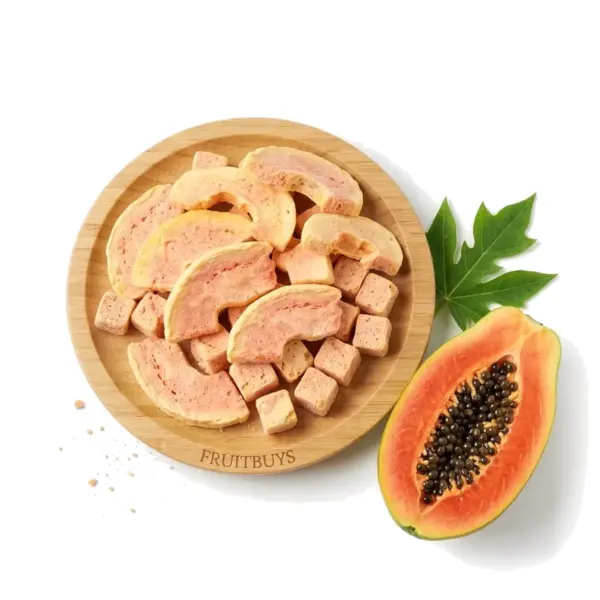
Freeze-Dried Papaya
Freeze-dried papaya is ripe red-flesh papaya (Carica papaya), peeled, deseeded, cut and freeze-dried to ≤5% moisture and aw ≤0.30, with nothing added. It comes out crisp and light, keeps the orange-red colour of the fresh fruit, and softens back in milk or yogurt within minutes. FruitBuys supplies 5 mm and 10 mm dice, 3–7 mm slices and 2–5 mm granules from the Mekong Delta of Vietnam, in bulk cartons and private-label pouches for cereal, snack, chocolate and dairy brands. It belongs to our freeze-dried fruit range, and the freeze-dried papaya supplier guide covers origin, season and supply control.
Most dried papaya on the shelf is candied: soaked in syrup, often coloured, and chewy. Freeze-dried papaya reads one word on your ingredient line, papaya, and ships in a standard dry container at about one-twelfth of its fresh weight. One 20 ft container holds about 550 cartons, or 4.4–5.5 t of dice: the flesh of roughly 35–50 t of fresh papaya, with no reefer and no cold store at the other end. For drinks, smoothie mixes and baby purées, the same fruit is milled into freeze-dried papaya powder.
Product specification
| Parameter | Specification |
|---|---|
| Ingredient | 100% ripe red-flesh papaya (Carica papaya), peeled and deseeded; processed without sulphites |
| Guaranteed specifications | Moisture ≤5.0% and Aw ≤0.30 on every lot COA; no added colour, no added sugar |
| Grade | Premium (fine) grade: ripe flesh only; fruit sorted at 11–13 °Brix, green and overripe fruit rejected at intake; ≥90% of pieces within the stated cut |
| Variety | Red Lady-type papaya, a conventionally bred F1 hybrid, not a GM variety |
| Origin | Mekong Delta, Vietnam: Dong Thap (including former Tien Giang), Vinh Long, Can Tho |
| Season | Year-round; highest Brix and deepest colour in the dry season, December to April |
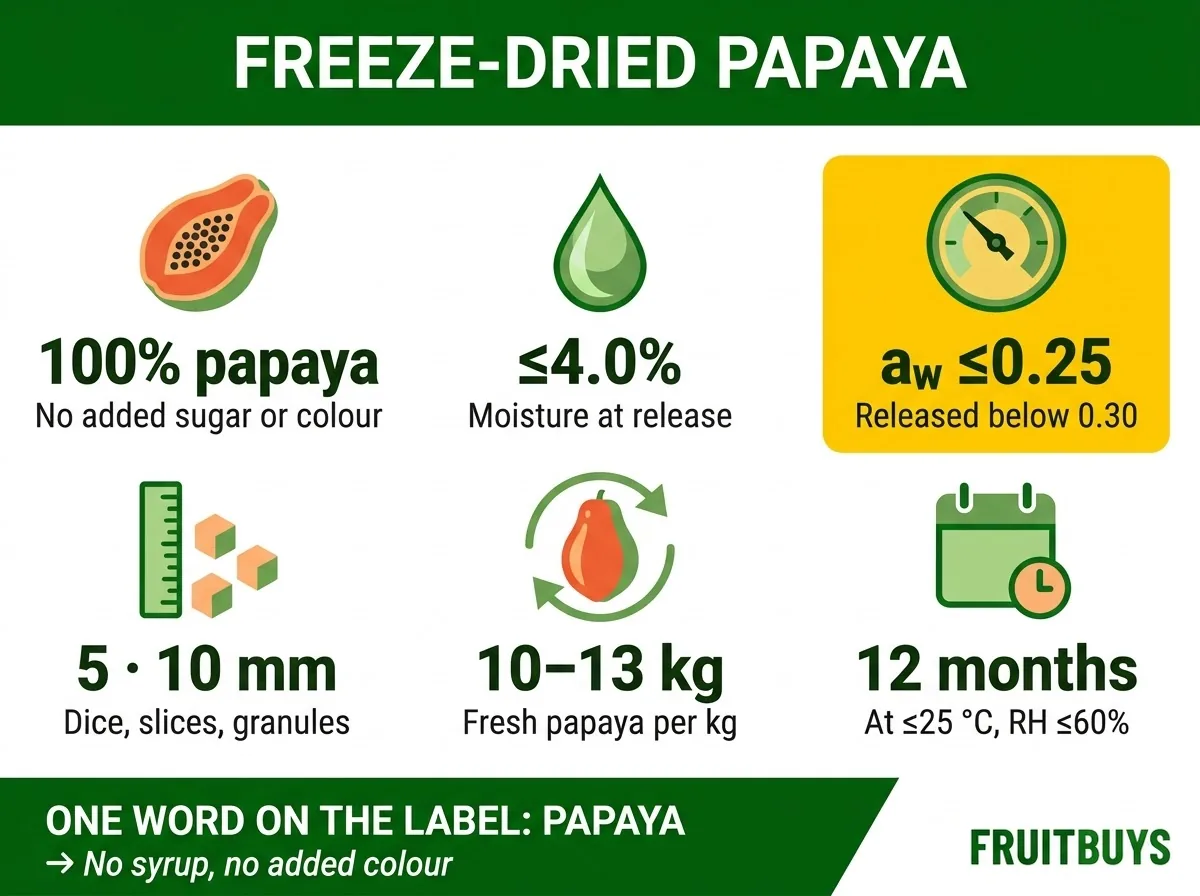
| Cuts | Dice 5 × 5 mm and 10 × 10 mm; slices 3–7 mm; granules 2–5 mm; custom cuts on request |
| Fines | <2 mm pieces ≤5% in dice and slices |
| Colour | Natural orange to orange-red, from beta-carotene and lycopene |
| Texture | Crisp and porous; melts in the mouth; does not stick to the teeth |
| Moisture | ≤4.0% at release; ≤5.0% contract limit |
| Water activity | ≤0.25 at release; ≤0.30 contract limit |
| Total plate count | ≤10⁴ CFU/g; inclusion grade (TPC <1,000 CFU/g) on request for chocolate, dairy, ice cream and bars |
| Yeasts and moulds | ≤10² CFU/g |
| E. coli / Salmonella | <10 CFU/g / not detected in 25 g |
| Rehydration | Softens in 2–5 minutes in water, milk or yogurt |
| Fresh-to-dry | 10–13 kg whole fresh papaya, or 8–9 kg peeled flesh, per 1 kg |
| Shelf life | 12 months at ≤25 °C, RH ≤60%; 18–24 months in cool storage at ≤18 °C, RH ≤50% |
| HS code | 0813.40 |
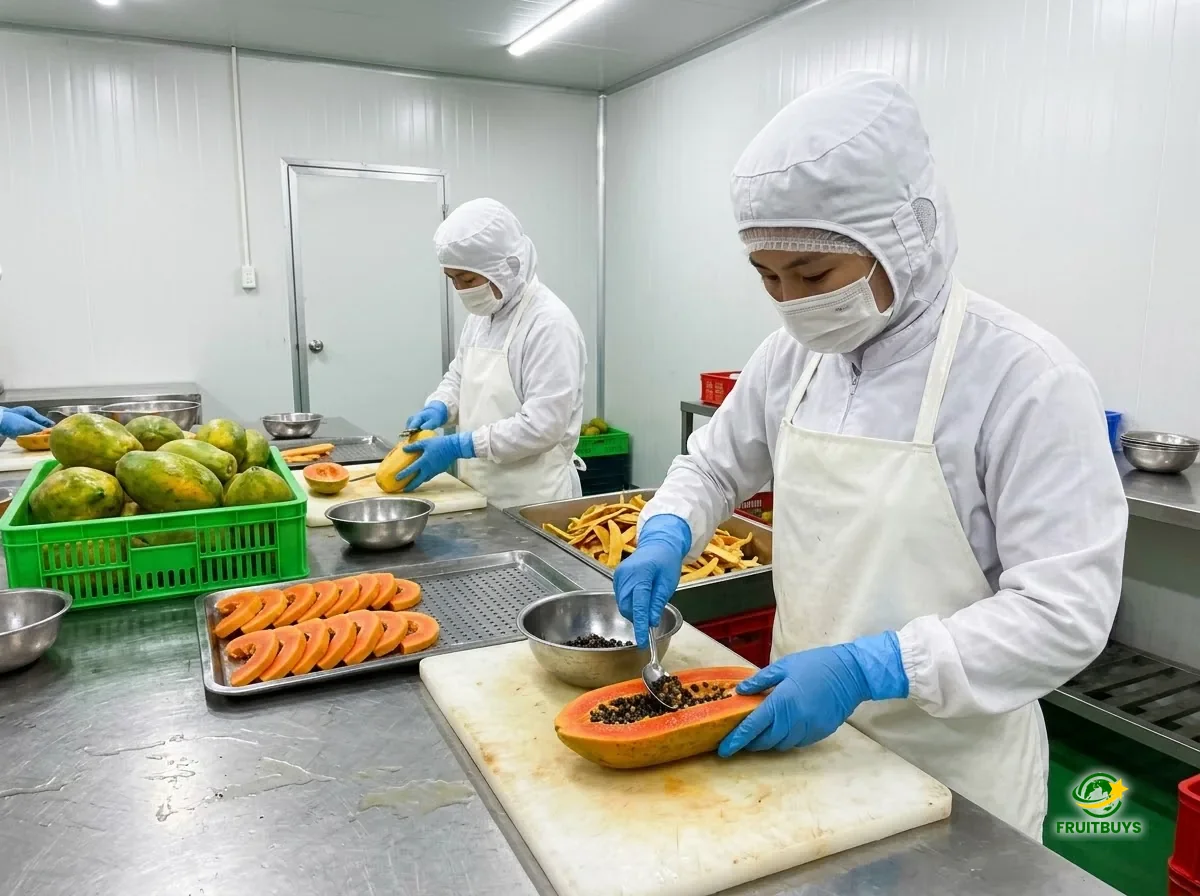
Why the yield moves with the season. At the intake scale we see it every year: dry-season fruit from December to April carries more sugar and solids, so about 10.5–11.5 kg of whole papaya make a kilogram of freeze-dried dice. In the rainy months the same kilogram takes 12.5–13 kg. The dry-season lots also have the deepest orange-red colour, so we reserve them for buyers whose product photo depends on it. A quote that sits far below the fruit cost these numbers imply usually means green fruit, higher moisture or sugar in the bag.
Which cut fits your product
| Cut | Size | Net per carton | Best for | Starting dose |
|---|---|---|---|---|
| Dice 5 mm | 5 × 5 mm | 8–10 kg | Breakfast cereal, granola, muesli, chocolate bark | 3–8%, added after baking |
| Dice 10 mm | 10 × 10 mm | 8–10 kg | Trail mixes, freeze-dried fruit blends, snack packs | 10–25% of the mix |
| Slices | 3–7 mm | 5–6 kg | Visible-fruit retail snacks and toppings | As a single-fruit snack or topping |
| Granules | 2–5 mm | ~10 kg | Muffins, cookies, bars, enrobed bites | 3–5% of flour weight; bake at ≤180 °C |
| Powder | 60–80 mesh | 15–20 kg | Drinks, smoothie mixes, baby food, coatings | See the powder page |
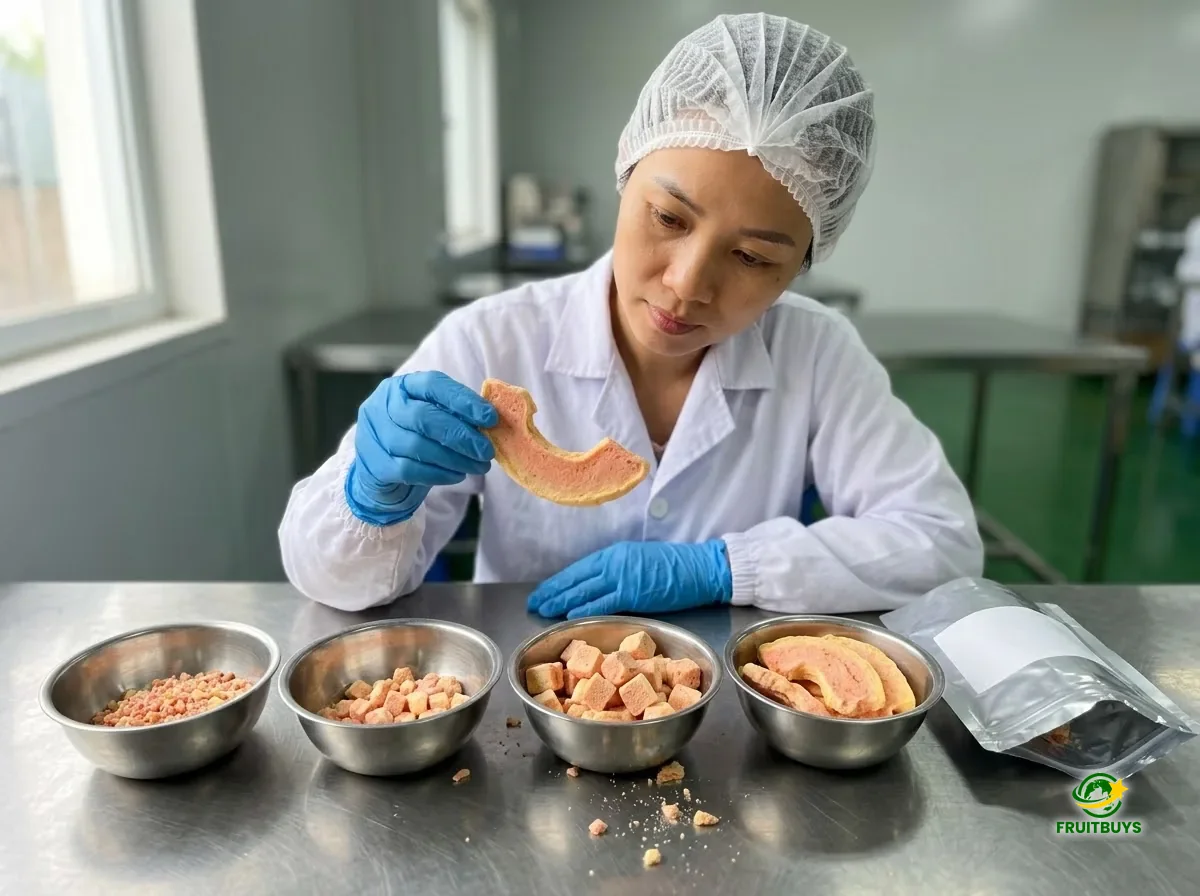
A 3–8% dose of 5 mm dice is enough to make a cereal or granola read “tropical” on the shelf, which keeps the cost of the colour accent low. Slices sell the fruit itself, so they are the cut where breakage matters most: they pack at 5–6 kg per carton to protect the shape. Granules cost less per kilogram of finished product wherever the fruit is baked in and nobody sees the cut. Tolerances and doses by application are in which freeze-dried papaya cut fits your cereal, trail mix, chocolate or yogurt line.
Use it where crisp is an advantage. Freeze-dried papaya stays crisp in dry mixes and softens in anything moist, which is exactly what a yogurt topping or overnight oats needs. In a chewy or high-moisture bar, use granules bound into the bar mass and run a shelf-life pilot; in yogurt and smoothie bowls, pack the papaya in a separate topping cup or dry sachet so it meets the dairy at the moment of eating.
Freeze-dried or candied dried papaya
| Freeze-dried papaya (this product) | Typical candied dried papaya | |
|---|---|---|
| Ingredient line | Papaya | Papaya, sugar or syrup, often acid and colour |
| Texture | Crisp, light, melts in the mouth | Chewy, sticky |
| Sugar | Fruit’s own sugar only, 0 g added | Added sugar on top of the fruit’s own |
| Colour | Natural orange-red from the fruit | Often coloured to look orange |
| In milk or yogurt | Softens in 2–5 minutes into soft fruit | Stays chewy |
Nutrition (per 100 g)
| Nutrient | Amount | % DV* |
|---|---|---|
| Calories | 350 kcal | |
| Total fat | 2 g | 3% |
| Saturated fat | 0.5 g | 3% |
| Cholesterol | 0 mg | 0% |
| Sodium | 65 mg | 3% |
| Potassium | 1,460 mg | 31% |
| Total carbohydrate | 87 g | 32% |
| Dietary fibre | 14 g | 50% |
| Total sugars | 63 g (0 g added) | |
| Protein | 4 g | 8% |
Typical values for 100% freeze-dried papaya; natural variation by origin, season and ripeness applies. Lot nutrition panel available for label artwork.
14 g fibre and 1,460 mg potassium per 100 g, with no added sugar. On an EU panel (energy 1,460 kJ / 350 kcal; carbohydrate 73 g; salt 0.16 g) freeze-dried papaya reaches the levels for “high fibre”, “high potassium”, “low fat” and “low sodium”, plus “no added sugars”. Freeze-drying keeps far more of papaya’s naturally occurring vitamin C than heat drying, at a typical 300–450 mg per 100 g. For an on-pack vitamin figure we sample your commercial lot and arrange the panel in FDA or EU format. It is vegan and naturally gluten-free, with none of the top-9 or EU-14 allergens as ingredients.
Packaging and handling
| Item | Detail |
|---|---|
| Bulk | 1–5 kg sealed aluminium-foil PE bags, soft vacuum, food-grade silica gel sachet, no nitrogen, in 5-ply cartons |
| Carton | 58 × 28 × 34 cm; dice 8–10 kg, granules ~10 kg, slices 5–6 kg, confirmed by trial pack |
| Retail (OEM) | 30 g / 50 g / 100 g / 500 g aluminium-foil zip pouches, or custom sizes |
| Packing room | Sealed in a dehumidified packing room at ≤40% RH |
| Shelf life | 12 months at ≤25 °C, RH ≤60%; 18–24 months in cool storage at ≤18 °C, RH ≤50%; unopened foil bag with desiccant |
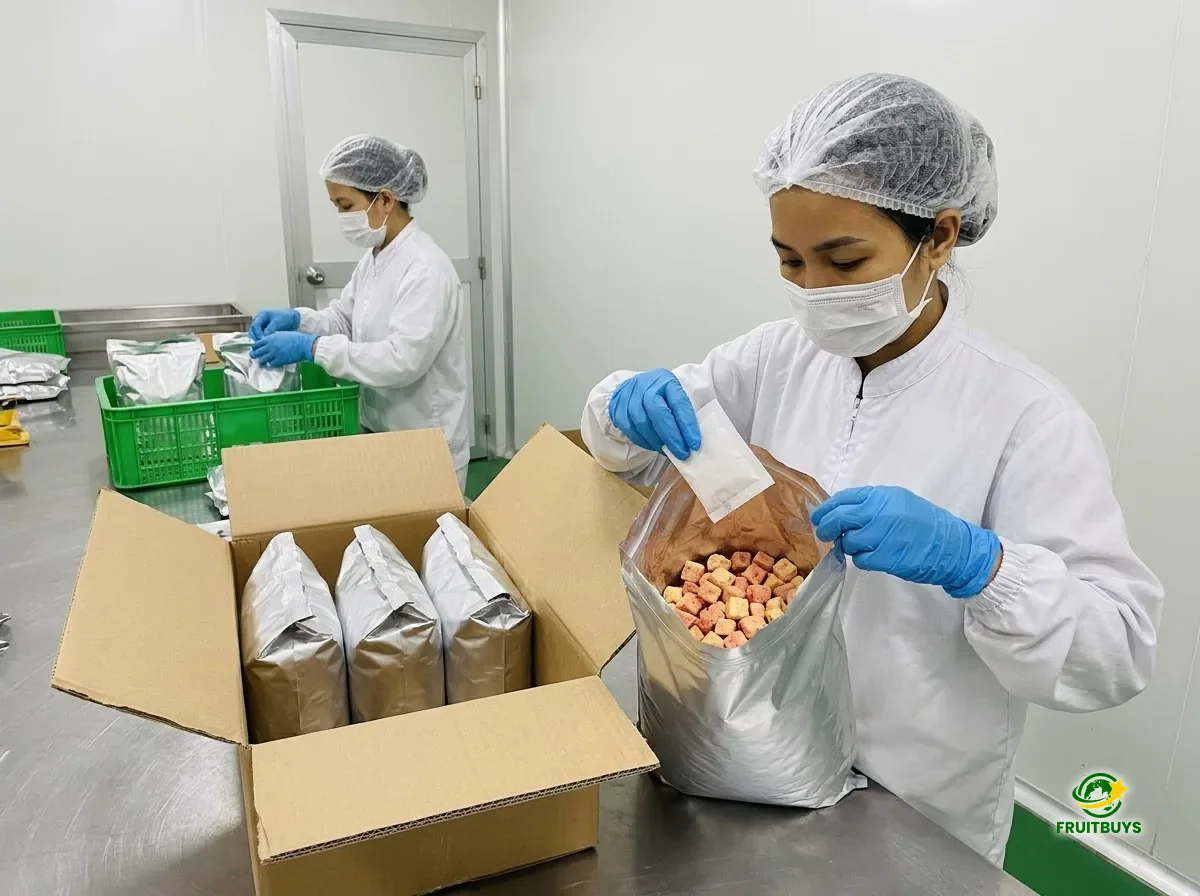
Papaya is about 63% natural sugar on a dry basis, which makes it one of the faster freeze-dried fruits to pick up humidity and turn sticky once a bag is open. That is why every bulk bag is sized to one production batch: open one, use it through, and every other bag stays crisp until its turn. Let cold cartons reach room temperature before opening so no condensation forms inside, keep cartons on pallets off the floor, and reseal a reopened bag at once with a fresh desiccant sachet. Layer plans and route risks are in how freeze-dried papaya should be packed and loaded.
Commercial terms and container planning
| Term | Detail |
|---|---|
| Production capacity | 100 t/year |
| 20 ft, floor-loaded | About 550 cartons: dice 4.4–5.5 t; granules ~5.5 t; slices 2.75–3.3 t |
| 40 ft HC, floor-loaded | About 1,100 cartons: dice 8.8–11 t; slices 5.5–6.6 t |
| Palletised | 1,200 × 1,000 mm pallets, 30–36 cartons each; 20–21 pallets per 40 ft HC (dice 4.8–7.5 t) |
| Container type | Standard dry container; no reefer |
| Trial orders | 50–100 kg by air or LCL; bulk from 300–500 kg |
| Mixed loads | A container shared with other FruitBuys freeze-dried lines costs about 15–20% less in logistics per kg than LCL |
| Production lead time | 20–30 days per 20 ft after deposit |
| Samples | Dispatched within 24–48 hours in two sealed foil pouches |
| Payment | T/T 40% deposit, 60% before shipment or against copy B/L; L/C at sight |
| Incoterms | FOB Cat Lai, CIF (sea and air) |
| Port of loading | Cat Lai Port or Tan Son Nhat International Airport, Ho Chi Minh City |
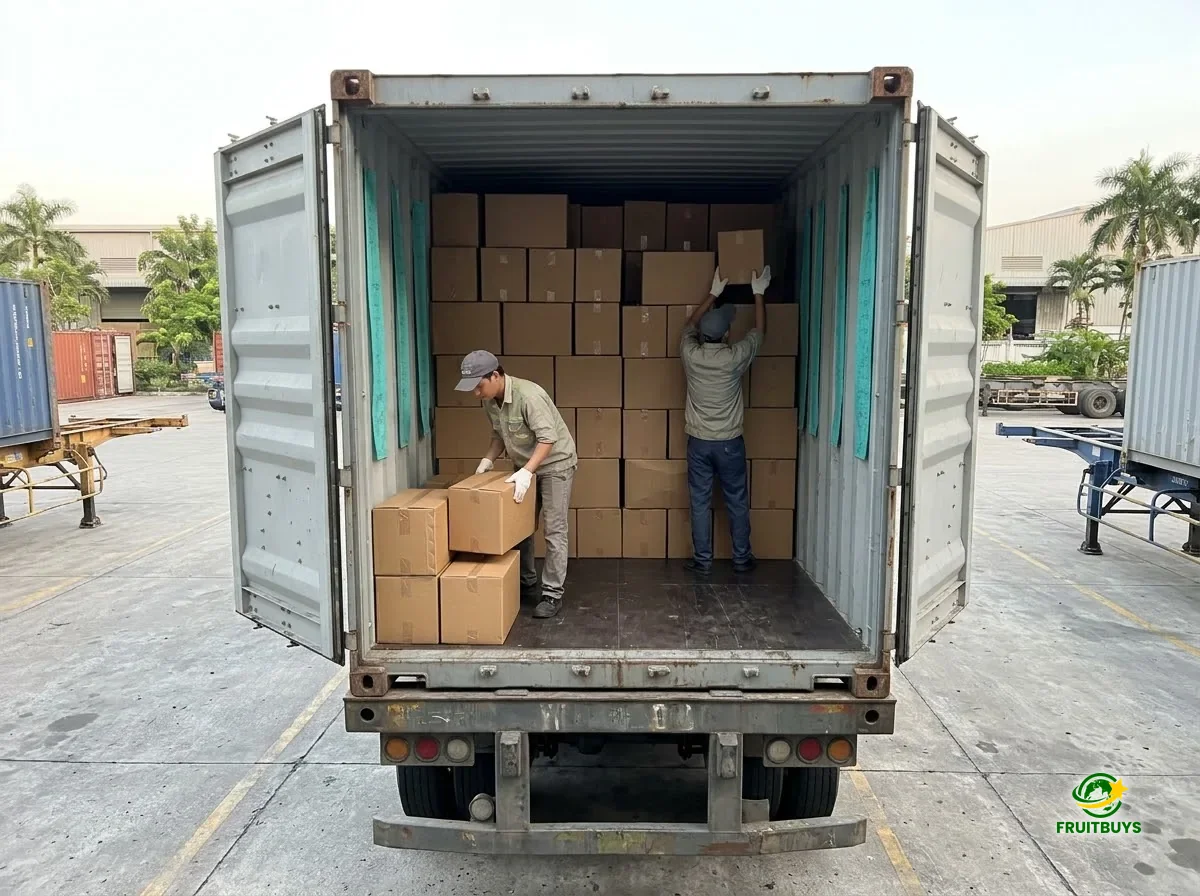
Private label and OEM. Retail pouches are filled and sealed at source in the dehumidified packing room, so the papaya reaches your warehouse already in its final pack. Minimum order for OEM, ODM and private label is 500 kg. Digital-print pouches start from 3,000–5,000 per SKU with no cylinder fee and print in 7–10 working days, which suits a test market or a seasonal line. Rotogravure starts from 500 kg per SKU, prints in 15–20 working days and gives the lowest pack cost for repeat orders. Carton and pallet labels follow your FBA instructions, with UPC or FNSKU printed on the pouch. We also pack tropical mixes with freeze-dried pineapple, mango or banana. Details are on our OEM and private label page.
Quality and documents
- Every container lot: COA from an independent ISO/IEC 17025 accredited laboratory for moisture, water activity, total plate count, yeasts and moulds, E. coli and Salmonella, plus sensory checks for colour, odour, cut size and foreign matter.
- Residues: multi-residue pesticides to your market’s MRLs, tested before stuffing.
- Available for each lot on request, before the container is sealed: ICP-MS heavy metals (lead, arsenic, cadmium, mercury); PCR screening for GM papaya events; Listeria and Enterobacteriaceae for ready-to-eat use; sulphite; gluten; a nutrition panel in FDA or EU format. FruitBuys arranges these at an accredited laboratory of your choice, such as Eurofins or SGS in Vietnam.
- Physical control: metal detection on the packing line.
- Trial orders: an in-house QC log per batch for moisture, water activity and sensory, with third-party testing on request.
- Pre-shipment sample: 100–200 g from the packed lot in two sealed foil pouches with desiccant, one for your trial and one kept sealed for your lab.
- Retained sample: kept from every container lot for its full shelf life, up to 24 months.
- Traceability: each lot is traceable to its harvest region and raw-material intake batch, with growing-area records available for your audits.
- Facility control: FruitBuys locks one qualified partner facility per contract. Any change needs prior written notice and re-approval of the pre-shipment sample, and you keep audit access.
- Facility certifications: HACCP, ISO 22000, US FDA Facility Registration and BRC (qualified processing facility). Halal certification available on request.
- Shipment documents: commercial invoice, packing list, bill of lading, COA, Certificate of Origin Form EUR.1 for the EU and UK or Form CEPA for the UAE, and a phytosanitary certificate with every shipment as part of FruitBuys’ standard export dossier.
Claims on packaging, appearance, breakage or water activity are accepted within 14 days of unloading, and lab results within 30 days.
Import and labeling
Freeze-dried papaya is exported under 0813.40, other dried fruit. Plain freeze-dried papaya stays in Chapter 08 because nothing is added; sugared, infused or coated papaya moves to 2008.99. FruitBuys writes the invoice, spec and COA with one description, “freeze-dried papaya (Carica papaya), diced 10 × 10 mm, no added ingredients, moisture ≤5%”, and prepares them with your customs broker so the entry line and the documents match on the first filing.
In the US Harmonized Tariff Schedule, dried papayas have their own line, 0813.40.10, at a 1.8% MFN rate; your customs broker confirms the total duty on the entry. For the EU, Form EUR.1 under EVFTA brings papaya (CN 0813 40 50) in at 0% duty, against the 2.0% MFN rate; your broker can check the current measure in the EU TARIC database. Form EUR.1 also covers the UK, and a Form CEPA goes with every shipment to the UAE. The final rate applies to the code declared at entry.
Two questions US and EU importers raise about papaya have short answers. Fresh papaya is on the FDA Food Traceability List; freeze-dried papaya is not, because the list covers papaya only in fresh form, and each FruitBuys lot is still traceable to its harvest region for your FSVP file. For the EU, where unauthorised GM papaya is stopped at the border, the Red Lady-type variety is conventionally bred, and a PCR screening report can travel with each shipment on request.
Name the ingredient “papaya” or “freeze-dried papaya” on your pack, and keep the claims to food claims such as fibre, potassium and no added sugar.
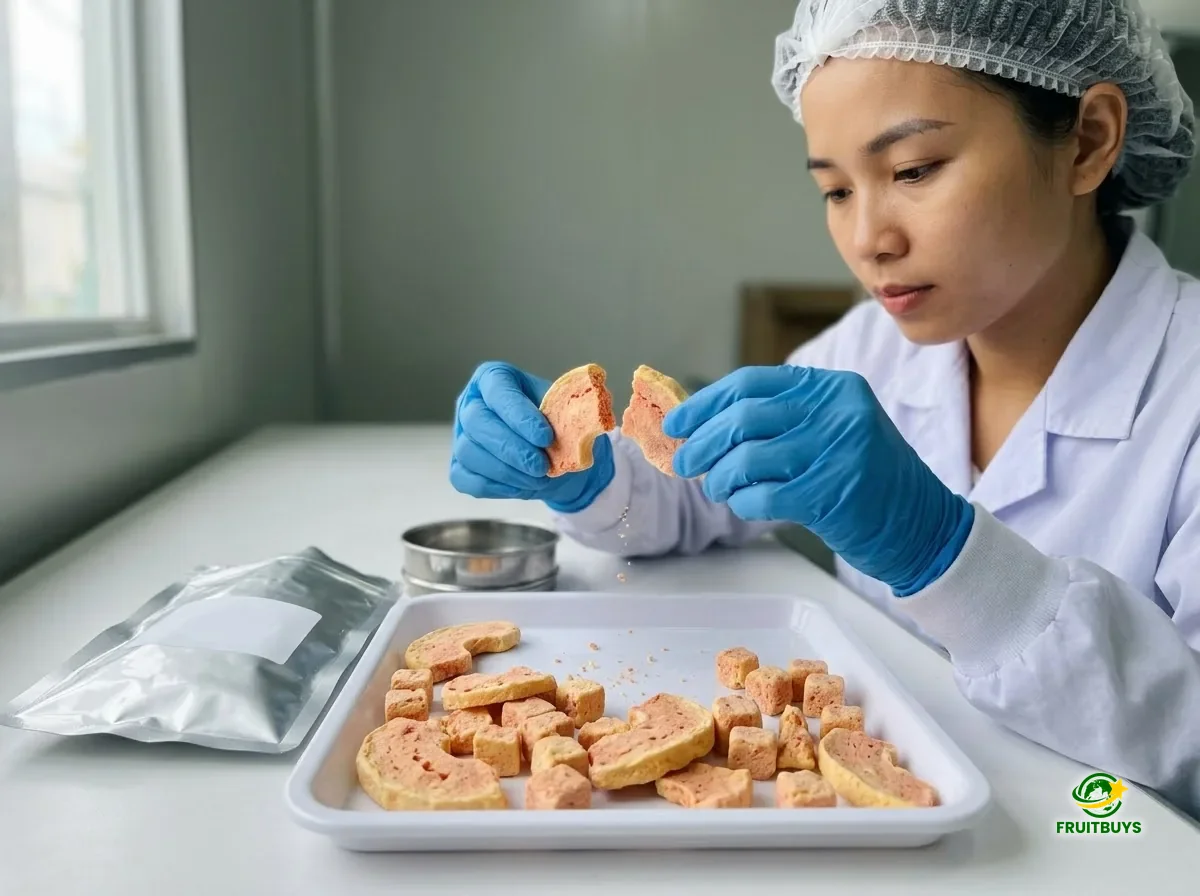
Verify the sample in five steps
- Cut a piece in half. The cross-section should be even orange to orange-red and porous, with no sugar crystals, syrup sheen or brown core.
- Snap it. A dice or slice should break with a clean crunch; a bendy piece points to moisture above spec.
- Read the water activity within a minute. Seal pieces in the meter cup within 60 seconds of opening the pouch; at or below 0.30 the lot was dried and sealed right. Keep the second pouch sealed for your own lab.
- Sieve 100 g. Pieces under 2 mm should stay at or below 5% of the weight in dice and slices.
- Run your application. Stir dice into cold milk or yogurt: they should soften in 2–5 minutes and taste of ripe papaya. Approve the pre-shipment sample in writing; it becomes the quality reference for your container.
The contract limits behind these checks are in what moisture, water activity and microbiology limits a freeze-dried papaya contract should set, and the path from sample to first container in will your freeze-dried papaya container match the sample you approved.
FAQ
Is freeze-dried papaya the same as dried papaya?
No. Most dried papaya is candied, soaked in syrup and chewy. Freeze-dried papaya is 100% fruit with no added sugar, crisp and light.
Does freeze-dried papaya have added sugar?
No. The ingredient line is papaya only; the 63 g of sugar per 100 g is the fruit’s own sugar, concentrated when the water is removed.
Is freeze-dried papaya crunchy?
Yes. It is crisp straight from the bag and softens in 2–5 minutes in milk, yogurt or water.
How much fresh papaya makes 1 kg of freeze-dried papaya?
About 10–13 kg of whole fresh fruit, or 8–9 kg of peeled flesh: near 10.5–11.5 kg in the dry season and 12.5–13 kg in the rainy season.
How long does freeze-dried papaya last?
12 months at ≤25 °C, RH ≤60%, or 18–24 months in cool storage at ≤18 °C, RH ≤50%, in the unopened foil bag with desiccant.
What is the HS code for freeze-dried papaya?
0813.40. In the US the line is 0813.40.10 (1.8% MFN); in the EU it is CN 0813 40 50 (0% with EUR.1). Papaya powder is classified under 1106.30.
Can I order custom cuts?
Yes. Dice, slices and granules are standard; other sizes are cut to your specification and confirmed on the pre-shipment sample.
Is your freeze-dried papaya organic?
No. It is conventional Mekong Delta papaya, and a multi-residue panel to your market’s MRLs is tested before stuffing.
What is the minimum order?
Trial orders from 50–100 kg; bulk from 300–500 kg; 500 kg for OEM, ODM and private label.
Request a quote
Before you shortlist, the ten questions to put to any papaya supplier, and how FruitBuys controls the chain from grower to container, are in how to choose a freeze-dried papaya supplier in Vietnam. Send these 10 details and we return a specification, loading plan and terms in one reply:
- Destination country and port
- Application: cereal or granola, trail mix, chocolate, bakery, yogurt topping, retail snack
- Cut and size: dice 5 mm or 10 mm, slices, granules or custom
- Microbiology grade: standard or inclusion grade
- Lot tests your market or customer needs (heavy metals, GM screening, nutrition panel)
- First-order volume: trial, LCL, 20 ft or 40 ft HC, floor-loaded or palletised
- Annual volume and call-off rhythm
- Packaging: bulk bag size, or retail pouch size and private-label artwork status
- Mixed container with other FruitBuys freeze-dried fruits, if any
- Preferred Incoterm, payment term and target delivery date