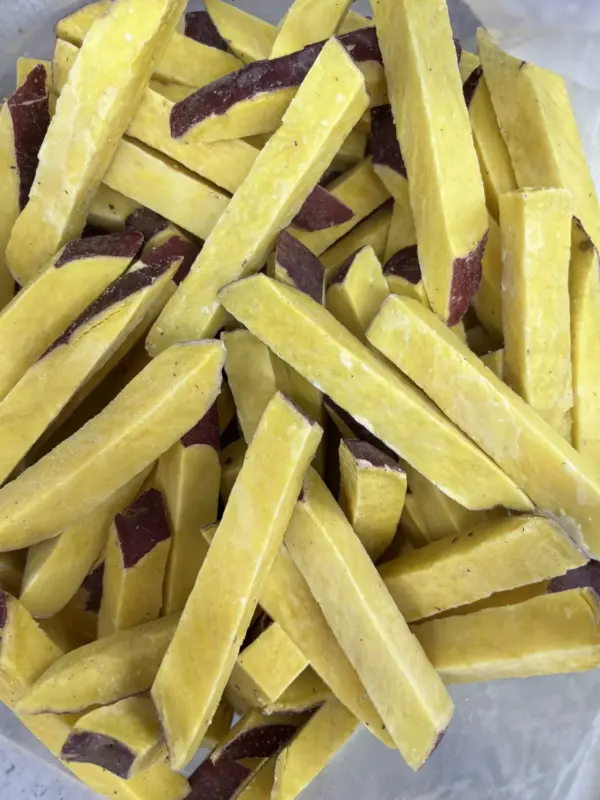
Freeze-Dried Yellow Sweet Potato (Japanese-Type) in Bulk from Vietnam
Freeze-dried yellow sweet potato is the Japanese-type root (Ipomoea batatas) with red-purple skin and golden flesh, sold as Japanese or honey sweet potato, washed, peeled, cut, blanched and dried under vacuum into crisp dice, slices, sticks and chunks. It is not a yam and not the orange-flesh type. Nothing is added: no sugar, oil, salt, colour or sulfites. FruitBuys supplies it from the Mekong Delta and Central Highlands of Vietnam in bulk cartons and private-label retail packs for cereal, instant-food, snack, bakery and pet-food brands. It belongs to our freeze-dried fruit range.
It eats like a baked Japanese sweet potato that has been turned into a crisp: chestnut-sweet, buttery gold, gone in a crunch. Drop a 5–6 mm dice into near-boiling water and it is soft in 1–2 minutes and fully rehydrated in 2–3 minutes, right inside the window of a 3-minute cup noodle or instant oatmeal. And it ships at about one-quarter of the fresh weight in a standard dry container, with no cold chain.
Product specification
| Item | Specification |
|---|---|
| Product | Freeze-dried yellow sweet potato (Japanese-type, red skin, yellow flesh) |
| Ingredient | 100% fresh yellow-fleshed sweet potato; no sugar, oil, salt, colours, sulfites or preservatives added |
| Origin | Mekong Delta (Vinh Long, Dong Thap) and Central Highlands (Dak Lak, Gia Lai, Lam Dong), Vietnam; harvested 3.5–4.5 months after planting, every month of the year |
| Formats | Slices 3–5 mm, Ø 25–45 mm · dice 5, 6, 8, 10 mm (1/4″, 3/8″) · sticks 6 × 6 × 40 mm · natural chunks 10–25 mm · granules 1–4 mm; custom cuts |
| Colour / texture / taste | Natural light yellow to golden yellow; crisp, porous, melts in the mouth; chestnut-like, baked sweet potato sweetness |
| Moisture | ≤5.0% contract limit; 3–4% at partner facility release |
| Water activity | ≤0.30 |
| Total plate count | ≤10⁴ CFU/g |
| Yeasts and moulds / coliforms | ≤10² CFU/g / ≤10² CFU/g |
| E. coli / Salmonella | <10 CFU/g / not detected in 25 g |
| Defects | No black spots, weevil damage or peel residue above contract limits; foreign matter none; metal detection on every carton |
| Rehydration at 85–95 °C | 5–6 mm dice 2–3 min; 8–10 mm dice 3–5 min |
| Fresh-to-dry | 3.8–4.3 kg fresh roots → 1 kg finished (3.4–4.8 kg by season, dry matter and cut) |
| HS code | 0714.20; EU CN 0714 20 90; US HTSUS 0714.20.20 |
| Shelf life | 12 months at ≤25 °C, RH ≤60%; 18–24 months in cool storage at ≤18 °C, RH ≤50%; original foil bag with desiccant |
Golden colour without a single additive. Cut sweet potato bleeds a white latex that darkens within minutes, and its enzymes brown the flesh as it sits. The partner facility rinses the cut pieces and blanches them at 85–90 °C for 2–3 minutes before freezing, which is why the dice come out light gold with no sulfite on the label. The process behind the numbers is in how freeze-dried sweet potato is made.
Roots chosen for the dryer, not the market stall. Dry-season roots carry the highest dry matter and the sweetest flavour, so fewer kilograms of fresh roots go into each kilogram you buy. Roots with weevil tunnels are turned away whole, because the damage makes the entire root bitter, and roots are never chilled below about 12 °C before processing, which would leave hard, brown-cored dice. Where the roots grow and how two regions keep supply running all year: Japanese sweet potato from Vietnam.
Crisp on arrival, not just at release. Each lot leaves the facility at 3–4% moisture, a clear step below the 5.0% contract limit, sealed with silica gel in a foil barrier at Aw ≤0.30. That buffer is what keeps a cereal inclusion crunchy after weeks at sea and months on shelf. QA limits and the lot test list are set out in freeze-dried sweet potato moisture, water activity and COA.
Nutrition (per 100 g, typical values)
| Nutrient | Amount | % Daily Value* |
|---|---|---|
| Calories | 350–365 kcal | |
| Total fat | 0.5 g | 1% |
| Saturated fat | 0 g | 0% |
| Trans fat | 0 g | |
| Cholesterol | 0 mg | 0% |
| Sodium | 30–90 mg | 1–4% |
| Potassium | 1,300–1,450 mg | 28–31% |
| Total carbohydrate | 85–89 g | 31–32% |
| Dietary fiber | 6–9 g | 21–32% |
| Total sugars | 10–18 g (naturally occurring; 0 g added) | |
| Protein | 3.5–6.0 g |
*Based on a 2,000 calorie diet.
Typical values for 100% freeze-dried yellow sweet potato; values typically move within ±5–10% with season, origin and ripeness. Lot nutrition panel available for label artwork.
Front-of-pack claims without reformulation. Per 100 g, these typical values meet the EU thresholds for “high fibre”, “high potassium”, “low sodium” and “no added sugars”, and in the US they fit the updated FDA “healthy” criteria for vegetable products ahead of the February 2028 compliance date. Complex carbohydrates for steady energy, natural fiber for satiety and zero oil give better-for-you and calorie-conscious lines a clear story. FruitBuys runs an independent nutrition panel on your commercial lot for the printed label. Per-serving numbers and claim wording: freeze-dried sweet potato nutrition facts.
Formats and applications
| Format | Best fit | Rehydration (85–95 °C) | Carton fill |
|---|---|---|---|
| Dice 5–6 mm | 3-minute cup noodles, instant oatmeal and congee, cup soup | 2–3 min | toward 10 kg |
| Dice 8–10 mm | Breakfast cereal, granola, muesli, ready meals | 3–5 min | toward 10 kg |
| Slices, sticks | Ready-to-eat crisp snacks, “fries-style” packs, bowl toppings | Eaten crisp | toward 7 kg |
| Natural chunks | Granola clusters, snack bars, pet treats and toppers | Eaten crisp | toward 10 kg |
| Granules 1–4 mm | Bakery inclusions, seasoning blends, soup bases | Under 1 min | toward 10 kg |
Hot-air dried sweet potato typically needs 15–20 minutes of simmering to soften, which rules it out of instant formats. Freeze-drying leaves an open, porous structure that drinks water back in minutes. There is also no frying or baking step: freeze-drying runs below browning temperatures, so it adds none of the acrylamide that frying and baking form in sweet potato, one risk fewer as the EU moves toward binding acrylamide limits for snacks and cereals. Cut-by-cut guidance is in freeze-dried sweet potato formats and applications; how it compares with dehydrated, hoshi-imo, vacuum-fried and IQF sweet potato is in freeze-dried vs dehydrated sweet potato. Pet treat and pet-food makers will find grades and spec in freeze-dried sweet potato for pet food, and for doughs, drinks and baby cereals there is freeze-dried yellow sweet potato powder.
Packaging
| Option | Detail |
|---|---|
| Bulk | 1–5 kg sealed aluminium-foil PE barrier bags, light vacuum with food-grade silica gel, in a 5-ply export carton |
| Export carton | 58 × 28 × 34 cm; 7–10 kg by cut (dice, chunks, granules toward 10 kg; slices and sticks toward 7 kg) |
| Retail / private label | 30 g, 50 g, 100 g, 500 g aluminium-foil zip pouches, light vacuum with silica gel, no nitrogen flush; window pouches in high-barrier laminate |
| Storage | ≤25 °C, RH ≤60%, away from sunlight and strong odours; ≤18 °C, RH ≤50% for stock held longer |
Pick the bag size that matches your usage. Once a bag is opened, press out the air, heat-seal or clip it shut with the original desiccant, keep it cool and dry, and use it within 2–4 weeks for full crunch. Shelf life, carton choice and container loading in detail: dried sweet potato shelf life and packaging.
Private label and OEM
FruitBuys packs and seals retail pouches at source, in the partner facility’s dehumidified packing room, so your brand ships ready for shelf.
- MOQ 500 kg per SKU; a digital print run can split across several artwork variants.
- Pouch printing: digital in 7–10 working days, no cylinder cost, ideal for a first run; rotogravure in 15–20 working days for repeat volumes.
- Retail-ready labelling: UPC or FNSKU on the pouch, FBA carton and pallet labels to your instructions.
- Label support: a lot nutrition panel for artwork, and an accelerated shelf-life study on the final pack as a value-added service.
Commercial terms
| Item | Detail |
|---|---|
| Supply capacity | 100 MT/year across qualified partner facilities |
| Trial order | From 1–2 full export cartons (about 7–20 kg by cut), then 20 ft container contracts |
| Private label / OEM / ODM | From 500 kg per SKU |
| Samples | Dispatched in 3–5 working days |
| Production lead time | 20–30 days for a 20 ft container, after deposit |
| 20 ft container, floor-loaded | About 550 cartons, 3,850–5,500 kg net |
| 40 ft HC container, floor-loaded | Up to about 1,120 cartons, 7,840–11,200 kg net |
| 40 ft palletised | 20–24 pallets, about 760–840 cartons |
| Container type | Standard dry container, no reefer |
| Batch consistency | One locked partner facility for the contract, change-control with written notice and sample re-approval, audit access |
| Payment terms | T/T 40% deposit, 60% before shipment or against copy of B/L; L/C at sight |
| Port of loading | Cat Lai Port or Tan Son Nhat Airport, Ho Chi Minh City |
| Shipping terms | FOB, CIF, DDP (sea and air) |
Buy the cut your line needs, ship the kilograms you pay for. If your product mills, blends or bakes the sweet potato, order dice or broken chunks rather than whole slices. They pack toward 10 kg per carton against about 7 kg for slices, so the same container carries roughly 40% more product and sea freight per kilogram falls by about 30%. Keep whole slices for retail packs where the shape is what sells. A full 40 ft HC carries the equivalent of about 30–48 tonnes of fresh roots.
Quality and documents
- Lot COA with every container, from an independent ISO/IEC 17025 accredited laboratory: moisture, water activity, total plate count, yeasts and moulds, coliforms, E. coli and Salmonella, plus a physical and sensory release check (colour, odour, black spots, peel residue, foreign matter).
- Contaminant surveillance: lead, arsenic and aflatoxin under periodic third-party testing, with reports available on request.
- Market panels: heavy metals including cadmium, pesticide multi-residue, Listeria, acrylamide or a nutrition panel, booked before stuffing so the evidence travels with the container.
- Trial lots: a free release QC log; third-party testing at lab cost, credited in full to your first container.
- Pre-shipment and retained samples: 100–200 g from the packed lot in two sealed foil pouches; a retained sample from every container lot kept for its full shelf life.
- Certifications: HACCP, ISO 22000, BRC (qualified processing facility), US FDA Facility Registration.
- Standard export dossier with every shipment: commercial invoice, packing list, bill of lading, C/O Form EUR.1, phytosanitary certificate and lot COA, so the container clears on arrival without a document chase.
Import and labeling
- One code for pieces, another for powder. Freeze-dried slices, dice, sticks, chunks and granules are classified under HS 0714.20 (sweet potatoes, fresh or dried, sliced or not); powder moves to 1106.20. A vacuum-fried or coated product would fall under a different heading altogether, so the ingredient line and the declaration stay matched. Full guidance by market: sweet potato HS code and customs.
- European Union: CN 0714 20 90. Third-country origins pay 6.40 EUR per 100 kg; Vietnamese origin with Form EUR.1 enters at the EVFTA preferential rate (EU TARIC).
- No increased border checks: sweet potatoes and sweet potato products are not on the EU list of products under increased official controls, so containers clear on standard frequency.
- Plant-health documents on a shared code: heading 0714.20 also covers fresh sweet potatoes, so port systems check plant-health documents on this code by default. The phytosanitary certificate in every FruitBuys dossier lets your broker clear the container without explaining fresh versus dried.
- United Kingdom: same commodity code, with Form EUR.1 under UKVFTA.
- United States: HTSUS 0714.20.20; the partner facility holds US FDA Facility Registration, and FruitBuys supplies Prior Notice data and the supplier file your FSVP needs.
- UAE / GCC: importer product registration and Arabic labeling for retail packs.
Verify the sample
- Snap test: a slice should snap cleanly; a dice should crush to a dry crumb between two fingers, not bend.
- Colour: even light yellow to golden; grey or brown patches point to slow blanching or chilled roots.
- Defect count: in 200 g, count pieces with black spots or peel residue against your contract limit.
- Rehydration: pour 90 °C water over 5–6 mm dice and wait 3 minutes; they should be soft right through.
- Water activity: read a sealed pouch within minutes of opening; ≤0.30 passes.
- Ingredient line: “sweet potato” only; any oil, sugar, salt or carrier means a different product.
FAQ
Is yellow sweet potato the same as Japanese sweet potato?
In trade, yes. Vietnam’s yellow sweet potato is the Japanese-type root with red-purple skin and golden flesh, sold as Japanese or honey sweet potato. It is drier and more chestnut-like than the orange-flesh type and is not a yam.
Does freeze-dried sweet potato contain added sugar or oil?
No. The ingredient is 100% sweet potato. The sweetness comes from the root’s own sugars, concentrated when the water is removed, and freeze-drying uses no oil.
How is it different from dehydrated or vacuum-fried sweet potato?
Hot-air dehydrated sweet potato is denser and needs 15–20 minutes of simmering to soften; vacuum-fried chips carry oil. Freeze-dried stays crisp and porous, with no added oil, and rehydrates in minutes. The full comparison is in freeze-dried vs dehydrated sweet potato.
How long does it last?
12 months at ≤25 °C and RH ≤60%, and 18–24 months in cool storage at ≤18 °C and RH ≤50%, in the original foil bag with desiccant. At Aw ≤0.30 it needs no preservative and no cold chain.
Which cut should I order for instant foods?
5–6 mm dice. They soften in 1–2 minutes and fully rehydrate in 2–3 minutes in near-boiling water, inside a 3-minute preparation window.
How much fresh sweet potato goes into 1 kg?
3.8–4.3 kg of fresh roots, depending on season, dry matter and cut. Peeling, trimming and blanching take part of the root before the water is removed.
Is it available all year?
Yes. Staggered planting across the Mekong Delta and Central Highlands brings roots to harvest every month, so container programmes run on scheduled call-offs.
How do I start?
Most buyers start with a trial order of 1–2 full export cartons, approve it against the sample checks above, then move to 20 ft container contracts. Private label starts at 500 kg per SKU.
Request a quote
Send these six details and we return a specification, a container loading plan and a sample schedule in one reply:
- Format and size: dice (5, 6, 8 or 10 mm), slices, sticks, chunks or granules
- Packaging: bulk bag size or retail pouch sizes
- Volume: trial lot and annual estimate, with call-off months
- Destination port and Incoterm
- Loading: floor-loaded or palletised
- Market panels beyond the standard COA (e.g. heavy metals, multi-residue, nutrition panel)