
Private Label Freeze-Dried Dragon Fruit: From Product Brief to Bulk Release
Private label freeze-dried dragon fruit fails when buyers treat packaging design as the starting point. A pouch mockup can look ready while the product remains undefined. Red slices, white bites, cubes and powder each require different controls for size, moisture, Aw, breakage, clumping, ingredient statement, Nutrition Facts, packaging and COA. A buyer who approves artwork before locking the product file creates rework before launch and disputes before repeat supply.
Private label approval must start with the product specification, not the front panel. Importers, distributors and brand owners need one route from product brief to sample, label review, packaging file and bulk release. FruitBuys supplies the configured SKU under one accountable product relationship, with OEM/private label delivery tied to QC, documentation and export readiness.
What an OEM Brief Must Define
A private label brief must define the exact product before packaging or artwork starts.
Freeze-dried dragon fruit needs variant, format, ingredient status, pack size, destination and release proof in the same approval file.
Buyers should submit the brief before sample approval, not after design work begins.
An OEM brief for freeze-dried dragon fruit should answer the product first. The buyer should not start with pouch color, logo placement or retail shelf story. Those items matter later. The first decision is whether the SKU is red-flesh slices, white-flesh bites, cubes, powder or another approved format.
The brief should define:
| Brief Item | Required Decision |
|---|---|
| Product variant | Red-flesh or white-flesh dragon fruit |
| Format | Slices, bites, cubes or powder |
| Application | Snack, topping, cereal inclusion, beverage powder, bakery, dairy or foodservice |
| Ingredient status | Fruit-only or formulated product |
| Carrier status | Required for powder review |
| Pack type | Retail pouch, sachet, bulk bag or foodservice pack |
| Pack size | Consumer, trial, bulk or industrial pack route |
| Destination | US, EU, UAE or another market |
| Label route | Nutrition Facts, nutrition declaration or local format |
| Release proof | COA, lab report, retained sample and specification |
| Packaging control | Barrier, seal, carton and storage condition |
| Change-control rule | What triggers re-approval |
The brief becomes the operating map. Buyers qualifying the full category should first review the freeze-dried dragon fruit buyer guide. Without it, the buyer’s team starts using separate assumptions. R&D approves one powder. Marketing designs another product. QA asks for a different document set. Operations later discovers the packaging file cannot support the stated shelf life. That is not a launch process. It is a slow collision.
FruitBuys should receive the brief before sample preparation. That lets FruitBuys align Raw Material Sourcing Governance, Quality Control, Documentation, OEM / Private Label Delivery and Export Logistics Coordination around one SKU.

Select the Product Format
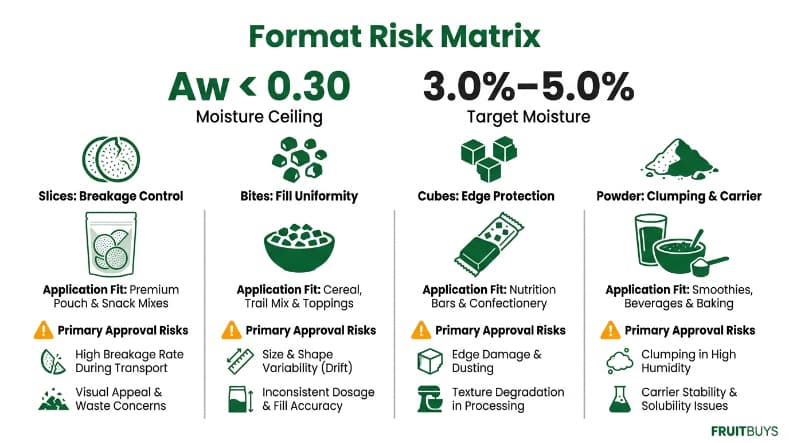
Private label format selection controls the whole project. A buyer cannot use one approval process for slices, bites, cubes and powder because each format fails differently.
| Format | Private Label Fit | Main Approval Risk |
|---|---|---|
| Slices | Retail snack pouch, topping, foodservice garnish | Breakage, thickness drift, color variation |
| Bites | Snack blend, tropical mix, small-pouch SKU | Irregular size, fines, inconsistent visual fill |
| Cubes | Cereal, granola, yogurt topping, controlled inclusion | Size tolerance, edge breakage, portion control |
| Powder | Beverage, bakery, dairy, smoothie, sachet | Mesh, carrier status, clumping, label impact |
The buyer should choose format by application. Slices sell visual identity. Bites support snack blends. Cubes support controlled inclusions. Powder supports formulation, but it demands stronger ingredient and packaging discipline.
Freeze-dried dragon fruit powder deserves special attention. Published powder research reports moisture, Aw, solubility and hygroscopicity values for freeze-dried dragon fruit powder, which supports the technical need to review powder as a separate specification rather than a smaller version of fruit pieces. The study does not prove a FruitBuys lot result, so the buyer still needs product-specific COA and release data. (U.S. Food and Drug Administration)
A private label buyer should define format before pack design and match it to the intended dragon fruit food and beverage applications. A pouch for slices needs different handling from a pouch for powder. A powder SKU may need a carrier declaration. A slice SKU may need stronger breakage limits. A cube SKU may need dimension tolerance. The format writes the rest of the file.
Lock Product and Packaging Specifications
Private label packaging must protect the approved product condition.
Shelf life depends on product format, moisture, Aw, package barrier, seal integrity and storage evidence.
Buyers should not approve packaging from material names alone.
Freeze-dried dragon fruit needs packaging control because the product remains sensitive after drying. FDA defines water activity as the ratio between the vapor pressure of a food and the vapor pressure of distilled water under identical conditions; FDA also links Aw to food stability and measurement conditions. (U.S. Food and Drug Administration)
For private label release, the product specification should connect:
- Format
- Size, thickness or mesh
- Moisture target
- Aw target
- Breakage and fines limit
- Color reference
- Ingredient statement
- Carrier status for powder
- Microbiology panel
- Packaging structure
- Seal method
- Storage condition
- COA scope
- Retained sample
Packaging should not use loose language. “Aluminium pouch” does not define barrier performance, direct-contact layer, seal process, food-contact status, pouch size or shelf-life support. FDA states that food packaging and other food-contact substances are regulated for safety, and FDA reviews food-contact substance information through its regulatory framework. (U.S. Food and Drug Administration)
A private label packaging file should include:
| Packaging Item | Buyer Approval Point |
|---|---|
| Primary pack | Direct product contact and barrier role |
| Direct-contact layer | Food-contact suitability |
| Laminate structure | Moisture and handling protection |
| Seal method | Moisture ingress and pack integrity |
| Pack size | Serving, filling, handling and label impact |
| Storage instruction | Shelf-life condition |
| Date coding | Market and traceability requirement |
| Carton format | Breakage and logistics protection |
| Retained sample | Later comparison and complaint review |
The buyer should not approve shelf life from a line on a product sheet. Shelf life must connect to the exact package and storage condition through the packaging and shelf-life requirements. Powder needs stricter inner-pack and reseal review because clumping can begin after opening. Slices and bites need breakage protection. Cubes need dimension and edge protection.

Build Label and Artwork Inputs
Artwork should not start as visual design. Artwork should start as a controlled product file. The label must match the actual formula, pack size, destination and release documents.
For the United States, FDA’s FSVP guidance explains that importers must establish and follow a foreign supplier verification program so imported food meets applicable US requirements and is not adulterated or misbranded with respect to allergen labeling. (U.S. Food and Drug Administration) Ingredient declaration also needs discipline: US ingredient rules require ingredients to be listed by common or usual name in descending order of predominance by weight, with defined exceptions. (Legal Information Institute)
For the EU, Regulation (EU) No 1169/2011 sets food-information requirements for consumers, and European Commission guidance states that nutrition information must generally be expressed per 100 g or per 100 ml. (Food Safety) For UAE and Dubai routes, Dubai Municipality lists food item registration and imported food consignment release services that the importer must handle under the relevant local process. (Dubai Municipality)
Private label artwork inputs should include:
| Artwork Input | Why It Must Be Locked |
|---|---|
| Product name | Prevents vague or misleading identity |
| Variant | Red-flesh or white-flesh |
| Format | Slices, bites, cubes or powder |
| Ingredient statement | Controls carrier, sugar and additive declaration |
| Nutrition basis | Supports Nutrition Facts or nutrition declaration |
| Pack size | Controls serving-size and label layout route |
| Storage instruction | Must match shelf-life and packaging evidence |
| Origin statement | Must match approved sourcing and documentation |
| Lot/date coding | Supports traceability and release |
| Claims | Must fit market-specific rules and product proof |
| Artwork version | Prevents old label files from entering production |
The powder route carries the highest label risk. A carrier change can change ingredient listing, Nutrition Facts, artwork language and buyer claims. The buyer should complete the Nutrition Facts and serving-size review before artwork approval. A pack-size change can reopen serving-size review. A destination change can reopen nutrition format and language requirements.
Do not let the label outrun the product. The destination file should follow the relevant market readiness requirements. When artwork moves faster than specification, the buyer prints uncertainty.
Approve the Sample Before Bulk
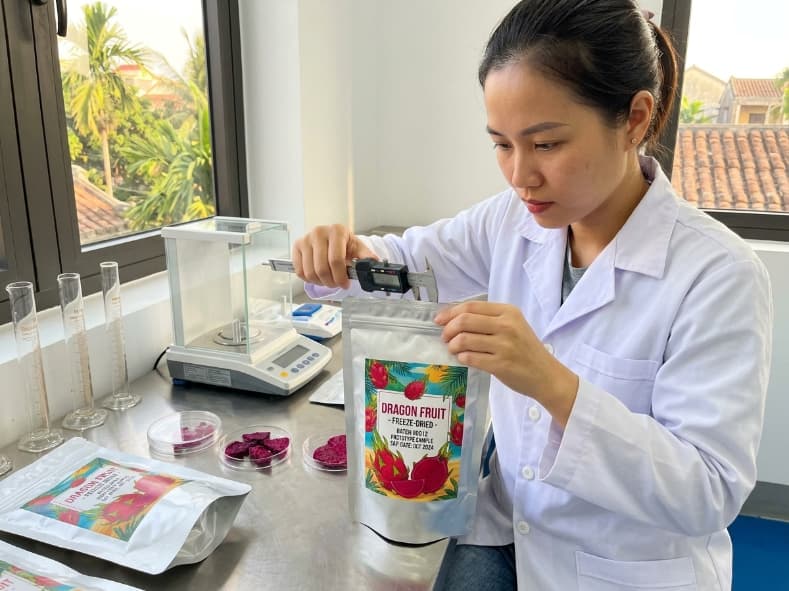
A private label sample should serve as a controlled approval object. It should not serve as a decorative promise.
The sample approval file should include:
- Sample lot code
- Product variant
- Format
- Size or mesh tolerance
- Ingredient statement
- Moisture target
- Aw target
- Visual reference
- Sensory reference
- Packaging sample
- Label or artwork draft version
- COA requirement
- Retained sample
- Approval date
- Change-control triggers
The buyer should test the sample in the intended use. A snack pouch sample needs handling and breakage review. A powder sample needs dispersion, clumping and package review. A cereal or granola inclusion needs mixing and fines review. A topping sample needs texture and visual review.
Low moisture does not remove the need for sanitation and microbiology review. FDA’s January 2025 draft guidance for low-moisture ready-to-eat human foods addresses sanitation programs, environmental monitoring and corrective actions after pathogen contamination events. (U.S. Food and Drug Administration) This matters for private label because the final retail brand carries consumer exposure. The sample approval should therefore include COA scope and microbiology expectations, not only sensory acceptance.
The sample should lock what bulk must match through the sample-to-bulk consistency controls. If the buyer approves a powder with one carrier status, bulk should not shift. If the buyer approves a slice thickness, bulk should not drift. If the buyer approves a retail pouch structure, bulk should not move into another barrier without review.
Release the Finished Lot
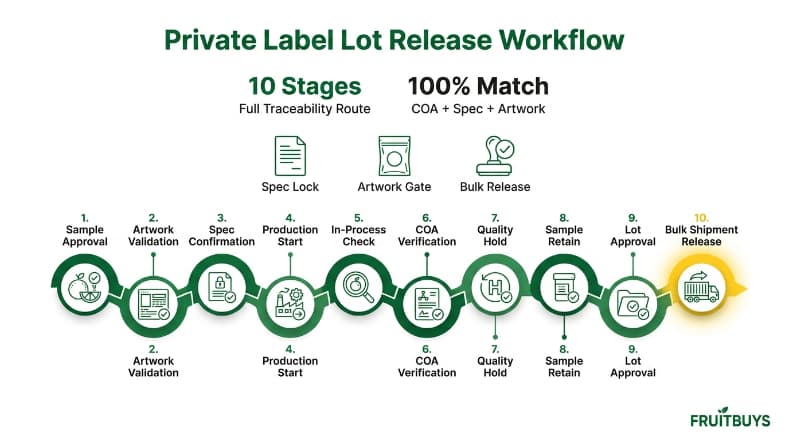
Finished-lot release requires the product, package, COA, artwork and shipment file to match.
A private label SKU is not ready when any one of those files carries a different identity.
Buyers should hold bulk approval until the release file ties the lot to the approved sample.
Bulk release is the stage where scattered decisions either connect or expose gaps. The buyer should not release private label freeze-dried dragon fruit because production finished. The buyer should release it because the files match.
The release file should connect:
| Release Item | Required Match |
|---|---|
| Approved sample | Same variant and format |
| Product specification | Same moisture, Aw, size, mesh and tolerance |
| Ingredient statement | Same formula and carrier status |
| Packaging file | Same pouch or inner-pack structure |
| Artwork | Same approved version |
| COA | Same product, lot code, method and result |
| Lab report | Same sample and test scope where needed |
| Packing list | Same lot and pack configuration |
| Carton mark | Same SKU and shipment identity |
| Retained sample | Same release reference |
ISO 22000:2018 is a food safety management system standard for organizations in the food chain, and ISO describes certification as one way to show that a food safety management system meets the standard’s requirements. (ISO) That system-level evidence does not replace product-specific lot release. The buyer still needs COA, packaging, artwork and lot identity.
A certificate logo cannot release a private label SKU. A COA from another lot cannot release the current goods. An artwork file that does not match ingredient status cannot release the pack. Release means connection.
FruitBuys should control final release through Quality Control and Documentation. The finished SKU must pass the COA and laboratory testing requirements and match the approved product file before shipment readiness review.
Change-Control for Private Label Projects
Private label projects need clear change-control rules because small changes can change the whole file. A pouch design can remain the same while the product behind it changes. That is the quiet risk.
A buyer should trigger re-approval when any of these change:
| Change Trigger | Required Review |
|---|---|
| Fruit variant | Color, sensory, application and label impact |
| Format | Size, packaging, breakage and application impact |
| Powder carrier | Ingredient, Nutrition Facts and claim impact |
| Mesh or particle range | Application and flowability impact |
| Moisture or Aw target | Shelf-life and COA impact |
| Pack size | Serving-size, label layout and handling impact |
| Packaging film | Shelf life, barrier and food-contact review |
| Artwork text | Label and market review |
| Destination market | Label format, language and document scope |
| Lab method | Result interpretation and COA review |
| Certificate scope | Site, process and product coverage |
| Carton configuration | Breakage and logistics review |
Change-control does not block progress. It protects the buyer from accidental nonconformity. When a change matters, FruitBuys should document it, review the impact and confirm whether a new sample or file update is required.
Private label supply works when product, label, pack and release proof move together. Final carton configuration should also follow carton and container payload planning. If they move separately, the SKU will eventually split under pressure.
Application Mapping
| Buyer Type | Application | Required Format | Proof Needed | FruitBuys Delivery |
|---|---|---|---|---|
| Private label brand | Retail pouch snack SKU | Slices or bites | Approved sample, artwork version, packaging file, Nutrition Facts basis and COA | OEM / Private Label Delivery and Documentation |
| Beverage brand | Smoothie or drink powder SKU | Powder | Mesh, carrier status, dispersibility, clumping review, label input and COA | Specification alignment and application-ready sample |
| Importer | Multi-market retail product | Slices, bites or powder | Destination file, ingredient statement, label route, COA and packing records | Documentation and export readiness review |
| Distributor | Tropical fruit snack range | Slices, bites and cubes | Format tolerance, shelf-life support, carton plan and lot documents | Quality Control and Export Logistics Coordination |
| QA manager | Private label lot release | Any approved format | COA, lab method, retained sample, packaging match and artwork identity | Controlled product release |
| R&D developer | Bakery, dairy or cereal application | Powder, cubes or bites | Application test, moisture, Aw, size or mesh and sample-to-bulk file | Raw Material Sourcing Governance and Quality Control |
Why FruitBuys Delivers This
FruitBuys supplies private label freeze-dried dragon fruit as a finished product under one accountable supplier relationship. The buyer does not buy a list of processors, packaging vendors and document contacts. The buyer receives one configured SKU with product, packaging, documentation and release criteria aligned.
Under OEM/Private Label Delivery, FruitBuys aligns format, pack size, artwork inputs, coding and label direction. Under Quality Control, FruitBuys verifies moisture, Aw, size, mesh, breakage, fines, sensory reference and retained sample against the approved specification. Under Documentation, FruitBuys connects ingredient statement, COA, lab reports, certificate scope, packaging file and lot identity. Under Raw Material Sourcing Governance, FruitBuys aligns variant, maturity and raw-material suitability with the selected product route. Under Export Logistics Coordination, FruitBuys aligns carton, handling and shipment readiness with fragile pieces or moisture-sensitive powder.
Private label execution punishes loose sequencing. Product first. Packaging second. Artwork after formula and destination review. Bulk release only after the files match.
Buyer Checklist
Before approving private label freeze-dried dragon fruit, confirm:
- Target destination
- Red-flesh or white-flesh variant
- Product format
- Application
- Ingredient statement
- Carrier status for powder
- Added sugar status
- Size, thickness or mesh
- Moisture target
- Aw target
- Microbiology panel
- Breakage and fines limit
- Packaging structure
- Food-contact file where required
- Pack size
- Storage instruction
- Nutrition Facts or nutrition declaration basis
- Label language route
- Artwork version
- Claims review
- COA scope
- Lab report scope
- Retained master sample
- Lot-code format
- Carton mark
- Shipment document identity
- Change-control triggers
Do not approve private label from artwork. Approve it from the product file, packaging file, label file and release file together.
Summary
Private label freeze-dried dragon fruit requires a defined product brief before artwork starts. Buyers should lock red-flesh or white-flesh variant, format, ingredient status, pack size, destination, moisture, Aw, packaging, Nutrition Facts route, COA and retained sample. Slices, bites, cubes and powder need different private label controls.
Powder needs added review for mesh, carrier status and clumping. FruitBuys supplies private label dragon fruit SKUs through OEM delivery, QC, documentation, raw-material governance and export logistics coordination.
FAQ
What should a private label dragon fruit brief include?
It should include variant, format, application, ingredient status, pack size, destination, packaging, nutrition route, COA scope and release criteria.
Should artwork start before product approval?
No. Product format, ingredient statement, pack size, destination rules and Nutrition Facts basis should be approved before artwork is locked.
Which format works best for private label snacks?
Slices and bites usually fit snack pouches. The buyer should control size, breakage, moisture, Aw, packaging and visual standard.
Which format works best for private label powder?
Powder works for beverage, bakery, dairy and dry blends. It needs mesh, carrier status, clumping review, packaging and COA.
Can the same label serve the US, EU and UAE?
No. Each market uses different label, nutrition, language and importer-review routes. Build separate artwork routes by destination.
Does certification replace COA?
No. Certification supports system or site review. COA supports the stated product lot. Private label release needs both when required.
When should a buyer request a new sample?
Request a new sample when variant, format, formula, mesh, packaging, pack size, destination, artwork claim or COA scope changes.
Conclusion
Submit the product brief, destination, format, pack size and artwork route so FruitBuys can review the private label release file before sample approval.
References
- U.S. Food and Drug Administration. Guidance for Industry: Foreign Supplier Verification Programs for Importers of Food for Humans and Animals. January 2023. (U.S. Food and Drug Administration)
- Legal Information Institute. 21 CFR § 101.4, Food; designation of ingredients. Current CFR text. (Legal Information Institute)
- European Commission. Mandatory food information. Current official guidance for Regulation (EU) No 1169/2011. (Food Safety)
- European Commission. Nutrition labelling. Current official guidance. (Food Safety)
- Dubai Municipality. Dubai Municipality Services, Register and Assess a Food Item and release imported consignments. Current official services page. (Dubai Municipality)
- U.S. Food and Drug Administration. Food Packaging & Other Substances that Come in Contact with Food. Current official guidance. (U.S. Food and Drug Administration)
- U.S. Food and Drug Administration. Water Activity (aw) in Foods. Current FDA technical guidance page. (U.S. Food and Drug Administration)
- U.S. Food and Drug Administration. Draft Guidance for Industry: Establishing Sanitation Programs for Low-Moisture Ready-to-Eat Human Foods and Taking Corrective Actions Following a Pathogen Contamination Event. 2025. (U.S. Food and Drug Administration)
- International Organization for Standardization. ISO 22000:2018 Food safety management systems, Requirements for any organization in the food chain. (ISO)