What does freeze-dried dragon fruit need to clear US, EU, UK and UAE customs?
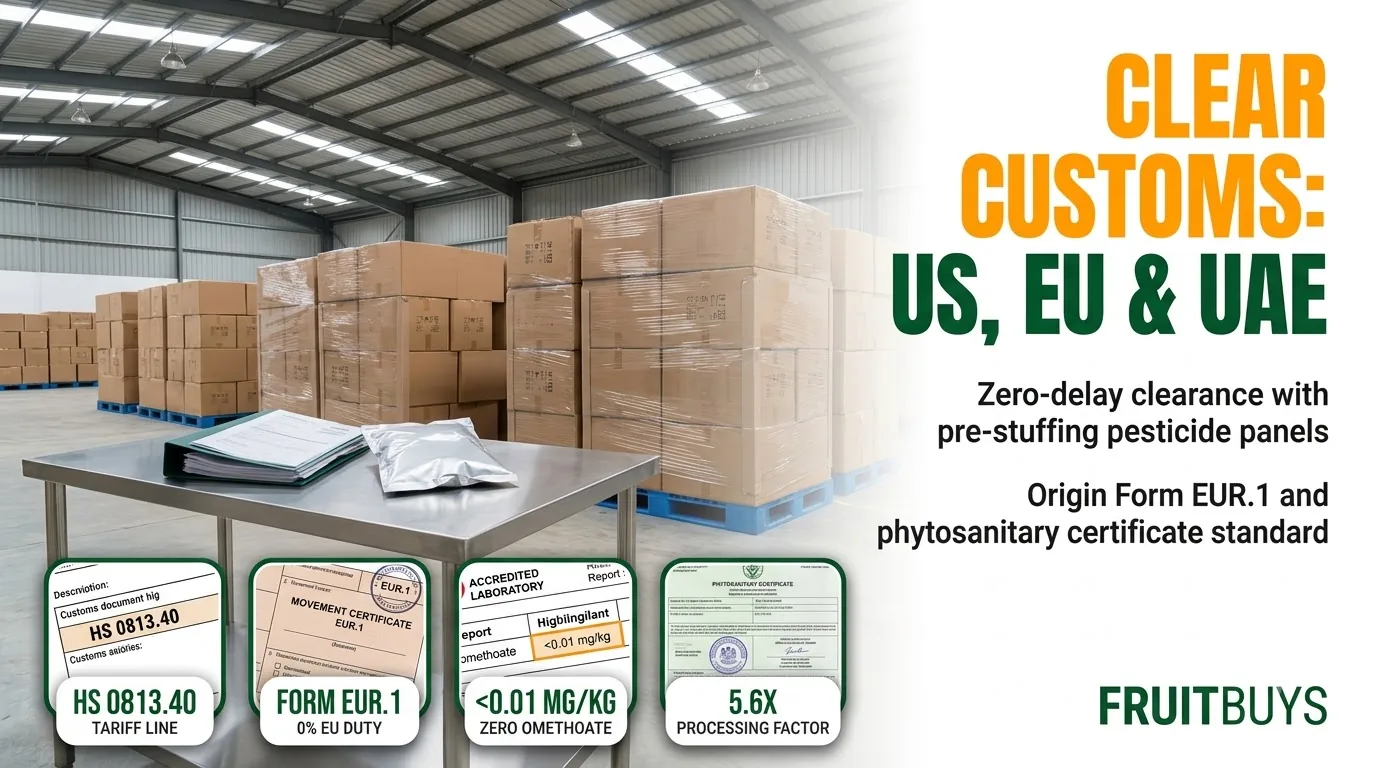
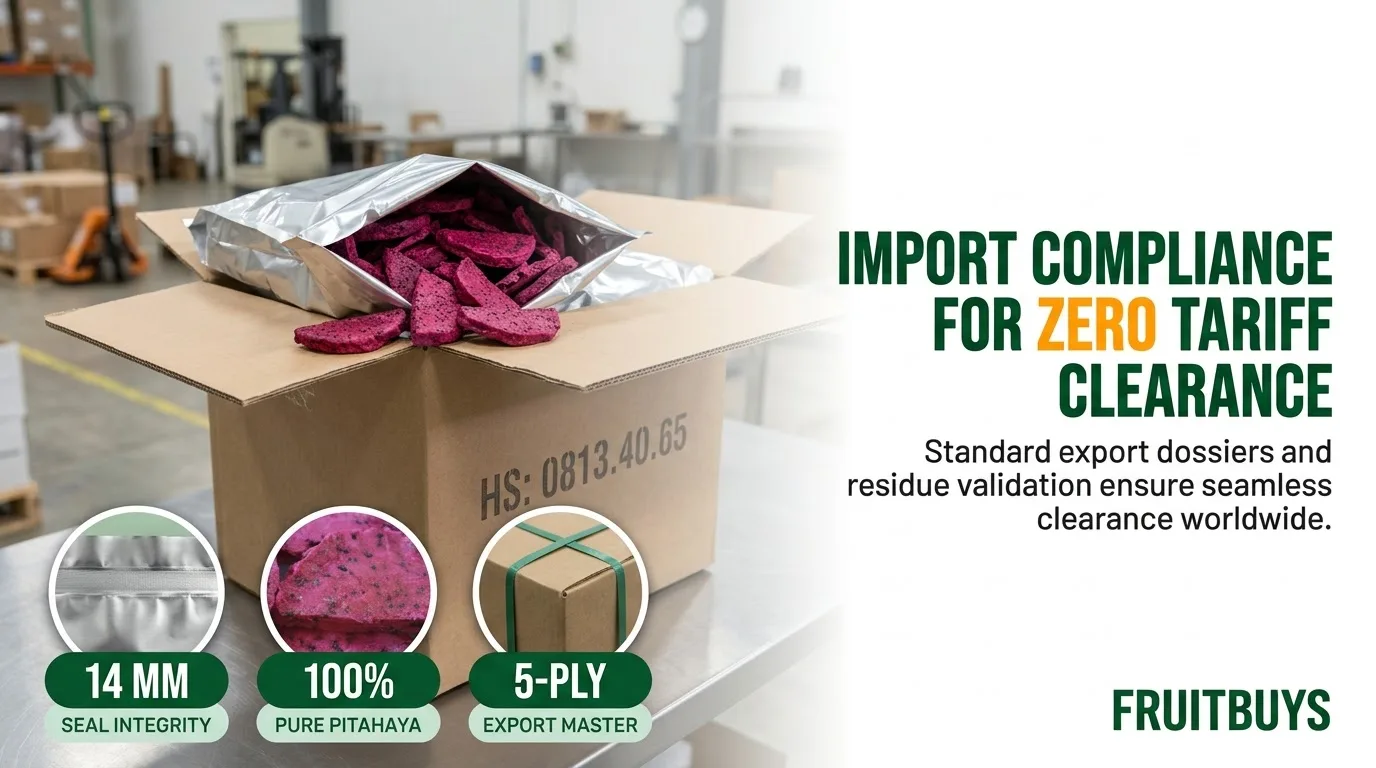
A clean dossier and a residue result that holds up on the fresh-fruit basis. Freeze-dried dragon fruit enters as dried fruit under heading 0813.40, not as fresh pitahaya, so the increased border checks the EU and UK run on fresh Vietnamese dragon fruit do not apply to it. Every FruitBuys container ships with the same standard set: commercial invoice, packing list, bill of lading, certificate of origin, phytosanitary certificate and the lot COA. What decides a fast release is settled before stuffing: the right code, the right origin form, and, for EU and UK lots, a multi-residue panel your importer can show on request.
Which code and documents does each market need?
| EU | UK | US | UAE | |
|---|---|---|---|---|
| Code | CN 0813 40 65 | 0813 40 65 00 | HTSUS 0813.40.90 | HS 0813.40 |
| Duty (reference) | 0% for every origin | 0% for every origin | 2.5% general rate, plus any additional duty on Vietnamese goods in force on the entry date | 5% GCC common tariff on CIF value |
| Certificate of origin | EUR.1 (EVFTA) | EUR.1 (UKVFTA) | Standard C/O | C/O Form B |
| Border regime for this product | Routine official controls | Routine import controls | FDA entry review | Municipality inspection |
| Importer files | Customs declaration | Customs declaration, IPAFFS where required | Prior Notice, FSVP records | Importer and product registration (Dubai Municipality FIRS) |
| From FruitBuys with every shipment | Invoice, packing list, B/L, EUR.1, phyto, lot COA | Same as EU | Invoice, packing list, B/L, C/O, phyto, lot COA, facility registration number | Invoice, packing list, B/L, C/O, phyto, lot COA, health certificate |
Europe is the cheapest entry: dried pitahaya under 0813 40 65 carries no import duty in either the EU or the UK, from any origin, so EUR.1 travels as part of the standard set rather than as a duty saver. These are reference rates for your landed-cost model. Before the container sails, FruitBuys sends the draft B/L, invoice, HS line and C/O to your broker for a cross-check, so the entry matches the documents at the destination port. For the US, the partner facility holds US FDA Facility Registration; your importer files Prior Notice before arrival and keeps the Foreign Supplier Verification file, for which FruitBuys supplies the specification, certificates, baseline reports and lot COA. A binding tariff ruling, if your broker wants one, is a one-time request on the product sheet.
Powder is a different entry. 100% dragon fruit powder classifies under 1106.30; powder with a carrier such as maltodextrin moves to 2106.90. See freeze-dried dragon fruit powder.

“Vietnamese dragon fruit is under EU checks.” Does that hit freeze-dried lots?
No. The EU lists fresh dragon fruit from Vietnam, CN 0810 90 20, for increased checks on pesticide residues: a 30% identity and physical check rate under the EU list of higher-risk imports of non-animal origin, with an official certificate and sampling results required from Vietnam. No 0813 line for Vietnam appears on that list. Great Britain runs the same logic at a higher rate: fresh pitahaya from Vietnam is checked at 50% under its high-risk food import rules, and dried fruit is not listed.

For an EU or UK buyer this is the strongest commercial case for freeze-dried over fresh or frozen. A fresh reefer container has a real chance of a port hold while a sample goes to the lab, and a held lot typically waits one to two weeks (7–14 days) for results, and every day on the quay adds demurrage, reefer plug-in charges and a cargo losing value by the hour. A freeze-dried container travels as a dry box, clears under routine controls and carries a shelf life measured in months, so the goods reach your warehouse and your invoice reaches your customer without waiting on a border lab. That is working capital released, not just a lower inspection rate. Both lists are reviewed every six months, and FruitBuys checks the current version at booking.
What the freeze-dried lot still has to meet is the residue limit. The fresh-fruit history is exactly why EU and UK QA teams ask for a residue panel on dried dragon fruit too, and why it pays to have one ready.
How are residue limits applied to a dried product?
On the fresh basis, corrected for water. EU limits for dragon fruit sit in the cactus-fruit group of the EU pesticide residue database, and many substances sit at the default 0.01 mg/kg. A lab reading on freeze-dried fruit is divided by the processing factor before it is compared:
Fresh-basis result = dried result ÷ Pf, where Pf = (100 − finished moisture) ÷ (100 − fresh moisture)
For red dragon fruit at 84–87% water dried to 4%, Pf is about 6–7.4. A reading of 0.06 mg/kg on the dried product equals 0.01 mg/kg on the fresh fruit, which is at the default limit, not above it. A QA team that compares the raw dried figure to the fresh limit will reject a compliant lot; one that has the factor on file next to the COA will not. The 13–15 kg production ratio is never used here, because peel and trimming remove fruit, not residue concentration. The full yield chain is in how many kilos of dragon fruit make 1 kg of freeze-dried.
The EU is moving toward hazard-based limits, with substances of high concern pushed to the default 0.01 mg/kg. That raises the value of a multi-residue result on the lot rather than a general statement from the supplier.

Which tests should you add before the container ships?
The lot COA covers moisture, water activity, TPC, yeasts and moulds, E. coli and Salmonella; lead, arsenic and aflatoxin run on periodic baseline surveillance. Release limits are in the moisture, water activity and microbial limits for freeze-dried dragon fruit. On top of that, three panels answer the questions border labs and retail QA teams actually ask of dragon fruit:
| Panel | Why buyers run it on dragon fruit | When it pays |
|---|---|---|
| Pesticide multi-residue (LC-MS/MS + GC-MS/MS, 500+ substances) | Fresh Vietnamese dragon fruit is on the EU and GB increased-check lists for residues; importers want proof the dried lot is clean on the fresh basis | Every first EU or UK container; then by programme |
| Synthetic colour screen (azo dyes, Rhodamine B) | The magenta is so vivid that a retail QA team opening the first pouch often asks whether it was dyed | Retail and private-label programmes, first lot |
| Sulfite, target <10 mg/kg as SO₂ | No sulfite is used; a result below the labelling threshold backs a “no added sulphites” line on pack | Retail packs in the EU, UK and US |
These panels are run at an independent ISO/IEC 17025 accredited laboratory in Vietnam. On full-container contracts they are coordinated before stuffing as part of export release, with the cost paid by the buyer or shared according to programme volume. On trial or LCL orders they run at net lab cost, credited in full against your first container. Allow 3–5 working days for results.

How do you prove the colour is the fruit, not a dye?
Run the screen and turn it into your story. Red-flesh dragon fruit from southern Vietnam dries to a magenta so intense that it looks added, and that is exactly why the colour screen is worth having: a clean result is the document that lets a demanding retailer list a vivid pink product with an ingredient line that reads “dragon fruit” and nothing else. No E-number, no colouring agent, no explanation needed at the border or on the shelf.

The pigment is betacyanin, and it behaves like a natural one: it bleeds pink into milk or yogurt within minutes and fades toward brown under long heat or strong light. A synthetic dye does neither as quickly. With the colour screen and a sulfite result below 10 mg/kg on file, a brand can print “100% fruit, no added sulphites, no colours” and back every word of it, which is the line that earns a place on clean-label and better-for-you shelves at a higher shelf price. How the colour behaves in your product is covered in freeze-dried dragon fruit formats.
What should be settled at each step?
| When | Importer | FruitBuys |
|---|---|---|
| Before the contract | Name the panels your market needs; share your broker’s contact | Sends specification, certificates, baseline reports and a sample dossier for your market |
| Before production | UAE retail: Arabic label approval. US: FSVP supplier file | Fixes the document set and panel plan in the order |
| Before stuffing | Approves panel results | Runs panels, issues lot COA, retains a sealed sample from the lot for its full shelf life |
| At sailing | Files Prior Notice (US) and pre-arrival declarations | Releases invoice, packing list, B/L, C/O or EUR.1, phyto, COA |
| On arrival | Keeps the processing factor with the COA for any residue query | Works with your QA team and broker on any border-lab question until the container is released |
In the UAE, retail goods must arrive with more than half of their declared shelf life remaining. On a 12-month shelf life at ≤25 °C, RH ≤60%, that is never close when the lot is produced against the booking. Packing, desiccant and container loading are in how freeze-dried dragon fruit is packed and loaded for export.
What about other formats and markets?
- Fresh or frozen dragon fruit sits on the EU and GB increased-check lists and follows US plant-health import rules, so it travels on a different dossier. Freeze-dried is the format that avoids all three.
- Soft-dried dragon fruit for chewy snacks is classified on its own recipe: see dried dragon fruit.
- China, Korea, Australia and other markets each have their own registration and residue lists. Tell us the destination and FruitBuys prepares the dossier for it before you commit volume.
Get the document pack for your market
Tell us your destination, entry port and whether you sell bulk or retail, and we send the specification, certificates, baseline reports and a sample shipping dossier for that market, with the panel plan for your first container. Product data is on the freeze-dried red dragon fruit product page, and the full buying checklist is in what to check before buying freeze-dried dragon fruit in bulk.
FAQ
What is the HS code for freeze-dried dragon fruit? Heading 0813.40. In the EU it is CN 0813 40 65; in the US, HTSUS 0813.40.90. Powder moves to 1106.30, or 2106.90 with a carrier.
Is there import duty on freeze-dried dragon fruit? Not in the EU or UK: 0813 40 65 carries 0% for every origin. The US general rate on HTSUS 0813.40.90 is 2.5%, plus any additional duty on Vietnamese goods in force at entry; the UAE applies the 5% GCC common tariff.
Are freeze-dried dragon fruit shipments subject to the EU 30% checks? No. The 30% rate applies to fresh dragon fruit from Vietnam, CN 0810 90 20. Dried fruit goes through routine controls.
Does FruitBuys send a phytosanitary certificate? Yes. A phytosanitary certificate is included with every shipment as part of FruitBuys’ standard export dossier, with the certificate of origin and lot COA.
How do I compare a residue result on dried fruit with the EU limit? Divide the dried result by the processing factor, about 6–7.4 for freeze-dried red dragon fruit, then compare it with the fresh-fruit limit.
Who pays for residue, colour and sulfite tests? On full containers the buyer pays or the cost is shared according to volume, and the panels are coordinated before stuffing. On trial lots they run at net lab cost, credited in full against the first container.