
Freeze-Dried Dragon Fruit Formats: Cubes, Bites, Slices or Powder
Freeze-dried dragon fruit formats look simple until a buyer has to approve bulk goods. A slice, cube, bite and powder do not carry the same risk. A slice sells on visual appeal but breaks easily. A cube fits cereal and granola but needs tight size control. A bite works for snack blends but can become irregular if sorting rules drift. Powder gives color and formulation flexibility, but it raises mesh, carrier, clumping and label questions.
A buyer who approves only the format name has not approved the product. Importers, private label brands, QA managers and R&D developers should define the format, dimension, moisture, Aw, breakage, fines, packaging and COA before bulk release. FruitBuys supplies the selected format as one controlled product, not as a loose sample pulled from a tray.
The Four Core Formats
Freeze-dried dragon fruit can be supplied as slices, bites, cubes or powder.
Each format serves a different buyer application and carries a different release risk.
Buyers should choose the format after confirming application, size tolerance, moisture, Aw, packaging and documentation.
Dragon fruit has high natural moisture, which makes drying control important. A dragon fruit drying study notes that fresh dragon fruit is highly perishable because of its high water content, and the same study compared freeze-dried dragon fruit slices and pulp with other drying methods across physicochemical and quality attributes. (MDPI)
For B2B buyers, that means format selection cannot stop at appearance. The product structure changes how the buyer should test, pack and release the goods. Slices, bites and cubes keep visible fruit structure. Powder changes the product into an ingredient system.
| Format | Best Use | Main Control Point | Buyer Risk |
|---|---|---|---|
| Slices | Retail snack, topping, garnish | Thickness, color, breakage | Beautiful sample breaks in bulk |
| Bites | Snack blends, mixed tropical packs | Size range, fines, texture | Irregular pieces disrupt fill and appearance |
| Cubes | Cereal, granola, dairy inclusions | Dimension, edge integrity, moisture | Poor portion control and excess fines |
| Powder | Beverage, bakery, dairy, color ingredient | Mesh, carrier status, clumping | Ingredient and label mismatch |
FruitBuys should treat the format as a specification decision. Buyers qualifying the wider category should first review the freeze-dried dragon fruit buyer guide. The buyer should not approve “freeze-dried dragon fruit” in general. The buyer should approve one selected format under one written release file.
For wider category navigation, buyers can review the FruitBuys freeze-dried fruit portfolio, but the final decision still requires a product-specific specification.
Slices for Retail, Topping and Visual Applications
Slices carry the strongest visual value. They show the fruit identity, the seeds, the red or white flesh and the freeze-dried structure. That makes slices useful for retail snack pouches, foodservice garnish, yogurt topping, dessert decoration and premium-looking tropical fruit assortments.
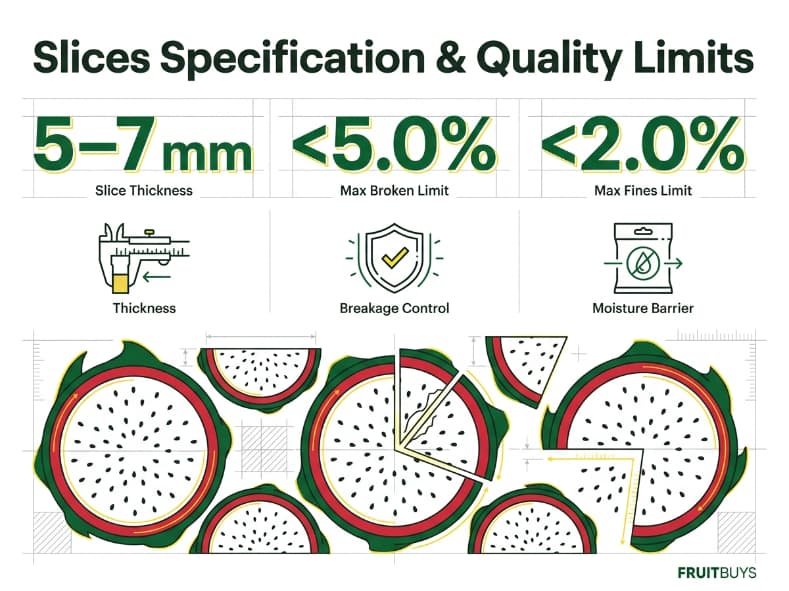
The same visual strength creates the risk. A slice can look impressive in a sample pouch and fail after transport because thin edges break, curled pieces fracture or moisture gain softens the texture. The buyer should not approve slices from a photo. The buyer should approve slices from a written specification.
A slice specification should define:
- Length range
- Width range
- Thickness range
- Acceptable shape variation
- Color reference or master sample
- Broken-piece limit
- Fines limit
- Moisture target
- Aw target
- Packaging structure
- COA requirement
A published dragon fruit drying study kept slice and pulp thickness at 5 to 7 mm in its experimental design, and it reported that freeze-dried slice powder produced from dried samples reached low moisture values under the study conditions. This does not create a FruitBuys specification, but it confirms that thickness and drying condition matter when comparing dragon fruit formats. (MDPI)
Slices require strong packaging alignment. A buyer who wants retail pouches should review retail pack structure. A buyer who wants bulk slices should review inner-bag weight, carton protection, headspace and handling through the packaging and shelf-life controls. Fragile slices do not forgive lazy logistics.
Bites for Snack Blends and Mixed Tropical SKUs
Bites sit between slices and cubes. They give visible fruit identity without requiring the same uniform geometry as cubes. They can work well in mixed tropical snack blends, healthy indulgence snack ranges, gift packs and small-portion retail pouches.
Buyers like bites because they look natural. QA teams worry about bites because “natural” can become a fog machine for weak size control. A bite format must still define what counts as acceptable product and what counts as broken pieces or fines.
Bites should be specified by:
| Item | Buyer Decision |
|---|---|
| Size range | Prevents oversized and undersized drift |
| Piece definition | Separates bite pieces from broken waste |
| Fines limit | Protects retail appearance and fill weight |
| Color range | Keeps red-flesh products visually consistent |
| Texture | Confirms crispness or intended bite |
| Moisture and Aw | Controls stability after packing |
| Packaging | Reduces breakage and moisture gain |
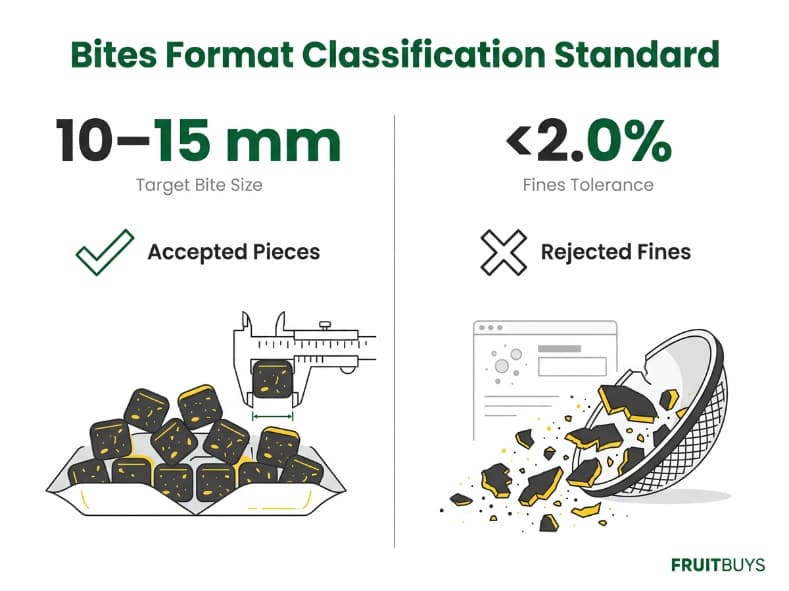
Bites suit private label snack development when the buyer wants a less rigid, more natural-looking fruit piece. They also fit blends with mango, pineapple or banana where the SKU relies on visual variety. Buyers can map this route against FruitBuys healthy indulgence snacks when building a snack category, not just a single dragon fruit SKU.
The release risk stays clear. If the sample shows attractive bites and the bulk lot contains too many flakes, the product will not match the approved retail concept. The buyer should lock the bite definition before production.
Cubes for Controlled Inclusions
Cubes serve buyers who need more repeatability. Cereal, granola, snack-mix, dairy topping and food-manufacturing teams often prefer cubes because they can control portioning, blending and visual distribution more easily than irregular pieces.
A cube specification should include:
- Target cube size
- Permitted tolerance
- Broken-cube limit
- Fines limit
- Moisture target
- Aw target
- Color standard
- Packaging method
- Bulk-density review when needed
- COA and retained sample

Cubes create their own risk. If the cube is too large, it may not blend well. If it is too small, it can disappear visually. If the edge integrity is poor, the product may generate fines during transport. If moisture is not controlled, the cube can lose crispness or collapse under compression.
FDA’s water activity guidance states that water activity affects food stability and should reach a suitable level after drying and remain within an acceptable range during storage. That applies directly to cube release because stable geometry after drying still needs stable Aw after packing. (U.S. Food and Drug Administration)
Cubes should not be approved by size name alone. “10 mm cube” means little if tolerance, sorting rules and breakage limits do not exist. The buyer should require a sample that matches the written cube specification and a bulk lot that matches both.
Powder for Beverage, Bakery and Ingredient Systems
Dragon fruit powder is not just a smaller format.
It becomes an ingredient system that needs mesh, carrier, moisture, Aw, clumping, color and label review.
Buyers should approve powder only after the ingredient statement and application test match the intended market.
Powder serves beverage mixes, smoothies, dairy systems, bakery, confectionery, dry blends, dessert bases and natural-color applications. Buyers should define the format through the dragon fruit powder specification. It gives the buyer formulation flexibility. It also creates the most documentation pressure.
A 2024 freeze-dried dragon fruit powder study reported moisture of 5.037 ± 0.17%, Aw of 0.3122 ± 0.06, solubility of 60.54 ± 0.40% and medium hygroscopicity of 34.61 ± 12.15, indicating a moderate tendency to absorb environmental moisture. This study supports the need for powder-specific moisture, Aw, solubility, hygroscopicity and packaging review. (Observatorio Latinoamericano)
Powder buyers should define:
| Powder Control | Why It Matters |
|---|---|
| Mesh or particle size | Controls mouthfeel, dispersion and blending |
| Carrier status | Affects ingredient statement and Nutrition Facts |
| Added sugar status | Affects label and buyer positioning |
| Solubility or dispersibility | Affects beverage and dairy applications |
| Hygroscopicity | Affects clumping and storage |
| Moisture and Aw | Supports stability review |
| Color behavior | Affects formulation outcome |
| Microbiology | Supports food-safety release |
| Packaging | Controls moisture exposure after opening |
Powder can be 100% fruit or formulated with carrier, depending on the product design. The buyer must not assume either direction. A carrier may improve flowability or handling in some applications. A fruit-only powder may support a cleaner ingredient statement, but it can raise clumping and shelf-life handling pressure. The right answer depends on the buyer’s application and destination label rules.
Buyers developing powder-based SKUs should also review FruitBuys dried fruit powder formats, then request a dragon-fruit-specific specification before sample approval.
Breakage, Fines and Size Tolerance
Breakage is not a warehouse complaint. It is a specification issue. Freeze-dried products can fracture when format, packaging, carton configuration and handling do not align.
The buyer should define three separate terms:
| Term | Definition Needed |
|---|---|
| Accepted pieces | Product that meets the approved format |
| Broken pieces | Product that no longer meets visual or size criteria |
| Fines | Small fragments or powder below the accepted threshold |
These definitions matter because every application has a different tolerance. Retail snack pouches need visual consistency. Granola producers may accept smaller pieces within limits. Powder buyers may care less about broken pieces but more about mesh, flowability and clumping.
A serious format specification should state:
- Sample inspection method
- Sieve or measurement method where relevant
- Acceptable size range
- Broken-piece limit
- Fines limit
- Test sample size
- Inspection frequency
- Photo or master sample reference
- Release action when limits fail
Do not approve “low breakage” as a phrase. It has no release force. Define the limit, test the lot and connect the result to the COA or QA release file.
Buyers should connect the selected format to real dragon fruit food and beverage applications before approving the sample.
Format Selection Matrix
| Buyer Type | Application | Recommended Format | Proof Needed | Main Risk |
|---|---|---|---|---|
| Importer | Ambient retail snack | Slices or bites | Moisture, Aw, visual standard, breakage limit | Sample looks better than bulk |
| Private label brand | Retail pouch SKU | Slices, bites or powder | Packaging file, artwork input, Nutrition Facts basis | Label and product file do not match |
| Cereal producer | Dry inclusion | Cubes or small bites | Size tolerance, fines, Aw, packaging | Uneven distribution and excess fines |
| Granola producer | Tropical inclusion | Cubes or bites | Breakage limit, moisture migration review | Product softens or breaks in blend |
| Beverage developer | Smoothie or drink base | Powder | Mesh, carrier status, solubility, microbiology | Clumping or label mismatch |
| Dairy developer | Yogurt or ice cream topping | Cubes, bites or powder | Microbiology, color, moisture, application test | Texture changes after application |
| Bakery developer | Color or fruit ingredient | Powder | Heat behavior, carrier, ingredient statement | Color shift or formula instability |
| Foodservice distributor | Garnish or topping | Slices | Visual standard, carton protection, storage | Broken pieces reduce presentation value |

Format Approval Workflow
A buyer should approve freeze-dried dragon fruit format in sequence. Skipping the sequence creates confusion later.
- Define the application.
- Select red-flesh or white-flesh product.
- Select slices, bites, cubes or powder.
- Define size, thickness or mesh.
- Define moisture and Aw targets.
- Define breakage and fines limits.
- Confirm ingredient and carrier status.
- Confirm packaging structure.
- Approve retained master sample.
- Confirm COA and lab-test scope.
- Confirm bulk-release checklist.
- Confirm change-control triggers.
This workflow protects both sides. The buyer knows what to expect. FruitBuys knows what to supply, verify and release. Bulk approval should follow the sample-to-bulk consistency criteria. The product stops drifting between sample stage and shipment stage.

Private Label Format Approval
Private label buyers face an extra layer of risk because format affects artwork, pack size, serving-size logic, ingredient statement, photography, claims review and shelf-life handling. The selected format should enter the private label dragon fruit delivery workflow before artwork approval. A powder SKU and a slice SKU should not share the same label assumptions.

Private label format approval should include:
- Approved product format
- Pack size
- Pouch structure
- Ingredient statement
- Nutrition Facts basis
- Storage instruction
- Visual standard
- Lot coding
- Carton mark
- COA scope
- Artwork version
If the product changes from bites to powder, the artwork file should reopen. If the powder contains a carrier, the ingredient and Nutrition Facts review should reopen. If the pack size changes, serving-size logic should reopen for the destination market. Buyers lose control when packaging moves faster than the product file.
FruitBuys handles this through OEM / Private Label Delivery and Documentation. The private label product should move as one approved SKU, not as separate conversations about fruit, pouch, artwork and lab reports.
Application Mapping
| Buyer Type | Application | Required Format | Proof Needed | FruitBuys Delivery |
|---|---|---|---|---|
| Importer | Retail snack distribution | Slices or bites | Approved sample, moisture, Aw, breakage limit and COA | Quality Control and Documentation |
| Distributor | Multi-channel dried fruit stock | Slices, bites and powder | Format-specific specification and packaging file | Integrated product supply and shipment readiness |
| Private label brand | Retail pouch SKU | Slices, bites or powder | Packaging brief, artwork input, ingredient file and release criteria | OEM/Private Label Delivery |
| QA manager | Supplier qualification | Any approved format | Lot COA, test method, format tolerance and retained sample | Documentation and controlled product release |
| R&D developer | Beverage, bakery or dairy formulation | Powder | Mesh, carrier status, solubility, moisture and Aw | Application-ready specification alignment |
| Cereal or granola producer | Dry inclusion | Cubes or bites | Size tolerance, fines, breakage and moisture migration review | Format control and packaging alignment |

Why FruitBuys Delivers This
FruitBuys supplies freeze-dried dragon fruit as an export-ready product under one accountable supplier relationship. The buyer does not need a menu of loose formats. The buyer needs one selected format built around the application, specification, packaging and release file.
Under Raw Material Sourcing Governance, FruitBuys aligns fruit variant, maturity and raw-material suitability with the intended format. Under Quality Control, FruitBuys verifies size, moisture, Aw, breakage, fines and sensory reference against the approved specification. Under Documentation, FruitBuys connects the COA, lab file, ingredient statement, packaging file and lot identity to the actual goods. Under OEM/Private Label Delivery, FruitBuys aligns pack size, artwork inputs and format-specific label needs. Under Export Logistics Coordination, FruitBuys reviews carton and handling conditions for fragile pieces and moisture-sensitive powder.
The format decision controls the rest of the order. If the buyer selects powder, the file must answer mesh, carrier and clumping. If the buyer selects slices, the file must answer breakage and visual standard. If the buyer selects cubes, the file must answer size tolerance and inclusion behavior. FruitBuys keeps those decisions inside one supply model.
Buyer Checklist
Before approving freeze-dried dragon fruit format, confirm:
- Red-flesh or white-flesh variant
- Intended application
- Format: slices, bites, cubes or powder
- Size, thickness or mesh
- Accepted-piece definition
- Broken-piece limit
- Fines limit
- Color reference or retained master sample
- Ingredient statement
- Carrier status for powder
- Added sugar status
- Moisture target
- Aw target
- Microbiology requirement
- Packaging structure
- Inner-pack weight
- Shelf-life support
- COA scope
- Bulk-release criteria
- Private label artwork impact
- Change-control triggers
Do not approve a format name. Approve a format specification.
Summary
Freeze-dried dragon fruit is commonly developed as slices, bites, cubes or powder. Slices fit retail snack and topping use but need breakage and visual control. Bites fit snack blends but need size and fines limits. Cubes fit cereal, granola and dry inclusions but need dimension control.
Powder fits beverage, bakery and dairy applications but needs mesh, carrier, moisture, Aw, clumping and label review. FruitBuys supplies format-specific freeze-dried dragon fruit through specification control, QA documentation, packaging alignment and private label delivery.
FAQ
Which freeze-dried dragon fruit format works best for retail snacks?
Slices and bites usually fit retail snack applications. The buyer should control visual standard, size, breakage, moisture, Aw and packaging.
Which format works best for cereal or granola?
Cubes or small bites usually fit cereal and granola. They need size tolerance, fines control, moisture control and packaging review.
Is dragon fruit powder always 100% fruit?
No. Powder may be fruit-only or formulated with a carrier. The buyer must confirm the ingredient statement before label or application approval.
Why does powder need a separate specification?
Powder needs mesh, carrier status, solubility or dispersibility, clumping review, moisture, Aw and packaging control. Piece-format specifications cannot cover powder properly.
Can one COA cover all formats?
No. A COA should match the exact product format and lot. Slices, cubes, bites and powder require different release logic.
What causes excessive fines?
Fines can come from weak format control, over-fragile texture, poor sorting, compression, vibration, bulk packing or inadequate carton protection.
Should private label buyers approve format before artwork?
Yes. Format affects pack size, ingredient statement, Nutrition Facts, storage instruction, visual standard and shelf-life review.
Conclusion
Submit the intended application, format, pack type and destination so FruitBuys can review the format specification and sample-release criteria before bulk approval.
References
- U.S. Food and Drug Administration. Water Activity (aw) in Foods. Content current as of 2014. (U.S. Food and Drug Administration)
- Iqbal, A., et al. Impact of Different Drying Methods on the Phenolic Composition, In Vitro Antioxidant Activity, and Quality Attributes of Dragon Fruit Slices and Pulp. Foods, 2023. (MDPI)
- Oliveira, V. C., Lourenço, M. T., Paiva, M. J. A., et al. Freeze-dried dragon fruit powder: characterization and incorporation in plant-based drink. Observatório de la Economía Latinoamericana, 2024. DOI: 10.55905/oelv22n6-079. (Observatorio Latinoamericano)