
Freeze-Dried Dragon Fruit Packaging and Shelf-Life Control
Freeze-dried dragon fruit packaging and shelf life decide whether a bright sample can survive real storage, repacking, private label handling and export release. A slice can leave the dryer crisp and arrive soft. A powder can pass color review and later clump inside a bulk bag. A pouch can look correct but fail the product if barrier data, seal control and storage conditions remain unverified. Importers, QA managers and private label owners should treat packaging as part of the product specification, not a decoration around it.
A shelf-life claim without moisture, Aw, package barrier, seal integrity and storage evidence does not protect the buyer. FruitBuys aligns packaging with product format, COA review, sample-to-bulk control and shipment readiness before the buyer approves bulk release.
Why Freeze-Dried Dragon Fruit Needs Barrier Packaging
Freeze-dried dragon fruit needs packaging that limits moisture exposure after drying.
Moisture gain can soften slices, increase breakage risk and make powder clump before use.
Buyers should review packaging structure, seal condition, moisture, Aw and storage evidence together.
Freeze-dried dragon fruit behaves like a dry sponge with a contract attached. It may look stable, but it still responds to air, humidity, handling and time. FDA explains that water activity affects food stability and must reach a suitable level after drying and remain within an acceptable range during storage. FDA also describes equilibrium behavior between food and surrounding air, which means moisture can move when the storage environment pushes the product out of balance. (U.S. Food and Drug Administration)
That principle matters for every freeze-dried dragon fruit format. Slices need crispness and visual integrity. Bites and cubes need size stability and low fines. Powder needs flowability and protection from clumping. A packaging file that only says “aluminium pouch” or “barrier bag” does not give QA enough information. Buyers qualifying the complete product should first review the freeze-dried dragon fruit buyer guide.
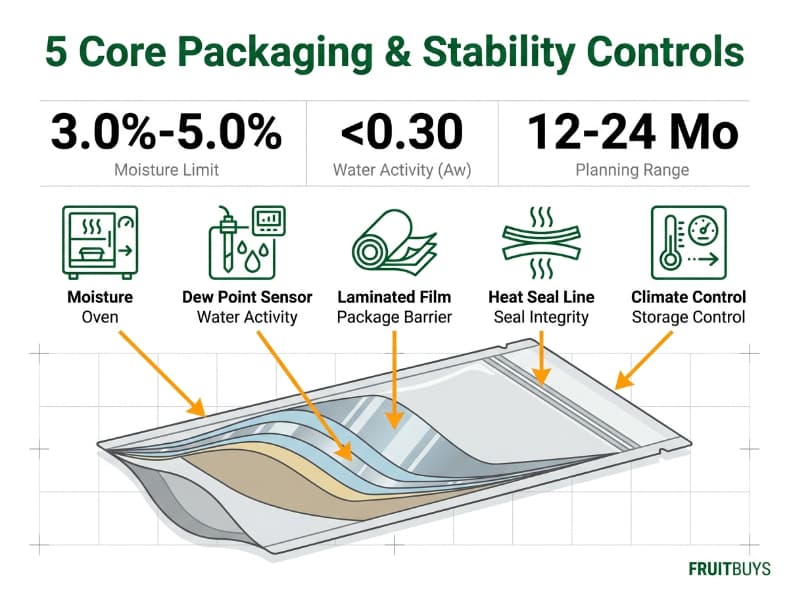
The buyer should review packaging through five controls:
| Control | Buyer Question | Release Risk If Missing |
|---|---|---|
| Moisture | Did the product meet the drying endpoint? | Soft texture or unstable weight basis |
| Aw | Is available water controlled after drying? | Poor stability review and weak release file |
| Package barrier | Does the film limit moisture and oxygen exposure? | Moisture gain and color or texture drift |
| Seal integrity | Does the pack remain closed under handling? | Rehydration, clumping or contamination exposure |
| Storage condition | Does the stated shelf life match handling reality? | Shelf-life claim fails during distribution |
Packaging must protect the product the buyer actually approves. Red-flesh slices, white-flesh bites, cubes and powder do not face the same risk profile. One generic pack claim will not control all of them.
Packaging Requirements for Slices, Bites and Cubes
Slices, bites and cubes require physical protection as much as moisture protection. The product can meet moisture and Aw targets, then fail because the pack allows compression, rubbing or breakage. A crisp product without breakage control turns into fines with a nice label.
Slices usually need more visual protection because the buyer often sells them as snack pieces, toppings or foodservice garnish. A slice with curled edges or visible cracks may still taste acceptable, but it can fail a retail or topping application. Bites and cubes need stronger size discipline because cereal, granola and dairy buyers rely on portion control and repeatable visual load.
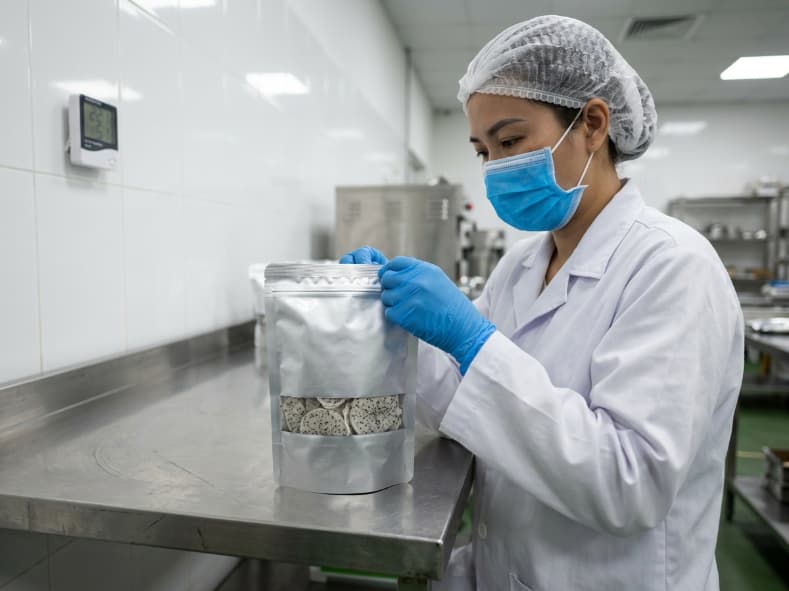
The packaging review should include:
- Inner bag format
- Retail pouch format where applicable
- Headspace decision
- Carton configuration
- Stacking and compression condition
- Breakage tolerance
- Fines tolerance
- Retained sample comparison
- Storage condition before shipment
- Product condition after transport simulation when available
The buyer should not approve only the product photo. The product photo shows color and shape at one point in time. It does not show moisture gain, seal condition, drop impact or carton compression.
A bulk format also needs different control from retail packing. Bulk bags face repeated opening, handling, inspection and repacking. Retail pouches face display, consumer handling and label compliance review. Both require packaging discipline, but they do not fail in the same way. The package should follow the approved freeze-dried dragon fruit format selection for slices, bites, cubes or powder.
FruitBuys should align the approved format, packaging file and breakage criteria before bulk release. The packaging decision must serve the application, not just the carton count.
Packaging Requirements for Dragon Fruit Powder
Freeze-dried dragon fruit powder carries a sharper packaging risk because powder exposes more surface area to air. It can absorb moisture faster than larger pieces. It can also clump, cake or lose flowability during storage and after opening.
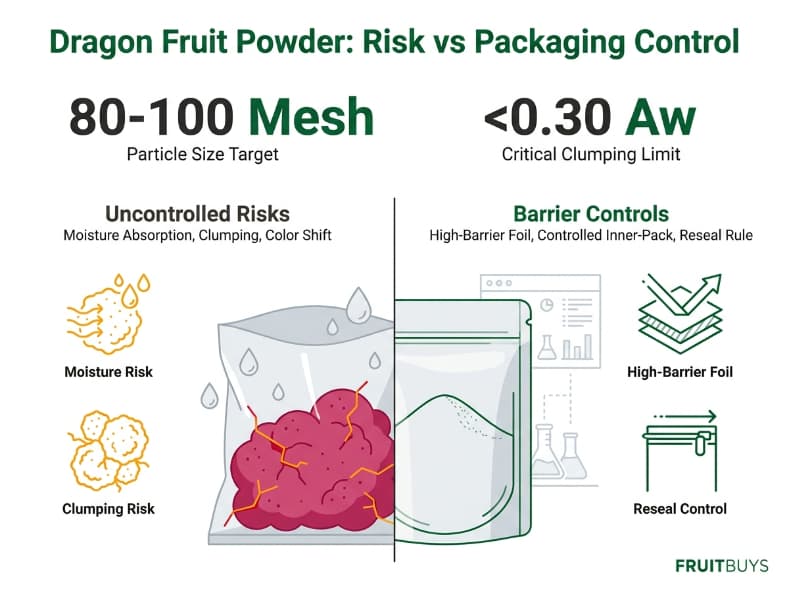
A 2024 study on freeze-dried dragon fruit powder reported low moisture and Aw values, but also described hygroscopic behavior and moisture absorption tendency. That study does not prove any FruitBuys lot result, but it supports the technical requirement that powder buyers must review moisture, Aw and packaging together. (U.S. Food and Drug Administration)
Powder packaging should address:
| Powder Risk | Packaging Control |
|---|---|
| Moisture absorption | High-barrier inner pack and controlled opening |
| Clumping | Smaller inner-pack size and clear reseal instruction |
| Flowability loss | Mesh and carrier status review |
| Color drift | Light and oxygen exposure control |
| Label mismatch | Ingredient and carrier declaration |
| Bulk handling failure | Inner bag, liner and storage discipline |
Pure fruit powder and carrier-containing powder need different packaging review. Pure powder may support a cleaner ingredient statement, but it can create stronger clumping and flowability pressure. A powder with carrier may behave better in some applications, but the buyer must approve ingredient status, Nutrition Facts impact and destination label rules before artwork development.
Powder should not move into private label or R&D formulation without a written packaging brief. The buyer needs mesh size, ingredient statement, carrier status, moisture, Aw, inner-pack weight, open-pack handling and COA requirement in the same approval file. This package decision should follow the full dragon fruit powder specification. For a retail SKU, the buyer should also use the private label packaging brief.
Shelf Life Is Conditional
Shelf life for freeze-dried dragon fruit depends on product format, moisture, Aw, package barrier, seal integrity and storage condition.
A 12 to 24-month target should remain conditional until supported by packaging and validation evidence.
Buyers should not approve shelf life from a statement alone.
A shelf-life claim is not a number glued to a pouch. It is a product-control conclusion. For freeze-dried dragon fruit, the stated period must connect to the exact product format, packaging structure, seal process, storage condition and supporting test evidence.
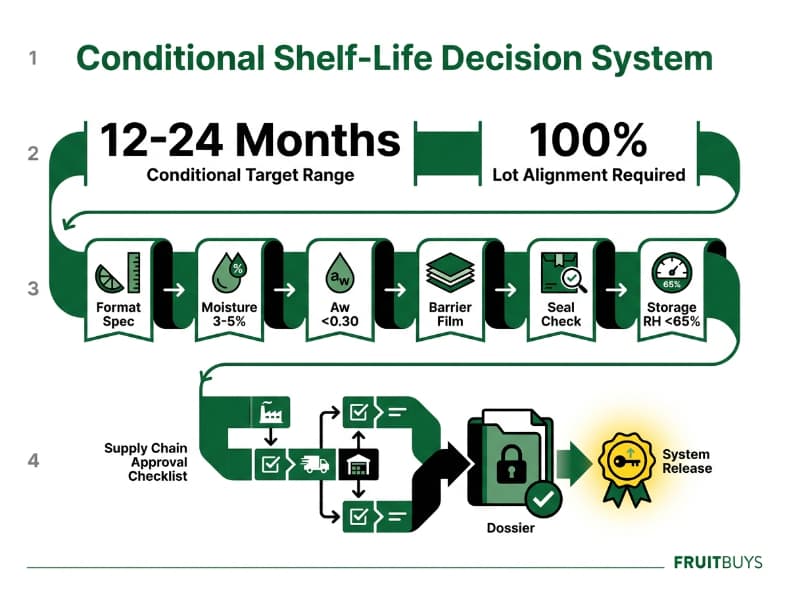
FDA’s water activity guidance links stability to keeping water activity within an acceptable range during storage, not only achieving a suitable level at the end of drying. (U.S. Food and Drug Administration) That matters because many buyers review the drying result but ignore what happens after packing. Moisture can return through weak film, poor seals, humid warehouses or repeated opening. Buyers should align shelf-life approval with the moisture and water activity requirements and the COA and laboratory testing requirements.
A shelf-life file should include:
| Shelf-Life Input | Why Buyer Needs It |
|---|---|
| Product format | Slices, bites, cubes and powder behave differently |
| Moisture result | Shows drying endpoint |
| Aw result | Shows available water control |
| Packaging structure | Supports barrier review |
| Seal condition | Protects the product after filling |
| Storage condition | Defines the environment behind the claim |
| Lab or retained-sample review | Supports validation |
| Lot code | Connects evidence to product identity |
Do not use a 12 to 24-month shelf-life direction as a universal promise. It can work as a planning range only when the package and storage conditions support it. If the buyer changes from bulk bag to retail pouch, the shelf-life review must reopen.
If the buyer changes powder formulation, the review must reopen. If the destination market requires specific label wording or date format, the artwork review must also reopen. Shelf life belongs to a controlled product, not to the product name alone.
Package Barrier and Food-Contact Review
Packaging for freeze-dried dragon fruit must serve two jobs. It must protect product condition, and it must fit the destination’s food-contact requirements. A strong barrier structure still needs regulatory suitability for its intended food-contact use.
FDA states that food contact substances that qualify as food additives must be authorized for their intended use before marketing in the United States, and FDA reviews migration and toxicological data as part of its process. (U.S. Food and Drug Administration) FDA also directs firms to review regulatory status through 21 CFR sections, GRAS status, prior sanctions, threshold exemptions or effective Food Contact Substance Notifications, depending on the component and intended use. (U.S. Food and Drug Administration)
For EU-bound goods, the European Commission states that food contact materials include packaging and containers used during production, processing, storage and serving; it also states that materials placed on the EU market must comply with Regulation (EC) No 1935/2004 and relevant GMP and material-specific rules. (Food Safety)
The buyer should request a packaging file that covers:
- Material structure
- Food-contact suitability
- Intended food type
- Condition of use
- Direct-contact layer
- Migration support where required
- Declaration or compliance documents where applicable
- Supplier change-control process
- Artwork and coding requirements
For technical barrier review, buyers may ask suppliers to provide WVTR evidence for plastic film or laminate systems. ASTM lists F1249-25 as a standard test method for water vapor transmission rate through plastic film and sheeting using a modulated infrared sensor. (ASTM International Store) The article should not claim any WVTR value unless the packaging supplier or test report provides it for the exact film structure.
Storage and In-Use Handling
The buyer controls part of shelf life after the goods arrive. That point rarely appears in sales copy, but it decides whether the product survives warehouse reality.
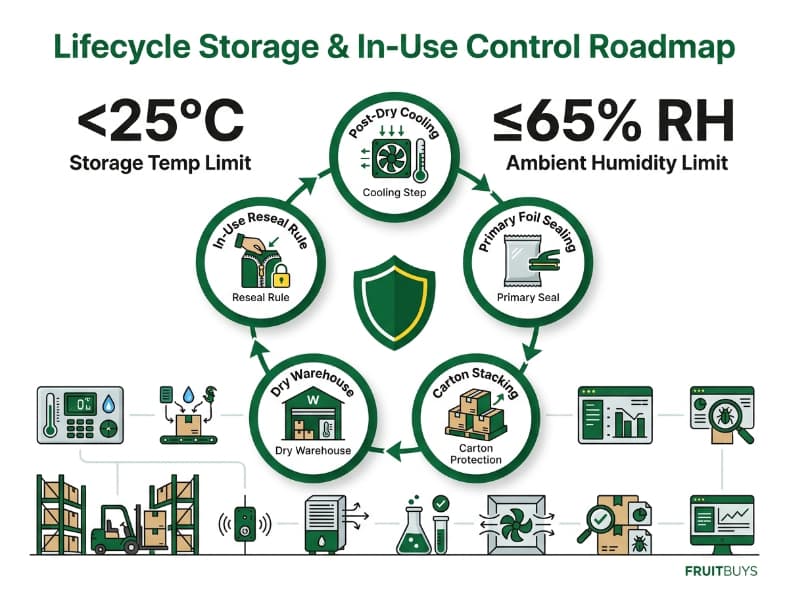
Freeze-dried dragon fruit should move through a storage plan that controls humidity, heat, light, seal damage and opening frequency. Powder needs tighter in-use handling than slices because opening a bulk bag in a humid formulation room can change flowability quickly. Slices need physical protection because broken pieces and fines reduce visual acceptance.
A practical storage file should define:
| Stage | Control Point |
|---|---|
| After drying | Cooling and protection before packing |
| Primary packing | Inner bag or retail pouch sealing |
| Secondary packing | Carton protection and handling |
| Warehouse | Dry, cool and clean storage condition |
| Shipment | Moisture exposure and compression control |
| Buyer receiving | Carton inspection and lot-code check |
| After opening | Reseal rule and use window where validated |
Carton protection, stacking and shipment handling should follow carton and container payload planning.
The label can instruct storage, but the package must make the instruction realistic. A resealable pouch with poor seal discipline does not protect powder. A bulk bag without a clear opening and resealing process gives the buyer a slow failure rather than a sudden one. Slow failures still cost the SKU its repeatability.
FruitBuys should connect storage requirements to the actual product format. This is not a generic “keep in a cool dry place” exercise. The storage instruction must reflect Aw, moisture, package barrier, seal condition and intended use.
Packaging and Sample-to-Bulk Consistency
A sample pack can hide a bulk-pack problem. The buyer may approve a small retail pouch, then receive bulk product in a different inner bag, with different headspace, different sealing and different storage history. The product may carry the same name, but the approved condition has changed.
This is the highest-risk packaging gap. The release process should follow the sample-to-bulk consistency controls.
A proper sample-to-bulk system should align:
- Approved sample format
- Approved product specification
- Packaging structure
- Inner-pack weight
- Seal method
- Moisture and Aw results
- Retained sample
- Carton configuration
- Lot code
- COA
- Release photo or inspection record
- Deviation procedure
If the sample uses one package and the bulk lot uses another, the buyer should treat packaging as a change-control point. If powder moves from a small pouch to a larger bulk bag, the in-use moisture risk changes. If slices move from rigid protection to loose carton filling, breakage risk changes.
FruitBuys should control this through Quality Control, Documentation and Export Logistics Coordination. The product, package and release file need one identity. Without that identity, the buyer approves a memory, not a lot.
Application Mapping
| Buyer Type | Application | Required Format | Proof Needed | FruitBuys Delivery |
|---|---|---|---|---|
| Importer | Ambient retail snack | Slices or bites | Packaging structure, moisture, Aw, shelf-life support and lot COA | Quality Control and Documentation |
| Private label brand | Retail pouch SKU | Slices, bites or powder | Pouch structure, artwork inputs, storage instruction and release file | OEM/Private Label Delivery |
| QA manager | Supplier and lot release | Any approved format | Seal condition, COA, packaging file and retained sample | Documentation and controlled product release |
| R&D developer | Beverage or dairy formulation | Powder | Mesh, carrier status, moisture, Aw and inner-pack handling | Quality Control and application-ready specification |
| Cereal or granola producer | Dry fruit inclusion | Cubes or bites | Size tolerance, breakage limit, fines limit and moisture migration review | Format control and packaging alignment |
| Distributor | Multi-channel inventory | Multiple formats | Shelf-life evidence, storage condition and carton protection | Export Logistics Coordination |
Why FruitBuys Delivers This
FruitBuys supplies freeze-dried dragon fruit as an export-ready product under one accountable supplier relationship. Packaging does not sit outside the product. Packaging carries the product’s moisture control, texture, shelf-life condition, label readiness and shipment stability.
Under Quality Control, FruitBuys aligns the approved format with moisture, Aw, breakage, fines and retained sample review. Under Documentation, FruitBuys connects the packaging file, COA, lot code, shelf-life evidence and storage instruction to the actual goods. Under OEM/Private Label Delivery, FruitBuys reviews pouch format, pack size, artwork input, date coding and label logic before SKU release. Under Export Logistics Coordination, FruitBuys aligns carton configuration, handling condition and shipment readiness with product fragility and moisture exposure.
The supply-chain reality is blunt. A good product inside the wrong package becomes a problem the buyer must explain. A correct pouch with an unsupported shelf-life statement becomes a documentation gap. A bulk bag that gains moisture after opening becomes an R&D failure. FruitBuys treats those points as one supply decision.
Buyer Checklist
Before approving freeze-dried dragon fruit packaging and shelf life, the buyer should confirm:
- Product variant: red-flesh or white-flesh
- Format: slices, bites, cubes or powder
- Ingredient and carrier status
- Moisture target and COA result
- Aw target and COA result
- Inner bag structure
- Retail pouch structure where applicable
- Food-contact suitability for the destination
- Seal method and seal inspection
- Pack size and open-pack handling
- Storage condition
- Shelf-life evidence
- Retained sample
- Breakage and fines tolerance
- Carton configuration
- Lot code and packing record
- Artwork version for private label
- Change-control triggers
Do not approve shelf life from a line in a product sheet. Approve it from the full package and release file.
Summary
Freeze-dried dragon fruit packaging must control moisture exposure, product fragility and shelf-life conditions after drying. Slices, bites, cubes and powder need different packaging review because each format faces different breakage, clumping and storage risks.
Shelf life should connect to moisture, Aw, package barrier, seal integrity, storage condition and validation evidence. FruitBuys supplies freeze-dried dragon fruit through packaging alignment, QA documentation, private label coordination and export logistics review.
FAQ
What packaging does freeze-dried dragon fruit need?
Freeze-dried dragon fruit needs moisture-barrier packaging matched to its format. Slices need breakage protection. Powder needs tighter humidity and resealing control.
Can shelf life be stated as 12 to 24 months?
It can be used only as a conditional direction. The buyer should verify product format, moisture, Aw, package barrier, seal integrity, storage condition and validation evidence.
Why does dragon fruit powder clump?
Powder can absorb environmental moisture after drying. Clumping risk increases when packaging, resealing or storage conditions do not control humidity.
Is an aluminium pouch enough?
No. The buyer needs full packaging structure, seal condition, food-contact suitability and shelf-life evidence. The word “aluminium” alone does not prove performance.
Should bulk bags and retail pouches use the same shelf-life claim?
Not automatically. Bulk and retail packs face different opening, sealing, handling and storage conditions. Each pack format needs review.
Does packaging replace COA testing?
No. Packaging protects the product after drying. COA testing verifies the stated lot against defined physical, chemical and microbiological requirements.
Conclusion
Submit the intended format, pack size, destination and storage condition so FruitBuys can review packaging, shelf-life evidence and lot-release requirements before approval.
References
- U.S. Food and Drug Administration. Water Activity (aw) in Foods. Content current as of 2014. (U.S. Food and Drug Administration)
- U.S. Food and Drug Administration. Draft Guidance for Industry: Establishing Sanitation Programs for Low-Moisture Ready-to-Eat Human Foods and Taking Corrective Actions Following a Pathogen Contamination Event. January 2025. (U.S. Food and Drug Administration)
- U.S. Food and Drug Administration. Food Packaging & Other Substances that Come in Contact with Food. Content current as of July 24, 2024. (U.S. Food and Drug Administration)
- U.S. Food and Drug Administration. Determining the Regulatory Status of Components of a Food Contact Material. Content current as of February 21, 2018. (U.S. Food and Drug Administration)
- European Commission. Food Contact Materials. Updated 2026. (Food Safety)
- ASTM International. ASTM F1249-25 Standard Test Method for Water Vapor Transmission Rate Through Plastic Film and Sheeting Using a Modulated Infrared Sensor. 2025. (ASTM International Store)
- Freeze-dried dragon fruit powder: characterization and incorporation in plant-based drink. Observatório de la Economía Latinoamericana, 2024. (U.S. Food and Drug Administration)