
Freeze-Dried Dragon Fruit Moisture and Aw: What Buyers Must Specify
Freeze-dried dragon fruit moisture and Aw decide whether a sample can survive real storage, private label packing and bulk shipment review. A bright red slice, a crisp bite or a fine pink powder can look approved while the stability data remains incomplete. QA buyers, importers and R&D teams should not treat “dry product” as a finished specification. The product needs two separate controls: moisture content for total water and Aw for available water.
If a buyer approves freeze-dried dragon fruit without both values and a matching COA, the shipment still carries preventable texture, clumping, shelf-life and release risk. FruitBuys treats moisture, Aw, packaging and documentation as one approval chain, not separate afterthoughts.
Moisture and Aw Measure Different Controls
Moisture tells the buyer how much total water remains in freeze-dried dragon fruit.
Aw tells the buyer how much water remains available for stability and microbial growth conditions.
The buyer should require both values before approving a sample or releasing a bulk lot.
Moisture content and Aw answer different questions. Moisture measures total water in the product. Aw measures water availability under equilibrium conditions. Buyers qualifying the wider category should first review the freeze-dried dragon fruit buyer guide. FDA defines water activity as a ratio between the vapor pressure of the food and the vapor pressure of distilled water under the same conditions; FDA also connects water activity to equilibrium relative humidity. (U.S. Food and Drug Administration)
This distinction matters for freeze-dried dragon fruit because the product can meet a low moisture target while still showing a different Aw behavior than expected. The fruit matrix, seed distribution, powder particle size, carrier use and post-drying handling can all influence how water binds or moves. A buyer who checks only moisture sees the surface of the problem. Aw shows the trapdoor underneath.
For B2B approval, the specification should list both:
| Parameter | What It Controls | Buyer Risk If Missing |
|---|---|---|
| Moisture | Total remaining water | Soft texture, unstable weight basis, inconsistent drying endpoint |
| Aw | Available water | Storage instability, microbial growth conditions, clumping risk |
| Packaging condition | Moisture exposure after drying | Rehydration, loss of crispness, powder caking |
| COA | Lot-specific release proof | Sample does not match bulk shipment |
| Microbiology | Safety verification on tested sample | Low Aw gets mistaken for full safety proof |
A specification that says “dry and crispy” has no release value. A specification that states moisture, Aw, method, tolerance and COA requirement gives QA a decision tool.

How to Treat a 3–5% Moisture Target
A moisture target of 3–5% can work as a technical direction for freeze-dried dragon fruit, but the buyer should not treat it as a universal result. Format, fruit maturity, slice thickness, drying endpoint and post-drying handling can shift the final number.
Published research on freeze-dried dragon fruit has reported low final moisture outcomes. A study comparing drying methods for dragon fruit included freeze-dried slices and pulp, and the indexed record identifies freeze-dried dragon fruit sample data among the reported quality attributes. (PubMed) Another study on freeze-dried dragon fruit powder reported moisture of 5.037 ± 0.17% with Aw of 0.3122 ± 0.06, showing that a low-moisture powder can still sit close to the Aw limit a buyer may want to control. (Observatorio Latinoamericano)
FruitBuys should use 3–5% as a working specification target only when the format and lot-release method support it. Slices need a different review from powder. Cubes and bites need size and core-drying checks. Powder needs particle-size, clumping and packaging review through the dragon fruit powder specification.
The buyer should ask for:
- Product format covered by the moisture specification.
- Test method or laboratory method reference.
- Sample condition before testing.
- Release tolerance.
- COA issued against the correct lot.
- Retained sample for comparison.
- Packaging condition at the time of test.
Moisture also affects commercial handling in a practical way. If slices sit too high, they can lose snap and compress in cartons. If powder gains moisture after packing, it can clump before use. If bites vary across a lot, the buyer may see different texture between sample pouch and bulk bag.
Moisture is not a decoration on a specification sheet. It is a release gate.
How to Treat an Aw Below 0.30 Target
Aw below 0.30 should be treated as a release target, not a visual assumption.
A product can look dry while the measured Aw still differs by format, temperature, packaging and handling.
The buyer should request lot-specific Aw results before accepting bulk goods.
An Aw target below 0.30 is a strong control point for freeze-dried dragon fruit, especially when the product moves through ambient storage and long distribution chains. The target fits the logic of low-moisture fruit snacks and ingredients, but it still requires measurement. No photo, crunch test or color check can verify Aw.
FDA notes that most foods with high water activity provide sufficient moisture to support bacteria, yeasts and mold, and that reducing available moisture can inhibit growth. FDA also states that water activity affects food stability and should reach a suitable level after drying and remain within an acceptable range during storage. (U.S. Food and Drug Administration)
That last phrase controls the buyer’s decision. Aw is not only a drying result. It is a storage condition. A product can leave the dryer within target and then drift upward through poor sealing, humid packing rooms, weak barrier materials or repeated opening.
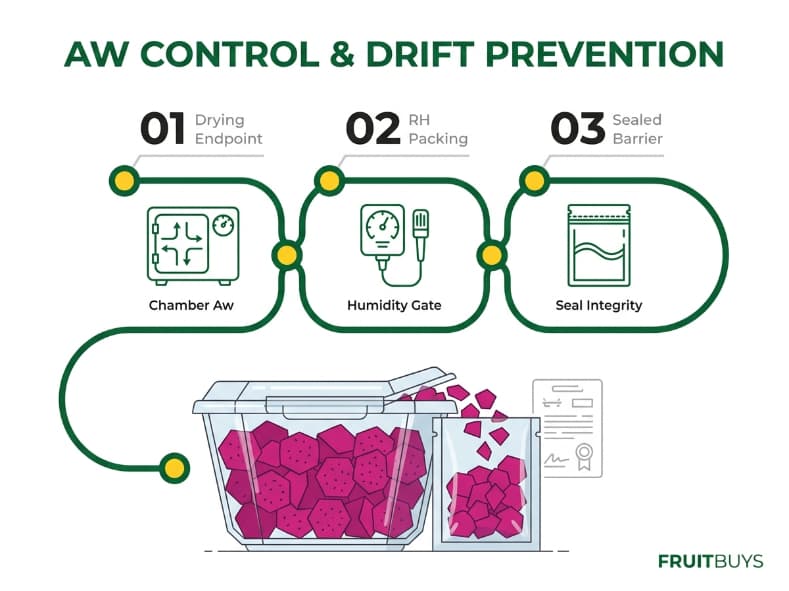
The buyer should not write “Aw <0.30” as a lonely line. The result should move through sample-to-bulk consistency controls, and the release specification should include:
| Control Item | Required Decision |
|---|---|
| Aw target | Define release limit |
| Test timing | Before packing, after packing or at final release |
| Test condition | Temperature and sample conditioning |
| Test frequency | Per lot or per production batch |
| Product format | Slices, bites, cubes or powder |
| Packaging link | Inner bag and retail pack condition |
| Document link | COA and lot code |
FDA also warns that water activity readings can shift when temperature control differs during measurement. The agency gives an example showing that a small temperature difference can cause a measurable Aw change. (U.S. Food and Drug Administration) That means the buyer should review not only the number, but also how the number was measured.
A supplier who reports Aw without method, date, sample identity and lot code gives the buyer an orphan number. Orphan numbers do not release export-ready product.
Low Aw Does Not Replace Microbiology Testing
Low Aw can limit growth conditions, but it does not prove the product contains no pathogens.
A COA must separate Aw results from microbiological test results, methods and sample identity.
The buyer should reject any release file that uses Aw as a substitute for microbiology.
This is the highest-risk misunderstanding in freeze-dried dragon fruit approval. Low moisture and low Aw support stability. They do not prove sterility. They do not erase contamination risk from raw material handling, cutting, drying trays, powder milling, packing rooms or food-contact surfaces.
FDA’s 2025 draft guidance for low-moisture ready-to-eat human foods focuses on sanitation programs, environmental monitoring and corrective actions after pathogen contamination events. The same FDA page also notes the limitations of relying only on product testing to verify that pathogen contamination has been eliminated. (U.S. Food and Drug Administration)
For buyers, the operational conclusion is clear: Aw belongs in the physical-chemical section of the release file. Microbiology belongs in the safety testing section. One cannot replace the other.
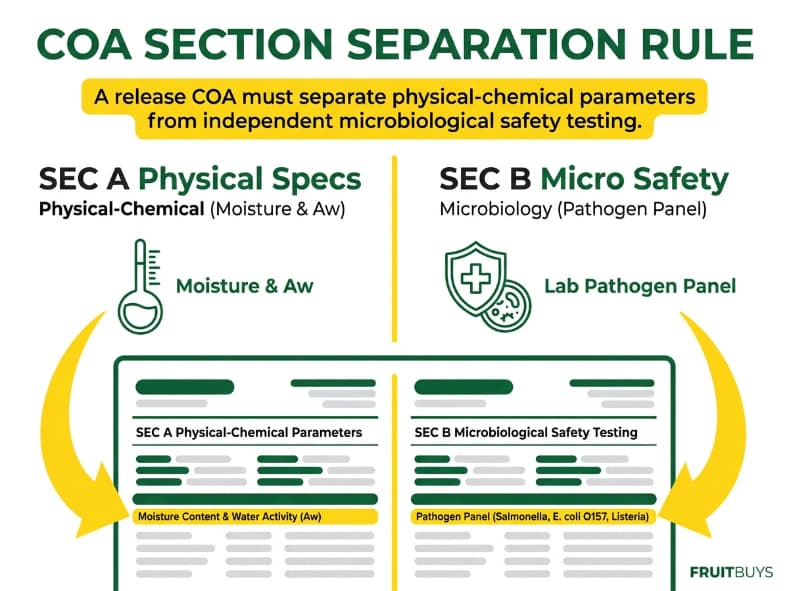
A proper COA structure should separate:
| COA Section | Example Controls |
|---|---|
| Physical-chemical | Moisture, Aw, color, particle size |
| Microbiology | Defined test panel, method, sample size, result |
| Contaminants | Heavy metals or other destination-specific checks |
| Residues | Pesticide panel aligned with raw material and market |
| Packaging | Pack type, lot code, seal condition when applicable |
| Traceability | Production lot, packing lot, report date |
“Not detected” also needs discipline. It means the target was not detected under the stated method, sample and reporting limit. It does not mean absolute zero. Buyers who ignore that distinction leave QA with weak language when a destination reviewer asks for method and scope.
FruitBuys should not release a lot on Aw alone. FruitBuys should align the approved specification, the lot-specific COA review, laboratory file and shipment lot before the buyer treats the goods as approved.
Moisture Migration After Packing
Freeze-dried dragon fruit does not stop interacting with the environment after drying. It keeps reading the room. Humid air, weak seals, damaged inner bags and slow repacking can move moisture back into the product.
FDA explains water movement through equilibrium behavior between a food product and surrounding air. At equilibrium, water is no longer moving in or out because the vapor pressure reaches balance. (U.S. Food and Drug Administration) That principle matters in practical storage. If the surrounding air creates the wrong condition, freeze-dried fruit can absorb moisture and lose texture.
The risk changes by format:
| Format | Moisture Migration Risk | Buyer Control |
|---|---|---|
| Slices | Softening, curling, breakage after texture loss | Barrier pack, thickness control, final Aw |
| Bites | Texture inconsistency across mixed sizes | Size tolerance, sealed inner pack, COA |
| Cubes | Core moisture variation, edge breakage | Cube dimension, drying endpoint, packing condition |
| Powder | Caking, lumping, flowability loss | Mesh, carrier declaration, inner-pack size, reseal control |

The powder route carries a special risk. The freeze-dried dragon fruit powder study reported medium hygroscopicity and described a tendency to absorb environmental moisture. (Observatorio Latinoamericano) This supports a direct B2B requirement: powder buyers must review packaging, inner-pack weight, open-pack handling and flowability. Pure fruit powder can clump faster than a formulated powder with a carrier or anti-caking agent. The buyer must know which product they approved.
Packaging data must support the shelf-life claim. A buyer should ask for laminate structure, seal method, inner bag format and storage condition. These controls should follow the packaging and shelf-life controls. Without this, a shelf-life statement floats without an anchor.
Sample-to-Bulk Moisture Drift
A sample can pass moisture and Aw review while the bulk lot still fails the buyer’s real requirement. That happens when the sample and bulk do not share the same raw material condition, cut size, drying cycle, packing film, storage time or test method.
The clean approval route starts with a master sample. The buyer should lock the sample against a written specification, not against memory. A proper master sample file should include:
- Product name and variant
- Format and size tolerance
- Moisture target
- Aw target
- Visual reference
- Breakage and fines limit
- Packaging condition
- COA requirement
- Retained sample date
- Approved lot identity
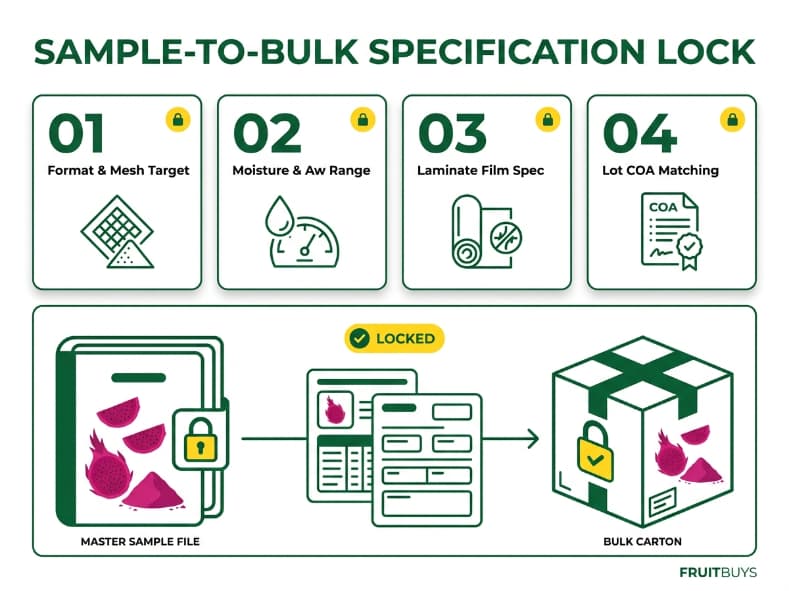
The document should also define change-control triggers. A switch from red-flesh to white-flesh dragon fruit is a change. A switch from slices to bites is a change. A shift from pure powder to carrier-containing powder is a change. A new film structure is a change. A different test method can also become a change if it alters release interpretation.
This is where many buyers lose control. They approve a sample with crisp slices in a retail pouch, then receive bulk inner bags with a different handling history. The product may still be freeze-dried dragon fruit, but the approval basis has changed. That gap creates rework, claim disputes and delayed release.
FruitBuys closes this gap through the sample-to-bulk consistency controls. The approved sample, production lot, packaging file and COA need one shared identity.
Application Mapping
| Buyer Type | Application | Required Format | Proof Needed | FruitBuys Delivery |
|---|---|---|---|---|
| Importer | Ambient fruit snack distribution | Slices or bites | Moisture, Aw, breakage and lot COA | Quality Control and Documentation |
| Private label brand | Retail pouch SKU | Slices, bites or powder | Product spec, package spec, Nutrition Facts input and release file | OEM/Private Label Delivery |
| QA manager | Supplier qualification | Any approved format | Method, COA, lab report, traceability and retained sample | Documentation and controlled product release |
| R&D developer | Beverage, dairy or bakery formulation | Powder | Aw, mesh, carrier declaration, flowability and sample behavior | Quality Control and application-ready specification |
| Cereal or granola producer | Dry inclusion | Cubes or bites | Size tolerance, fines, moisture migration and breakage | Format control and packaging alignment |
| Foodservice distributor | Topping or garnish | Slices or bites | Texture, color range, Aw and storage condition | Product release and export readiness review |
Why FruitBuys Delivers This
FruitBuys supplies freeze-dried dragon fruit as an export-ready product under an Integrated Product Supply Model. The buyer does not need scattered claims from raw material, processing, packaging and documentation points. The buyer needs one approved product file and one accountable supplier relationship.
Under Quality Control, FruitBuys aligns the approved specification with moisture, Aw, format, sensory reference and release criteria. Under Documentation, FruitBuys connects the COA, laboratory file, lot identity and packing records to the actual goods. Under OEM/Private Label Delivery, FruitBuys reviews whether the selected pouch, inner bag, artwork input and storage instruction match the product’s moisture sensitivity. Under Export Logistics Coordination, FruitBuys aligns carton, handling and shipment readiness with product fragility and moisture exposure.
The field reality is simple. The fruit can be right, the drying can be right and the buyer can still lose the SKU if the final pack gains moisture or the COA does not match the lot. FruitBuys treats those points as part of one supply decision.
Buyer Checklist
Before approving freeze-dried dragon fruit moisture and Aw, the buyer should confirm:
- Product variant: red-flesh or white-flesh
- Product format: slices, bites, cubes or powder
- Ingredient status: pure fruit or formulated product
- Moisture target and tolerance
- Aw target and tolerance
- Test method and test timing
- COA issued against the correct lot
- Microbiology panel and method
- Retained master sample
- Packaging structure and seal condition
- Inner-pack weight and open-pack handling
- Storage condition before and after shipment
- Change-control triggers
- Final release authority
Do not approve bulk release from a photo, a sample pouch or a verbal statement. Approve it from the specification and the matching lot file.
Summary
Freeze-dried dragon fruit needs both moisture and Aw control. Moisture measures total remaining water, while Aw measures available water related to stability and microbial growth conditions. A working target of 3–5% moisture and Aw below 0.30 should be confirmed by lot-specific COA, test method and packaging condition.
Low Aw does not replace microbiology testing. FruitBuys supplies freeze-dried dragon fruit through specification control, lot-based documentation, packaging alignment and sample-to-bulk release review.
FAQ
What moisture level should freeze-dried dragon fruit target?
A working target of 3–5% moisture can guide specification development. The buyer should confirm the value by format, test method and lot-specific COA before approval.
Is Aw below 0.30 enough for freeze-dried dragon fruit?
Aw below 0.30 is a strong stability target, but it is not enough alone. The buyer still needs moisture, microbiology, packaging and COA review.
Can low Aw prove the product is safe?
No. Low Aw can limit growth conditions, but it does not prove the absence of contamination. Microbiology testing must remain separate.
Why does dragon fruit powder clump?
Dragon fruit powder can absorb environmental moisture. Pure fruit powder may clump faster when packaging, resealing or storage conditions do not control humidity.
Should slices and powder use the same Aw specification?
They can share a target, but they should not share the same approval logic. Powder needs extra review for mesh, carrier status, flowability and open-pack handling.
What should appear on the COA?
The COA should identify the lot, test date, method, moisture, Aw and required microbiology results. It should match the goods under release.
Conclusion
Submit the intended format, application and destination requirements so FruitBuys can review the moisture, Aw, packaging and COA release conditions before sample approval.
References
- U.S. Food and Drug Administration. Water Activity (aw) in Foods. 1984, content current as of 2014. (U.S. Food and Drug Administration)
- U.S. Food and Drug Administration. Draft Guidance for Industry: Establishing Sanitation Programs for Low-Moisture Ready-to-Eat Human Foods and Taking Corrective Actions Following a Pathogen Contamination Event. January 2025. (U.S. Food and Drug Administration)
- Impact of Different Drying Methods on the Phenolic Composition, In Vitro Antioxidant Activity, and Quality Attributes of Dragon Fruit Slices and Pulp. PubMed record, 2023. (PubMed)
- Freeze-Dried Dragon Fruit Powder: Characterization and Incorporation in Plant-Based Drink. Observatório de la Economía Latinoamericana, 2024. (Observatorio Latinoamericano)