Freeze-Dried Lotus Seeds: What Import Buyers Must Verify Before Ordering
The three most expensive mistakes in this category all happen before the contract, not after. A bakery buyer orders what the supplier calls “lotus seeds” and discovers at customs that the paperwork names a different product category. A QA manager accepts a shelf life claim and watches the first retail units turn bitter within a season because the warehouse held water activity the supplier never measured.
A procurement officer compares quotes across suppliers that are actually selling three different products, a heat-dried kernel, a puffed fox nut, and a genuine freeze-dried lotus seed, then books the shipment that fails on the shelf. Each mistake traces to the same root cause: nobody verified the numbers that decide lotus seed quality. This guide runs the full verification sequence, from raw material math to container planning, and links every checkpoint to the detailed evidence behind it, so each member of your buying center can test the supplier’s claims without waiting for a sales explanation.
Why Lotus Seeds Behave Differently From Tropical Fruits
Most buyers source freeze-dried tropical fruit by checking fruit quality and packaging. Lotus seed adds a second layer: a botanical ingredient where the raw material math controls everything downstream. One kilogram of whole fresh lotus seed in its green shell yields only about 600 g of peeled kernel, and 5.5 to 6.5 kg of that peeled fresh kernel produce one kilogram of freeze-dried product, because the fresh kernel holds 80 to 82 percent water and the freeze-dried kernel leaves the chamber at 3 to 5 percent [1].
The ratio you hear from a supplier tells you which technology they actually run: the 3:1 to 4:1 figure describes hot-dried product stopped at around 12 percent moisture, not freeze-dried. Buyers planning supply need this number early because the fresh harvest window (July to September in Dong Thap, Hue and Hung Yen) locks the production calendar, and old-crop blending destroys the milky aroma that drives repeat orders in Asian markets [2].
The complete mass-balance breakdown belongs to how many kilograms of fresh lotus seed make 1 kg freeze-dried, and the carton loading consequences of that ratio feed directly into container load math: packing and freight planning for freeze-dried lotus seeds.

| Checkpoint | Correct number for freeze-dried | Red flag |
|---|---|---|
| Fresh-to-dry ratio (peeled kernel) | 5.5 to 6.5 : 1 | Supplier quotes 3 to 4 : 1 for freeze-dried |
| Kernel recovery from whole seed | About 60 percent | No explanation of shell and shell-loss handling |
| Harvest window (Vietnam) | July to September | No seasonality discussion at all |
| Crop year policy | 100 percent current crop, no old blending [2] | “Same aroma” claim without crop documentation |
The Process That Decides Kernel Color and Rehydration
Freeze-drying is the only drying technology that holds the lotus kernel at frozen temperature while sublimating the water, which is why the kernel keeps its ivory color, its shape and its fast rehydration instead of shrinking, browning and hardening the way heat-dried kernels do [3]. The controlled Vietnamese process runs in eight steps: harvest selection at the right maturity (which alone cuts drying time from 5.8 hours to 1.0 hour according to polymer research [4]), mechanical shelling and plumule removal down to at least 99 percent coreless, a dilute salt-water wash with no chemical anti-browning agents, a 5 to 10 minute steam, deep freezing at minus 30 degrees C for 6 to 8 hours, primary sublimation that removes roughly 90 percent of the moisture, secondary drying to 1 to 4 percent residual moisture, and immediate sealing into aluminum pouches [5].
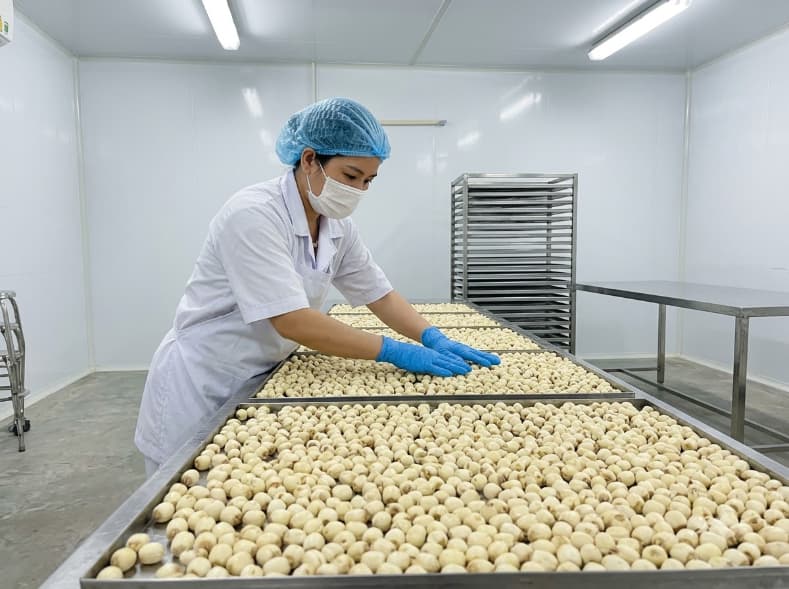
Two things matter for a buyer reading this sequence. First, the color in the spec is a process outcome, not an additive: sulfur dioxide is zero by design. Second, step eight is a control point you can put in the contract, because the minutes between the drying chamber and the pouch decide the water activity the buyer actually receives. Full step parameters and the patent record are in the freeze-drying process for lotus seeds: 8 steps and control points, and the product page carries the complete specification sheet at freeze-dried lotus seeds: full specification and OEM supply from Vietnam.
Water Activity: The Number QA Should Check First
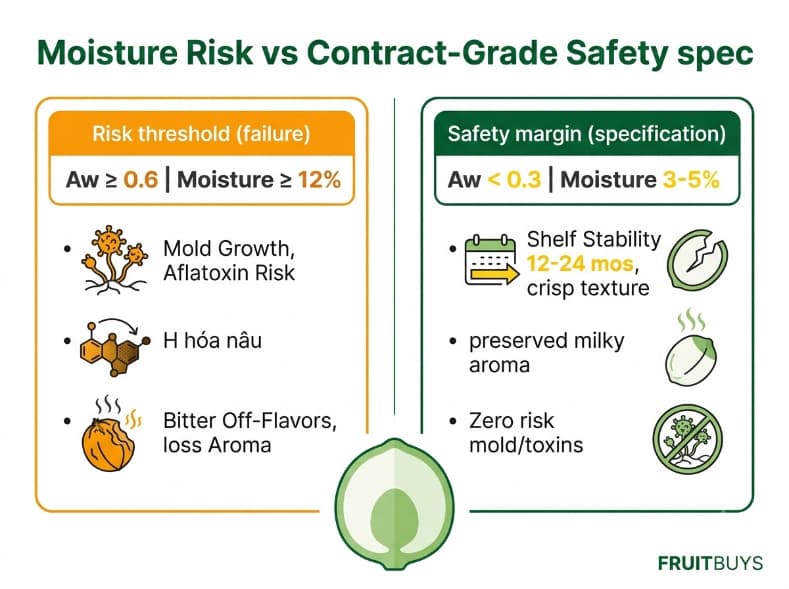
If your QA team takes one number from this guide, make it water activity. Research on stored lotus seeds shows mold and aflatoxin growth appear when water activity crosses about 0.6 and moisture crosses about 12 percent [6], and independent surveys of the dried market have found aflatoxin contamination in large shares of tested samples where moisture control failed [7].
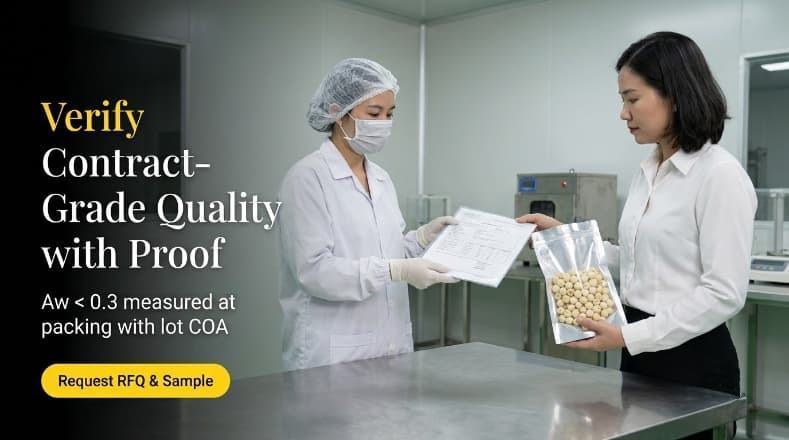
The freeze-dried spec therefore holds moisture at 3 to 5 percent and water activity below 0.3 at packing, a safety margin of more than double the growth threshold. That margin only exists while the aluminum barrier stays sealed, which is why the packing step matters as much as the drying step, and why a lot-level COA that records moisture and water activity measured together at the packing point beats any generic claim sheet.
The full evidence base, measurement method and rejection criteria live in water activity below 0.3: the number that protects lotus seed shelf life.
| Verification item | Contract language | Rejection point |
|---|---|---|
| Moisture | Measured at packing, recorded per lot | Above 5 percent |
| Water activity | Measured at packing, recorded per lot | At or above 0.35 |
| Storage | Below 25 degrees C, RH below 60 percent, sealed | Seal breach without retest |
| Shelf life claim | 12 to 24 months, oxygen absorber in every bag | Claim without COA backing |
Nutrition Baseline and the COA Rule for Labels
USDA FoodData Central records dried lotus seed at 332 kcal, 15.4 g protein, 64.5 g carbohydrate and an unusual mineral profile per 100 g: manganese around 2.3 mg, phosphorus 626 mg, magnesium 210 mg, iron 3.5 mg and potassium 1,368 mg [8] [9]. Vietnamese cultivars measure higher: a 2021 study of pink lotus from Thua Thien Hue recorded dry protein between 19.9 and 23.8 g per 100 g [10].
The rule that follows is the one that separates professional labeling from rejected shipments: the retail label takes its numbers from the lot-level laboratory COA, never from a database table, because cultivar and season move protein by as much as eight grams between these two figures.

Sugar can never exceed total carbohydrate, percent daily values must follow the FDA 2016 reference table, and the calorie line must reconcile with the Atwater math of the rows above it; shipments have failed audits on exactly these inconsistencies. The full baseline, the cultivar variance and the label error checklist are in lotus seed nutrition facts: USDA baseline and the COA rule.
Seven Applications, Two Seasonal Spikes
Application fit drives SKU selection, and the seven commercial channels split cleanly by shape. Mooncake and bakery paste makers buy whole kernels, a channel that clusters around the Mid-Autumn Festival and orders 20 to 30 days before the lunar August peak [11] [12]. Premium snack brands take whole kernel as a protein-dense, unfried, unsweetened SKU.
Granola and cereal bar manufacturers take the 2 to 5 mm granule. Plant milk and functional drink brands take powder. Instant soup and congee makers exploit the porous structure for fast rehydration. Beverage topping channels use half kernel and granule. Wellness and botanical brands buy whole kernel and powder for the bioactive profile that cold drying preserves [13].
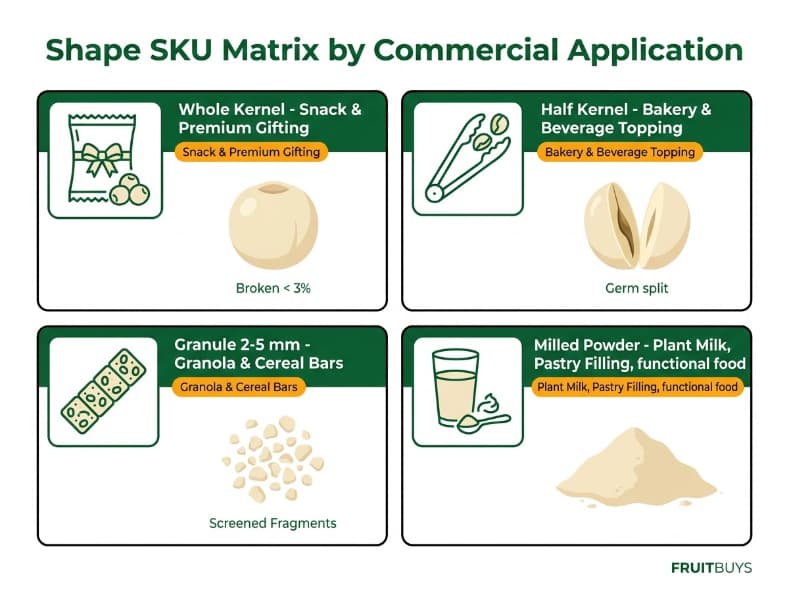
Two spikes decide the calendar: Mid-Autumn baking demand and the Western January wellness wave. The application-by-application fit, including which shape to request for a specific formula, maps out in lotus seed applications: where freeze-dried whole kernel wins. Buyers building a broader ingredient portfolio can also review the dried fruit powder category and the wider freeze-dried fruit catalog.
Is It a Lotus Seed or a Makhana?
These two products share a common name and nothing else. Freeze-dried lotus seed comes from Nelumbo nucifera, the aquatic lotus grown in Vietnam’s Mekong Delta and central lakes, a botanical ingredient for paste, snack, plant milk and wellness channels. Makhana comes from Euryale ferox, the prickly water lily of India, roasted and puffed into a popcorn-like snack with different nutrition and a different aisle [14].

Heat-dried lotus seed, the third product buyers confuse, shows the shrinkage, browning and slow rehydration that freeze-drying specifically prevents [3]. A buyer who orders the wrong one does not get a disappointing unit: the buyer gets inventory that cannot substitute for the intended product on the shelf. The full three-way comparison sits in lotus seeds vs makhana: two species, three processing paths, and the puffed-snack option itself lives on our makhana snack page.
Customs and Documentation Path
Documentation for this category follows a predictable path with one decision point that buyers frequently miss: the HS code. Vietnam practice classifies dried lotus seeds under 1212.99 with zero percent export tax, while US rulings show the seed declared as 1209.99.4090 and some shipments arriving under 2008.99.90 [15].
The variation exists because the code follows the declared form at destination, which is why the buyer’s broker, not the supplier, confirms the code before the first shipment. Beyond the code, the mandatory set runs from the phytosanitary certificate required under Vietnamese Circular 15/2018, through the labeling fields of Decree 111/2021 (product name, country of origin, importer and exporter), to market-specific additions: FDA facility registration and FSVP documentation for the US, Regulation 2017/625 compliance and aflatoxin MRL testing under 1881/2006 for the EU, and Halal certification for GCC markets [16].
The complete checklist, with the ruling references, fills importing lotus seeds from Vietnam: HS code and documentation checklist.
| Market | Core documentation | Extra layer |
|---|---|---|
| United States | Phytosanitary, C/O, HS code 1209.99.4090 or 1212.99 per broker | FDA registration, FSVP |
| European Union | Phytosanitary, C/O, EVFTA rules of origin | Reg 2017/625, aflatoxin MRL |
| UAE/GCC | Phytosanitary, C/O | Halal |
| China, Korea, SEA | Phytosanitary, C/O | RCEP/RPTPP origin where applicable [2] |
Container and Freight Math
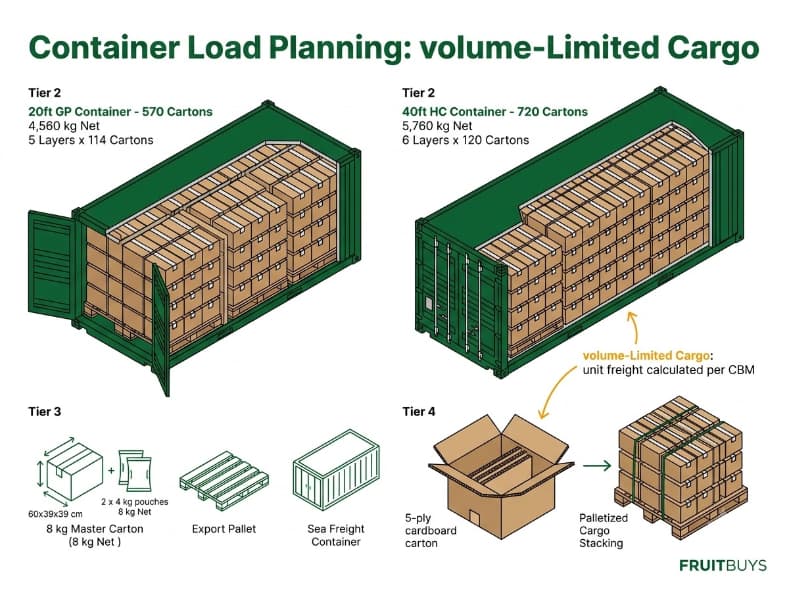
Freeze-dried lotus seed is a volume-limited cargo, not a weight-limited one. A 20ft container accepts 27 tons of weight but carries only about 4,560 kg net of this product, packed as 570 cartons of 8 kg net, a 40ft HC carries about 5,760 kg net across 720 cartons [17].
The physical box could hold three to five times that weight, but the porous kernel compresses and breaks, which is why the carton design holds 2 x 4 kg aluminum pouches, and why freight economics work per cubic meter instead of per kilogram.
Buyers testing a market start with LCL or air freight from Tan Son Nhat airport on the same 8 kg carton; repeat buyers consolidate into the full container plan from Cat Lai port. The packing density math and the storage rules inside the container are in container load math: packing and freight planning for freeze-dried lotus seeds.
| Unit | 20ft GP | 40ft HC |
|---|---|---|
| Cartons | 570 | 720 |
| Net weight | 4,560 kg | 5,760 kg |
| Carton config | 60 x 39 x 39 cm, 2 x 4 kg bags | Same |
| Constraint | Volume, not weight | Volume, not weight |
The Verification Checklist
Procurement closes this guide with one page. Confirm the pre-production sample COA includes moisture and water activity measured together at packing, not estimated at sale. Confirm the spec names Nelumbo nucifera and the coreless rate. Confirm the fresh-to-dry ratio the supplier quotes matches the 5.5 to 6.5 : 1 freeze-drying range, not the hot-drying 3 to 4 : 1 figure.
Confirm the destination broker has locked the HS code for your declared form. Confirm the carton configuration fits your warehouse handling limits. Confirm the production slot lands before the July to September harvest window or before your peak season, whichever comes first.
And confirm the supplier refuses sulfur dioxide on principle, because that refusal is what makes the ivory color verifiable. The full specification behind every line above stands at freeze-dried lotus seeds: full specification and OEM supply from Vietnam, and buyers sampling for a broader range can also evaluate the dried fruit snacks selection and the veggie chips catalog, which includes lotus root chips from a different part of the same plant.
Summary
Freeze-dried lotus seeds imported from Vietnam come from Nelumbo nucifera, freeze-dried at minus 30 degrees C after 5 to 10 minute steaming, and ship at 3 to 5 percent moisture and water activity below 0.3 measured at packing. Import buyers verify the 5.5 to 6.5 kg fresh-to-dry ratio, the 8-step process with immediate aluminum pouch sealing.
The USDA-based nutrition baseline with lot-level COA, the Nelumbo versus makhana species distinction, the phytosanitary and market-specific documentation path, and the volume-limited container math of 570 cartons (4,560 kg) per 20ft and 720 cartons (5,760 kg) per 40ft HC. Vietnam’s lotus harvest runs July to September, and premium bakery channels order 20 to 30 days before the Mid-Autumn peak.
FAQ
What should I verify first when evaluating a lotus seed supplier? Water activity below 0.3 measured at packing, recorded on a lot-level COA alongside moisture. That single measurement separates shelf-stable product from risk.
Why does the supplier quote a higher fresh-to-dry ratio than other frozen fruit? Lotus kernel starts at 80 to 82 percent water and only about 60 percent of the whole seed is usable kernel, so 5.5 to 6.5 kg of peeled fresh seed make 1 kg freeze-dried.
Can I use USDA nutrition numbers on my retail label? Use USDA as the baseline, then pin the actual label figures to the lot-level laboratory COA, because Vietnamese cultivars measure protein between 15.4 and 23.8 g per 100 g.
Is makhana the same product? No. Makhana comes from Euryale ferox, a different species with different nutrition, texture and retail category. The two cannot substitute for each other.
Why is this cargo volume-limited? The porous kernel breaks under compression, so cartons carry 8 kg net instead of the box’s physical capacity of over 30 kg, and a 20ft container carries about 4,560 kg.
When should I place my order? Before the July to September harvest window for Vietnam lotus, and at least 20 to 30 days before a Mid-Autumn production deadline.
What certifications should I expect? Phytosanitary certificate and C/O for every shipment, plus FDA FSVP documentation for the US, EU Reg 2017/625 compliance for Europe and Halal for GCC, per market.
Order Samples
Request a sample set in three OEM shapes (whole kernel, granule, powder) after confirming your destination market, so the samples arrive with the COA format and certification set that match your label requirements.
References
- Sở KH&CN TP.HCM via Techport, Quy trình công nghệ sấy thăng hoa hạt sen (hạt tươi 80-82 percent nước, sấy xuống 3-5 percent ): https://techport.vn/83/quy-trinh-cong-nghe-say-thang-hoa-hat-sen-92017.html
- VinaSources, Vietnam Lotus Seeds: Sourcing Guide and Export Market 2026 (top importers, crop year blending risk, EVFTA 0 percent tariff ): https://vinasources.com/blog/vietnam-lotus-seeds/
- CN107581451B (bằng sáng chế ), Method for freeze-drying lotus seeds (không co, không nâu, hoàn nguyên tốt ): https://patents.google.com/patent/CN107581451B/en
- Carbohydrate Polymers (2024 ), Maturity effect on freeze-drying time of lotus seeds (5.8 giờ giảm còn 1.0 giờ ): https://www.sciencedirect.com/science/article/pii/S1043452624000321
- Sở KH&CN TP.HCM via Techport, Quy trình 8 bước sấy thăng hoa hạt sen (coreless ≥ 99 percent, hấp 5-10 phút, cấp đông -30°C 6-8 giờ ): https://techport.vn/83/quy-trinh-cong-nghe-say-thang-hoa-hat-sen-92017.html
- Liao et al., AMB Express (2020 ), Storage conditions, mold and aflatoxin in lotus seeds (ngưỡng mốc và aflatoxin tại Aw 0.6 ): https://pmc.ncbi.nlm.nih.gov/articles/PMC7218039/
- Liu et al. (2013 ), Aflatoxin contamination in dried lotus seeds from Chinese markets (95 percent mẫu dương tính ): https://pubmed.ncbi.nlm.nih.gov/23536467/
- USDA FoodData Central, Dried lotus seeds, FDC ID 170149 (332 kcal, protein 15.4 g, potassium 1,368 mg per 100 g ): https://fdc.nal.usda.gov/food-details/170149/nutrients
- Nutrition-and-You (USDA National Nutrient Database reference ), Lotus seeds nutrition facts (mangan 2.3 mg, phospho 626 mg per 100 g ): https://nutrition-and-you.com/lotus-seeds.html
- ResearchGate (Thua Thien Hue, 2021 ), Pink lotus (Nelumbo nucifera) composition study (dry protein 19.9-23.8 g per 100 g ): https://www.researchgate.net/publication/355396615
- The Woks of Life, Mooncake lotus paste guidance (hạt sen sấy cho nhân bánh cao cấp ): https://thewoksoflife.com/mooncake-recipe/
- Serious Eats, Chinese lotus seed buns (dried seed vs canned preference ): https://www.seriouseats.com/chinese-lotus-seed-buns-recipe
- Food Research International (2022 ), Comprehensive review of lotus seed bioactives (polysaccharides, flavonoids, alkaloids preserved by cold drying ): https://www.sciencedirect.com/science/article/pii/S0963996922002052
- ScienceDirect Topics, Euryale ferox (makhana ) (loài khác Nelumbo nucifera ): https://www.sciencedirect.com/topics/agricultural-and-biological-sciences/euryale-ferox
- US CBP Ruling NY N025538, HS classification of lotus seeds (1209.99.4090, duty 0.83 cent/kg ): https://www.cbp.gov/trade/rulings/nyn025538
- Sky Queen Logistics, Thủ tục xuất khẩu hạt sen khô (phytosanitary Circular 15/2018, nhãn Decree 111/2021 ): https://skyqueen.vn/thu-tuc-xuat-khau-hat-sen-kho/
- Tridge (UN Comtrade data ), Vietnam lotus seeds export market (Vietnam hạng 8 toàn cầu, 570 cartons / 20ft container planning ): https://www.tridge.com/tridge-woods/lotus-seeds/VN