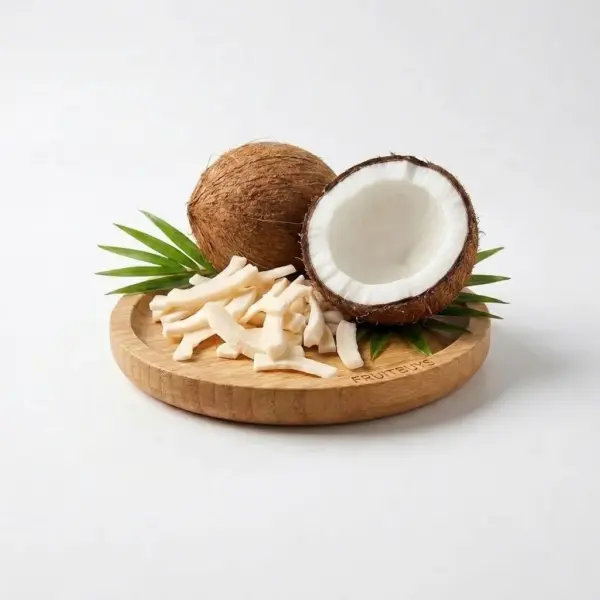
What is freeze-dried coconut powder, and how is it different from coconut milk or water powder?
Freeze-dried coconut powder is the white kernel of mature coconuts, pared of its brown skin, steam-blanched, freeze-dried and then milled, with nothing added: no carrier, no maltodextrin, no sugar. It carries the kernel’s fibre, fat and fresh coconut flavour, so it builds body and taste in bakery, granola, seasoning and dessert bases. It is not instant coconut milk powder or coconut water powder, which are dried from liquids and dissolve in a glass. FruitBuys supplies it from Ben Tre, Mekong Delta, in bulk and private-label packs, alongside the cut product, freeze-dried coconut meat, within our dried fruit powder range.
The most expensive mistake with coconut powder is buying the wrong one. A kernel powder stirred into a clear drink leaves sediment; a milk powder baked into a cookie brings no fibre and no bite. Pick the type first, then the specification.
Which coconut powder are you buying?
| Freeze-dried coconut powder (this product) | Coconut milk powder | Coconut water powder | |
|---|---|---|---|
| Made from | Whole kernel, freeze-dried then milled | Pressed coconut milk, dried with a carrier in most grades | Coconut water, dried from the liquid |
| Fibre | High: 16.3 g per 100 g | Low | Very low |
| Fat | Kernel fat, about 64 g per 100 g | High (from the milk cream) | Almost none |
| In water | Disperses, fibre settles; does not fully dissolve | Dissolves to a creamy liquid | Dissolves clear |
| Best for | Bakery, keto baking, granola, bars, seasoning and curry blends, ice cream and dessert mixes, confectionery fillings | Curries, soups, coffee creamer, drinks | Sports and electrolyte drinks, smoothies |
| Label | One ingredient: coconut | Coconut milk, often with a carrier | Coconut water, often with a carrier |
| From FruitBuys | Standard product | On R&D or OEM order through our partner network | On R&D or OEM order through our partner network |
If your product is a drink that must dissolve fully, ask us for coconut milk or coconut water powder instead and we will source it to your specification through our partner network. Everything below is the kernel powder.
Product specification
| Item | Specification |
|---|---|
| Product | Freeze-dried coconut powder (100% mature coconut kernel, no carrier) |
| Ingredient | 100% coconut kernel; no maltodextrin, sugar, preservatives or sulfites |
| Origin | Ben Tre, Mekong Delta, Vietnam; mature coconuts harvested at 11–12 months, year-round, thickest kernel February–August |
| Appearance and aroma | Fine ivory-white powder with visible kernel fibre; clean, mild, naturally sweet coconut aroma, free from foreign odours and off-notes |
| Particle size | Milled to your specification, from fine bakery grade to a coarser flake-type meal; confirmed by trial batch and checked at release |
| Moisture | 3–5% (contract limit ≤5.0%) |
| Water activity | ≤0.30 |
| Microbiology, standard | TPC ≤10⁴ CFU/g · yeasts and moulds ≤10² CFU/g · E. coli <10 CFU/g · Salmonella not detected/25 g |
| Microbiology, inclusion grade | TPC <1,000 CFU/g for ice cream, dairy and dessert mixes, confirmed on every lot COA |
| Foreign matter | None; metal detection on every carton (Fe 1.5 mm, non-Fe 2.0 mm, SUS 2.5 mm) |
| Kernel per kilo | 2.0–2.4 kg pared kernel, or 7–9 mature coconuts, per 1 kg powder |
| HS code | 0801.11 (fine desiccated grade) or 1106.30 (powder of Chapter 8 products), confirmed by your broker |
| Shelf life | 12 months at ≤25 °C, RH ≤60%; 18–24 months in cool storage at ≤18 °C, RH ≤50%; original foil bag with desiccant |
Milled from kernel that was never browned. The kernel is hand-pared, steam-blanched at 85–88 °C and freeze-dried below browning temperatures before it reaches the mill. That is why the powder stays ivory with a fresh coconut note, where powder ground from hot-air desiccated coconut tastes toasted and looks cream. The same blanch is the kill step that answers the Salmonella question every US importer asks about coconut, and it stops the lipase enzyme behind soapy off-notes. The line from nut to finished piece is in how freeze-dried coconut is made.
A fat-rich powder that wants a cool store. Coconut fat softens at about 24–26 °C, and a powder kept warm packs into lumps in the bag and the hopper. Held at or below 25 °C it stays loose with no anti-caking agent, so the label stays one word long.
Nutrition (per 100 g, typical values)
| Nutrient | Amount | % Daily Value* |
|---|---|---|
| Calories | 660 kcal | |
| Total fat | 64.5 g | 83% |
| Saturated fat | 57.2 g | 286% |
| Trans fat | 0 g | |
| Cholesterol | 0 mg | 0% |
| Sodium | 37 mg | 2% |
| Potassium | 543 mg | 12% |
| Total carbohydrate | 23.6 g | 9% |
| Dietary fiber | 16.3 g | 58% |
| Total sugars | 7.4 g (naturally occurring; 0 g added) | |
| Protein | 6.9 g |
*Based on a 2,000 calorie diet.
Typical values for 100% freeze-dried coconut powder; values typically move within ±5–10% with season, origin and kernel maturity. Lot nutrition panel available for label artwork.
A keto-baking ingredient as it comes. About 7 g net carbohydrate per 100 g and 0 g added sugar suit keto and low-carb recipes, and 16.3 g fibre clears the EU “high fibre” threshold of 6 g per 100 g by a wide margin. Lauric acid, coconut’s signature medium-chain fatty acid, makes up about half of the fat, a natural fit for keto, sports nutrition and clean-label formulations. It is vegan and gluten-free, coconut is not one of the EU’s 14 allergen groups, and since FDA’s January 2025 allergen guidance it is no longer listed as a tree nut for US labelling. Claim wording and per-serving numbers: freeze-dried coconut nutrition facts.
Applications
| Application | What the powder does |
|---|---|
| Bakery and keto baking | Cookies, biscuits, muffins, low-carb breads and crusts: fibre, body and a fresh coconut note in place of flavourings |
| Granola, bars and clusters | Coconut taste spread through the dry blend, with fibre that helps bind |
| Seasoning and curry blends | Creamy coconut body in dry rubs, curry bases and instant sauce mixes |
| Ice cream, dairy and dessert mixes | Flavour and texture in bases that are mixed and processed; choose inclusion grade |
| Confectionery fillings | Coconut centres, pralines and truffle fillings |
Start your pilot by replacing the coconut flavouring or desiccated coconut already in your recipe, then tune the dose to taste and texture. Need visible coconut pieces as well? The cut product, in chips, dice and crumble, is on the freeze-dried coconut meat page, with cut-by-cut guidance in freeze-dried coconut chips, flakes or cubes.
Packaging
| Option | Detail |
|---|---|
| Bulk | 1–5 kg sealed heavy aluminium-foil barrier bags, gently de-aerated with food-grade dust-free silica gel, no iron-based oxygen absorber, in a 5-ply export carton |
| Standard export carton | 58 × 28 × 34 cm, up to 10 kg per carton, exact fill confirmed by trial pack; custom cartons and palletisation on request |
| Retail / private label | 30 g, 50 g, 100 g, 500 g and 1 kg aluminium-foil zip pouches or custom OEM sizes |
| Storage | ≤25 °C, RH ≤60%, away from sunlight and strong odours; ≤18 °C, RH ≤50% for stock held beyond 12 months |
Pick the bag size that matches one production batch, so each bag is opened and emptied in a single run. Once a bag is opened, press out the air, heat-seal or clip it shut with the original desiccant, keep it cool and dry, and use it within 2–4 weeks so the powder stays free-flowing. Shelf life and storage in detail: how long freeze-dried coconut lasts.
Commercial terms
| Item | Detail |
|---|---|
| Supply capacity | 100 MT/year of freeze-dried coconut across qualified partner facilities |
| Trial order | Trial and R&D quantities without a fixed MOQ, from 1–2 full export cartons, then container contracts |
| Private label / OEM / ODM | From 500 kg per SKU; digital pouch printing in 7–10 working days, rotogravure in 15–20 |
| Samples | Dispatched in 3–5 working days |
| Production lead time | 20–30 days for a 20 ft container, after deposit |
| 20 ft container, floor-loaded | About 550 cartons, up to about 5,500 kg net |
| 40 ft HC container, floor-loaded | Up to about 1,120 cartons, up to about 11,200 kg net |
| Container type | Standard dry container, no reefer |
| Batch consistency | One locked partner facility for the contract, change-control with written notice and sample re-approval, audit access |
| Payment terms | T/T 40% deposit, 60% before shipment or against copy of B/L; L/C at sight |
| Port of loading | Cat Lai Port or Tan Son Nhat Airport, Ho Chi Minh City |
| Shipping terms | FOB, CIF, DDP (sea and air) |
Powder packs tighter than chips, so it fills cartons toward the top of the range and puts the most coconut into every container. Combine powder and cut pieces in one container if your range uses both.
Quality and documents
- Kill step on 100% of the kernel: steam blanching at 85–88 °C before deep freezing.
- Lot COA with every container, from an independent ISO/IEC 17025 accredited laboratory: moisture, water activity, total plate count, yeasts and moulds, E. coli and Salmonella, plus a physical and sensory release check (colour, odour, foreign matter); particle size checked at release against your specification.
- Inclusion grade: TPC <1,000 CFU/g for ice cream, dairy and dessert mixes, confirmed on each lot COA.
- Contaminant surveillance: lead, arsenic and aflatoxin under periodic third-party testing, with reports available on request.
- Market panels on request: Listeria monocytogenes through an LAAF-accredited lab for US release when applicable, Enterobacteriaceae, pesticide multi-residue, cadmium, sulfite or a nutrition panel, booked before stuffing.
- Trial lots: a free release QC log and our baseline reports; third-party testing on trial lots is arranged on request.
- Pre-shipment and retained samples: 100–200 g from the packed lot in two sealed foil pouches; a retained sample from every container lot kept for its full shelf life.
- Certifications, through a qualified partner facility: HACCP, ISO 22000, BRC (qualified processing facility), US FDA Facility Registration, Halal certification available on request.
- Standard export dossier with every shipment: commercial invoice, packing list, bill of lading, C/O Form EUR.1, phytosanitary certificate and lot COA, so the container clears on arrival without a document chase.
Import and labeling
- Two possible lines, one set of documents. Customs authorities read a milled freeze-dried kernel either as a fine grade of desiccated coconut, HS 0801.11, or as a powder of Chapter 8 products under 1106.30; your broker confirms the line on the product description. C/O Form EUR.1 travels with every shipment, so the EVFTA and UKVFTA preferences can be claimed under either line (EU TARIC). Full guidance by market: dried coconut HS code and import guide.
- No increased EU border checks: coconut is not on the EU list of foods under increased official controls, so containers clear on standard frequency.
- United States: coconut products sit under FDA Import Alert 23-12; the lot Salmonella COA, the partner facility’s US FDA Facility Registration and the Prior Notice data FruitBuys supplies are the core of your FSVP file.
- Phytosanitary certificate with every shipment, as part of the standard dossier, so your broker clears without a document chase.
- UAE / GCC: Halal certification available on request, C/O Form CEPA with every UAE shipment under the UAE–Vietnam CEPA (in force since 3 February 2026), importer product registration and Arabic labeling for retail packs.
Verify the sample
- Colour and aroma: even ivory white with fine fibre visible; clean, mild coconut, free from foreign odours and off-notes.
- Particle size: shake 50 g through the sieve named in your specification; the retained fraction should match the agreed limit.
- Behaviour in water: stir 10 g into 100 ml warm water; it should disperse and the fibre settle. Full dissolving would mean a milk or water powder, not kernel.
- Flow: at room temperature the powder should pour loose from the pouch, with no hard lumps.
- Water activity: read a sealed pouch within minutes of opening; ≤0.30 passes.
- In your recipe: bake or blend at your target dose next to your current coconut ingredient.
- Paperwork: the COA lot number matches the pouch label, with Salmonella reported as not detected in 25 g.
FAQ
Is freeze-dried coconut powder the same as coconut flour?
No. Coconut flour is usually made from the press cake left after oil or milk extraction, so most of the fat is gone. Freeze-dried coconut powder is the whole kernel milled, with its natural fat, fibre and flavour.
Is it the same as coconut milk powder?
No. Coconut milk powder is dried from coconut milk, often with a carrier, and dissolves to a creamy liquid. Kernel powder disperses and its fibre settles. FruitBuys supplies milk and water powders on R&D or OEM order through its partner network.
Does it dissolve in water?
It disperses but does not fully dissolve, because it carries the kernel’s fibre. Use it in bakery, granola, seasoning and dessert bases rather than clear drinks.
Does it contain a carrier or anti-caking agent?
No. It is 100% coconut kernel. Kept at or below 25 °C it stays free-flowing on its own.
Is freeze-dried coconut powder keto?
It fits keto and low-carb recipes: about 7 g net carbohydrate per 100 g and no added sugar.
What particle size can I order?
From a fine bakery grade to a coarser flake-type meal, milled to your specification and confirmed by trial batch.
How long does it last?
12 months at ≤25 °C and RH ≤60%, and 18–24 months in cool storage at ≤18 °C and RH ≤50%, in the original foil bag with desiccant.
How do I start?
Request a sample in the particle size you need, run it in your recipe, then place a trial order of 1–2 full export cartons before a container contract. Private label starts at 500 kg per SKU.
Request a quote
Send these six details and we return a specification, a loading plan and a sample schedule in one reply:
- Product: kernel powder, or coconut milk / water powder for a drink
- Particle size or the sieve your line uses
- Microbiology grade: standard or inclusion grade (TPC <1,000 CFU/g)
- Packaging: bulk bag size or retail pouch sizes
- Volume: sample, trial lot and annual estimate, with destination port and Incoterm
- Market panels beyond the standard COA (e.g. Listeria via LAAF lab, multi-residue, nutrition panel)