
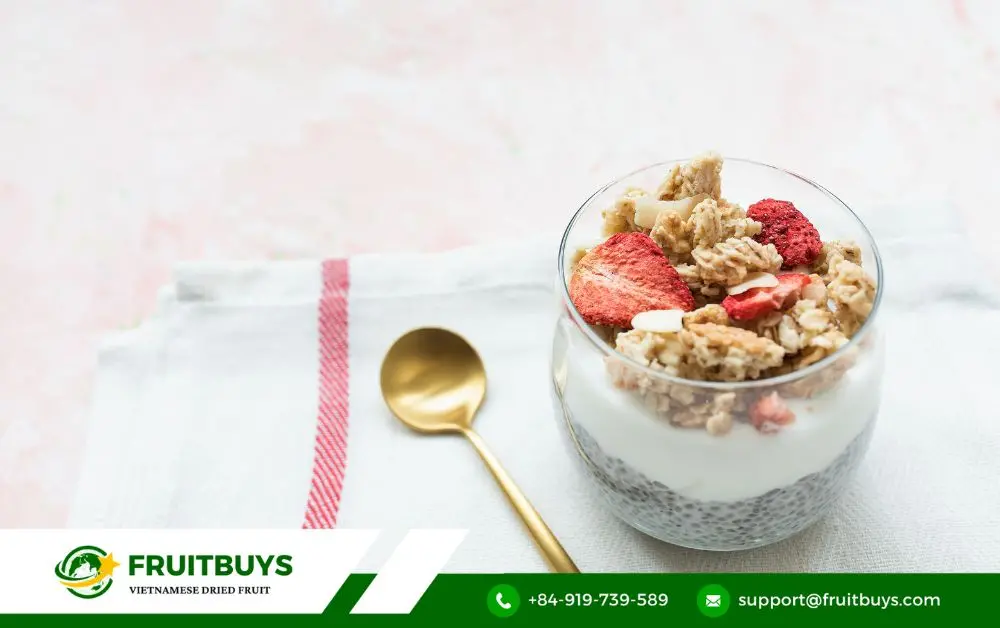
Freeze-Dried Strawberry for Ice Cream and Yogurt: Colour Without Water, Crunch That Lasts
Freeze-dried strawberry powder colours and flavours an ice cream or yogurt base at 2–5% without adding water, so there are no extra ice crystals and the mix balance hardly moves. Freeze-dried pieces add crunch, but uncoated pieces soften as they draw moisture from the base, in minutes in yogurt and over days in ice cream. Coat them in fat or chocolate, or pack them in a separate topper, and the crunch reaches the spoon.
Strawberry is the flavour every dairy and frozen-dessert range needs, and the hardest to get right with fresh fruit or purée: water, pale colour and icy texture. This guide compares powder, pieces and purée, sets out dosages and cuts, and shows how to keep freeze-dried pieces crisp in a frozen or cultured base.
Freeze-dried vs purée in ice cream
Strawberry purée is mostly water. Water that goes into an ice cream mix freezes into ice crystals, and every extra crystal makes the texture coarser and the scoop harder. Freeze-dried powder brings the fruit’s solids, colour and flavour with no added water.
| Strawberry purée | Freeze-dried powder | Freeze-dried pieces | |
|---|---|---|---|
| Water added to the mix | About 90% of the purée weight | None (≤5% moisture) | None |
| Typical dose | High, to get colour and flavour | 2–5% of the base | 3–8% inclusion |
| Fruit carried | Fruit at its own weight | 10 g ≈ 100–120 g of fresh fruit | Same concentration |
| Colour | Pale pink, often boosted with colour | Natural pink to red | Red pieces in a white or pink base |
| Texture effect | More ice, harder scoop | Smooth; adds fibre and solids | Crunch, if protected from moisture |
| Storage | Frozen | Ambient, 12 months | Ambient, 12 months |
A 3% dose of powder carries the fruit of roughly 30–36% fresh strawberry in the base, with none of its water. That is a strawberry ice cream with real fruit on the label and a smooth body. Powder also adds the fruit’s own sugar, about 52 g per 100 g, so a 3% dose brings about 1.6% sugar to the mix; take that out of the sugar addition to keep sweetness and freezing point where your recipe had them.
Powder for colour and flavour in bases
Ice cream and gelato. Add powder at 2–5% to the mix and run it through your usual high-shear or homogenising step, so the fibre and fine solids disperse evenly. For a smooth base with no specks, order the seed-reduced, sieved powder in 100 mesh; the standard powder keeps the seeds as fine dark specks, which many brands like as a sign of real fruit. Powder adds solids and a little viscosity, and overrun is set as usual on the freezer.
Yogurt. Yogurt is the best base for strawberry colour. Its natural acidity, pH around 4.0–4.6, keeps the anthocyanins that give strawberries their colour bright pink to red, so a 2–5% dose gives a clean strawberry yogurt without added colour. In neutral bases such as milk or cream the same pigment shifts toward mauve; check the colour in your own base before printing the pack photograph.
Whipped cream, mousse and fillings. Fold powder in at 5–10% for a pink cream with strong flavour; the powder carries no water, so the cream holds its whip. Powder doses for other applications are in strawberry powder recipes and doses.
Inclusions and toppings: keeping the crunch
A freeze-dried strawberry piece is a dry, porous sponge at water activity ≤0.30. Placed in a wet base, it draws water in until it matches its surroundings. The texture result depends on the base and the time:
| Base | Uncoated pieces | What to do |
|---|---|---|
| Yogurt, chilled | Soften in about 2–5 minutes to a soft, jam-like piece | Pack in a separate topper or use coated pieces |
| Ice cream at −18 °C | Soften over about 1–3 days in the frozen mix | Coat pieces for retail; uncoated works for scoop-shop use within a day |
| Dry topping on a soft serve or sundae | Crisp at serving | Add at serving |
Choose the cut by job:
- Dice 5–10 mm at 3–8% for visible pieces in pints and tubs, or folded through a ribbon or swirl.
- Slices for toppings and sundae garnish, where the shape is the selling point.
- Crumble 2–5 mm for coatings on ice cream bars, cones and shortcake-style bites, and yogurt toppers.
Format differences are in freeze-dried strawberry formats.
Developing a strawberry ice cream, gelato or yogurt? Email [email protected] or WhatsApp +84 919 739 589 with your base and pack format. REQUEST SAMPLE →
Coated pieces for frozen desserts
A thin fat barrier keeps water out of the piece. Coating dice or crumble in cocoa butter, compound coating or chocolate, at around 30–50% of the piece weight, typically keeps the crunch for 3–6 months in a frozen retail product. These are working figures; your coating, base and storage temperature set the result, so confirm them with a storage trial on your own product.
Three practical points:
- Coat dry, coat fully. Panning or enrobing the pieces before they meet any moisture gives a complete barrier; a gap lets water in.
- Use a fat that stays crisp when frozen. Coatings designed for frozen desserts stay snappy at −18 °C, where a standard chocolate can turn brittle or waxy.
- White chocolate makes the red stand out. A white-coated strawberry dice in a pink or vanilla base reads as fruit at a glance.
Coating, dragée and chocolate work are covered in freeze-dried strawberry for bakery and chocolate.
Yogurt cups and toppers
For a cultured product, the simplest way to deliver crunch is to keep the strawberries out of the yogurt until the customer opens the pack:
- Split cup or dome lid topper. Freeze-dried slices or crumble in a sealed compartment, tipped in at eating. The pieces stay crisp until they meet the yogurt, then soften to a fresh-fruit texture within minutes, which many customers prefer.
- Fruit-on-the-bottom without the jam. Powder in the base gives colour and flavour; a topper adds visible fruit. Both keep the ingredient line short: Yogurt, strawberries.
- Granola and yogurt pots. Strawberry crumble in the granola compartment, where it stays dry with the cereal.
The topper compartment needs a good moisture barrier and a dry fill; slices and crumble arrive in sealed foil bags with silica gel, ready for a dehumidified filling room.
Food safety for non-heated use
In ice cream and yogurt, freeze-dried strawberries are often added after pasteurisation or culturing, so the fruit is eaten without a further heat step. Freeze-drying is not a kill step, which is why the ingredient specification matters:
| Parameter | Release limit, every lot |
|---|---|
| Total plate count | ≤10⁴ CFU/g |
| Yeasts and moulds | ≤10² CFU/g |
| E. coli | <10 CFU/g |
| Salmonella | Not detected in 25 g |
| Water activity | ≤0.30 |
Each lot ships with a COA from an independent ISO/IEC 17025 accredited laboratory. For dairy and frozen-dessert customers, FruitBuys can add Listeria and Enterobacteriaceae, and hepatitis A and norovirus testing on berries for ready-to-eat use, at an accredited laboratory of your choice, such as Eurofins or SGS in Vietnam, before the container is sealed. The full specification is in freeze-dried strawberry specification and COA.
Which strawberry ingredient fits your product?
| Your product | Ingredient | Dose or cut |
|---|---|---|
| Strawberry ice cream or gelato base | Powder, seed-reduced 100 mesh for a smooth base | 2–5% |
| Pints with visible fruit | Dice 5–10 mm, coated for retail | 3–8% |
| Ice cream bars, cones, shortcake bites | Crumble 2–5 mm, in or on the coating | To coverage |
| Strawberry yogurt | Powder | 2–5% |
| Yogurt with crunchy fruit | Slices or crumble in a topper | To pack size |
| Whipped cream, mousse, fillings | Powder | 5–10% |
| Ingredient for long-life fruit prep instead of purée | Powder or dice | Replace purée by fruit equivalent |
If your product is cooked into a sauce or ripple that runs through a pasteuriser anyway, frozen fruit or purée can be the simpler choice; freeze-dried strawberry earns its place where water, colour or crunch is the problem. The buying guide is freeze-dried strawberries in bulk.
Request samples for your base
Send your product, base, dose target and pack format. FruitBuys returns powder and piece samples in the cuts that fit, so your R&D team can run colour, texture and storage trials in your own mix before the first container. Product details are on the freeze-dried strawberries page and the freeze-dried strawberry powder page.
REQUEST SAMPLE →
Email [email protected] · WhatsApp Export +84 919 739 589
FAQ
Can you put freeze-dried strawberries in ice cream?
Yes. Powder at 2–5% colours and flavours the base without adding water; dice of 5–10 mm at 3–8% give visible fruit. Uncoated pieces soften over a few days in the frozen mix, so retail products use coated pieces.
How do you keep freeze-dried strawberries crunchy in ice cream?
Coat the pieces in a fat or chocolate coating made for frozen desserts, typically 30–50% of the piece weight, which keeps them crisp for months in storage trials; or add them at serving.
Freeze-dried strawberry powder vs purée for ice cream?
Purée is about 90% water, which forms ice crystals and a harder scoop. Powder adds the fruit’s solids, colour and flavour with no added water: 3% powder carries the fruit of about 30–36% fresh strawberry.
Can you add freeze-dried strawberries to yogurt?
Yes. Powder at 2–5% gives a bright pink yogurt, because yogurt’s acidity keeps the strawberry colour vivid. Pieces mixed in soften within minutes, so for crunch pack them in a separate topper.



