
Freeze-Dried Strawberry for Baby and Toddler Food: The Spec Baby Brands Need
Freeze-dried strawberry suits baby and toddler food because the ingredient line is one word, Strawberries, with no added sugar, and the fruit dissolves quickly once moistened. Baby brands need a tighter specification than a snack brand: lead, cadmium and arsenic tested on every lot, pesticide residues screened to baby-food limits, extended microbiology, and a format sized for the child’s age. FruitBuys Vietnam supplies that specification as powder and fine crumble for melts, puffs, cereals and toddler snacks.
Baby-food buyers carry more risk per kilo than any other customer. One lot with lead over the action level, or a piece size that is wrong for the age on the pack, is a recall and a headline. This guide sets out what a baby-food brand should write into a strawberry specification, what FruitBuys tests and how, which formats fit which age, and the documents that come with each lot.
What baby-food brands need from a fruit ingredient
The difference between a standard strawberry ingredient and one built for infants and toddlers is not the fruit; it is the specification and the testing around it.
| Requirement | Standard grade | Baby-food grade |
|---|---|---|
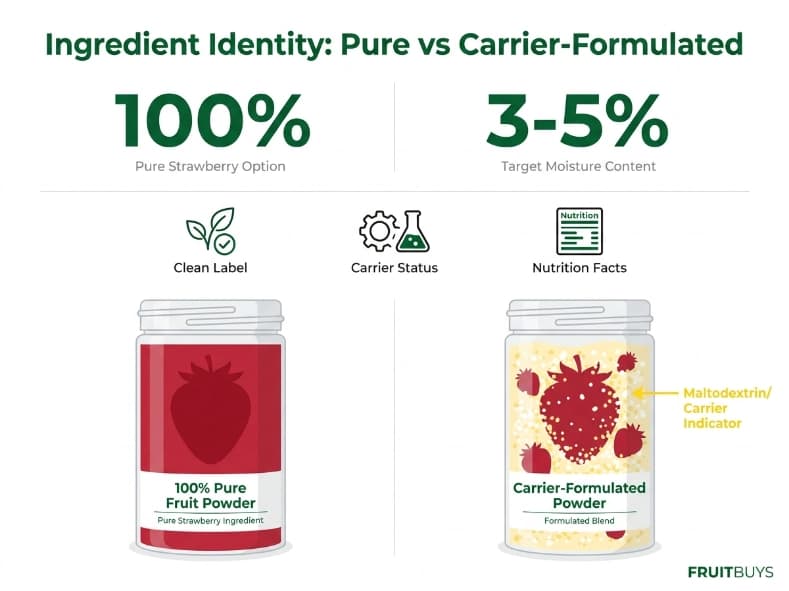
| Ingredient | 100% strawberries | 100% strawberries, nothing added, no carrier |
| Moisture / water activity | ≤5.0% / ≤0.30 | ≤5.0% / ≤0.30 |
| Lead, cadmium, arsenic | Periodic surveillance | Tested on every lot against your limits |
| Pesticide residues | EU or US limits for the fruit | Multi-residue screen per lot against baby-food limits |
| Microbiology | TPC, yeasts and moulds, E. coli, Salmonella per lot | Plus Enterobacteriaceae, and Cronobacter or Listeria where your specification calls for them |
| Format | Whole, slices, dice, crumble, powder | Powder 60–80 or 100 mesh, crumble 1–3 mm, dice 3–5 mm |
| Fruit selection | Seasonal lots | Lots selected for colour and flavour, season stated |
| Release | Lot COA | Lot COA plus the extended panel, approved before loading |
The fruit itself makes the case for the brand. Strawberries are grown under polytunnels and net-houses on raised beds in the Lam Dong highlands, frozen and dried under vacuum with nothing added, and every gram on the label is fruit. Baby-food shoppers read ingredient lists more closely than any other shoppers; a pack that reads Strawberries or Bananas, strawberries wins that read.
Heavy metals: testing lead, cadmium and arsenic
Lead is the number that decides a baby-food supplier. The limits are set per market, and both of the largest have moved in the last few years:
- United States: FDA’s final guidance of January 2025, part of its Closer to Zero programme, sets action levels for lead in processed food for babies and young children under two: 10 ppb for fruits, vegetables, mixtures, yogurts and similar foods, and 20 ppb for dry infant cereals and single-ingredient root vegetables.
- European Union: Regulation (EU) 2023/915 sets maximum levels for lead and cadmium in baby food and processed cereal-based food for infants and young children, including 0.020 mg/kg (20 ppb) for lead in baby food.
These limits apply to the finished food as sold or as prepared, not to a dry ingredient on its own, which is why the calculation matters. A melt or puff that contains 20% strawberry powder takes a fifth of the powder’s lead level into the product; a powder reconstituted into a purée is diluted further. Your QA team sets the ingredient limit backwards from the finished-product limit and the recipe.
How FruitBuys handles it for baby-food programmes:
- Your limits in the specification: lead, cadmium and inorganic arsenic, set by your QA team from your recipes.
- Tested on every lot at an accredited laboratory of your choice, such as Eurofins or SGS in Vietnam, before the container is sealed.
- Result on the release file: the lot ships only when the result is inside your limits.
Extended panels for baby-food programmes are paid by the buyer or shared, depending on volume, and agreed in the contract before the first lot.
Pesticide residues and microbiology
Residues. Baby foods in the EU carry a default limit of 0.01 mg/kg for each pesticide residue under Directive 2006/125/EC, much tighter than the limits for ordinary fruit. A multi-residue screen on every lot, read against those limits, is the standard request from EU baby-food brands. For residue calculations on dried fruit, results are converted back to fresh fruit with the processing factor; the method is in freeze-dried strawberry specification and COA.
Microbiology. Every lot ships with a COA from an independent ISO/IEC 17025 accredited laboratory:
| Parameter | Release limit |
|---|---|
| Total plate count | ≤10⁴ CFU/g |
| Yeasts and moulds | ≤10² CFU/g |
| E. coli | <10 CFU/g |
| Salmonella | Not detected in 25 g |
For infant and toddler products, add Enterobacteriaceae, and Cronobacter where the fruit goes into a powdered cereal or similar dry product for infants, plus Listeria if your specification asks for it. Retailers buying ready-to-eat berries also ask for hepatitis A and norovirus; that panel can be run on the same lot. Water activity at ≤0.30 keeps microorganisms from growing in the dry product, which is why it sits on every lot COA.
Planning a baby or toddler product with strawberry? Email [email protected] or WhatsApp +84 919 739 589 with your product, age group and target limits. REQUEST SAMPLE →
Formats: powder for melts and puffs, crumble for toddlers
| Format | Size | Typical use | Age stage in the brand’s range |
|---|---|---|---|
| Powder | 60–80 mesh or 100 mesh | Melts, puffs, infant cereals, purées, yogurt for babies | First foods and baby snacks |
| Fine crumble | 1–3 mm | Toddler cereal, yogurt topping, bar inclusions | Toddler |
| Small dice | 3–5 mm | Toddler snack mixes, bars | Older toddler |
Melts and puffs. Freeze-dried yogurt or fruit melts typically carry 10–20% fruit powder for flavour and natural pink colour. Strawberry powder colours the melt without any added colour, and the single-ingredient powder keeps the ingredient line short: for example Yogurt, strawberries. Use 100 mesh where a smooth melt surface matters; 60–80 mesh is the economical choice for puffs and cereals.
Purées and infant cereals. Powder reconstitutes into a purée or cereal with water or milk, carrying the fruit of 100–120 g of fresh strawberries in every 10 g, so the brand can sell strawberry year-round without a frozen chain.
Colour. Strawberry red comes from anthocyanins, which stay bright in acidic bases such as yogurt and fruit purée and shift toward mauve in neutral or alkaline bases. Test the colour in your own base before you print the pack photograph. Powder detail is in freeze-dried strawberry powder specification.
Choking size and texture
Freeze-dried fruit has an open, porous structure: moistened by saliva or liquid, it softens and dissolves much faster than fresh fruit, dried fruit or a baked snack. That is why freeze-dried powder and crumble are used in melts and dissolvable snacks for babies learning to self-feed.
Dissolving quickly is not the same as safe for every age. Whole and sliced freeze-dried strawberries are firm, crisp pieces before they meet saliva, and a whole berry is a size no baby product should use. Three rules for the product team:
- Choose the format by age: powder for first foods and melts; fine crumble for toddlers; dice only for older toddler products.
- Validate the finished product: dissolution and piece-size testing on your melt or snack, to the standards your market and retailers apply.
- Write the age guidance on the pack as your regulatory and paediatric advisers set it.
FruitBuys controls the ingredient side: cut size ±1–2 mm, sieved powder, and breakage limits written into the specification, so the piece size that arrives is the piece size your product was tested with.
Labelling: single ingredient, no added sugar
The ingredient line is the strongest asset on a baby-food pack, and with freeze-dried strawberry it is one word. For mixes, the fruits are listed by weight, for example Bananas, strawberries. Nothing else is added: no sugar, no salt, no colour, no flavouring, no preservative, no sulphites, no carrier.
Label claims for foods for infants and young children follow tighter rules than adult snacks in both the US and the EU, and many nutrient content claims are not allowed on products for children under two. The single-ingredient line does the selling without a claim. Nutrition values per 100 g and the US and EU panel formats are in freeze-dried strawberry nutrition facts; FruitBuys arranges a nutrition panel on your lot for the final artwork.
Strawberries are introduced to infants as a fruit like any other in most feeding guidance, and some children react to them; the age on your pack and any advisory text follow your regulatory and paediatric advice.
Documentation per lot
Each baby-food lot ships with a release file your QA team can sign off before the container is loaded:
| Document | Content |
|---|---|
| Lot COA | Moisture, water activity, TPC, yeasts and moulds, E. coli, Salmonella |
| Extended panel | Lead, cadmium, inorganic arsenic; pesticide multi-residue; Enterobacteriaceae and any other agreed tests |
| Pre-shipment sample | 100–200 g from the packed lot, two sealed foil pouches, approved in writing before loading |
| Retained sample | From every lot, kept for the full shelf life, up to 24 months |
| Facility file | HACCP, ISO 22000, BRC (qualified processing facility), US FDA Facility Registration; Halal certification available on request |
| Export documents | Commercial invoice, packing list, B/L, certificate of origin (EUR.1 for the EU and UK), phytosanitary certificate with every shipment |
Your programme runs at one qualified partner facility, with written notice and a new sample approval before any change, and audit access for your QA team. Bulk powder is packed in 5 kg foil bags with food-grade silica gel, 4 bags per carton, and keeps 12 months at ≤25 °C, RH ≤60%, or 18–24 months in cool storage at ≤18 °C, RH ≤50%.
Which starting point fits your brand?
| Your situation | Start with |
|---|---|
| Developing a strawberry melt or puff | Powder samples in 60–80 and 100 mesh, run in your base for colour and dissolution |
| Toddler cereal or snack range | Fine crumble 1–3 mm and powder, one specification for both |
| First commercial lot | Trial lot with the full extended panel, so your QA approves the limits on real results |
| Annual programme | Season plan, one locked facility, extended panel on every lot |
If your brand also sells to older children and adults, the same fruit runs as slices and dice for snacks under the standard specification, without the extended panel. The buying guide is freeze-dried strawberries in bulk.
Request baby-food grade samples
Send your product, age group, recipe share of strawberry and your limits for lead, cadmium, arsenic and residues. FruitBuys returns a specification built from your limits, powder or crumble samples in the formats that fit, and the testing plan for every lot, so your QA team signs off the system before the first container. Product details are on the freeze-dried strawberry powder page.
REQUEST SAMPLE →
Email [email protected] · WhatsApp Export +84 919 739 589
FAQ
Are freeze-dried strawberries safe for babies?
It depends on the format and the child’s age. Powder in purées, cereals and melts is used for first foods; crumble suits toddlers; whole and sliced pieces are not a baby format. Age guidance on the pack follows your paediatric and regulatory advice.
Do freeze-dried strawberries dissolve in a baby’s mouth?
Freeze-dried fruit softens and dissolves much faster than fresh or dried fruit once moistened, which is why powder and fine crumble are used in melts. Dissolution of the finished product is tested by the brand for its age group.
Do you test heavy metals for baby-food customers?
Yes. For baby-food programmes, lead, cadmium and inorganic arsenic are tested on every lot at an accredited laboratory of your choice, against limits set in your specification, before the container is sealed.
Can you supply no-added-sugar strawberry powder for melts?
Yes. The powder is 100% freeze-dried strawberries with no sugar, carrier or flow agent, in 60–80 or 100 mesh.
What pesticide limits apply to baby food in the EU?
A default of 0.01 mg/kg per pesticide residue for baby foods. FruitBuys runs a multi-residue screen on each baby-food lot against the limits in your specification.



