
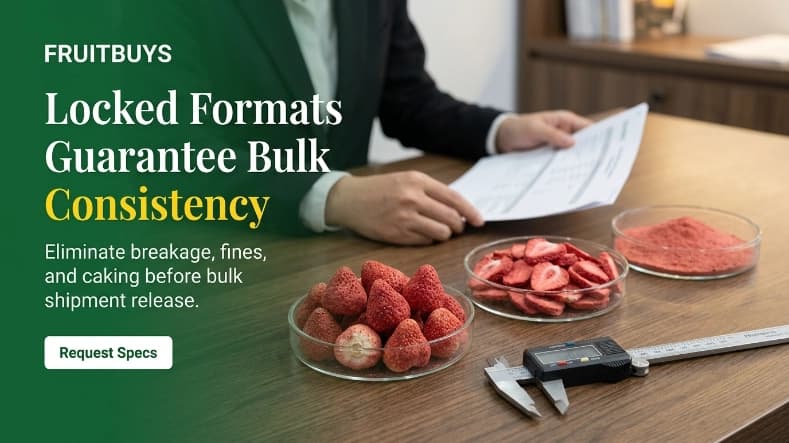
Freeze-Dried Strawberry Formats: Whole, Slices, Dice, Crumble or Powder?
Choose the format by where the strawberry sits in your product, not by the prettiest photo. Whole berries (20–35 mm) and slices (4–8 mm) are for products where the shopper sees the fruit; dice (3–10 mm) and crumble (1–5 mm) are for bars, bakery and fillings; powder is for colour and flavour. FruitBuys Vietnam supplies all six from the same Da Lat strawberries.
The format you pick decides three things at once: what the strawberry looks like in your product, how much breakage you pay for, and how many tonnes fit in a container. A 20ft carries 3.3 t of whole berries but 5.5 t of dice. This guide sets out each format, where it works, how to keep pieces crisp, and what the choice does to cost. The buying guide is freeze-dried strawberries in bulk.
Format selector
| Format | Size | Best for | Breakage to plan for | Net per carton | Per 20ft, floor-loaded |
|---|---|---|---|---|---|
| Whole | 20–35 mm | Window pouches, gift packs, chocolate-dipped fruit | ≤5–8% at loading | 6 kg | about 3.3 t |
| Halves | Berry cut once | Toppings, pouches where the red cut face shows | ≤5–8% at loading | 6 kg | about 3.3 t |
| Slices | 4–6 mm thin · 5–8 mm standard | Cereal, granola, muesli, snack mixes, drink garnish | ≤5–8% at loading | 7 kg | 3.85 t |
| Dice | 3–5 mm · 5–10 mm · 10 × 10 mm | Bars, bakery, chocolate, ice cream | Fines set on the sample | 10 kg (22 lb) | 5.5 t |
| Crumble | 1–3 mm · 2–5 mm | Toppings, coatings, bar centres, rim sugar | Sold as small pieces | 10 kg (22 lb) | 5.5 t |
| Powder | 60–80 mesh · 100 mesh | Drinks, dairy, frostings, natural colour | – | 20 kg | about 11 t |
Every format is 100% strawberries, released to the same moisture (≤5.0%) and water activity (≤0.30) limits. Final sizes are fixed on the pre-shipment sample, with a tolerance of about ±1–2 mm.
Whole berries and halves: when is the shape worth paying for?
When the berry itself is the product. In a clear retail pouch, a gift box or chocolate-dipped fruit, the shopper buys what they see, and a whole red strawberry of 20–35 mm sells on sight. Halves show the red cut face and the pale core of a real berry, which works well on toppings and in mixed fruit pouches.
Shape is also the most expensive thing in freeze-dried strawberry. Whole berries are sorted hardest, because every piece has to look perfect on its own; they pack at 6 kg per carton, lighter than other cuts, so the bottom layer arrives intact; and they take the longest drying cycle, 24–36 hours against 18–24 for slices and dice. Book whole and halves in the dry season, December to April, when Da Lat berries are firmest and reddest. The FruitBuys range and spec are on the freeze-dried strawberries page.
Slices: thin or standard?
Slices show a red cross-section with the pale centre that tells a shopper “real strawberry” from across the aisle.
- 4–6 mm thin slices give a light, crisp bite in granola and cereal, and soften fast in a cold drink as a garnish.
- 5–8 mm standard slices hold together better through mixing and in snack mixes, and read as a bigger piece in the bowl.
Slices pour at about 60–80 g/L, so each kilo takes 12–17 litres of hopper or pouch space; size the dosing head and the retail pouch from that number before the sample lands. In ribbon or drum mixers, slices hold up well for the first few minutes; past 3–5 minutes of tumbling, broken pieces rise by a further 2–4%, so add them in the last stage of the mix.
Dice: which size for which product?
Dice dose evenly and give a steady piece count per pack, which is what a bar or bakery line needs.
| Dice | Where it fits |
|---|---|
| 3–5 mm | Cereal bars and protein bars: small enough to bind, visible in the cut face |
| 5–10 mm | Muffins, cookies, scones, ice cream, yogurt toppers |
| 10 × 10 mm | Chocolate bark, enrobed pieces, premium cereal clusters, toppings where the piece must be seen |
Dice also make the best use of rainy-season fruit, May to November: brighter, more tart and just as red once dried, where shape no longer matters.
Need samples of two or three sizes for a side-by-side trial? Email [email protected] or WhatsApp +84 919 739 589 with your product and line. REQUEST SPEC SHEET / SAMPLE →
Crumble and granules: what are freeze-dried strawberry bits used for?
Crumble, sometimes called bits or granules, is freeze-dried strawberry in small pieces of 1–3 mm or 2–5 mm. It carries the most surface per gram, so it releases colour and flavour fastest:
- 1–3 mm: rim sugar on drinks, cold-foam and whipped-cream toppings, coatings on chocolate and confectionery.
- 2–5 mm: yogurt and dessert toppings, bar centres, ice-cream ripples, cereal coatings.
Crumble is made from pieces that whole and sliced runs set aside, so it costs less per kilo than slices while keeping the single-ingredient label. For a bar centre or a ripple, buying crumble is cheaper than buying slices and milling them on your own line.
Powder: when do you need it instead of pieces?
When the strawberry has to be everywhere in the product rather than in pieces: an even pink in a frosting or a yogurt, real strawberry taste in a drink, or a natural colour replacing a synthetic red. Powder is milled from the same freeze-dried fruit with no carrier, at 60–80 mesh or 100 mesh for drinks. It has its own page, freeze-dried strawberry powder, with the full line-by-line specification in freeze-dried strawberry powder specification.
Seen or hidden: the rule that saves the most money
The most useful question in format selection is simple: will the consumer see the strawberry?
| Where the strawberry sits | Format that earns its cost |
|---|---|
| In a clear pouch or gift box | Whole or halves |
| On top of a cereal bowl or a drink | Slices |
| In the cut face of a bar, on top of bark | Dice |
| Inside a filling, a pressed granola or the bottom of a yogurt | Crumble or dice |
| Spread through the product as colour and flavour | Powder |
If the strawberry is hidden in a filling, pressed into a bar or stirred through a base, paying for whole-berry sorting buys nothing the consumer will notice. Specify dice or crumble there: they typically quote 20–30% below whole berries per kilo, before the freight saving on top. Keep whole and sliced fruit for the places where shape sells the product, and the same budget buys more fruit.
How do you keep pieces crunchy in your product?
Freeze-dried strawberry is mostly air held in a fine honeycomb, which is what makes it crisp. It also means any free water around it gets drawn straight in:
| Base | What happens | What works |
|---|---|---|
| Dry cereal, granola, snack mix | Stays crisp through the shelf life in a good barrier pack | Pack in a high-barrier pouch; keep the mix dry |
| Bars and clusters | Stays crisp if the binder’s water activity is low | Match binder aw to the fruit; dice 3–5 mm bind best |
| Chocolate and fat-based fillings | Stays crisp; no water to take up | Ideal home for dice, crumble and powder |
| Yogurt and milk | Softens within about 2–5 minutes and shares its red with the base | Topper compartment or sachet added at serving; or powder in the base |
| Cold drinks | Slices soften in about 30–90 seconds | Garnish at the point of serving |
| Batters and doughs | Softens and becomes a jammy fruit piece | Dice 5–10 mm; welcome in muffins and cookies |
A thin fat-based or chocolate coating slows moisture uptake and keeps the red inside the piece; chocolate-coated dice are a standard route into ice cream and bakery. For a product that sits weeks in a wet base, put powder in the base and a crisp topper on the side. Run a 4-week trial in your real base and check crispness and colour at week 1 and week 4 before printing “crunchy strawberry pieces” on the pack. Bakery and chocolate use is covered in depth in freeze-dried strawberry for bakery and chocolate.
Can freeze-dried strawberries be rehydrated?
Yes, quickly: the open structure takes up water in seconds to minutes and the fruit regains colour and flavour. It does not return to the firm bite of a fresh berry, so rehydration is for sauces, smoothies, fillings and toppings, not for replacing fresh fruit on a plate. In a recipe, add the pieces dry and adjust the liquid; one kilo replaces about 10–12 kg of clean, fresh strawberries. The full conversion chart is in freeze-dried strawberry conversion ratio and chart.
What does the format do to cost and container load?
The same 20ft container, floor-loaded at about 550 cartons, carries:
| Format | Per 20ft | Per 40ft HC | Freight per kg vs whole |
|---|---|---|---|
| Whole or halves | about 3.3 t | about 6.6 t | Base |
| Slices | 3.85 t | 7.7 t | About 14% lower |
| Dice or crumble | 5.5 t | 11 t | About 40% lower |
| Powder | about 11 t | mixed loads | About 70% lower |
Switching from whole berries to slices puts about 17% more fruit in each container; switching to dice, about 67% more. Floor-loading matters as much as the cut: about 550 cartons on the floor against about 240 on pallets halves freight per kilo again. A 40ft HC can carry powder on the floor and slices above, so one booking feeds two lines. The full cost picture is in why are freeze-dried strawberries so expensive?; packing and loading detail is in freeze-dried strawberry packaging, shelf life and loading.
Can you get custom cuts?
Yes. Beyond the standard sizes, FruitBuys cuts to order after a short cutting trial on your sample: a specific slice thickness for a pouch window, a dice size matched to your bar, or shapes such as hearts for seasonal retail packs. The cut, tolerance and breakage limit are fixed on the pre-shipment sample, so container ten matches the sample your team approved.
Request samples by format
Send your product, base, line and pack format. FruitBuys returns samples of the cuts that fit, with sizes and breakage limits stated, and powder alongside if colour is part of the brief, so your R&D team can trial them in your own product before committing a container.
REQUEST SPEC SHEET / SAMPLE →
Email [email protected] · WhatsApp Export +84 919 739 589
FAQ
What are freeze-dried strawberry bits?
Small pieces of freeze-dried strawberry, also called crumble or granules, usually 1–3 mm or 2–5 mm. They are 100% fruit and are used for toppings, coatings, rim sugar, bar centres and ice-cream ripples, where they release colour and flavour fast at a lower cost per kilo than slices.
Are freeze-dried strawberry slices good for cereal?
Yes. Thin 4–6 mm slices give a light, crisp bite and a red cross-section in the bowl; standard 5–8 mm slices hold up better through mixing. Add them at the end of the mix and pack in a high-barrier pouch to keep them crisp.
Can freeze-dried strawberries be rehydrated?
Yes, in seconds to minutes. They regain colour and flavour but not the firm bite of a fresh berry, so use them rehydrated in sauces, smoothies and fillings, or add them dry and adjust the liquid in the recipe.
Whole vs slices: which is cheaper per kg?
Slices, and dice are cheaper still: dice and crumble typically quote 20–30% below whole berries per kilo. Whole berries are sorted hardest, take the longest drying cycle and load only about 3.3 t per 20ft, against 3.85 t for slices and 5.5 t for dice, so freight per kilo of dice is also about 40% lower than for whole fruit.
Do you cut custom shapes, such as hearts?
Yes. Custom thicknesses, dice sizes and shapes such as hearts are cut to order after a short cutting trial on your sample, with the cut and breakage limit fixed on the pre-shipment sample.



