
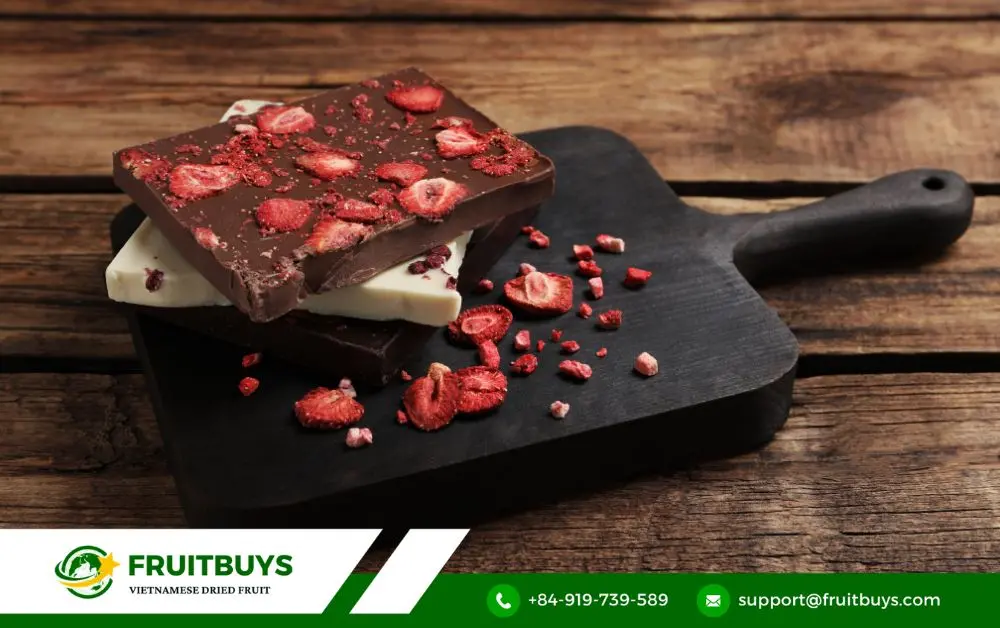
Freeze-Dried Strawberries for Baking and Chocolate: Real Fruit, No Added Water
Bakers and chocolatiers use freeze-dried strawberries because they add real strawberry without water: 5–10% powder colours and flavours buttercream and white chocolate without splitting or seizing, and 3–5 mm dice stay as red pieces in cookies and bars. FruitBuys Vietnam supplies powder, dice and slices from Da Lat strawberries at water activity ≤0.30.
Fresh strawberries and purée bring flavour, and they bring water with it: a buttercream that weeps, a ganache that splits, a white chocolate that seizes into paste, a cake with a short shelf life. Freeze-dried strawberries carry the same fruit with the water taken out, so the recipe stays stable and the label still says Strawberries. This guide covers each application with doses, the two technical traps (heat and moisture migration), and which mesh and piece size to buy. The buying guide is freeze-dried strawberries in bulk.
Why do bakers use freeze-dried instead of fresh or purée?
Because water is the problem in almost every bakery and confectionery application:
| Ingredient | Water it brings | What goes wrong | Freeze-dried result |
|---|---|---|---|
| Fresh strawberries | About 90% | Weeping frosting, soggy crumb, short shelf life | No added water; 12-month ingredient |
| Strawberry purée | High | Split buttercream, seized chocolate, diluted colour | Stable emulsion and chocolate |
| Jam or fruit filling | Moderate, with added sugar | Extra sugar on the label; bleeds into the crumb | 100% fruit, nothing added |
| Strawberry flavouring and red colour | None | “Flavoured” rather than “made with strawberries”; synthetic red on the label | Real fruit and natural pink |
Every 10 g of powder carries the fruit of 100–120 g of fresh strawberries, so the taste is stronger, not weaker, than fresh fruit at the same weight. And with the US FDA asking the food industry to phase out Red No. 40 by the end of 2026, and EU and UK labels carrying a warning on Allura Red (E129), strawberry is the one-word answer for a pink frosting or a red-flecked cookie.
Which format, dose and risk for each bakery application?
| Application | Format | Dose | Watch for |
|---|---|---|---|
| Buttercream, frosting, icing | Powder, 60–80 or 100 mesh | 5–10% | Thickens: add a little cream |
| Ganache and fillings | Powder | 5–10% | Add with the sugar or after the emulsion forms |
| White chocolate, compound | Powder + dice or crumble | 5–10% powder, 8–15% pieces | Thickening; moisture migration into pieces |
| Cookies | Dice 3–5 mm | 3–6% of dough | Colour fades in long, hot bakes |
| Muffins, scones, cakes | Dice 5–10 mm or powder | Dice 3–6%; powder 3–6% of flour | Soda-raised batter turns pink grey-violet |
| Sourdough and breads | Powder or dice | 3–5% of flour | Acidity helps keep the pink |
| Macarons | Powder, 100 mesh, seed-reduced | 3–5% of shell dry mix | Seeds show in the shell; sieved version for smooth shells |
| Dragées and panned pieces | Whole, halves or 10 × 10 mm dice | Fruit centre, chocolate coat about 60–70% of piece weight | Seal the centre first |
| Toppings and decoration | Slices, crumble | To finish | Add after baking |
How do you make buttercream with freeze-dried strawberries?
Use powder at 5–10% of the finished frosting, about 25–40 g per 450 g batch. Most bakery lines land at 6–8% for a deep natural pink with no added colour.
- Sieve the powder with the icing sugar. That breaks soft clumps and spreads the fruit evenly.
- Beat into soft butter, then adjust texture with a spoon of cream. The powder takes up a little moisture from the fat phase and stiffens the frosting, so hold back some sugar.
- Add a few drops of lemon juice. Acid brightens the anthocyanin pink.
- Rest 10 minutes and re-whip. The powder keeps hydrating and the colour deepens.
Compared with fresh berries or purée, the frosting holds its pipe, does not weep in the cabinet, and keeps for the life of the cake. A run of 1,000 cupcakes at 20 g of frosting each takes about 1.6 kg of powder at 8%. Full starter formulas, including the buttercream at production ratios, are in strawberry powder uses and dosage for food brands.
Can you bake freeze-dried strawberries into cookies, cakes and sourdough?
Yes, with two rules for the colour.
Heat: the red pigment, anthocyanin, starts to fade toward brown in bakes above about 180 °C for more than 20 minutes. Cookies and muffins with short bakes keep their red flecks well; a long-baked loaf cake will show softer, darker pieces.
Alkali: baking soda pushes the pink to grey-violet. In a soda-raised batter, balance the soda with an acid (buttermilk, yogurt, lemon) or move the strawberry into a filling, glaze or topping. Sourdough’s natural acidity works in your favour and keeps the pink better than a soda-raised dough.
Practical choices:
- Cookies: 3–5 mm dice at 3–6% of the dough. Small enough to bake through without burning, big enough to show as red pieces. White-chocolate and strawberry cookies are the classic pairing.
- Muffins and scones: 5–10 mm dice, folded in at the end; they turn into soft, jammy fruit pieces in the crumb.
- Cakes: powder at 3–6% of flour weight for flavour; for a pink sponge, put the strawberry in the frosting or a filling layer as well.
- Sourdough: powder or dice at 3–5% of flour, added with the flour; a swirl of powder and a little sugar layered before shaping gives a visible pink ribbon.
Dice can also be fat-coated before they go into a batter or dough, which keeps their colour in and slows moisture uptake.
Running a bakery trial this quarter? Email [email protected] or WhatsApp +84 919 739 589 with your products and line, and get powder and dice samples sized for a test bake. REQUEST SPEC SHEET / SAMPLE →
Why does freeze-dried strawberry not seize chocolate?
Chocolate seizes when a small amount of water meets the sugar and cocoa particles and they clump into a stiff paste. Purée, juice or even fresh fruit in a moulding line does exactly that. Freeze-dried strawberry at water activity ≤0.30 carries no free water to give, so it goes into tempered white, milk or dark chocolate as a dry ingredient:
- Solid bars and tablets: add powder with the sugar and milk powder before refining, so it is ground down with the rest of the mass to a smooth mouthfeel.
- Bark and slabs: stir 5–10% powder into tempered white chocolate for an even velvet pink, spread, and scatter 8–15% dice or crumble on top for crunch and visible red fruit.
- Enrobed and dipped pieces: whole berries, halves or slices half-dipped in dark or white chocolate are a retail and gifting staple; the dry fruit keeps the chocolate glossy and set.
Expect the chocolate to thicken as powder goes in; spread or deposit straight away, or adjust with a little cocoa butter. This is the format seasonal gifting lines are built on, for Valentine’s Day, Mother’s Day and Christmas: a pink bar with red fruit on top sells on sight, and the pack can say made with real strawberries with no artificial flavour or red dye.
Do freeze-dried strawberries stay crunchy in chocolate?
For a good while, and longer with one precaution. Chocolate typically sits at a water activity of about 0.4–0.5, higher than freeze-dried strawberry at ≤0.30, so over months a little moisture moves from the chocolate into the fruit and the pieces slowly soften. Three things slow it down:
- Fat-coat the pieces before inclusion or panning: a thin layer of cocoa butter or compound seals the fruit surface.
- Use smaller dice or crumble fully embedded in the chocolate, rather than large pieces breaking the surface.
- Pack the finished product in a good moisture barrier and keep it at ≤25 °C and RH ≤60%.
Run a crunch check on your own product at 1, 3 and 6 months before setting the shelf-life claim on the pack. In baked goods with moist crumbs, pieces turn soft and jammy, which is welcome in a muffin and expected in a cake.
What about nougat, dragées and panned confectionery?
Freeze-dried strawberry works wherever confectioners already use dried fruit, with the advantage of colour and a light texture:
- Nougat: dice 5–10 mm folded into the nougat mass at the end of mixing; the fruit shows in every cut slice.
- Dragées and panned pieces: whole berries, halves or 10 × 10 mm dice as the centre, sealed with a thin fat or gum layer, then panned in chocolate to about 60–70% of the piece weight.
- Coated and dusted products: fine crumble or powder dusted on chocolate truffles and coated nuts for colour and a sharp fruit note.
Which mesh and piece size should a bakery buy?
| Product | Buy | Why |
|---|---|---|
| Buttercream, ganache, fillings | Powder 60–80 or 100 mesh | 100 mesh for a silky finish |
| Macarons, smooth mousses | Powder 100 mesh, seed-reduced | No specks in a smooth shell |
| Cakes and bakery mixes | Powder 60–80 mesh | Visible red specks read as real fruit |
| Cookies, bars | Dice 3–5 mm | Bakes through, shows as red pieces |
| Muffins, scones, nougat | Dice 5–10 mm | Soft fruit pieces in the crumb |
| Bark, enrobed pieces, toppings | Dice 10 × 10 mm, slices, crumble | Visible fruit and crunch on the surface |
| Dipped and panned fruit | Whole, halves | Shape is the product |
Where the strawberry is hidden inside a filling or a cookie, dice and crumble typically quote 20–30% below whole berries per kilo and load 5.5 t per 20ft against 3.3 t of whole fruit. Keep whole berries for dipped and panned pieces where the shape sells. Every format and size is set out in freeze-dried strawberry formats and applications; the powder specification is on the freeze-dried strawberry powder page.
How should a bakery store and handle it?
Powder ships in 5 kg foil bags with silica gel, 20 kg per carton; pieces in 1–5 kg foil bags, sized to a production batch. Unopened, it keeps 12 months at ≤25 °C and RH ≤60%, or 18–24 months in cool storage at ≤18 °C and RH ≤50%. In the bakehouse, open one bag per batch, keep it away from ovens, proofers and dishwashers, and reseal a part-used bag with its desiccant; use it within about two weeks. Soft clumps in powder break with a sieve; they are natural fruit sugar, not spoilage.
Request samples for your bakery or chocolate trial
Send your products, line and target dose. FruitBuys returns a specification and samples of the powder and piece sizes that fit, so your R&D team can run test bakes and a chocolate trial before committing to a container. Trials start from 50–100 kg of powder or one pallet of pieces.
REQUEST SPEC SHEET / SAMPLE →
Email [email protected] · WhatsApp Export +84 919 739 589
FAQ
What is the best freeze-dried strawberry powder for baking?
A 100% strawberry powder with no carrier, at 60–80 mesh for cakes and bakery mixes (visible red specks) or 100 mesh for buttercream and macarons (silky finish). Choose the seed-reduced version for smooth shells and mousses.
How do you make buttercream with freeze-dried strawberries?
Sieve 25–40 g of powder per 450 g of frosting (5–10%) with the icing sugar, beat into soft butter, add a spoon of cream and a few drops of lemon juice, rest 10 minutes and re-whip. Around 6–8% gives a deep natural pink with no added colour.
Do freeze-dried strawberries stay crunchy in chocolate?
For months, softening slowly because chocolate holds slightly more moisture than the fruit. Fat-coat the pieces, use smaller dice fully embedded in the chocolate, and pack in a good moisture barrier. Check crunch at 1, 3 and 6 months before setting the shelf life.
Can you bake freeze-dried strawberries into cookies?
Yes. Use 3–5 mm dice at 3–6% of the dough. Short bakes keep the red flecks; above about 180 °C for more than 20 minutes the colour fades toward brown, and baking soda turns it grey-violet unless balanced with an acid.
Freeze-dried vs fresh strawberries in frosting: which is better?
Freeze-dried. Fresh strawberries and purée add water that makes frosting weep or split; powder gives a stronger strawberry taste and natural pink with no added water, and the frosting keeps its texture for the life of the cake.



