
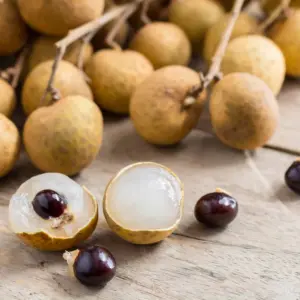
Longan vs lychee (and rambutan): how do they differ, and which fits your product?
They are cousins with different personalities. Longan is small and honey-sweet, with a musky floral aroma and a light caramel finish. Lychee is larger, juicier and perfumed, with a rose-like, sweet-tart taste. Rambutan sits between them: sweet with a gentle acidity and a firmer bite. All three belong to the soapberry family, all three have a translucent white flesh around a single seed, and all three are grown in Vietnam. For a product developer, the choice comes down to flavour, how the fruit holds up when dried, and whether it can be supplied all year.
How do longan, lychee and rambutan compare side by side?
| Longan | Lychee | Rambutan | |
|---|---|---|---|
| Also called | Dragon eye (long nhãn) | Litchi (vải) | Chôm chôm in Vietnam |
| Skin | Thin, smooth, tan to light brown | Red, rough, leathery | Red or yellow, covered in soft spines |
| Size | Small, about 2–2.5 cm | Medium | Medium, oval |
| Flesh | Translucent, firm, dense | Translucent, very juicy, soft | Translucent, firm; Rongrien releases the seed cleanly, Java holds it tighter |
| Taste | Honey-sweet, musky-floral, light caramel | Sweet-tart, rose-like, perfumed | Sweet with mild acidity, clean |
| Vietnam season | Every month in the Mekong Delta, peak June–July | Short early-summer crop | Main May–August, off-season December–March |
The one-line version: lychee is the most perfumed, rambutan the most refreshing, longan the warmest and sweetest.
What does each taste like, and where does that flavour work?
Longan reads as honey and flowers with a caramel finish. It pairs naturally with warm, rounded flavours: red dates, brown sugar, white chocolate, vanilla, chamomile and black or oolong tea. It is the fruit of Asian evening teas and Mid-Autumn desserts.
Lychee reads as rose and bright fruit. It suits sparkling drinks, cocktails, sorbets and anything floral and fresh, where its acidity lifts the recipe.
Rambutan reads as sweet and clean, with a little acidity. It suits yogurt, fruit snacks and mixed tropical blends where a mild fruit carries other flavours.
If your product is warm, creamy or tea-based, longan usually wins. If it is cold, sparkling or rose-forward, lychee usually wins. If you need a mild, crowd-pleasing tropical note, rambutan is the safe pick.
How do they compare on nutrition?
Fresh, per 100 g, the three are close: around 60–70 kcal, mostly natural sugar, almost no fat.
| Fresh fruit, per 100 g | Longan | Lychee |
|---|---|---|
| Energy | 60 kcal | 66 kcal |
| Total carbohydrate | 15 g | 16.5 g |
| Sugars | about 12 g | 15 g |
| Dietary fibre | 1.1 g | 1.3 g |
| Protein | 1.3 g | 0.8 g |
| Potassium | 266 mg | 171 mg |
| Vitamin C | 84 mg | 72 mg |
Longan carries a little less sugar and more potassium and vitamin C than lychee per 100 g fresh; lychee is slightly higher in sugar. Freeze-dried, both concentrate as the water leaves: freeze-dried longan sits at 340 kcal and 70 g of natural sugar per 100 g, with 1,500 mg of potassium, enough for a “high in potassium” claim in the EU. The full freeze-dried panel, per serving, is in longan calories and sugar, fresh vs dried.
How does each fruit behave when it is freeze-dried?
This is where longan has a structural advantage that shows on the shelf.
| Freeze-dried | Longan | Rambutan | Lychee |
|---|---|---|---|
| Usual format | Whole hollow balls, halves, pieces | Halves and pieces | Not in FruitBuys’ standard range |
| Look | Ivory to light cream, round, hollow where the seed was | Pale blush to light peach, cupped halves | |
| Bite | Light, airy crack, like meringue | Crisp, slightly denser | |
| Fresh fruit per kg | 8–9.5 kg whole fruit | About 13–17 kg whole fruit (thicker skin, larger seed) | |
| Year-round supply from Vietnam | Yes, Mekong Delta | Main crop plus off-season | Summer crop |
Longan’s thick, firm aril comes off the seed in one piece and holds a round cup through freezing and drying, so it can be sold as a whole ball. A hollow ball carries 2.2–2.5× the apparent volume of soft-dried fruit, so a 35–50 g pouch looks as full as a 100–120 g pouch of chewy dried fruit. Rambutan has a thicker skin and a larger seed, so a kilogram takes about 13–17 kg of whole fruit. Rongrien fruit, which releases its seed cleanly, becomes cupped halves; aromatic Java fruit, which holds its seed tighter, becomes pieces for inclusions and mixes. Both are unsulfured in FruitBuys’ range, with nothing added.
Which should you source for your product?
| If your product is… | Choose | Why |
|---|---|---|
| A tea blend, milk tea or warm dessert | Longan | Honey-floral, caramel finish; softens in 60–90 s in hot water |
| A snack pouch sold on looks | Longan, whole balls | Round, ivory, full-looking pack at low weight |
| A yogurt, granola or tropical mix | Rambutan or longan pieces | Mild, firm, even dosing |
| A sparkling drink, sorbet or rose-forward flavour | Lychee | Perfumed, sweet-tart profile |
| A year-round container programme | Longan | Mekong fruit reaches the gate every month |
Many brands use two of them: longan as the hero in a tea or snack line, rambutan as a supporting fruit in a tropical mix.
Where does FruitBuys fit?
FruitBuys supplies freeze-dried longan year-round from the Mekong Delta, as whole balls, halves, pieces and powder, and freeze-dried rambutan in halves and pieces from Mekong Delta and Dong Nai orchards, with main-crop fruit frozen to cover off-season call-offs. For other Vietnamese tropical fruits, FruitBuys runs custom OEM batches on request, including summer-crop lychee, alongside its standing freeze-dried fruit range. How freeze-dried longan compares with the traditional dark dried fruit is in what is dried longan, and when does freeze-dried sell better; full specifications are on the freeze-dried longan product page and the freeze-dried rambutan product page. If longan is your pick, the checks and RFQ lines for a first order are in what to specify for a firm freeze-dried longan quote.
FAQ
What is the difference between longan and lychee?
Longan is smaller, with thin tan skin and honey-sweet, musky-floral flesh. Lychee is larger, with red rough skin and juicier, rose-like, sweet-tart flesh.
Which tastes sweeter, longan or lychee?
Longan tastes sweeter and rounder, with a caramel note; lychee has more acidity and a perfumed, rose-like finish.
Is longan healthier than lychee?
They are close. Per 100 g fresh, longan has slightly less sugar and more potassium and vitamin C; lychee has slightly more sugar. Both are fat-free fruits.
What is the difference between longan, lychee and rambutan?
All three are soapberry-family fruits with white flesh around one seed. Longan is honey-sweet, lychee perfumed and sweet-tart, rambutan sweet and mildly acidic with spiny skin.
Why is longan called dragon eye?
When the shell is opened, the dark seed shows through the translucent flesh like an eye.
Which works best freeze-dried?
Longan, for whole-ball snacks and tea, because its thick flesh holds a round, hollow shape. Rambutan works well in halves and pieces for mixes.
Can FruitBuys supply freeze-dried lychee?
Not from its standard range. FruitBuys runs custom OEM batches on request for other Vietnamese tropical fruits, including summer-crop lychee.



