
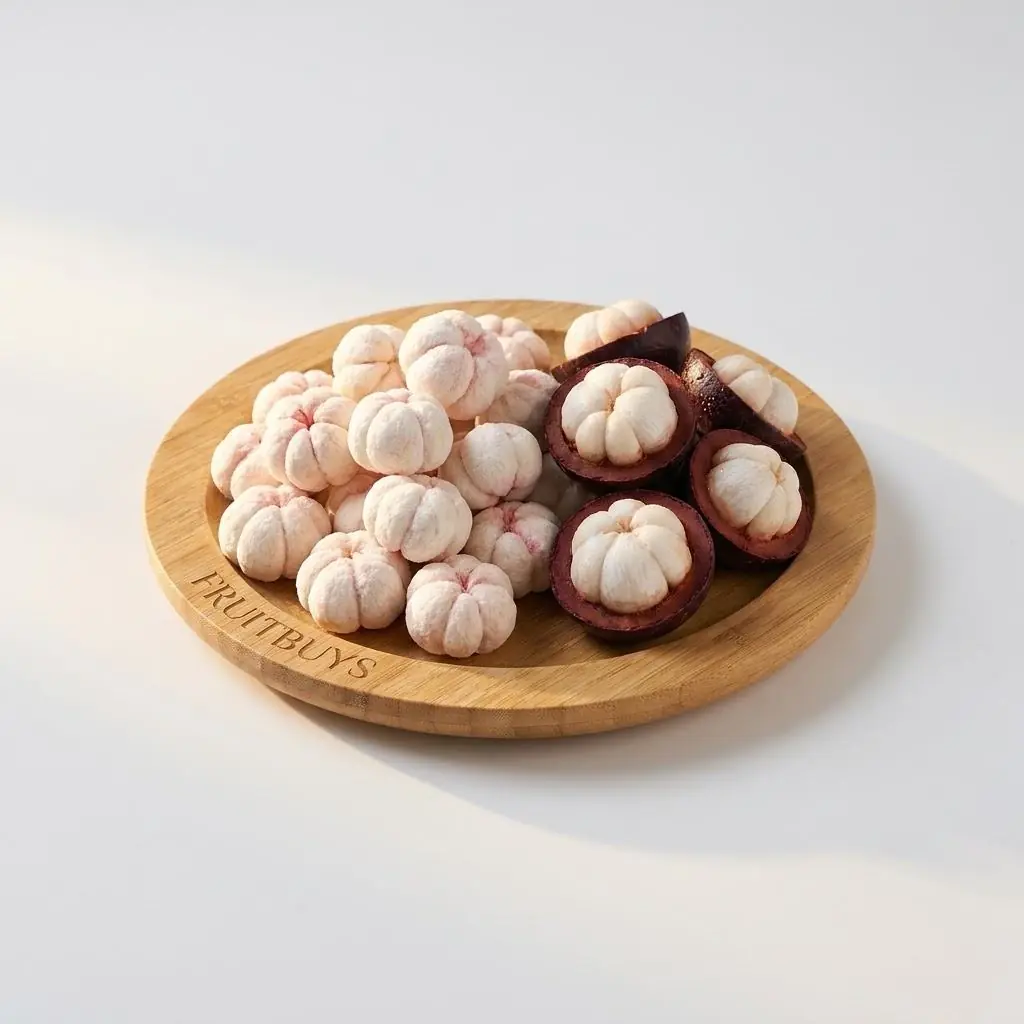
Can you private-label freeze-dried mangosteen from Vietnam?
Yes, from 500 kg, packed in your own pouches with a one-line ingredient list: “100% mangosteen”. That is about 10,000 pouches of 50 g, enough to launch a SKU in one market and read the sell-through before committing to a container. Mangosteen is a fruit many shoppers have heard of and few have tasted, so a private-label launch starts with a story the shelf does not already have. The one thing to plan around is the harvest: the best fruit arrives between May and mid-July and is frozen at −25 °C for production through the year, so your volume is confirmed before April and your pouches can be filled in the month your launch needs.
What is the minimum order?
500 kg for OEM, ODM and private-label packing. Split by pouch size, that works out at roughly:
| Pouch size | Pouches per 500 kg | Typical use |
|---|---|---|
| 30 g | about 16,600 | Single-serve, impulse, office snacking |
| 50 g | about 10,000 | Core retail snack |
| 100 g | about 5,000 | Sharing pack, e-commerce |
| 500 g | about 1,000 | Foodservice, bulk retail, gifting |
That makes a first run small enough to test a market without tying up a container’s worth of stock, and large enough to supply a regional retail listing. On digital print, the same 500 kg can be split across several artwork variants, so one run can test two pack designs or supply two retailers’ own packs. If your test sells, the next order scales to a full container on the same specification and the same locked facility.
Which format should go into a retail pack?
Whole arils for the shelf. A complete, flower-shaped ivory cluster seen through a window pouch tells the shopper exactly what is inside, and that recognition is what lets a mangosteen pack carry a higher price than the mango and pineapple beside it. For a retail launch where every pouch is on show, the tray-packed option places the arils by hand and holds breakage to ≤5%, from 500 kg, which matches the minimum order. Intact single segments that separate from a cluster count as whole product.
Diced suits a mix: trail mix, cereal toppers, chocolate-and-fruit snack packs, where the fruit shares the pouch with other ingredients. Format choices by application are covered in which freeze-dried mangosteen format fits your product.
What goes on the label?
The ingredient line is the strongest thing on the pack: “100% mangosteen (Garcinia mangostana)”, with no added sugar, carrier or preservative. A single-ingredient line reads cleanly in every main market and gives your marketing a simple, true claim.
It is also the line US label rules are moving towards. FDA’s updated “healthy” claim, required from 25 February 2028, lets single-ingredient fruit with nothing added qualify on that basis, and FDA’s proposed front-of-pack Nutrition Info box would rate freeze-dried mangosteen Low on saturated fat, sodium and added sugars, all three at zero. A brand redesigning packs before 2028 starts with an ingredient that already fits; final eligibility is confirmed on your finished label.
Five label points to settle at the brief stage:
| Label element | What to use | Note |
|---|---|---|
| Ingredient line | 100% mangosteen | Single ingredient |
| Sugar | “No added sugar” where your market allows it | The 70 g per 100 g is the fruit’s own |
| Energy | 400 kcal per 100 g (US) or 360 kcal (EU); 160 kcal per 40 g US serving | Two conventions; print the right one per market |
| Fibre | 13.3 g per 100 g | “Good source of fiber” at the 40 g US serving; “high fibre” in the EU |
| Seeds | “Contains natural seeds” | Every format is seed-in; the seed is crisp and edible |
| Claims | Taste, clean label, fibre | No xanthone or health claims; most xanthones sit in the rind |
For the printed nutrition panel, FruitBuys samples your commercial lot and arranges the analysis at an independent ISO/IEC 17025 accredited laboratory, so the numbers on your pack come from the fruit in your pack. The nutrition basis is set out in freeze-dried mangosteen nutrition per 100 g.
For the UAE, Arabic labelling and product registration are arranged with your importer before the first shipment; a C/O Form CEPA travels with every UAE shipment, and Halal certification is available on request.
For Amazon and marketplace sellers, UPC or FNSKU codes are printed on the pouch and FBA labels applied to cartons and pallets to your instructions, so stock goes from the container into the fulfilment centre without a relabelling step.
Which pouches can you use?
Standard retail pouches are 30 g, 50 g, 100 g and 500 g aluminium-foil zip pouches, or a custom format to your brief. Foil matters for this fruit: freeze-dried mangosteen carries about 70 g of natural sugar per 100 g and draws moisture quickly, so the pouch must be a real moisture barrier and reseal well once opened. A zip closure keeps the arils crisp from the first handful to the last.
Mangosteen sells through a window. The ivory, flower-shaped arils are the best advertisement the pack can carry, so FruitBuys supplies window pouches in a high-barrier laminate, built to keep moisture out while the shopper sees the fruit. It is the same protection as the full-foil pouch, with the product on show.
How long does pouch printing take? Two routes, chosen by volume:
| Printing | Lead time | Best for |
|---|---|---|
| Digital | 7–10 working days | First runs and test launches; no cylinder cost |
| Rotogravure | 15–20 working days | Repeat volume; sharpest print and lowest cost per pouch |
Rotogravure cylinders are an investment that pays back over larger runs, and gravure printers typically work to minimum runs well above a 10,000-pouch launch. So most private-label programmes start on digital print for the first 500 kg, read the market, and move to rotogravure once the SKU has proven itself. Your artwork stays the same; only the print route changes.
How long can the printed date be?
As long as your data supports. Freeze-dried mangosteen keeps 12 months at ≤25 °C, RH ≤60%, and 18–24 months in cool storage at ≤18 °C, RH ≤50% in the bulk foil bag. A retail pouch is a different pack, so the date you print should be backed by data on your own pouch. For private-label programmes, FruitBuys arranges an accelerated shelf-life study on your final pack, so the best-before date rests on your packaging, not on an assumption.
How does the harvest set your launch date?
The best fruit for whole arils comes from May to mid-July. Those arils are frozen at −25 °C in season and freeze-dried to order, so the harvest sets your volume deadline, not your production month:
| When | Step |
|---|---|
| November – March | Brief, format and pouch decisions; samples; artwork |
| Before April | Confirm whole-aril volume for the next twelve months |
| May – mid-July | Main-season arils peeled and frozen at −25 °C |
| Any month after | Pouches printed (7–10 working days digital, 15–20 rotogravure); freeze-drying and packing in your pouches; pre-shipment sample approved |
| Shipping | Production lead time 20–30 days per 20ft after deposit |
A brand that briefs in winter and confirms volume before April can time its launch to any season it chooses: a spring health range, a summer snack listing or the year-end gifting trade. A brand that comes after April can still launch on diced, or on whole arils from volume still available.
Should you pack in Vietnam or at home?
Pack in Vietnam when you want a finished retail product and your volume is at or above 500 kg per SKU. The fruit goes from the dryer into your pouch without being opened again, which protects crispness, and you ship finished goods ready for your distribution centre, with no repacking step at destination. For gifting, the same 500 kg of tray-packed arils fills about 1,000 boxes of 500 g, each opening on whole, ordered clusters.
Pack at home when your volume is below 500 kg, when you run many small SKUs, or when your own packing line is already set up for dried fruit. In that case, buy bulk in 1–5 kg foil bags sized to your packing batches, open a bag and pack the whole bag, and keep the packing room dry.
Start your private-label mangosteen
Send your target market, pouch sizes, format and launch month. FruitBuys returns a plan built on the season: format, pouch and label recommendations, the volume deadline and the production slot. Full product details are on the freeze-dried mangosteen page. The complete buyer checklist is in what to check before buying freeze-dried mangosteen in bulk.
FAQ
What is the minimum order for private-label freeze-dried mangosteen?
500 kg, about 10,000 pouches of 50 g.
Can the ingredient list read “100% mangosteen”?
Yes. Nothing is added: no sugar, carrier or preservative.
Which format is best for a retail snack pack?
Whole arils, tray-packed if every pouch must look perfect. Breakage on tray-packed arils is held to 5%.
Can I make a health claim about xanthones?
No. Most xanthones sit in the rind, and the white flesh carries only small amounts. Sell on taste, clean label and fibre.
Do I need to mention seeds on the label?
Yes, print “Contains natural seeds”. Every format is seed-in; after freeze-drying the seed is crisp and eaten with the fruit.
When should I start a private-label project?
Brief in winter and confirm volume before April. Main-season arils are frozen and freeze-dried to order, so your pouches can be packed in the month your launch needs.
What shelf life can I print?
The bulk product keeps 12 months at ≤25 °C and RH ≤60%. For a retail pouch, FruitBuys arranges an accelerated shelf-life study on your final pack.



