
How many kilograms of fresh lotus seeds make 1 kg freeze-dried, and why do quotes disagree?
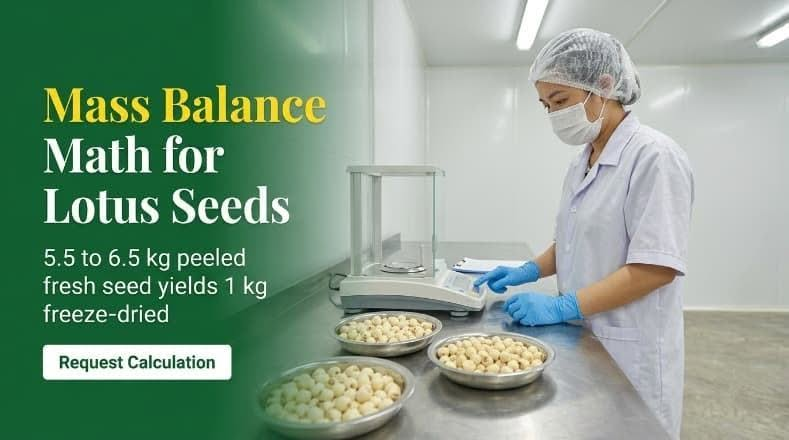
It takes about 10–12 kg of fresh lotus seeds in the green husk, as they are bought at the pond, or 5.5–6.5 kg of fresh shelled kernels, to make 1 kg of freeze-dried lotus seeds. Those are two stages of the same chain, and both belong in a supplier conversation. Any quote built on 3–4 kg is counting from a different starting point or delivering a wetter product, and the arithmetic below shows why.
The ratio is the single biggest line in what a kilo of freeze-dried lotus seeds costs to make. Get it right and you can test any offer on your desk in five minutes, without a price list from anyone.
Why are there two numbers, and which one should you use?
Because lotus seeds change hands twice before they reach a freeze-dryer, and each stage has its own unit.
| Stage | What is weighed | Fresh weight per 1 kg freeze-dried | Who uses it |
|---|---|---|---|
| Pond-side | Seeds in the green husk, as traded at Dong Thap buying points | 10–12 kg | Growers, collectors, anyone buying direct from ponds |
| Processing | Shelled kernels, husk off, before coring | 5.5–6.5 kg | Processing facilities and supply-chain managers |
The husk and the thin skin under it take roughly 45% of the weight of a seed in its husk. That is why the pond-side figure is about double the processing figure.
Use the processing figure to test a quote, because shelled kernels are the input whose local price you can check. Use the pond-side figure when you want to know whether a supplier really buys at source. A supplier who can give you both numbers, and explain the gap between them, is one who stands at the pond and at the drying line.
Where does the weight go between the pond and the tray?
Most of it is water, and the rest is everything that is not a clean, cored, whole kernel.
| What leaves | Why it leaves | What it means for you |
|---|---|---|
| Green husk and skin | Not edible; removed by hand or machine | About 45% of the in-husk weight, gone before processing starts |
| Empty and underfilled seeds | Some seeds in every harvest never fill out | Sorted out at shelling; a supplier who skips this sells you light kernels |
| Green plumule (core) | Bitter; pushed out of every kernel | The step that decides whether your paste tastes clean |
| Blanch and handling losses | Kernels that crack or discolour in steam blanching are sorted out | Keeps the ivory colour and the whole-kernel grade honest |
| Fines and breakage | Small fragments from coring, drying and grading | Halves and pieces go into their own formats; only true fines are lost |
| Water | About 77% of a fresh kernel; finished kernels hold about 4% | The part no one can avoid |
On paper, water alone sets the floor at about 4.2 kg. A fresh shelled kernel is about 77% water and a finished kernel about 4%, so (100 − 4) ÷ (100 − 77) = 4.17 kg of fresh kernel per kilo, if nothing at all were lost. Real lines run at 5.5–6.5 kg, which means between a quarter and a third of the shelled weight that arrives at the facility never reaches the drying tray. That is the empty seeds, the cores, the blanch losses and the fines from the table above. Any supplier who prices from the 4.2 kg figure is quoting a line that does not exist.
How the kernels are cored, blanched and frozen, and why each step costs weight but saves colour and crunch, is in how lotus seeds are freeze-dried.
Why do some quotes show 3 to 4 kg, and what are they really selling?
Some quotes on the market are built on 3.2–3.5 kg of fresh lotus seeds per kilo of freeze-dried. That sits below the 4.2 kg water floor, so it cannot come from fresh shelled kernels at 77% water. One of three things is going on:
- The input was already drained or part-dried. Kernels that have sat, drained or been pre-dried before weighing hold less water, so fewer kilos go in. The ratio looks better; the cost per kilo of real dry matter has not changed.
- The finished product holds more water. A kernel that leaves the dryer above the 5% contract ceiling weighs more, so fewer fresh kilos make “one kilo”. You pay for that water, and it costs you crunch and shelf life: a kernel above Aw 0.30 chews instead of snapping.
- The grade is looser. Missed cores, empty seeds and broken pieces left in whole-kernel grade raise the yield on paper and lower it in your product.
None of these is visible on a price sheet. All three are visible in a sample: count the cores in 100 kernels, sort the broken share and read the water activity within 60 seconds of opening the bag. The full acceptance check is in what a freeze-dried lotus seed COA should prove.
Does the ratio change with the season?
Yes, within the range, and that is why it is a range and not a single number. Dong Thap’s main harvest runs from July to September, when kernels are fully mature, dense and well filled, and lines run toward the 5.5 kg end. Seeds picked young, or at the start and end of a flush, are softer and wetter and carry more empty or underfilled seeds, and the ratio moves toward 6.5 kg. Whole-kernel grade also needs more fresh weight than pieces, because only intact kernels qualify.
This is why the year’s volume is contracted in the main harvest: the best ratio and the best kernels arrive together. Where the seeds grow and how the season runs is in where Vietnam’s lotus seeds come from.
How do you test a quote on your desk?
Build the cost of one kilo yourself. The formula needs four inputs you can check without asking any supplier for their margin.
| Line | How to fill it |
|---|---|
| Raw material | Local price of fresh shelled lotus kernels per kg × 5.5–6.5 |
| Processing and packing | Freeze-drying, grading, foil bags, desiccant and cartons per kg; ask for it as a separate line |
| Sea freight per kg | Your container rate ÷ net load. Example for comparison, not a quote: at USD 2,000 per 20ft and 3.85–5.5 t net, freight is USD 0.36–0.52 per kg |
| Duty | The rate on the line declared at entry; plain kernels move under HTS 1212.99.92, free of general duty in the US, plus any US tariffs in force on the entry date |
Add the four lines. An offer far below that total is buying a wetter kernel, a looser grade or a different starting point. Ask the supplier which input their ratio counts from, and what moisture and Aw the quote is based on. Those two answers explain most of the gaps between offers.
If your target is a lower cost per kilo, change the format, not the ratio. Every fresh kilo yields whole kernels, halves and pieces together. Whole-kernel grade takes only the intact kernels, so it carries the most raw material per kilo. If your product is a paste, a filling, a granola or a bar where nobody sees the shape, halves and pieces come from the same fresh kilo and carry less of that grading cost. FruitBuys quotes each format on its own, so you pay for whole kernels only where your customer sees them.
Request a quote built on a ratio you can check
Send your format, volume and destination, and the quote comes back with the moisture and Aw it is based on, the format split and the documents that travel with the container.
FAQ
How many kg of fresh lotus seeds make 1 kg of freeze-dried lotus seeds?
About 10–12 kg of fresh seeds in the green husk, or 5.5–6.5 kg of fresh shelled kernels.
Why is the ratio higher than the water content suggests?
Water alone sets a floor of about 4.2 kg of shelled kernel per kilo. Empty seeds, cores, blanch losses and fines take another quarter to a third of the shelled weight, so real lines run at 5.5–6.5 kg.
Is a 3 kg ratio possible?
Not from fresh shelled kernels at about 77% water. A ratio of 3–4 kg counts from drained or part-dried kernels, or delivers a product above the 5% moisture ceiling, or a looser grade.
Why do whole kernels cost more than pieces?
Only intact, cored kernels qualify for whole-kernel grade, so it carries the most raw material per kilo. Halves and pieces from the same fresh kilo carry less, which makes them the better choice for pastes and inclusions.
When is the best time to contract lotus seeds?
In the main harvest, July to September in Dong Thap, when kernels are fully mature and the ratio sits at the efficient end of the range.
Does freeze-dried lotus seed cost more than heat-dried?
Per kilo of product, usually yes: freeze-drying runs longer under vacuum than hot-air drying, and the grade is tighter. Per kilo used, the gap narrows: freeze-dried kernels skip the 4–8-hour soak, and the soak tanks, water and overnight labour that come with it.



