
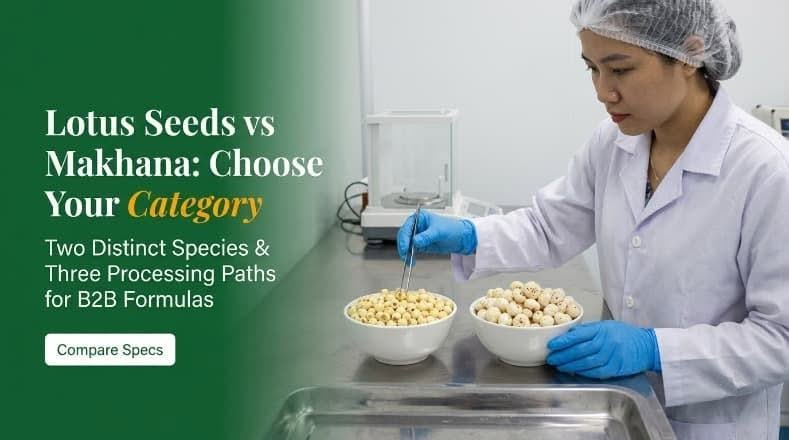
Is makhana the same as lotus seed?
No. Makhana is the seed of Euryale ferox, the prickly water lily, popped into a light white puff. Lotus seed is the kernel of Nelumbo nucifera, the sacred lotus. Both grow in ponds, both are sold dried and pale, and Western snack packs often call makhana “lotus seeds” or “puffed lotus seeds”, which is where the confusion starts. For a buyer, the difference matters on three counts: the texture your customer gets, the species name on your label, and which shelf the product earns.
Freeze-dried lotus seeds are the shelled, cored kernels of Nelumbo nucifera, steam-blanched and freeze-dried to ≤5% moisture and water activity ≤0.30. They are crisp and ready to eat from the bag, and rehydrate in 10–15 minutes in warm water instead of an overnight soak. They are not makhana (fox nut, Euryale ferox), which comes from a different water plant.
Why do the two names get mixed up?
Because the two plants look alike from the bank of a pond, and the products look alike in a clear bag. Both are large water plants with floating leaves. Both seeds are harvested from the water, dried, and sold pale. Some English-language packs then borrowed “lotus seed” as a familiar label for something that is not lotus at all.
The names in use add to it. Makhana is also sold as fox nut, gorgon nut or phool makhana. Lotus seed is sold as lotus nut, lian zi in Chinese markets and hạt sen in Vietnamese. None of these names crosses over: a fox nut is never a lotus seed, and a lotus nut is never makhana.
How do they differ, line by line?
| Lotus seed | Makhana (fox nut) | |
|---|---|---|
| Species | Nelumbo nucifera (sacred lotus) | Euryale ferox (prickly water lily) |
| Plant | Lotus, with leaves and flowers held above the water | Water lily with large, spiny floating leaves |
| Main growing areas | Across Asia; FruitBuys sources from Dong Thap, in Vietnam’s Mekong Delta | Mainly Bihar, in eastern India |
| What is sold | The kernel, shelled, skinned and cored | The seed, roasted and popped out of its hard black coat |
| How it is processed | Steam-blanched and freeze-dried, or heat-dried | Dry-roasted and popped |
| Texture | Crisp and denser when freeze-dried; soft when cooked | Light, airy puff that melts in the mouth |
| Colour | Natural ivory to light cream | White puff, often with brown flecks of seed coat |
| Ingredient line | “Lotus seeds” | “Fox nut” or “makhana (Euryale ferox)” |
| Typical uses | Sweet soups, lotus seed paste and mooncake, congee, tea, crunchy snacks, cereal inclusions | Roasted seasoned snacks, kheer and other Indian desserts, curries |
The practical summary for a category buyer: makhana is a puffed snack seed; lotus seed is a dense kernel that works as a snack, a cooking ingredient and a paste. They sit side by side on a seed-snack shelf, but they are not substitutes in a recipe. A mooncake paste cannot be made from makhana, and a lotus seed will not pop into a puff.
Which one fits your shelf?
Choose by what your customer expects to bite into.
- If your shopper wants an airy, popcorn-light snack, that is makhana, and it is the right product for that SKU.
- If your shopper wants a crunchy kernel with more bite, or a clean ingredient for desserts and Asian cooking, that is lotus seed. Freeze-dried kernels are crisp from the bag with no oil, and soften in 10–15 minutes when cooked.
- If you already sell makhana, lotus seed is the natural second line on the same shelf: same pond-grown story, different texture, different kitchen uses. Seasoned lotus seed kernels, made to your recipe as ODM from 500 kg per SKU, sit next to seasoned makhana without competing for the same bite.
FruitBuys supplies lotus seeds, not makhana. For a makhana buyer, that means a new line from a different plant and a different origin, which spreads sourcing across two supply chains instead of one.
How big is the makhana market, and where does lotus seed add a line?
Makhana is a growing, organised category. Government of India data for 2025-26 put production at about 80,590 t, with exports of about 7,265 t. The United States took about 40% of those exports, Canada about 20% and the UAE about 17%. India launched a National Makhana Board on 15 September 2025 to develop the crop and its exports.
Those numbers say two useful things to a lotus seed buyer. First, the seed-snack shelf in the US, Canada and the UAE is real and already stocked: shoppers there have learned to buy a pond-grown seed as a snack. Second, much of that shelf leans on one species from one region. Lotus seed adds a second species, a different texture and a different origin to the same aisle, together with the Asian dessert and cooking uses that makhana does not cover.
How should each one be labelled?
By its own name and species. On a pack of lotus seeds, the ingredient line reads “lotus seeds”, and your spec names Nelumbo nucifera. On a pack of makhana, it reads “fox nut” or “makhana”, with Euryale ferox in the spec. Calling makhana “lotus seeds”, or the reverse, puts the wrong food name on the label, which is a correction no brand wants to make after printing.
Two practical rules for a range that carries both:
- Keep them as separate SKUs with separate specs. Different species, different processing, different nutrition panels.
- Keep the names apart in your marketing too. “Popped lotus seeds” on a makhana pack invites the same confusion your customers are searching to clear up.
Customs treats them differently as well. Plain freeze-dried lotus seeds export under HS 1212.99; roasted, seasoned seed snacks such as makhana are classified as prepared foods under 2008.19, as a 2026 UK advance tariff ruling on roasted, seasoned makhana shows. The classification of lotus seed by market is in what HS code freeze-dried lotus seeds ship under.
What lotus seeds put on a nutrition panel, and which claims they carry, is in lotus seed nutrition facts.
Add lotus seed to your seed-snack range
Request a sample of freeze-dried lotus seed kernels, plain or seasoned, and taste them next to the makhana on your shelf. The full specification is on the freeze-dried lotus seeds product page.
FAQ
Are makhana and lotus seeds the same?
No. Makhana comes from Euryale ferox, the prickly water lily; lotus seeds come from Nelumbo nucifera, the sacred lotus. They are different plants.
What is makhana called in English?
Fox nut or gorgon nut. It is sometimes sold as “popped lotus seeds”, but it is not lotus seed.
Why is makhana called lotus seed?
Both grow in ponds and both are sold as pale, dried seeds, so some packs borrow the better-known name. The plants are different.
Is lotus nut the same as lotus seed?
Yes. “Lotus nut” is another trade name for the lotus seed kernel of Nelumbo nucifera.
Can lotus seeds be popped like makhana?
No. Lotus seed is a dense kernel. Freeze-drying makes it crisp, and cooking makes it soft, but it does not puff.
Can I use makhana instead of lotus seeds in mooncake paste?
No. Lotus seed paste is made from lotus seed kernels; makhana gives a different texture and flavour.
Does FruitBuys supply makhana?
No. FruitBuys supplies freeze-dried lotus seeds from Dong Thap, Vietnam, as whole kernels, halves, pieces, powder and seasoned kernels.



