
Water Activity Below 0.3: The Number That Protects Lotus Seed Shelf Life
Shelf life claims fail the same way in every category: the supplier promises 24 months, the warehouse stores at 35 degrees C with humidity cycling through the monsoon, and the first bitter lot arrives at the retail shelf inside the claimed window. The claim was never the problem; the missing measurement was. For lotus seed, one number decides whether the product survives its own shelf life: water activity, the fraction of unbound water available to mold and toxigenic fungi.
The research record for stored lotus seed is unusually specific, which makes this a rare category where QA can hold a supplier to a published scientific threshold instead of a marketing figure. This article sets out that threshold, the evidence behind it, and the two-measurement verification protocol that keeps responsibility assigned to the right point in the chain.
The Answer
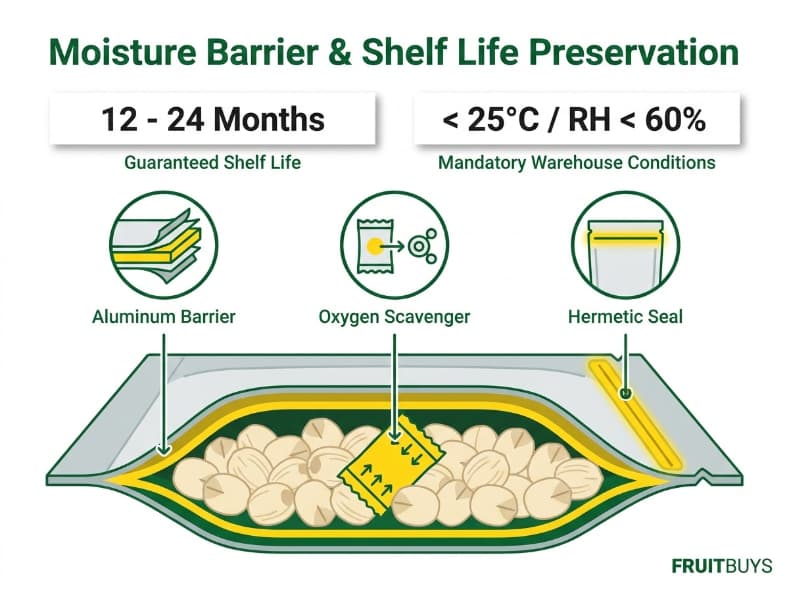
Mold and aflatoxin growth in stored lotus seed appear when water activity crosses about 0.6 and moisture crosses about 12 percent. The freeze-dried spec holds moisture at 3 to 5 percent and water activity below 0.3, measured together at the packing point on every lot. That packing Aw sits at less than half the growth threshold, which is the margin that supports a 12 to 24 month shelf life claim, provided the aluminum barrier stays sealed and storage stays below 25 degrees C with relative humidity under 60 percent.

The margin only exists as a paired reading: moisture alone, the figure most spec sheets quote, cannot predict fungal growth because it says nothing about how much of the water in the kernel remains unbound. A kernel can sit below 5 percent moisture and still carry an Aw above the danger zone if humidity re-absorption happened after drying. The control point that matters is therefore not a number in the contract file but a measurement taken at a physical point: the minutes at the packing station, recorded on the lot COA.
What the Research Actually Measured
The most direct evidence comes from a storage study on medicinal and edible lotus seed held 30 days at 25 degrees C under 40 to 70 percent relative humidity. The finding separates clean numbers from hand-waving: at relative humidity of 40 to 60 percent, no mildew and no aflatoxin appeared as long as water content stayed under 12 percent and Aw stayed under 0.6; at 70 percent relative humidity, moisture exceeded the official limit and aflatoxin B1 appeared even without visible mold [1].
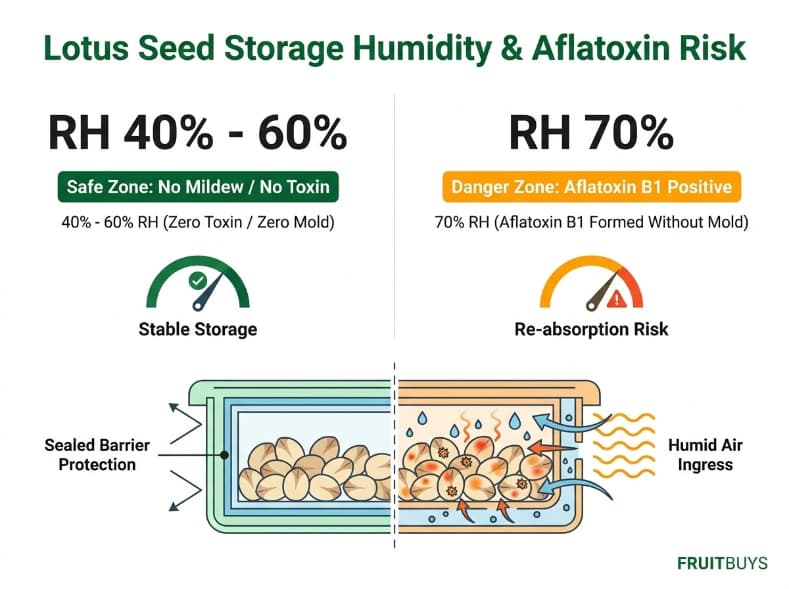
The third condition is the one most buyers miss: the toxin can arrive ahead of the visible growth. A warehouse that sees no mold and signs off the lot has not tested for what the study found. The wider dried-market record explains why the threshold earns its place in the spec rather than a footnote. A survey of dried lotus seed samples from Chinese markets found aflatoxin contamination in 95 percent of tested samples, with concentrations ranging across three orders of magnitude and far above pharmacopoeia limits [2].
That contamination maps to the failure mode the storage study describes: moisture control lost somewhere between drying and retail. Buyers sourcing into the EU face the same hazard through a legal lens, since lotus seed falls under the general dried food category of the aflatoxin MRL regime (total aflatoxins not above 10 micrograms per kilogram under Regulation 1881/2006 as amended) [3]. A freeze-dried product that leaves the chamber at Aw below 0.3 clears the growth zone by design; the burden shifts to keeping it there.
Moisture and Aw Are Two Different Numbers
The pair deserves an explicit definition because spec sheets conflate them. Moisture content is the total water in the kernel measured against total weight, a drying-finish indicator: the freeze-drying process for lotus seeds: 8 steps and control points pulls it down to 1 to 4 percent at the chamber exit and the finished spec holds 3 to 5 percent.
Water activity is the equilibrium measure of water available for biological use, a storage-safety indicator: below roughly 0.6, mold cannot grow; below roughly 0.65, most toxigenic fungi stall [1]. The spec holds both, because a kernel that dried perfectly and then sat open in a humid warehouse still reads low moisture while its Aw climbs toward the growth zone. The freeze-drying chamber produces the low moisture [4], the aluminum pouch produces the low Aw at delivery; the buyer’s warehouse preserves it.
| Indicator | What it measures | Freeze-dried spec | Growth threshold [1] |
|---|---|---|---|
| Moisture content | Total water vs total weight | 3 to 5 percent at packing | About 12 percent |
| Water activity | Unbound water available to microorganisms | Below 0.3 at packing | About 0.6 |
| Relative humidity (storage) | Environment the sealed pouch faces | Below 60 percent | 70 percent triggers re-absorption |
The Verification Protocol
The protocol converts the science into three contract actions. First, require moisture and Aw measured together at the packing point and recorded per lot; the pair is one data point, and the COA should show them on the same line with the same timestamp. Second, set the rejection point at Aw 0.35 rather than 0.3, because the contract needs a buffer between acceptance and the half-threshold safety line, and a supplier confident in the process accepts the wider margin without argument.
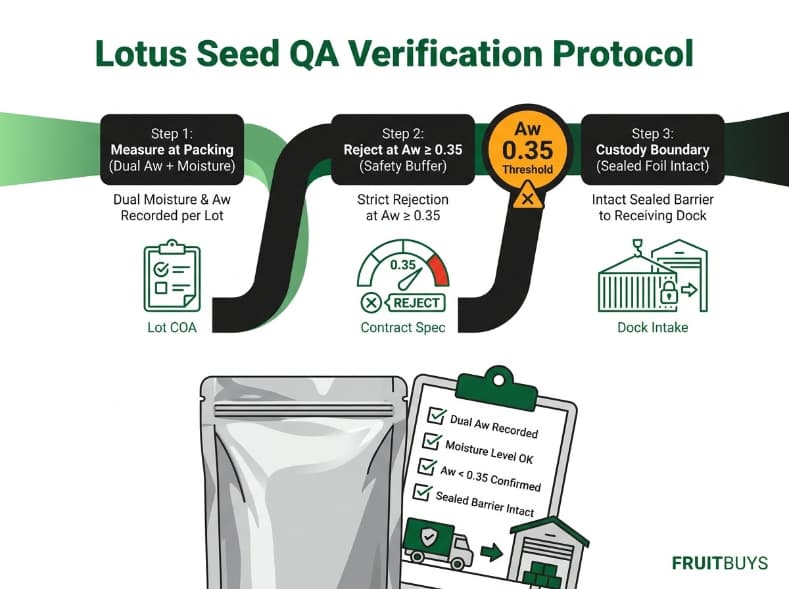
Third, define the custody boundary: the sealed aluminum pouch with oxygen absorber carries the measured Aw to the buyer’s receiving dock, so a retest triggered at intake should happen within the unopened pouch window, and a broken seal moves the question to the logistics record rather than the production record. Facilities that measure Aw per lot typically run a dedicated meter at the packing station, and a buyer audit request for a recorded measurement run is a normal expectation, not an intrusion.
The same two numbers anchor the shelf life claim that procurement forwards to legal teams: 12 to 24 months stated only for intact sealed packaging stored below 25 degrees C and RH below 60 percent. The claim without the condition is not a claim; it is advertising. The raw material math that determines how much enters the chamber in the first place runs in fresh-to-freeze-dried ratio: how many kilograms of fresh lotus seed make 1 kg freeze-dried, and the complete specification sheet, including the packing and storage clauses this article expands, stands at freeze-dried lotus seeds: full specification and OEM supply from Vietnam.
Buyers assembling the full verification checklist before ordering can find the shelf life line inside freeze-dried lotus seeds: what import buyers must verify before ordering, and the wider catalog including other low-moisture formats sits at the freeze-dried fruit category.
FAQ
Why not just control moisture? Moisture measures total water; water activity measures the water available to mold. A kernel can hold low moisture and unsafe Aw after humidity re-absorption.
What did the storage study actually find? No mold and no aflatoxin below Aw 0.6 and moisture 12 percent at 40 to 60 percent RH; at 70 percent RH, aflatoxin B1 appeared without visible mold.
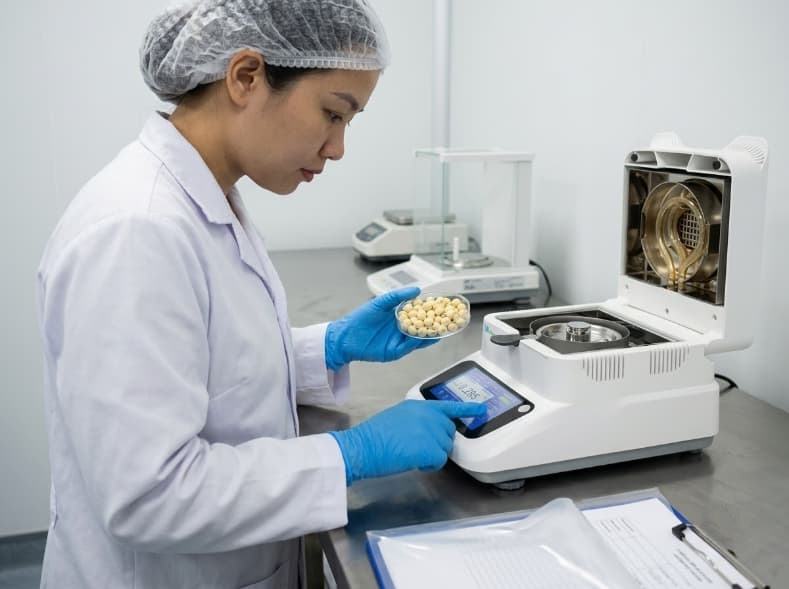
Why measure at the packing point? The freeze-dried kernel absorbs moisture from the air within minutes of leaving the chamber; the packing measurement is the last point the producer controls.
What rejection point should the contract set? Aw at or above 0.35, recorded together with moisture on the lot COA.
Does aflatoxin matter for lotus seed? Yes. Market surveys found contamination in 95 percent of tested dried samples, and the EU sets MRLs under the general dried food category.
What storage conditions protect the claim? Intact sealed aluminum pouches, storage below 25 degrees C and RH below 60 percent, within the 12 to 24 month window.
Request the Measurement Protocol
Ask for the packing-point Aw and moisture protocol document after confirming your lot’s target shelf life, and the team returns the measurement setup, the lot COA format and the custody boundary for your contract.
References
- Liao et al., AMB Express (2020), Exploration of the safe water content and activity control points for medicinal and edible lotus seeds from mildew (ngưỡng mốc và aflatoxin tại Aw 0.6, độ ẩm 12 percent; RH 70 percent gây aflatoxin dù không thấy mốc ): https://pmc.ncbi.nlm.nih.gov/articles/PMC7218039/
- Liu et al. (2013 ), Aflatoxin contamination in dried lotus seeds from Chinese markets (95 percent mẫu dương tính, nồng độ trải rộng ba bậc độ lớn ): https://pubmed.ncbi.nlm.nih.gov/23536467/
- EUR-Lex, Commission Regulation (EC ) 1881/2006 setting maximum levels for certain contaminants (aflatoxin tổng không quá 10 micrograms/kg cho thực phẩm khô nói chung; sửa đổi 2023/915 ): https://eur-lex.europa.eu/legal-content/EN/TXT/?uri=CELEX%3A02006R1881-20230101
- Sở KH&CN TP.HCM via Techport, Quy trình công nghệ sấy thăng hoa hạt sen (secondary drying xuống độ ẩm cuối 1-4 percent, đóng túi ngay vì hút ẩm mạnh ): https://techport.vn/83/quy-trinh-cong-nghe-say-thang-hoa-hat-sen-92017.html
- Food Research International (2022 ), A comprehensive review on lotus seeds (Nelumbo nucifera Gaertn.) (bioactives polysaccharides, flavonoids, alkaloids; phân loại an toàn thực phẩm ): https://www.sciencedirect.com/science/article/pii/S175646462200007X