
Lotus Seed Nutrition Facts: The USDA Baseline and the COA Rule for Retail Labels
A nutrition label fails in one of two ways: it prints wrong numbers and the shipment fails a label audit at the border, or it prints generic numbers and the buyer’s own lab measures something different, which kills the repeat order quietly. Both failures share the same root cause, the label taking its figures from a database instead of from the lot it describes.
Lotus seed makes this failure more likely than most ingredients, because the protein content moves by as much as eight grams per 100 g between the USDA baseline and Vietnamese cultivars, and because the dried market circulates labels where sugar exceeds total carbohydrate, a chemical impossibility that no audit software needs to catch. This article gives regulatory and R&D buyers the baseline, the variance range, and the three-step verification sequence that makes the label verifiable before the artwork goes to print.
The Answer
USDA FoodData Central records dried lotus seed at 332 kcal, 15.4 g protein, 1.97 g total fat and 64.5 g carbohydrate per 100 g [1]. Vietnamese cultivars measure higher protein: a study of pink lotus from Thua Thien Hue recorded 19.9 to 23.8 g per 100 g dry basis [5].
The rule that follows governs the label: baseline figures come from USDA, actual label figures come from the lot-level laboratory COA, and the finished label must pass three arithmetic checks (Atwater reconciliation, sugar below total carbohydrate, percent daily values against the FDA 2016 table) before printing.
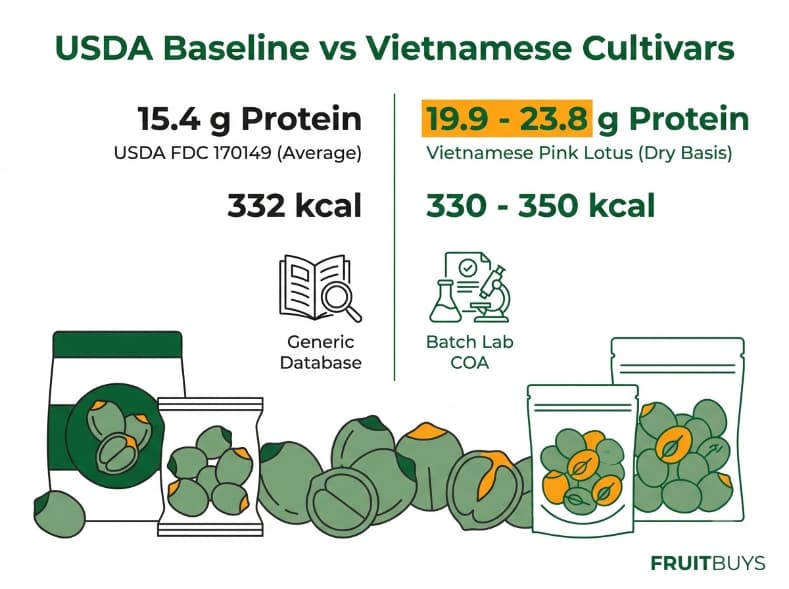
The baseline table holds for any buyer starting from zero. The cultivar range holds for any buyer importing from Vietnam specifically. The COA rule holds everywhere, for every lot.
The USDA Baseline, Line by Line
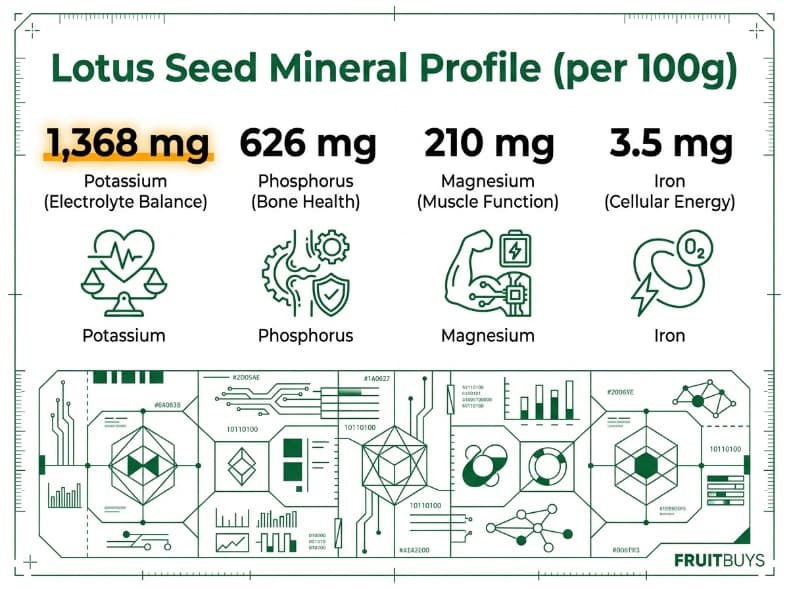
USDA FoodData Central entry FDC ID 170149, “Seeds, lotus seeds, dried”, anchors the category at 332 kcal per 100 g, with protein at 15.4 g (31 percent of the daily value), total fat at 1.97 g, total carbohydrate at 64.5 g and sugars near zero [1]. The mineral profile stands out against most seeds: roughly 2.3 mg manganese, 626 mg phosphorus, 210 mg magnesium, 3.5 mg iron and 1,368 mg potassium per 100 g [1] [2].
The amino acid profile is balanced for a dicot seed, with phenylalanine, tyrosine, leucine and lysine dominant [2]. A mirror of the FDA FoodCentral entry confirms the fiber figure recorded at the low end, roughly 2 g per 100 g, which is why the label line for fiber needs the lot COA rather than the database minimum [3].
| Nutrient (per 100 g) | USDA FDC 170149 [1] | Vietnamese cultivars [5] |
|---|---|---|
| Calories | 332 | 330-350 (typical range) |
| Protein | 15.4 g | 19.9-23.8 g |
| Total fat | 1.97 g | 2.05-2.67 g |
| Total carbohydrate | 64.5 g | 58.8-62.3 g |
| Potassium | 1,368 mg | Comparable |
| Dietary fiber | About 2 g | Lot-dependent, COA required |
The cultivar variance row is the commercial point of this table. A buyer building a high-protein claim on the USDA 15.4 g figure underclaims a Vietnamese lot that the lab measures at 21 g; a buyer building the label on the cultivar high end and shipping a lot that measures 17 g fails the label audit on protein, the line regulators check first. Neither figure is wrong; both are wrong when applied without the lot COA behind them.
The COA Rule
The rule assigns each number on the label to a source with a verifiable chain of custody. Macronutrient figures come from the laboratory COA measured on the production lot, not from USDA, not from a supplier’s marketing sheet, and not from the buyer’s memory of the previous shipment.
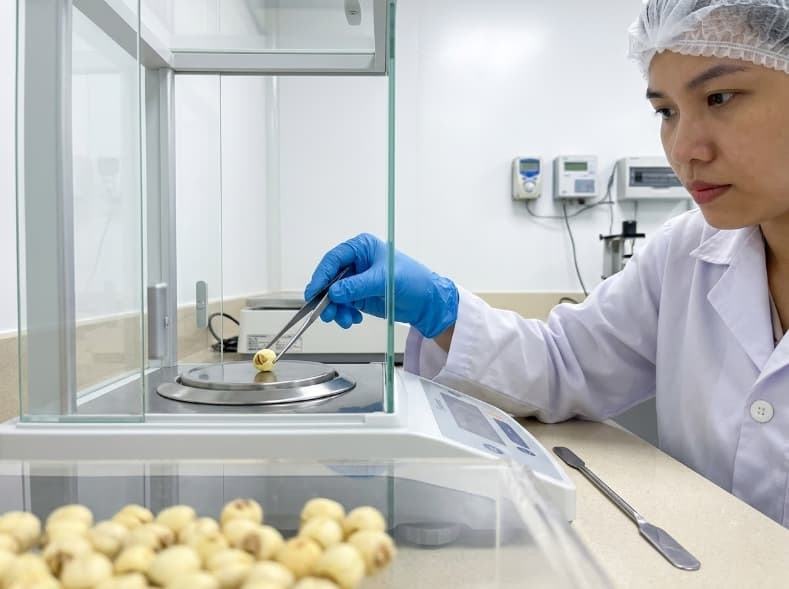
The COA itself should name the measurement method (Kjeldahl or Dumas for protein, gravimetric for moisture and fat), because the method choice moves protein results by observable amounts and the buyer’s own compliance lab must be able to reproduce the figure within tolerance.
Storage conditions and drying method shape what the COA shows: the freeze-drying cycle preserves the bioactive fraction (polysaccharides, flavonoids, alkaloids) that heat drying degrades [4], and the drying endpoint (moisture 3 to 5 percent, Aw below 0.3) sets the concentration basis the per-100-g figures assume.
The moisture endpoint itself is the subject of water activity below 0.3: the number that protects lotus seed shelf life, because a lot that drifts above the endpoint before packing carries diluted nutrient concentrations and rising water activity together. The full 8-step cycle that produces the COA-measurable endpoint runs through the freeze-drying process for lotus seeds: 8 steps and control points.
The Three Arithmetic Checks Before Printing
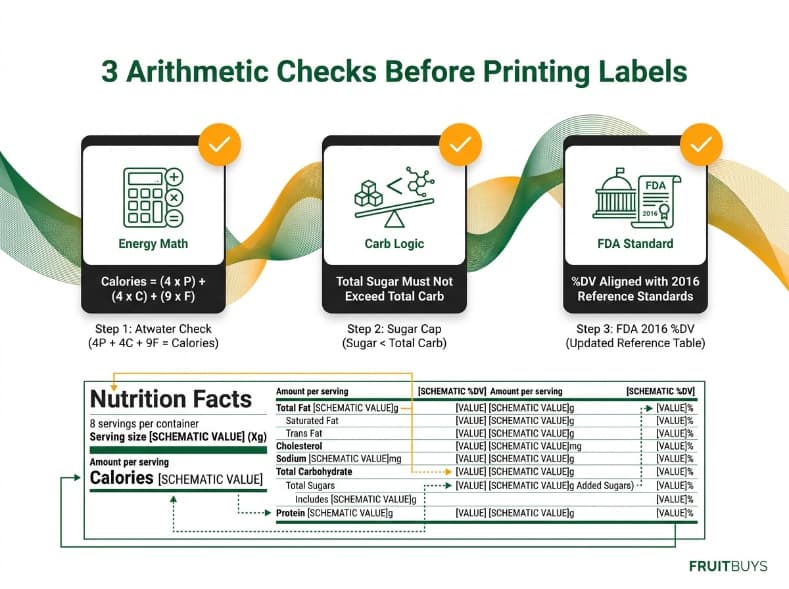
Artwork approval needs three calculations, and all three are doable in a spreadsheet in under five minutes. First, the Atwater reconciliation: calories printed on the label should equal 4 times protein grams plus 4 times carbohydrate grams plus 9 times fat grams, within the rounding tolerance FDA allows, a label printing 130 kcal against macronutrient rows that sum to 70 kcal fails this check and indicates transposed or guessed rows.
Second, the sugar cap: total sugar must never exceed total carbohydrate, since sugar is a subset of carbohydrate, labels where sugar doubles the carbohydrate figure signal data entered from the wrong column. Third, the percent daily values: every %DV must come from the FDA 2016 reference table (protein daily value 50 g, total carbohydrate 275 g, dietary fiber 28 g, iron 18 mg, potassium 4,700 mg), not from the pre-2016 table still used by some template tools, an iron line showing 14.4 percent for 0.72 mg of iron implies a 5 mg daily value that exists in neither table. Labels circulating in this category fail one or more of these checks, the ones that pass all three and carry lot-linked COAs are the ones that survive customs label review without revision cycles.
What This Means for SKU Selection and Claims
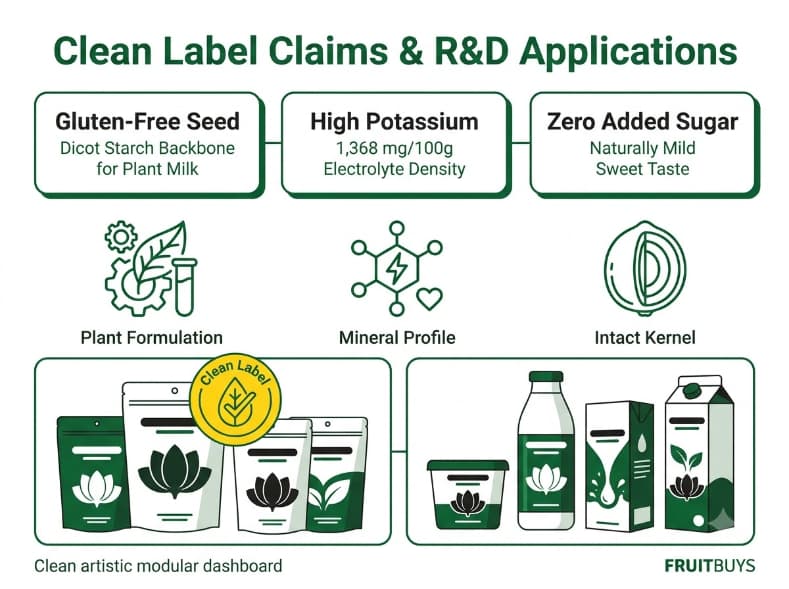
The nutrition profile supports three claim structures for import buyers. The gluten-free dicot seed positioning fits the plant milk and cereal channels, where the starch-carbohydrate backbone carries the formula [2].
The mineral density supports functional food positioning without exotic claims: manganese, phosphorus and potassium numbers that database-label competitors cannot document per lot. And the freeze-dried form adds a texture claim, the intact kernel rehydrates in minutes, that heat-dried suppliers structurally cannot match because their process crosses the browning zone.
Buyers converting the kernel to ingredient form can evaluate the dried fruit powder category for the same botanical processing discipline applied to fruit, and the plant-specific alternative on our lotus root chips page.
The complete specification sheet, including the nutrition baseline this article documents, stands at freeze-dried lotus seeds: full specification and OEM supply from Vietnam, and the buyer-level checklist that includes the label verification line sits in freeze-dried lotus seeds: what import buyers must verify before ordering. The wider catalog for cross-category comparison sits at the dried fruit category.
FAQ
What are the nutrition facts for dried lotus seed per 100 g? USDA records 332 kcal, 15.4 g protein, 1.97 g fat, 64.5 g carbohydrate, plus 1,368 mg potassium and 626 mg phosphorus.
Why do Vietnamese lots measure higher protein? A 2021 study of Thua Thien Hue pink lotus recorded 19.9 to 23.8 g per 100 g dry basis, above the USDA dried average of 15.4 g.
Can I print USDA numbers on my retail label? Use USDA as the planning baseline, but pin the printed figures to the lot-level laboratory COA, because cultivar and season move protein by up to eight grams.
What checks should my label pass before printing? Atwater calorie reconciliation, sugar below total carbohydrate, and every percent daily value against the FDA 2016 reference table.
What measurement method should the COA name? Kjeldahl or Dumas for protein, gravimetric for moisture and fat, so the buyer’s compliance lab can reproduce the figures.
Does freeze-drying change the nutrition profile versus heat drying? Freeze-drying preserves the bioactive fraction (polysaccharides, flavonoids, alkaloids) and the intact kernel structure that heat drying degrades.
Request the COA Format
Ask for the lot COA template after confirming your destination market’s labeling regime, and the team returns the measurement methods, the lot number field and the nutrition figures format that match your market’s label requirements.
References
- USDA FoodData Central, Dried lotus seeds, FDC ID 170149 (332 kcal, protein 15.4 g, carbohydrate 64.5 g, potassium 1,368 mg, phosphorus 626 mg per 100 g ): https://fdc.nal.usda.gov/food-details/170149/nutrients
- Nutrition-and-You (USDA National Nutrient Database reference ), Lotus seeds nutrition facts (amino acid profile phenylalanine, tyrosine, leucine, lysine; khoáng manganese, sắt, magie per 100 g ): https://nutrition-and-you.com/lotus-seeds.html
- Foodstruct (mirror of FDA FoodCentral ), Lotus seeds nutrition data (fiber ghi nhận ở mức thấp khoảng 2 g per 100 g ): https://foodstruct.com/food/lotus-seeds
- Food Research International (2022 ), A comprehensive review on lotus seeds (Nelumbo nucifera Gaertn.) (bioactives polysaccharides, flavonoids, alkaloids liensinine, neferine ): https://www.sciencedirect.com/science/article/pii/S175646462200007X
- ResearchGate (Thua Thien Hue, 2021 ), Pink lotus (Nelumbo nucifera) composition study (dry protein 19.9-23.8 g, carbohydrate 58.8-62.3 g, lipid 2.05-2.67 g per 100 g ): https://www.researchgate.net/publication/355396615