Where can I buy freeze-dried jackfruit in bulk, and what should I check before I shortlist a supplier?
Vietnam is one of the steadiest sources of bulk freeze-dried jackfruit: its main export variety fruits every month of the year, and each kilogram takes 5–6 kg of deseeded bulbs. Supply is rarely what goes wrong. The wrong kind of jackfruit, the wrong form, or a container that does not match the approved sample is. Standard terms are on the freeze-dried jackfruit product page.
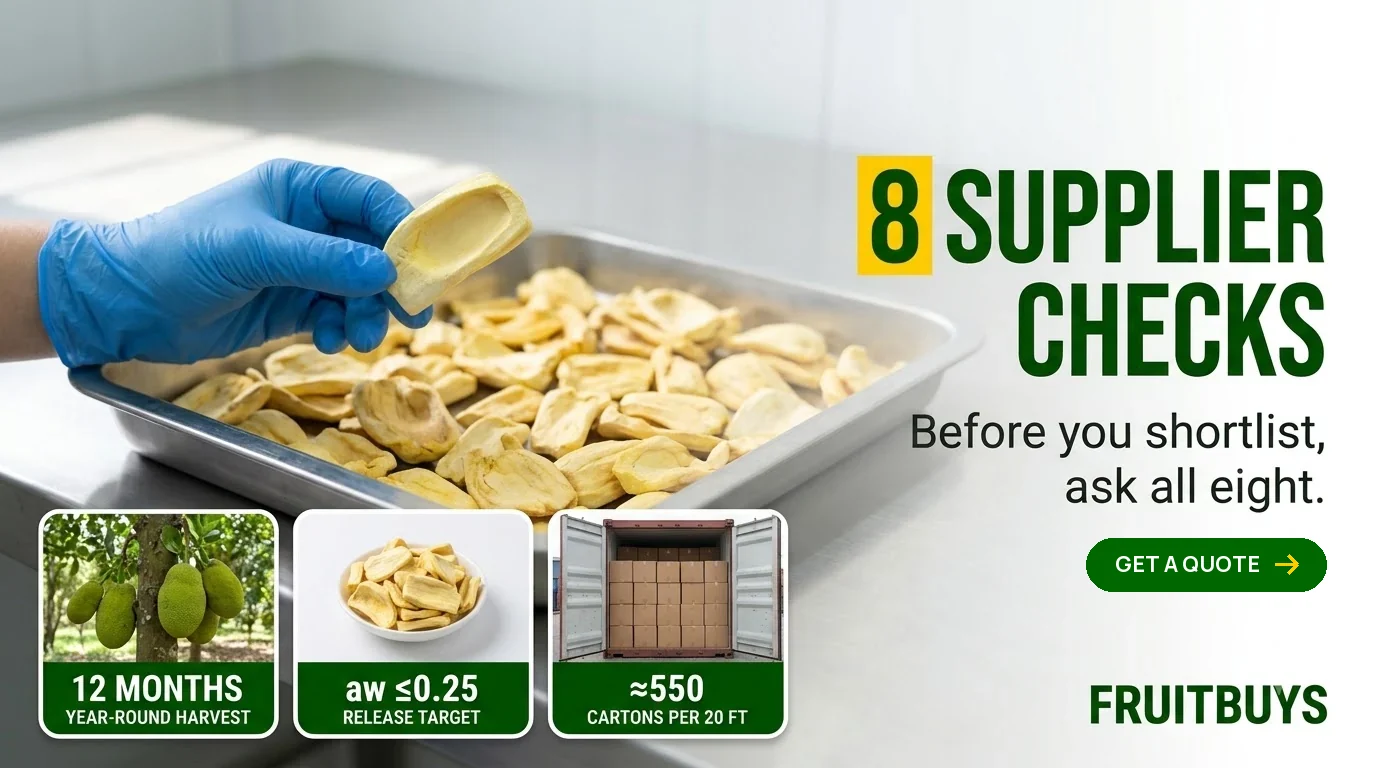
This page is the starting point for the whole decision. It answers the shortlisting questions directly, then sends each specialist on your team to the guide that covers their part in depth.
Which part of this decision is yours?
| If you are… | Your first question | Go to |
|---|---|---|
| Procurement | Why do quotes differ so much, and how do I compare them? | How much fresh jackfruit makes 1 kg of freeze-dried |
| QA | What should the specification and COA show? | Moisture, water activity and the COA |
| QA / supplier audit | Will the container match the approved sample? | Production process and quality control |
| R&D / OEM | Which cut works in my product? | Formats for food manufacturing |
| Importer (US, EU, UK) | Which HS code and documents? | HS code and import documents |
| Importer (UAE) | Do I need product registration? | UAE import and registration |
| Logistics / distributor | How is it packed, and how much fits in a container? | Packing and container loading |
The rest of this page covers what everyone needs before those detailed questions: what you are buying, where it comes from, and how to tell a supplier worth sampling.
Is freeze-dried jackfruit the same as the jackfruit sold as a meat substitute?
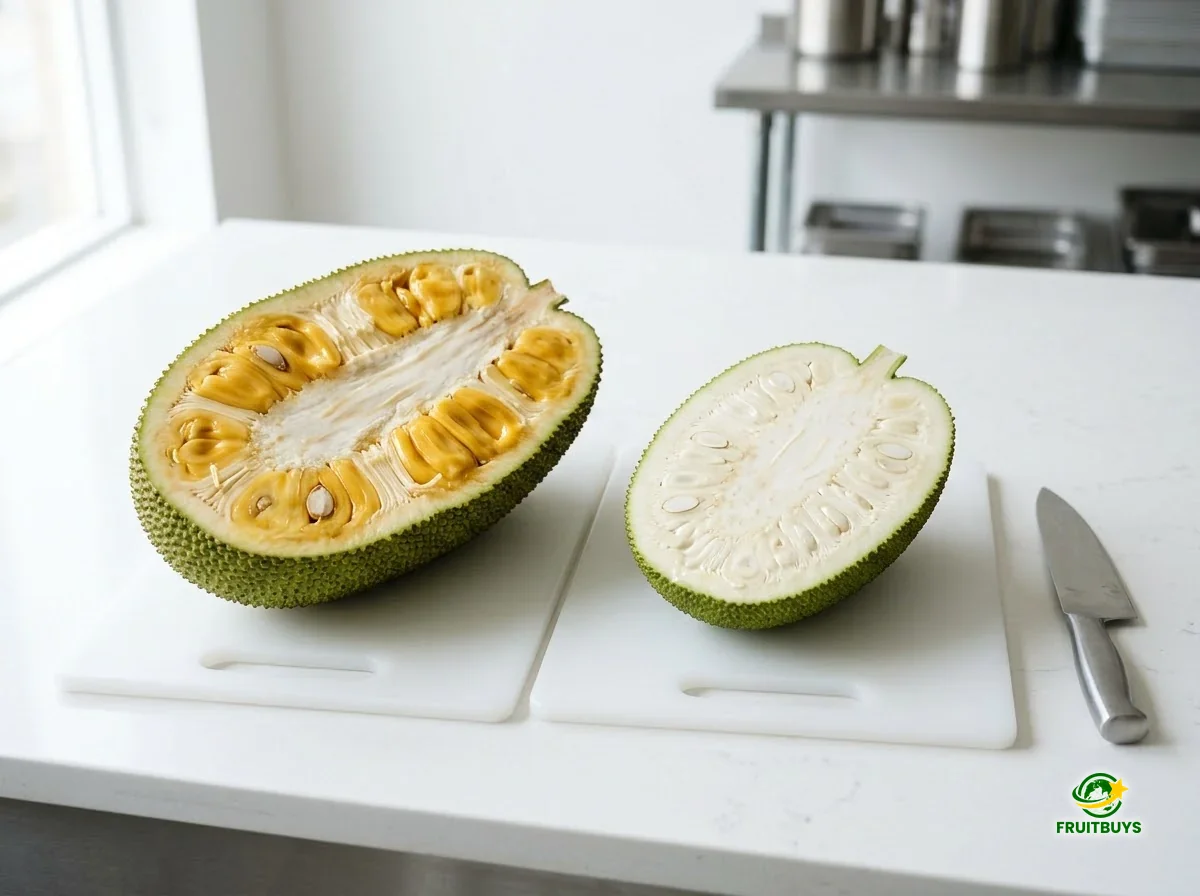
No. Both come from the same tree, but they are different products.
- Green (young) jackfruit is harvested unripe. It is starchy, neutral and fibrous, which is why it shreds like pulled meat. It is usually sold canned in brine.
- Freeze-dried jackfruit is made from ripe, deseeded bulbs: the yellow, sweet flesh. FruitBuys selects fruit at 18–24 °Brix. The result is crisp, golden and tastes of ripe fruit; about 70% of its dry matter is natural sugar.
If you are building a savoury plant-based protein, you need young jackfruit instead; FruitBuys supplies young jackfruit for savoury and plant-based lines as a custom project order. A sample that arrives pale and bland is not ripe fruit, whatever the specification says.
Freeze-dried, air-dried or chips: which jackfruit fits my product?
Pick the form by what the fruit has to do in your product. The wrong form costs more than any price difference between forms.
| Form | Texture | Fits | Wrong choice when |
|---|---|---|---|
| Freeze-dried | Crisp, light, 100% fruit | Cereal, granola, snack packs, chocolate and bakery inclusions, retail snacks | It sits uncoated in a moist base such as yogurt or fillings |
| Air-dried | Chewy, dense | Trail mix, chewy snacks, price-led lines | You need crunch or bright colour |
| Vacuum-fried chips | Crunchy, contains oil | Savoury-sweet snack chips | Your claim is “100% fruit” or “no added fat” |
| Powder | Free-flowing | Drinks, dairy, bakery mixes | You need visible pieces |
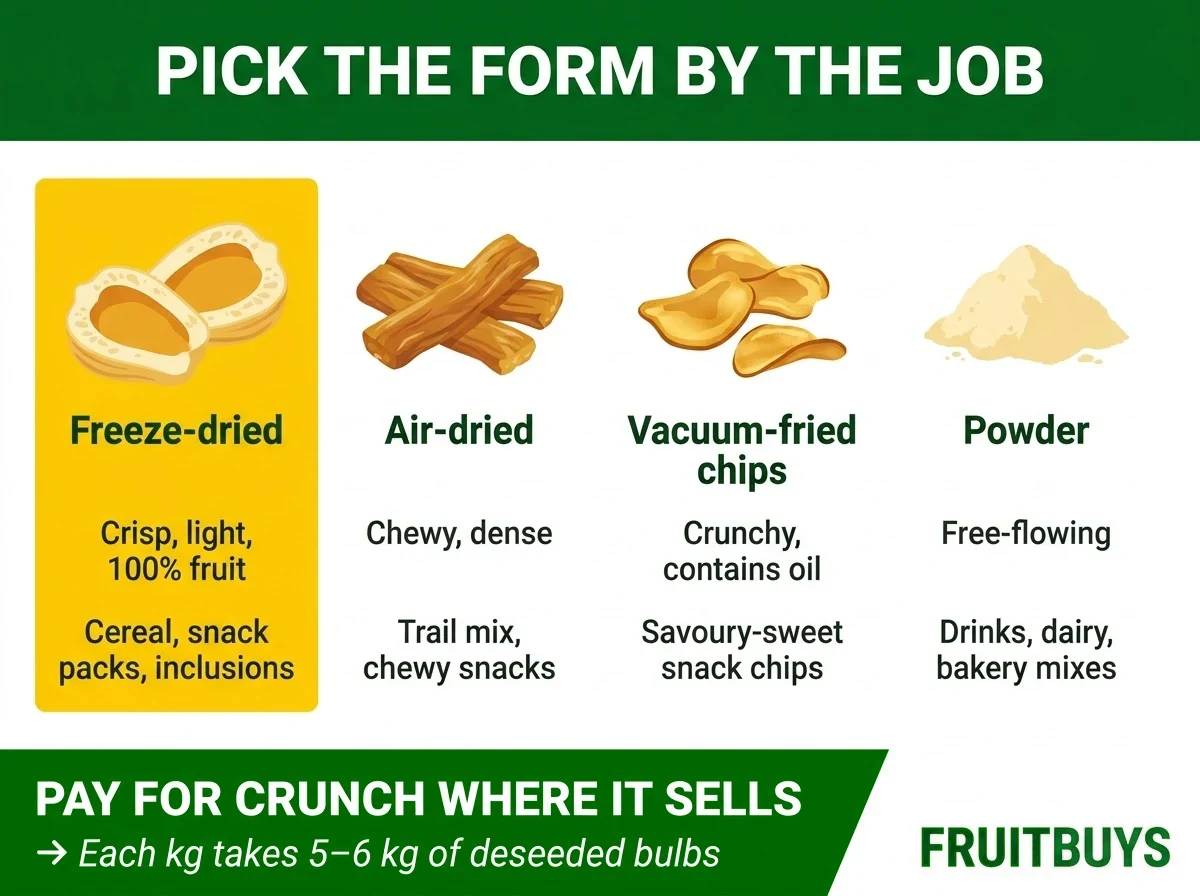
Freeze-dried costs more because each kilogram takes 5–6 kg of deseeded bulbs, or about 15–18 kg of whole fruit, plus an 18–24 hour drying cycle. Pay for it where crunch, colour and a clean label sell your product. Powder has its own page: freeze-dried jackfruit powder. FruitBuys also supplies unsweetened soft-dried jackfruit and vacuum-fried chips on request, for lines where chew or a lower price per kilogram matters more than crunch.
Buying dried ripe jackfruit in bulk: freeze-dried or soft-dried?
Most bulk enquiries for “dried ripe jackfruit” mean one of two products. Freeze-dried bulbs are crisp, 100% fruit and light, so they suit cereal, snack packs and inclusions, and ship about 550 cartons to a 20 ft container. Soft-dried jackfruit is chewy and denser, with or without added sugar, and suits trail mix and bakery fillings where a bite matters more than crunch. FruitBuys supplies freeze-dried jackfruit as its standard line, and arranges soft-dried and vacuum-fried jackfruit as OEM or bulk programmes for distributors and supermarket brands. Send one RFQ for both and compare them on the same landed-cost basis.
Where does Vietnamese jackfruit come from, and is supply steady all year?
Most commercial jackfruit for processing is Thai jackfruit grown in the Mekong Delta, mainly Tien Giang and Hau Giang, with further supply from Dong Nai and the Central Highlands. The variety flowers continuously, so there is no harvest window to book against.
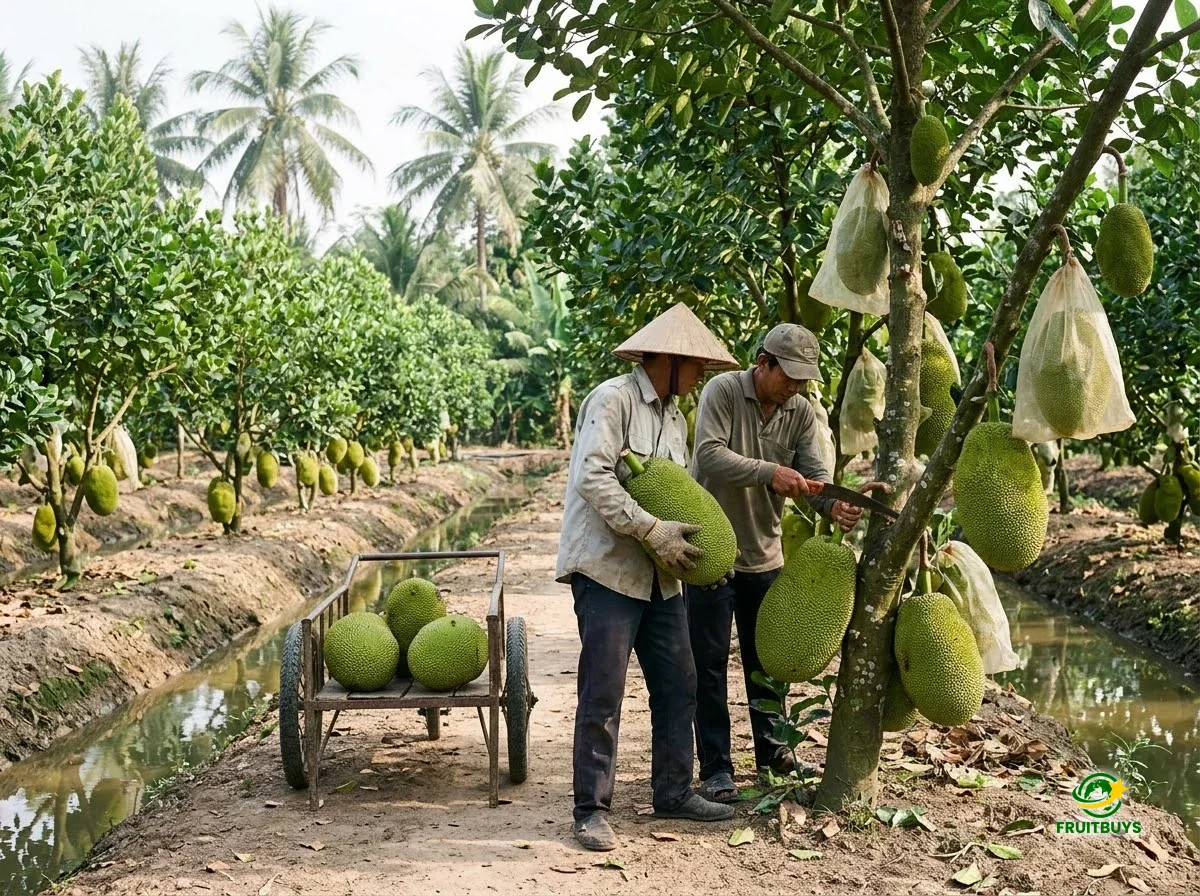
Steady supply does not mean steady quality. Dry-season fruit (November to May) is firmer and sweeter, and fewer fruit are rejected at intake (5–8% against 12–18% in the rainy season), which changes what each kilogram costs to make. Agree how prices are reviewed across seasons, and hold every lot to the approved sample. The variety, ripeness window and the raw material clause to put in your contract are covered in which Vietnamese jackfruit makes good freeze-dried jackfruit.
Can I private-label freeze-dried jackfruit?
Yes, and it suits retail well: a single-ingredient snack few shelves already carry. Three decisions shape the launch.
- Pouch. Use an aluminium-laminated zip pouch, gently vacuumed with a desiccant sachet inside. In clear film, the sugar-rich fruit pulls in moisture and softens well before its date.
- Claims. “No added sugar” is allowed for 100% fruit, but total sugars, about 67 g per 100 g, must still be declared. Base the panel on a laboratory test of your production lot.
- Quantity. Private label runs from 3,000–5,000 pouches per SKU on digital print (7–10 working days, no cylinder cost) or from 500 kg per SKU on rotogravure (15–20 working days, lowest cost per pouch), with 30 g, 50 g, 100 g and 500 g pouches as standard. Digital print suits a market test or a seasonal line; rotogravure suits repeat volume.
Eight checks before you shortlist a supplier
Send these to every supplier on your list, including us. A supplier who answers all eight clearly earns a sample order. One who avoids three or more does not.
| # | Ask | A good answer | Why it matters |
|---|---|---|---|
| 1 | Which facility manufactures my order, and can I audit it? | A qualified facility locked to your contract, with on-site audit access and a written change-control clause | Brokers often switch sub-contractors between orders to chase spot margins, and lots drift |
| 2 | Which certifications does that facility hold? | Certificate numbers, scope and expiry you can verify | A logo on a website is not a certificate |
| 3 | Is it 100% ripe jackfruit, with no sugar or sulfite added? | A signed ingredient declaration | Infused fruit changes your label and HS code |
| 4 | What moisture and water activity do you release at, and what do you contract? | A tighter internal target than the contract limit | The gap is your safety margin in transit |
| 5 | What comes with each order, and what costs extra? | A written COA scope by order type | Avoids test costs and gaps at the port |
| 6 | Can I review an independent laboratory report? | A third-party report with methods and limits of quantification cited, covering heavy metals and aflatoxin | Filters out traders who show an internal test slip or a single result from an untraceable bench sample |
| 7 | What is the conversion ratio, and from what starting point? | Kilograms of deseeded bulbs per kilogram of product | Quotes on different bases cannot be compared |
| 8 | Will I see the actual lot before it ships? | A pre-shipment sample drawn from the packed lot | Your last chance to stop a wrong container |
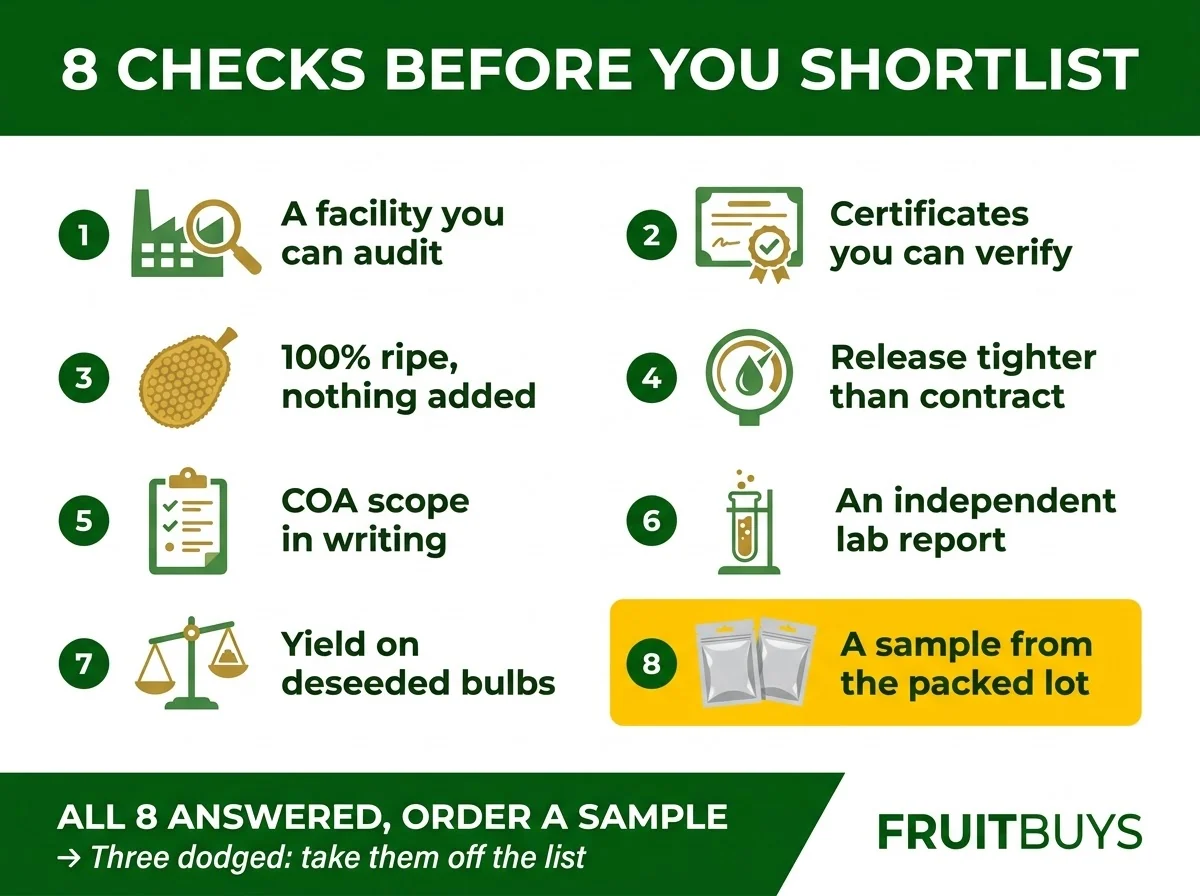
Here is how FruitBuys answers checks 1, 2, 4, 5, 6 and 8, as a benchmark for your shortlist:
- Facility integrity: we allocate and lock a qualified freeze-drying facility to your contract. Process parameters stay fixed across re-orders, and no facility change happens without prior written notice and re-approval of a new pre-shipment sample.
- Certification transparency: the facility allocated to your contract operates under HACCP, ISO 22000 and BRC, holds US FDA food facility registration, with Halal certification available on request. Certificate copies, scope, expiry dates and registration numbers are part of the technical dossier you receive before signing, so you verify them before you commit.
- Release vs contract: we release at ≤4.0% moisture and aw ≤0.25 against contract limits of ≤5.0% and ≤0.30, a built-in buffer against softening in transit.
- COA scope: every full-container order carries a lot COA for moisture, water activity, total plate count, yeasts and moulds, Salmonella and E. coli. Lead, arsenic and aflatoxin are tested in periodic batches. Trial and LCL orders receive a free in-house release QC log, backed by our third-party baseline reports. If you want independent testing on a trial order, it runs at net lab cost and is credited back in full against your first container.
- Baseline surveillance: periodic third-party testing for lead, arsenic and aflatoxin tracks long-term process capability, separately from lot release. Extended and market-specific tests run at ISO/IEC 17025 laboratories in Vietnam. Current baseline reports, with methods and limits of quantification cited, are available on request.
- Pre-shipment sample: a 100–200 g composite sample, split into two sealed foil pouches with desiccant (one for sensory checks, one kept sealed for your laboratory), drawn from your packed master cartons, is couriered within 24–48 hours of packing, so final QA sign-off happens without holding the vessel booking.
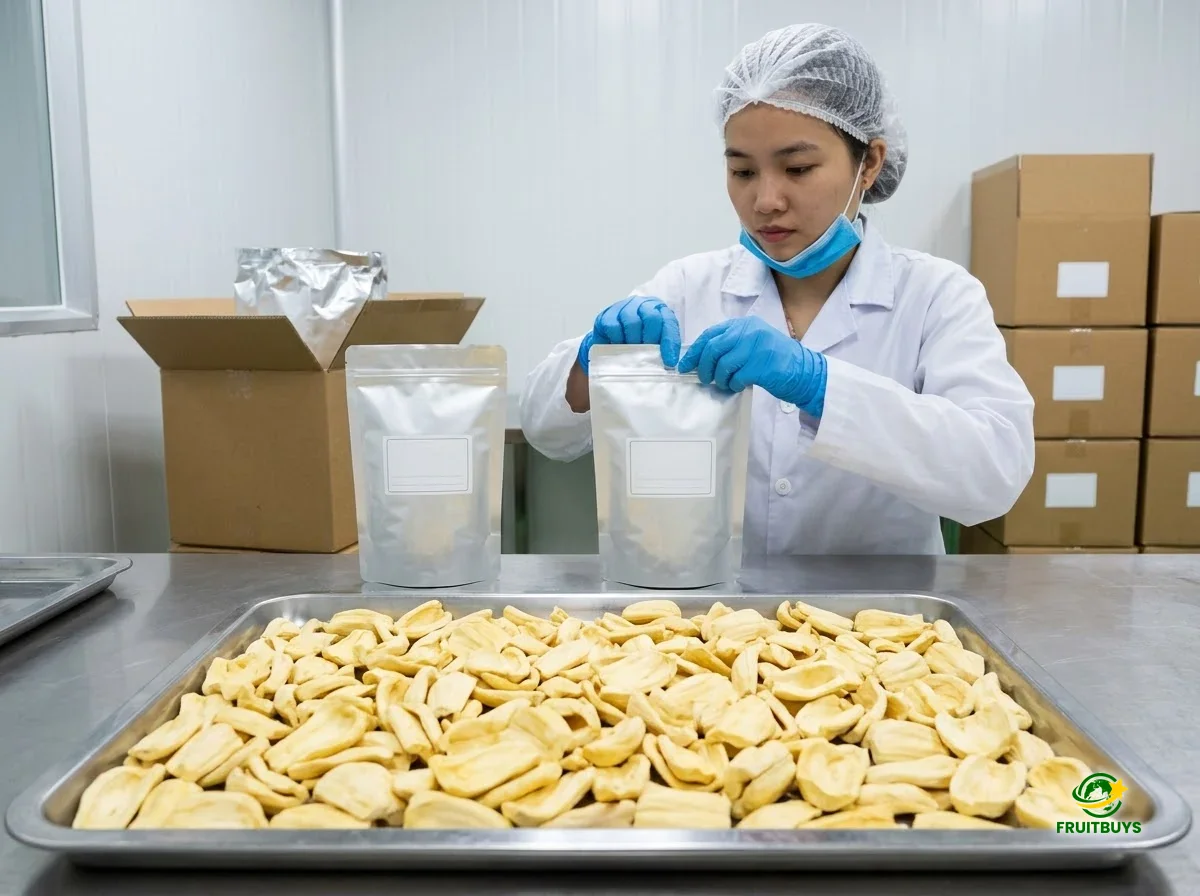
Checks 7 and 8 matter most when quotes look far apart. The detail is in the conversion and cost guide and the production and QC guide.
What should an RFQ for freeze-dried jackfruit include?
A complete RFQ gets comparable quotes and an accurate landed cost. Include:
- Form and cut: whole bulbs, pieces, or dice (10 mm or 5–6 mm)
- Volume and schedule: trial volume and annual forecast. Production is made to order, 20–30 days for a 20 ft container after deposit
- Packaging: bulk cartons of 7–10 kg with PET/AL/LLDPE barrier bags, or retail pouches of 30, 50, 100 or 500 g
- Loading: floor-loaded for the lowest freight per kilogram, or palletized for forklift handling
- Incoterm and port: FOB Cat Lai (Ho Chi Minh City), or CFR/CIF to your port. Freeze-dried jackfruit ships in a standard dry container year-round; for summer arrivals into the Gulf, add a thermal reflective liner and plan clearance so the box does not wait on the quay. Consolidating into one full container typically cuts logistics cost per kilogram by about 15–20% against LCL
- Specification: contract moisture and water activity, plus market-specific panels such as an EU pesticide multi-residue screen, or a sulfite screen confirming the fruit is below 10 mg/kg, the level at which US and EU labels must declare sulfites
- Labelling and origin documents: English bulk labels, Arabic retail stickers applied at origin, or a Form EUR.1 where an FTA preference applies (EU duty on dried jackfruit is already 0%); a phytosanitary certificate travels with every shipment as part of the standard export dossier
Two lines in that list change your landed cost more than buyers expect. Carton weight: in the same carton, a 10 kg fill ships 43% more product than a 7 kg fill. Loading: palletizing protects the cargo but holds about 42–45% fewer cartons in a 20 ft container (300–320 instead of about 550). Both trade-offs are worked through in the packing and loading guide.
Standard FruitBuys terms (cartons, container payloads, lead times, payment) are listed on the freeze-dried jackfruit product page.
When is freeze-dried jackfruit the wrong choice?
- You need a meat substitute. That calls for young jackfruit; FruitBuys supplies young jackfruit for savoury and plant-based lines as a custom project order.
- The fruit sits uncoated in a moist base. In yogurt or fillings it softens within minutes; see the formats guide for coated options or powder.
- Your channel is price-led and texture does not sell the product. Air-dried jackfruit costs less per kilogram.
- You need chewiness. Freeze-dried fruit is crisp by design.
Start with the specification, not the price
Send us your product, form, volume and destination. We will reply with a specification, packing plan and lead time you can lay next to any other quote.
Email [email protected] · WhatsApp Export +84 919 739 589
FAQ
Who supplies freeze-dried jackfruit in bulk?
Mainly processors and exporters in Vietnam and Thailand. Vietnam’s Thai jackfruit fruits all year, which keeps supply steady.
Is freeze-dried jackfruit a meat substitute?
No. Meat substitutes use unripe young jackfruit. Freeze-dried jackfruit is ripe, sweet and crisp. FruitBuys supplies young jackfruit for savoury and plant-based lines as a custom project order.
What is the minimum order?
Bulk trial and LCL orders are accepted. Private label starts at 3,000–5,000 pouches per SKU on digital print, or 500 kg per SKU on rotogravure.
Do small orders come with a COA?
Trial and LCL orders receive a free in-house release QC log and our third-party baseline reports. Independent testing is available at net lab cost, credited back in full against your first container.
Why does freeze-dried jackfruit cost more than dried jackfruit?
Each kilogram takes 5–6 kg of deseeded bulbs, and freeze-drying runs 18–24 hours per cycle.
Is jackfruit cheaper at certain times of year?
Raw material is more efficient in the dry season, November to May, when fewer fruit are rejected at intake.
About the author. Udo Nguyen is CEO of FruitBuys Vietnam. He coordinates freeze-dried fruit sourcing, qualified partner facilities and export documentation for importers, food manufacturers and private-label brands.