
Freeze-Dried Jackfruit COA, Testing and U.S./EU/UAE Import Documentation
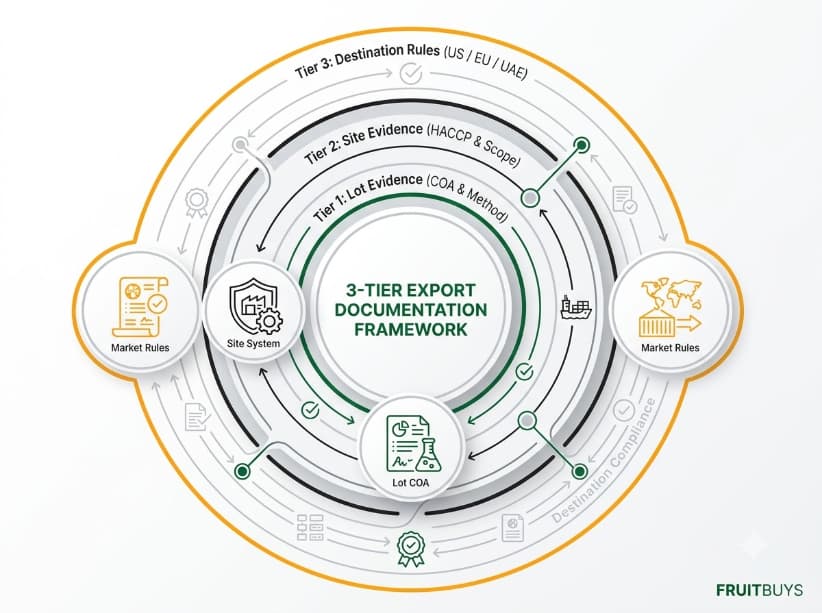
A supplier can send a COA, HACCP certificate, certificate of origin and health document while the buyer still lacks the evidence needed to approve a shipment. The gap usually comes from scope. One document may describe a site, another a product family, and a third a single historical lot. None automatically proves that the current freeze-dried jackfruit lot, format, packaging and destination are covered.
A COA also does not carry the same function as a certificate or import document. It reports test results for a defined sample or lot. A certification document, by contrast, describes a management system, audit scope or activity, an import document supports a specific shipment, authority or customs process.
This guide separates lot evidence, site/system evidence and destination-specific import documents. It is a buyer-side documentation framework, not legal advice or a universal clearance guarantee. Importers, customs brokers and competent authorities must confirm the current requirements for the actual product, route and consignee.
Ask for lot evidence, system/site evidence and destination documents as separate categories
Ask for lot evidence, system/site evidence and destination-specific import documents as separate categories. A COA does not replace a supplier audit or importer program. A certificate does not prove that the tested result belongs to the shipment in front of you.
A procurement or QA request should identify the product before requesting documents. “Freeze-dried jackfruit” is not enough when the supplier handles whole pieces, chunks, powder, blended products or multiple packaging formats.
| Identity field | Why it must appear in the request |
|---|---|
| Product name | Prevents a document for another fruit, format or formulation being reused |
| Format | Connects testing and packaging to whole pieces, chunks, crumble or powder |
| Ingredient statement | Identifies additives, carriers, pretreatments or blends |
| Lot code | Links the COA, production record, pack code and shipment |
| Production site | Confirms which facility the document covers |
| Destination market | Determines importer and labeling review |
| Packaging format | Connects the evidence to the actual shipment configuration |
For product discovery, review the verified freeze-dried fruit category. The current Freeze-Dried Jackfruit product page is not used as a technical destination until its claims are reconciled with the approved master specification.
What a lot-level COA should contain
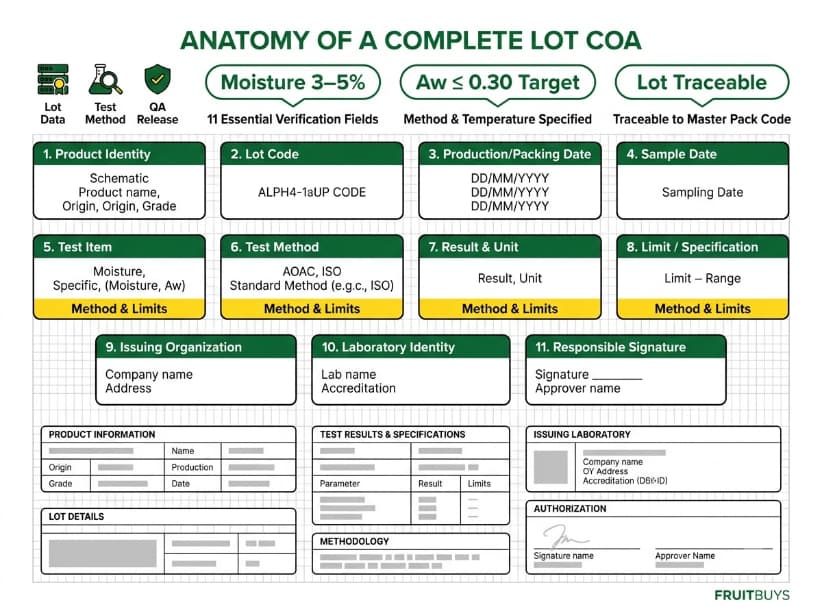
A COA should be traceable to the tested lot. The document should state the product identity, lot code, production or packing date, sample date where relevant, result, unit, method, specification or limit and issuing organization.
The issuing organization may be the manufacturer’s QA function or an external laboratory, depending on the test and buyer arrangement. Laboratory identity should be included where the laboratory performed or verified the test. “Tested” without method and responsibility leaves the buyer unable to judge the result’s scope.
| COA field | Minimum review question |
|---|---|
| Product identity | Does it match the approved name, format and ingredient statement? |
| Lot code | Is it identical to the pack and shipment records? |
| Production/packing date | Does the date basis match the buyer’s shelf-life calculation? |
| Sample date | When was the sample taken relative to production and packing? |
| Test item | What property or hazard was examined? |
| Method | Is the method named and appropriate to the result? |
| Result and unit | Can QA interpret the value without guessing the unit? |
| Limit or specification | Is the acceptance basis stated and approved? |
| Issuing organization | Who reviewed and released the result? |
| Laboratory identity | Is the laboratory named where applicable? |
| Approval/signature | Is the responsible reviewer identified? |
A single number without method, unit and acceptance limit is not a complete release record. Moisture and Aw should be reported with the method and sample basis because the two measures answer different questions.
Minimum testing layer: moisture, Aw, microbiology and physical checks
The minimum panel depends on the product, intended use, process, packaging and destination. A dried fruit COA should not copy a standard panel from another ingredient without a hazard review.
| Test layer | Buyer-side purpose | Evidence needed |
|---|---|---|
| Moisture | Supports release and storage review | Result, method, unit and limit |
| Water activity | Assesses the product’s available-water condition | Aw result, method, temperature and limit |
| Microbiology | Addresses specified biological hazards | Panel, method, result and acceptance basis |
| Foreign matter | Supports physical-hazard review | Inspection method and disposition record |
| Sensory/visual | Checks color, aroma, visible defects and format | Lot record or defined inspection result |
| Packaging/seal | Connects the test lot to the actual pack | Seal, code, bag and carton records |
| Net weight | Confirms the packed quantity | Weighing basis and tolerance |
A low moisture result does not prove that the product is sterile. A low Aw result does not eliminate every hazard or replace sanitation, hazard analysis and importer verification. The FDA’s draft low-moisture guidance describes sanitation, environmental controls, hazard analysis and preventive controls as part of the control framework, it is draft and nonbinding, not a jackfruit-specific release limit [10].
Microbiology results should be interpreted against the product category, intended use and buyer specification. The panel may differ for a direct-consumption snack, an ingredient for further processing or a powder used in a beverage formulation.

Risk-based additions: pesticide residues, heavy metals and other hazards
Additional testing should follow a documented risk assessment. The buyer may need pesticide residues, heavy metals, mycotoxins, allergens, sulfites, additives, foreign matter or other hazards depending on raw materials, process, formulation and destination.
The request should state whether the result applies to the finished product or a raw-material input. A raw-fruit pesticide report does not automatically cover the finished freeze-dried product if the lot, supplier, time period or sampling basis differs.
| Additional layer | Questions before requesting the test |
|---|---|
| Pesticide residues | Which crop inputs, substances, MRL framework and commodity classification apply? |
| Heavy metals | Which elements, method, sample basis and destination limits apply? |
| Mycotoxins | Is the crop, storage condition or ingredient route relevant to the hazard? |
| Allergens | Are shared lines, additives or cross-contact controls relevant? |
| Sulfites/additives | Is the ingredient statement consistent with the test and label? |
| Foreign matter | What inspection method and defect classification are used? |
| Radiological or other hazards | Does the destination, origin or buyer risk assessment require review? |
For EU work, use the Pesticides Database as a lookup tool, not as the legal authority. The European Commission states that the database has no legal value; confirm pesticide requirements against Regulation (EC) No 396/2005 and current amendments [7] [8]. Contaminant maximum levels require a separate review against Commission Regulation (EU) 2023/915 and the applicable product classification [9].
Traceability, packaging, seals and lot coding
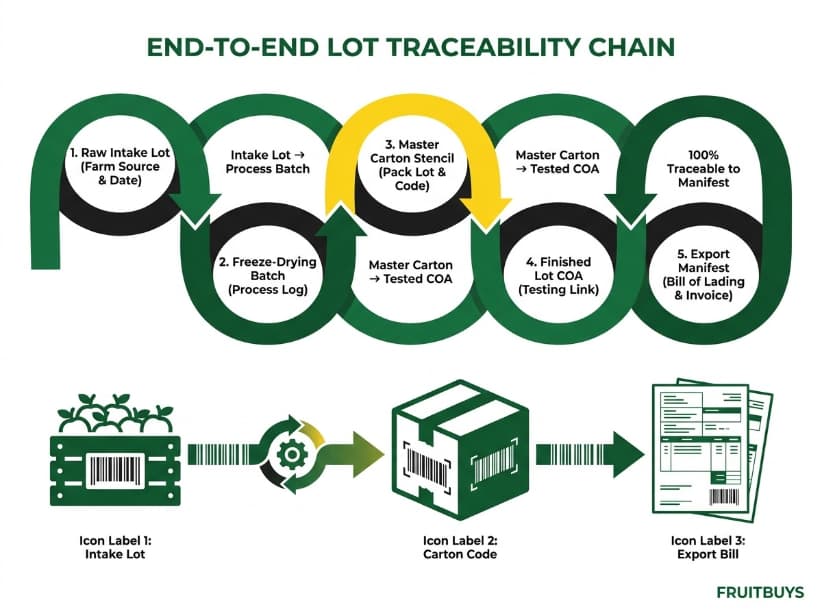
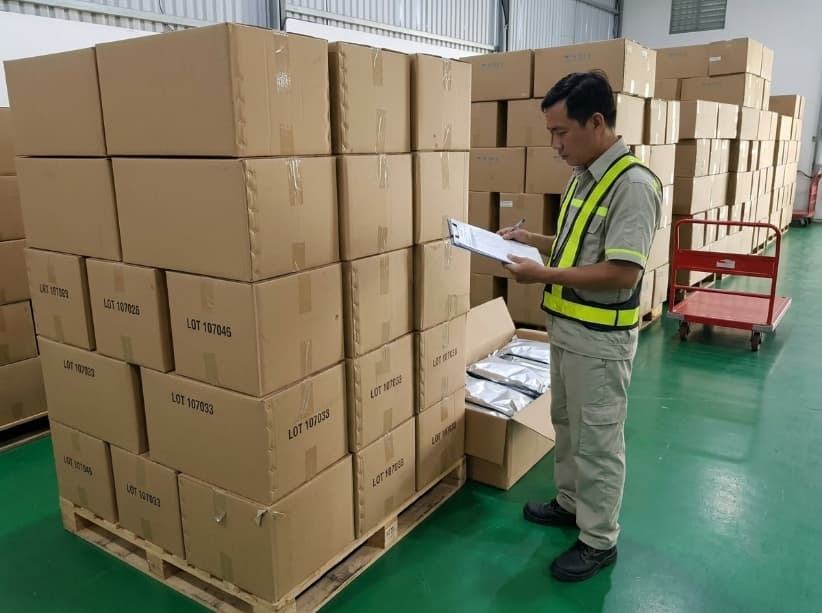
A document pack is only useful when the buyer can connect it to the shipment. Traceability should run from raw-material lot through processing, packing, finished lot, carton code and transport document.
The buyer should request a simple lot map. It does not need to expose confidential supplier information, but it should show the relationships needed for QA release and recall response.
| Traceability record | What it should connect |
|---|---|
| Raw-material intake | Source lot, receiving date and acceptance decision |
| Process record | Product lot, process date and format |
| Packaging record | Inner bag, carton, code and pack date |
| COA | Finished lot and tested sample |
| Deviation record | Nonconformance, disposition and corrective action |
| Shipment record | Lot, carton count, consignee and transport reference |
| Retention sample | Lot, format, packaging and storage condition |
A certificate of analysis cannot correct a missing lot-code connection. If the COA says “freeze-dried jackfruit” but the carton code cannot be reconciled to the COA lot, the document should remain on hold pending clarification.
Certificate scope: site, product, activity and validity
A certificate should be read as a scoped document, not as a badge. Review the issuing body, certificate holder, address, activity, product or product category, audit standard, issue date, expiry date, exclusions and status.
| Certificate field | What can go wrong |
|---|---|
| Certificate holder | The named company may not be the producing site |
| Address | A trading office may be confused with the factory address |
| Activity scope | Storage, packing and manufacturing are not interchangeable claims |
| Product scope | A broad food category may not name freeze-dried fruit or the relevant process |
| Validity | An expired certificate may still circulate in a document pack |
| Issuing body | Accreditation or recognition status may require confirmation |
| Exclusions | The omitted process or site may be the one the buyer needs |
HACCP certification or a third-party audit does not replace a lot COA. A COA does not prove that the entire site operates under a certified management system. The buyer needs both documents when both questions matter.
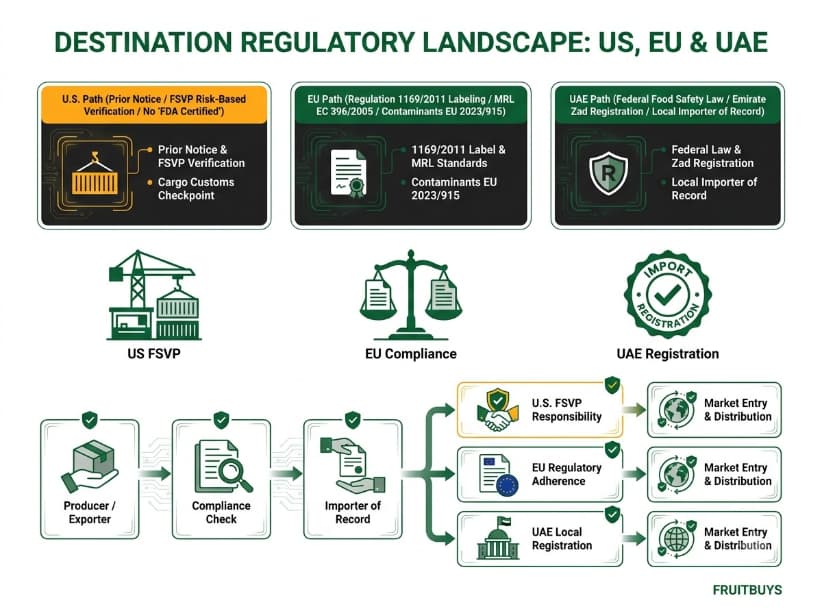
Do not publish “FDA certified,” “EU compliant” or “UAE ready” without current scope evidence. FDA states that it does not approve or certify individual food products, labels or shipments [1]. A facility registration, prior-notice filing or import review still do not amount to product certification.
U.S. path: FDA import responsibilities, Prior Notice and FSVP
The U.S. path has at least two different responsibility layers: shipment entry requirements and the covered importer’s foreign-supplier verification program.
Import documentation follows responsibility, not product marketing. The supplier supplies lot and site evidence; the importer or broker manages destination filings and entry actions. Confirm the handoff before the shipment is booked.
FDA requires prior notification for food imported or offered for import into the United States [2]. Prior Notice is a shipment-related notification. It does not certify the product or replace the importer’s broader food-safety review.
FSVP applies to covered U.S. importers. FDA describes the program as risk-based foreign-supplier verification and identifies activities such as hazard analysis, supplier evaluation, supplier approval, verification and corrective action [3]. The exact applicability depends on the importer, food, transaction and rule scope or exemptions.
| U.S. document or record | Usually owned or controlled by | Buyer review point |
|---|---|---|
| Facility registration information | Relevant facility/import process | Confirm the applicable facility and registration status |
| Prior Notice | Importer or responsible filing party | Confirm shipment information and filing responsibility |
| FSVP record | Covered U.S. importer | Confirm hazard analysis, supplier evaluation and verification plan |
| Lot COA | Supplier QA or issuing organization | Connect to actual lot and method |
| Commercial invoice and packing list | Exporter/importer | Match product, quantity, lot and consignee |
| Certificate of origin | Exporter or competent issuer | Confirm origin and customs use |
| Label review | Brand owner/importer | Confirm U.S. labeling requirements and claims |
A supplier can support FSVP by providing hazard information, process details, test results, audit records and corrective-action history. The supplier does not become the U.S. importer’s FSVP by sending a COA.
EU path: labeling, hygiene, contaminants and pesticide review
EU readiness should be separated into food information, hygiene and hazard-specific requirements. Regulation (EU) No 1169/2011 addresses the provision of food information to consumers, including the information framework for labels [4]. It does not, by itself, complete the food-safety, customs or importer review.
EU hygiene requirements and HACCP principles must be mapped to the applicable food business and process. The buyer should not treat “HACCP available” as a substitute for lot evidence or destination label review.
The EU path also requires attention to contaminants and pesticide residues. The applicable limit depends on the substance, commodity classification, product condition and current legal text. Use the current EU sources and the importer’s compliance review rather than copying a limit from another fruit or country.
| EU review layer | Evidence or decision needed |
|---|---|
| Food name and ingredient list | Approved label text and formulation |
| Allergen and cross-contact | Ingredient, facility and label review |
| Nutrition information | Calculation or test basis where required |
| Origin and operator details | Correct responsible operator and origin wording |
| Lot and date marking | Pack-code and shelf-life basis |
| Hygiene/HACCP | Applicable process controls and supplier evidence |
| Contaminants | Product-specific limit review and test plan |
| Pesticide residues | Commodity/substance MRL review and risk-based test |
| Packaging and materials | Destination and food-contact review where applicable |
The buyer should treat EU labeling as one workstream and laboratory testing as another. A correct label does not prove that the lot passes contaminant or pesticide review.
UAE path: importer, registration, inspection and traceability
The UAE path depends on the federal framework, emirate authority, importer setup, product category and route. UAE federal food-safety law covers food organizations and consignments entering or transiting the UAE and includes provisions related to licensing, registration, import documents, risk analysis, inspection, traceability and food-information accuracy [10].
Dubai Municipality lists services for registering and assessing a food item, releasing imported food consignments for sale in the local market, transferring consignments between emirates and approving food imports for re-export [11]. Those service paths show why the importer and emirate must be identified before the supplier prepares a final document list.
| UAE review question | Why it matters |
|---|---|
| Which emirate receives the goods? | Authority and service path may differ |
| Is the product for local sale or re-export? | Release and document route may differ |
| Who is the importer of record? | The importer controls local registration and filing actions |
| Is the product already registered? | New-item assessment may be required |
| What label and pack are being imported? | Registration and inspection review the actual product presentation |
| Which certificates are requested? | Current authority or importer instructions control |
| Can the lot be traced? | Inspection, release and recall require record linkage |
Do not state “UAE ready” because a supplier has a certificate of origin or health document. The importer should confirm the current registration, release, inspection and labeling path for the actual product.
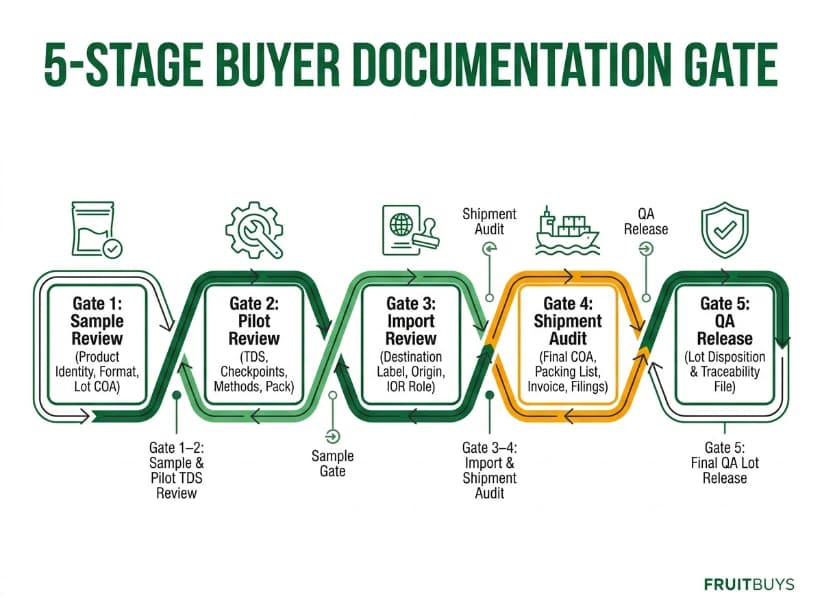
Buyer checklist before sample, pilot or shipment approval
A buyer can use the following sequence to decide whether the file is ready for the next stage.
| Stage | Minimum evidence |
|---|---|
| Sample review | Product identity, format, ingredient statement, lot and available COA |
| Pilot review | Specification, process/QC checkpoints, test methods and packaging record |
| Import review | Destination label, importer responsibilities, origin and shipment documents |
| Shipment review | Final COA, lot-code match, packing list, invoice, required certificates and filing confirmation |
| Release | QA disposition, deviations closed or approved, retention and traceability records |
A missing certificate does not always mean the shipment is impossible. It means the responsible buyer, importer or authority must identify whether the document is required, optional, substitutable or not applicable. Record that decision instead of silently removing the field.
A complete import file has three layers: the tested lot, the supplier/site system and the destination-specific shipment process. A gap in any layer can block approval even when the other two layers look complete. Review the file by responsibility, scope and lot connection.
FAQ
What should a freeze-dried jackfruit COA contain?
It should identify the product, format, lot, date basis, test item, method, result, unit, limit or specification and issuing organization. Include laboratory identity where applicable and connect the COA to the pack code.
Is there an FDA certification for freeze-dried jackfruit?
Do not claim one. FDA states that it does not approve or certify individual food products, labels or shipments. U.S. import review involves applicable facility, shipment and importer responsibilities.
Does HACCP replace a COA?
No. HACCP or a food-safety system addresses process hazards and controls. A COA reports defined test results for a product or lot. The documents answer different questions.
Is a phytosanitary certificate always required?
Do not assume either way. Requirement depends on product classification, destination, route and authority. The importer or customs broker must confirm whether it applies to the specific shipment.
What differs between U.S., EU and UAE documentation?
The responsibility structure and authority pathways differ. U.S. review includes Prior Notice and, for covered importers, FSVP. EU review includes food information, hygiene and hazard-specific requirements. UAE review depends on federal and emirate-level registration, release and inspection processes.
Can one certificate cover every product from a supplier?
Not automatically. Confirm the named site, address, product or process scope, validity, exclusions and issuing body. A certificate for storage or another product category may not cover freeze-dried jackfruit manufacturing.
What should QA request before approving a shipment?
Request the final lot COA, method and limits, lot-code match, packaging and seal records, traceability, invoice, packing list, origin and any destination-specific certificates or filing confirmations. Close scope gaps before release.
Next step
Request a destination-specific documentation checklist with the buyer, importer, product format, ingredient statement and shipment route identified. Ask the supplier to separate lot evidence, site/system evidence and destination documents so procurement, QA and the importer can review the same file without reinterpreting the claims.
For product discovery, review the verified freeze-dried fruit category. The category is a discovery path only; the unreconciled product page is not a technical reference.
References
- U.S. Food and Drug Administration (“Importing Food Products into the United States”: FDA does not approve or certify individual food products, labels or shipments; imported food responsibilities and facility/import context).https://www.fda.gov/food/food-imports-exports/importing-food-products-united-states
- U.S. Food and Drug Administration (“Prior Notice of Imported Foods”: prior notification requirement for food imported or offered for import into the United States ).https://www.fda.gov/industry/fda-import-process/prior-notice-imported-foods
- U.S. Food and Drug Administration (“FSMA Final Rule on Foreign Supplier Verification Programs”: risk-based importer verification, hazard analysis, supplier evaluation and corrective action ).https://www.fda.gov/food/food-safety-modernization-act-fsma/fsma-final-rule-foreign-supplier-verification-programs-fsvp-importers-food-humans-and-animals
- EUR-Lex / European Union (“Regulation (EU ) No 1169/2011 on the provision of food information to consumers”: consolidated text in force on 1 April 2025).https://eur-lex.europa.eu/eli/reg/2011/1169/2025-04-01/eng
- European Commission (“Food hygiene legislation”: EU hygiene framework and HACCP-related food-safety context ).https://food.ec.europa.eu/food-safety/biological-safety/food-hygiene/legislation_en
- European Commission (“EU Pesticides Database”: information-only lookup tool; the Commission states that it has no legal value ).https://food.ec.europa.eu/plants/pesticides/eu-pesticides-database_en
- EUR-Lex / European Union (“Regulation (EC ) No 396/2005 on maximum residue levels of pesticides in or on food and feed”: legal pesticide-residue framework).https://eur-lex.europa.eu/eli/reg/2005/396/oj
- European Commission (“EU Pesticides Database: official residue lookup”: official information is published in the Official Journal; use the database as a lookup tool ).https://food.ec.europa.eu/plants/pesticides/eu-pesticides-database_en
- European Commission (“Contaminants Legislation”: Commission Regulation (EU ) 2023/915 and maximum levels for specified contaminants).https://food.ec.europa.eu/food-safety/chemical-safety/contaminants/legislation_en
- United Arab Emirates Legislation (“Federal Law Concerning Food Safety”: food organizations and consignments, registration, import, inspection, traceability and food-information provisions ).https://uaelegislation.gov.ae/en/legislations/1161
- Dubai Municipality (“Food Safety Department — Our Services”: food-item registration, imported-food release, re-export and related food services ).https://www.dm.gov.ae/municipality-business/food-safety-department-2/important-information-to-food-establishment/
- U.S. Food and Drug Administration (“Draft Guidance for Industry: Establishing Sanitation Programs for Low-Moisture Ready-to-Eat Human Foods”: draft, nonbinding sanitation and preventive-control context ).https://www.fda.gov/media/184815/download