
Freeze-Dried Jackfruit HS/Customs Classification Readiness
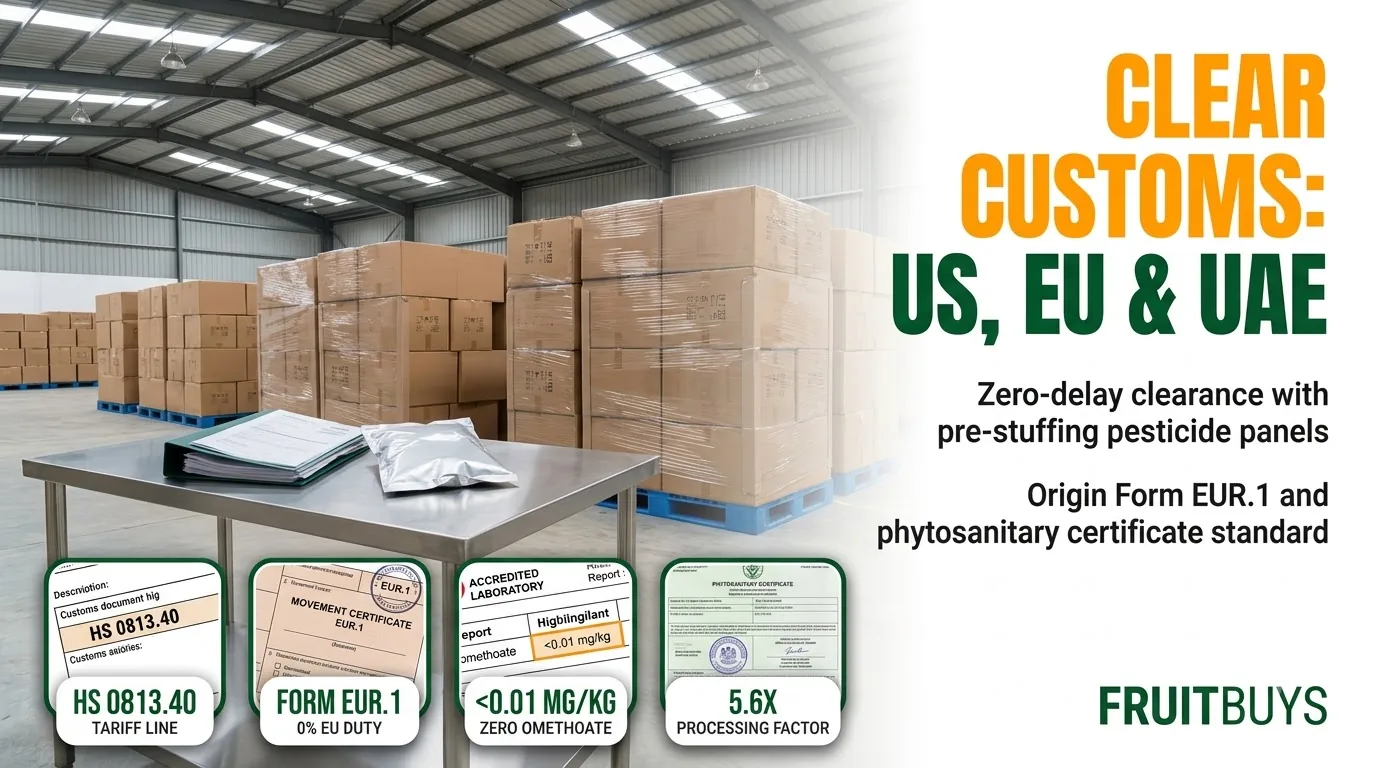
A freeze-dried jackfruit HS or customs classification cannot be selected safely from the product name alone. The result may depend on the exact form, formulation, degree of processing, presentation, intended use, origin, destination jurisdiction and the goods as presented at import.
The correct first action is not to copy a code from a supplier, marketplace listing or previous shipment. It is to build a fact-locked product-description file, identify the destination customs system and obtain an attributable classification review. This guide does not assign a universal HS code, duty rate or customs-clearance result.
The freeze-dried jackfruit B2B buyer qualification guide provides the broader product route. This page isolates the customs decision and sends food-safety, label, COA and market-access questions to their respective owners.
HS, destination tariff systems and customs decisions are related but different
The Harmonized System is the international foundation for uniform classification of traded goods. The World Customs Organization identifies HS 2022 as the seventh edition of the Harmonized System, effective from 1 January 2022 and used worldwide by the Contracting Parties to the HS Convention.[1]
A destination jurisdiction may build additional tariff and statistical layers on the HS foundation. For the European Union, TARIC integrates the Common Customs Tariff and commercial and agricultural legislation, including nomenclature, additional codes, tariff measures and certain import controls.[2]
A customs code is therefore not a free-standing marketing label. It is a jurisdiction-specific conclusion based on the applicable nomenclature, the objective facts of the goods and the rules in force on the relevant date.
| Evidence layer | What it can do | What it cannot prove by itself |
|---|---|---|
| HS nomenclature | Provide the international classification foundation. | It does not automatically determine every destination extension or measure. |
| Destination tariff database | Show the destination’s nomenclature and applicable measures. | A search result may still require product-fact interpretation and current-date review. |
| Broker or customs-specialist opinion | Apply product facts to a destination procedure. | An informal opinion may not have the same status as a binding authority decision. |
| Binding Tariff Information or equivalent authority decision | Provide a formal, scoped classification decision where the destination system offers it. | It does not automatically cover a different product, form, importer, origin, jurisdiction or changed legal basis. |
| Supplier or marketplace code | Provide a lead for investigation. | It is not final legal proof for the buyer’s shipment. |
The EU TARIC and Binding Tariff Information route should be used for EU-specific review. The classification process for the United States, UAE or another destination must use the relevant local customs authority and nomenclature.
The seven product facts that drive the classification file
1. Product identity and botanical description
State what the product is, not only how it is marketed. The file should identify jackfruit, its botanical identity where relevant, the product name, the form at import and whether it is a single ingredient or a formulated food.
A product described as “fruit snack” may not provide the same classification input as a product described as “freeze-dried jackfruit powder for food manufacturing.” The description should match the commercial invoice, packing list, specification, label and entry declaration.
2. Physical form at import
Record whether the goods are whole pieces, slices, chunks, dice, crumble, powder or another form. Form affects the description, packaging, intended use and potentially the applicable tariff heading or subheading.
Do not assume that the classification of powder transfers to pieces or that the classification of slices transfers to a formulated ingredient. The buyer should retain form-specific product specifications and photographs or technical descriptions where they help identify the goods.
The freeze-dried jackfruit formats and application-qualification guide explains why form-specific evidence matters for product qualification. Customs review should use the exact form shipped.
3. Formulation and composition
The file should state whether the product is 100% jackfruit or contains sugar, oil, acid, sulfites, carriers, flavorings, preservatives or other ingredients or processing aids. The formulation should be supported by the approved bill of materials or product specification.
A user target such as “100% jackfruit” is not the same as a verified commercial formulation. If pretreatment or another processing input changes the product composition, the customs and label review should use the actual formulation rather than an assumed target.
The Vietnam jackfruit origin, cultivar and raw-material guide provides the raw-material route. Customs classification should not use cultivar or origin language as a substitute for the actual product description and composition.
4. Degree and method of processing
State the relevant processing sequence in concise, factual language: preparation, freezing, freeze drying, cutting, milling, sieving, blending, packing or other steps that define the imported good.
The purpose is not to claim that one process creates a preferred tariff result. The purpose is to give the customs reviewer enough information to assess the goods as presented. A process description should distinguish freeze-dried fruit pieces from a powder ingredient, a blend or a product with added components.

5. Presentation, packaging and sales unit
Record whether the goods enter as retail packs, bulk bags, cartons, foodservice packs, industrial ingredient packs or private-label units. Include the net quantity, inner and outer packaging, label presentation and whether the product is sold as a stand-alone food or for further manufacturing.
Packaging does not automatically determine classification, but it can clarify how the goods are presented and sold. The file should avoid using carton dimensions or fill assumptions as a substitute for product identity.
6. Intended use and buyer channel
State the intended use carefully: direct consumption, topping, cereal inclusion, bakery ingredient, beverage formulation, foodservice, further processing or another documented purpose. Intended use may be relevant to the customs analysis, but it should not be invented to obtain a preferred outcome.
If the same physical product is sold through different channels, ask whether the destination customs authority treats the presentation or declared use as relevant. Record the reviewer’s conclusion rather than assuming that one channel’s classification applies to all channels.
7. Origin, destination and date of review
Record the country of origin, country of export, importing jurisdiction, importer and date of classification review. Tariff systems and trade measures can vary by jurisdiction and change over time.
A code used for one country does not automatically transfer to another. A historical code may also become outdated after a nomenclature amendment, tariff measure change, product change or new authority decision.
Build a fact-locked product-description file
The product-description file should allow a customs specialist to understand the imported goods without relying on commercial adjectives or assumptions.
| File section | Information to include |
|---|---|
| Product identity | Product name, botanical/product description and single-ingredient or formulated status |
| Form | Pieces, slices, chunks, dice, crumble, powder or another exact form |
| Composition | Ingredient list, percentages where relevant, additives, carriers and processing inputs |
| Processing | Preparation, freezing, freeze drying, cutting, milling, blending and packing steps |
| Physical characteristics | Particle or piece description, moisture/Aw fields if relevant to identification, and product photographs where useful |
| Packaging | Retail/bulk presentation, inner pack, outer pack, net quantity and label configuration |
| Intended use | Direct consumption, ingredient, topping, inclusion, foodservice or further processing |
| Origin | Country of origin and source/facility information as required by the customs review |
| Destination | Country or customs territory, port or entry route and importer |
| Commercial documents | Invoice, packing list, specification and product label |
| Supporting evidence | COA, formulation/BOM, process description, prior ruling/decision and broker analysis |
| Change record | Revision date, product changes and reason for reclassification review |

The description in this file should match the product actually shipped. If the formulation, form or packaging changes, the classification owner should decide whether a new review is required.
Use destination evidence, not inherited codes
A supplier may provide an HS code on a quotation, invoice or product sheet. That code can help the buyer identify a starting point, but it does not prove the correct classification for the buyer’s destination and transaction.
| Source of code | Use in the review |
|---|---|
| Supplier code | Compare with the product facts and ask for the legal or broker basis. |
| Marketplace code | Treat as discovery only; do not use as final evidence. |
| Previous shipment code | Check product, form, origin, importer, date and destination before reuse. |
| Broker analysis | Request written reasoning tied to the exact product-description file. |
| Destination tariff database | Check current nomenclature and measures after facts are locked. |
| Binding decision | Use where available and confirm scope, validity and product match. |
For the EU, the European Commission describes TARIC as a database integrating Common Customs Tariff measures and commercial and agricultural legislation and transmitting updated data daily to national administrations.[2] The European Commission also describes Binding Tariff Information as a legal decision issued by an EU country’s customs authority on the tariff classification of a product.[3]
A BTI or equivalent authority decision is valuable because it is tied to a defined product and legal system. It should not be copied to a changed product or another jurisdiction without a new review.
Keep customs classification separate from food compliance
Customs classification is one workstream in the import file. It does not replace product safety, food registration, labeling, testing, traceability or importer review.
| Question | Correct owner or route |
|---|---|
| What is the product form and composition? | Product specification, formulation and QA |
| What evidence supports the lot? | COA, testing and traceability guide |
| What does the U.S. importer need? | U.S. import-readiness guide |
| What does the EU importer need? | EU compliance-readiness guide |
| What does the UAE importer need? | UAE import and product-registration guide |
| What is the customs classification? | Destination customs authority, broker or binding-decision route |
| How does OEM affect the file? | OEM and private-label buyer guide |
A classification decision should align with the product and commercial documents, but it should not be used as evidence that the product is compliant with every other destination requirement.
Review classification when facts or rules change
Reclassification review should be triggered by changes that could alter the description or legal basis of the imported goods.
| Change | Why a new review may be needed |
|---|---|
| Pieces changed to powder | Physical form and presentation changed. |
| Single ingredient changed to blend | Composition and product description changed. |
| Added sugar, oil, acid, carrier or flavor | Formulation and possible tariff treatment changed. |
| Retail changed to bulk ingredient | Presentation and intended-use evidence changed. |
| New country of origin or destination | Jurisdiction, trade measure and tariff system changed. |
| New packaging or label | Product presentation or declared use changed. |
| Processing step changed | Goods as presented may no longer match the prior file. |
| New tariff amendment or measure | Legal basis or applicable code may have changed. |
| New customs ruling or authority interpretation | Previous rationale may require reassessment. |
| Importer or broker changed | The evidence owner and filing route changed. |

Keep the original classification rationale, the evidence version and the date of review. A change log is more defensible than silently reusing an old code.
Buyer checklist before using an HS or tariff code

Before a code is placed on an invoice, packing list or customs entry, confirm:
- The exact product identity and physical form
- The actual ingredient list and formulation
- The relevant processing steps
- The intended use and sales presentation
- The retail, bulk, foodservice or industrial configuration
- The country of origin, destination jurisdiction and review date
- The exact product-description file matches the goods shipped
- The supplier code, if any, has been treated as a lead rather than final proof
- The destination tariff database or customs source has been checked
- The broker or customs specialist has documented the rationale
- A binding decision or equivalent authority route has been considered where appropriate
- The code is consistent across invoice, packing list, label and entry data
- Changes to form, formulation, origin, destination, package or law trigger re-review
- The classification decision is not being used as proof of food-safety or label compliance
If the facts are incomplete, pause the classification decision and complete the product-description file. A precise code attached to an imprecise product description creates more risk than an openly unresolved classification question.
Related product route
The freeze-dried jackfruit B2B buyer qualification guide links the customs decision to raw-material, process, specification, COA, packaging, market and OEM owners. For a new private-label product, use the OEM and private-label buyer guide to lock the form, formulation, package and destination before requesting a customs review.
Conclusion
The correct HS or customs classification begins with a fact-locked description of the goods, not a copied code. Form, formulation, processing, presentation, intended use, origin, destination and review date should be recorded before the importer or customs specialist evaluates the applicable nomenclature.
The international HS foundation, destination tariff database, broker analysis and binding authority decision each have a different role. Supplier and marketplace codes can help start the investigation, but they should not become final legal conclusions without destination-specific review.
A controlled classification file protects the importer from mismatched documents, outdated codes and silent changes. It also keeps customs classification separate from food safety, labeling, testing, traceability and market-access decisions.
References
- World Customs Organization: “HS Nomenclature 2022 Edition: Harmonized System nomenclature, effective date, worldwide use and correlation tables” (https://www.wcoomd.org/en/topics/nomenclature/instrument-and-tools/hs-nomenclature-2022-edition.aspx )
- European Commission, Directorate-General for Taxation and Customs Union: “EU Customs Tariff (TARIC): integrated database for the Common Customs Tariff, commercial and agricultural legislation, nomenclature and import measures” (https://taxation-customs.ec.europa.eu/online-services/online-services-and-databases-customs/eu-customs-tariff-taric_en )
- European Commission, Directorate-General for Taxation and Customs Union: “European Binding Tariff Information (EBTI): binding tariff classification decisions issued by EU customs authorities” (https://taxation-customs.ec.europa.eu/online-services/online-services-and-databases-customs/european-binding-tariff-information-ebti_en )