
How much fresh jackfruit does it take to make 1 kg of freeze-dried jackfruit?
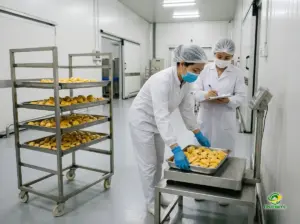
In commercial production at FruitBuys, 5–6 kg of deseeded jackfruit bulbs, or about 15–18 kg of whole fresh fruit, make 1 kg of export-grade freeze-dried jackfruit. Quotes that look far apart usually count from different starting points, so check the basis before the price. The wider supplier checklist is in the bulk buying guide.
In B2B procurement, a conversion ratio means nothing without its starting point:
- Whole fruit basis (15–18 : 1) measures the harvest input. A fresh jackfruit gives only about 28–34% usable bulbs once the heavy rind, central core, latex-laden rags and seeds are removed.
- Deseeded bulb basis (5–6 : 1) measures what goes onto the freeze-drying trays.
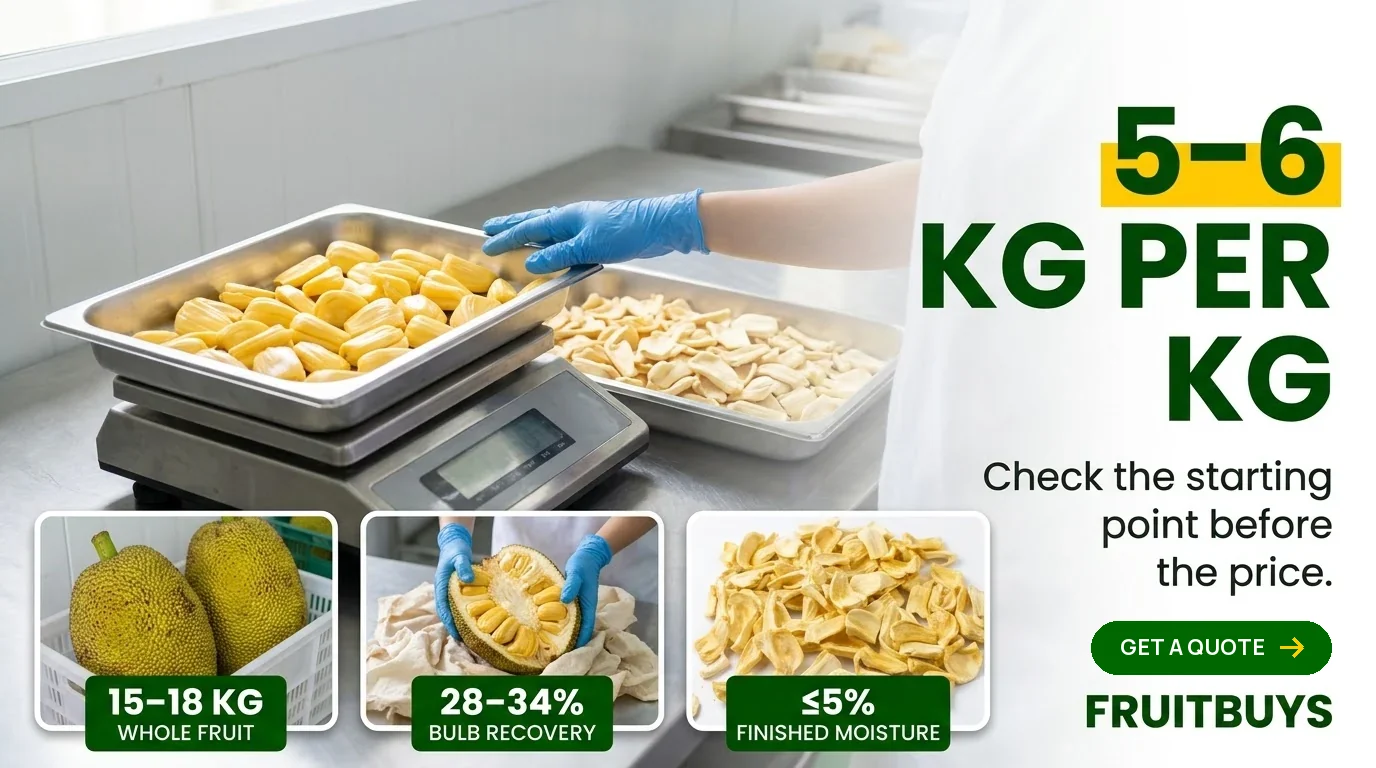
When you compare quotes, the first checkpoint is never the price. It is whether both suppliers count yield from the orchard gate or from the preparation table.
Where does the fruit go between the orchard and the carton?
Through three stages. Each one has its own loss and its own reasons for that loss to move.
| Stage | Operational benchmark | What makes the number move |
|---|---|---|
| 1. Whole fruit → clean deseeded bulbs | 15–18 kg → 5–6 kg (bulb recovery about 28–34%) | Seed weight, rind and core thickness, variety, season |
| 2. Sorting and trimming the bulbs | 5–10% of the bulbs removed | Hard bulb tips cut off; under-ripe, low-sugar or bruised bulbs rejected |
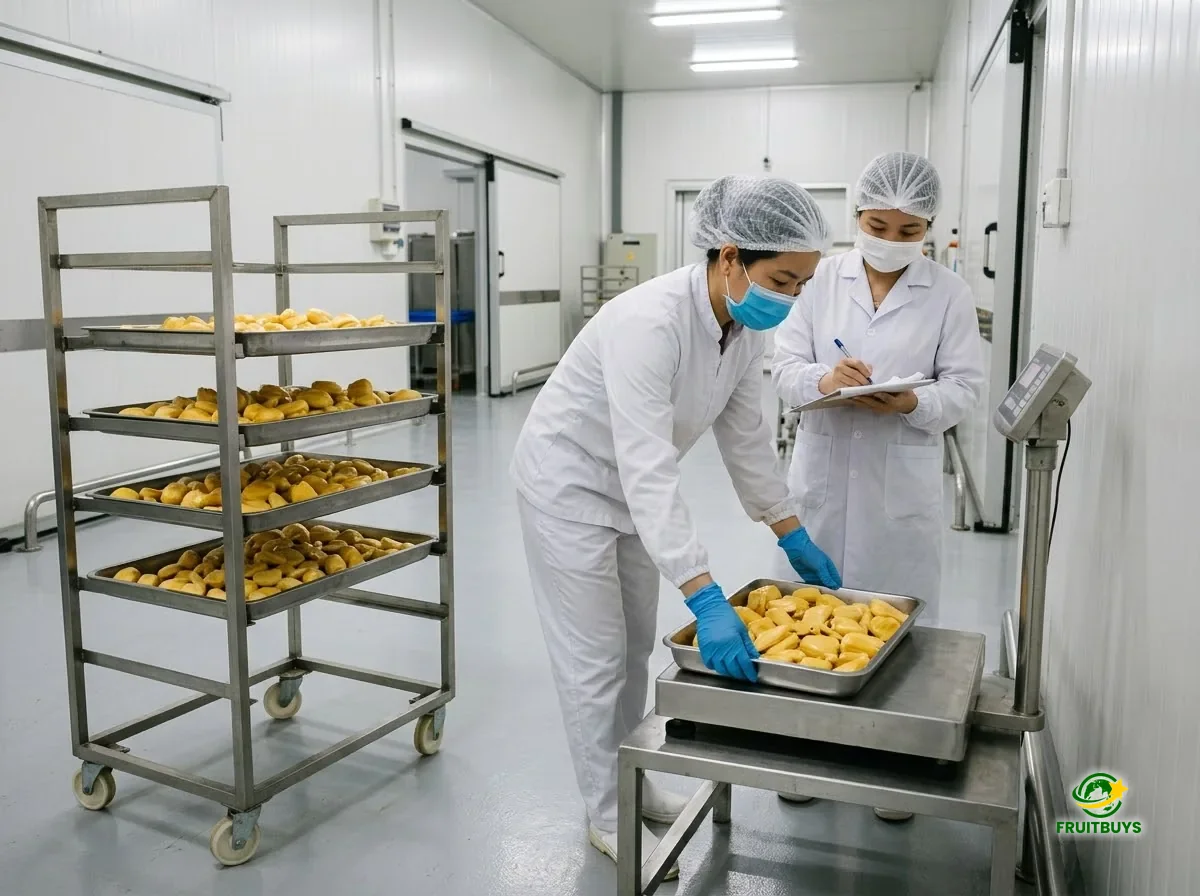
| 3. Freezing and freeze-drying → finished product (≤5% moisture) | 5–6 kg of clean bulbs → 1 kg of whole-piece product | Water content of the incoming fruit, breakage into fines at unloading and packing |
Two things follow for a buyer:
- Whole-fruit recovery rarely goes above 34%. If a supplier’s numbers imply 40% or more, ask how.
- When recovery drops toward 28%, for example with small, thin-fleshed fruit from densely planted orchards, one kilogram of finished product needs closer to 21 kg of whole fruit.
Why does real factory yield sit at 5–6 kg instead of the theoretical 3.7 kg?
On paper, bulbs with about 75% water suggest 3.65–3.8 kg of bulbs per kilogram of product at ≤4% moisture. In Southeast Asian factories, no export line producing whole freeze-dried jackfruit bulbs runs below 4 : 1. That figure exists only in laboratory spreadsheets, and quoting on it leads to failed deliveries or quiet quality downgrades.
The fruit itself is Thai jackfruit, the early-bearing variety grown across Tien Giang, Dong Nai, Hau Giang and the Central Highlands. It reaches 18–24° Brix, and its seed and rind share varies with tree age and season.
Export production runs at 5–6 kg of clean bulbs because the export standard requires active sorting at three points:
- Brix and ripeness screening. Under-ripe bulbs lack aroma and turn chalky white after drying; over-ripe bulbs collapse under vacuum. Sorting to a uniform 18–24° Brix removes 5–8% of edible pulp from the export line.
- Seasonal water content. Jackfruit harvested in southern Vietnam’s rainy season, June to October, takes up more water and loses sweetness. Starting moisture rises to about 82%, which pushes the ratio toward the 6 : 1 ceiling.
- Defect and fibre trimming. Bruised sections, hard bulb caps and inner rags cannot go into a whole-piece export carton.
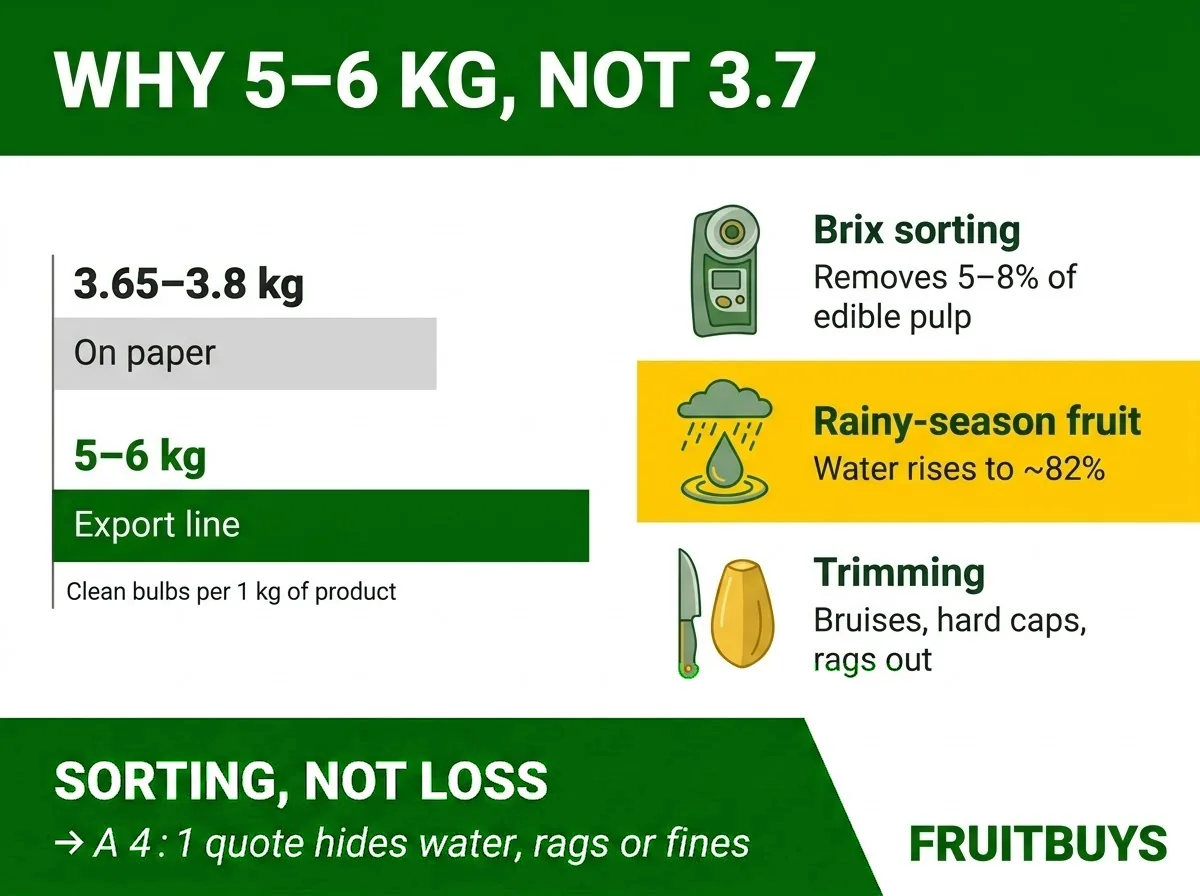
The commercial takeaway: the 5–6 : 1 ratio is the material threshold for uniform golden colour and a clean snap. It is active quality screening, not loss.
If a vendor quotes close to 4 : 1 for whole freeze-dried jackfruit bulbs, audit the specification for three things:
- finished moisture above 6%;
- core tissue, rags or seed skins mixed into the pack;
- a high fines tolerance hiding broken material.
Why does freeze-dried jackfruit cost more than dried jackfruit?
Because three costs stack up, and raw material is the largest.
- Raw material. Every kilogram in the carton carries 15–18 kg of fruit bought at the orchard gate. Air-dried jackfruit keeps more water in the finished product, so it uses less fruit per kilogram sold.
- Drying time. Freeze-drying removes ice under vacuum over many hours, often a full day per batch. The cost is machine time and energy. Air-drying is faster and uses simpler equipment.
- Packaging. A crisp product needs high-barrier aluminium bags. Ordinary film lets it go soft long before its date.
Raw material is also the most sensitive line. Each extra kilogram of bulbs per kilogram of product adds about 17–20% to the raw material cost. Moving from a 5 : 1 dry-season batch to a 6 : 1 rainy-season batch is the full 20%.
Procurement strategy: price by season. Jackfruit raw material costs move between Vietnam’s dry season (November to May) and rainy season (June to October). A single fixed price for the whole year forces the supplier to build the rainy-season conversion loss into every kilogram. Experienced buyers do better with one of two approaches:
- An annual framework contract with a seasonal index: the dry-season price is the base, and an agreed adjustment band applies to rainy-season production.
- Dry-season allocation: book the bulk of the year’s volume for production between November and May, when Brix is highest and conversion cost lowest.
What this means for you: if your product does not need crunch, natural colour or a “100% fruit” claim, air-dried jackfruit is the cheaper choice. Our freeze-dried jackfruit buyer guide compares the forms.
Which cost drivers can a buyer influence?
More than most buyers think. Four choices on your specification move the ratio or the cost per usable kilogram.
| Your choice | Effect on cost | Practical rule |
|---|---|---|
| Cut and grade | Whole intact bulbs need slower cycles and lose more in sorting; dice run faster with less pulp per kilogram | If the fruit disappears into a cereal or bar, buy dice or pieces |
| Fines tolerance | Accepting a small share of broken pieces keeps more of each batch saleable | Set a fines limit your line can use, not zero |
| Moisture target | Drier product needs more fruit | Moving from 3% to 5% moisture saves about 2% of the bulbs; do not specify drier than you need |
| Carton weight | Freight is paid per container, not per kilogram | A heavier fill lowers freight per kilogram; see how bulk freeze-dried jackfruit is packed and loaded |
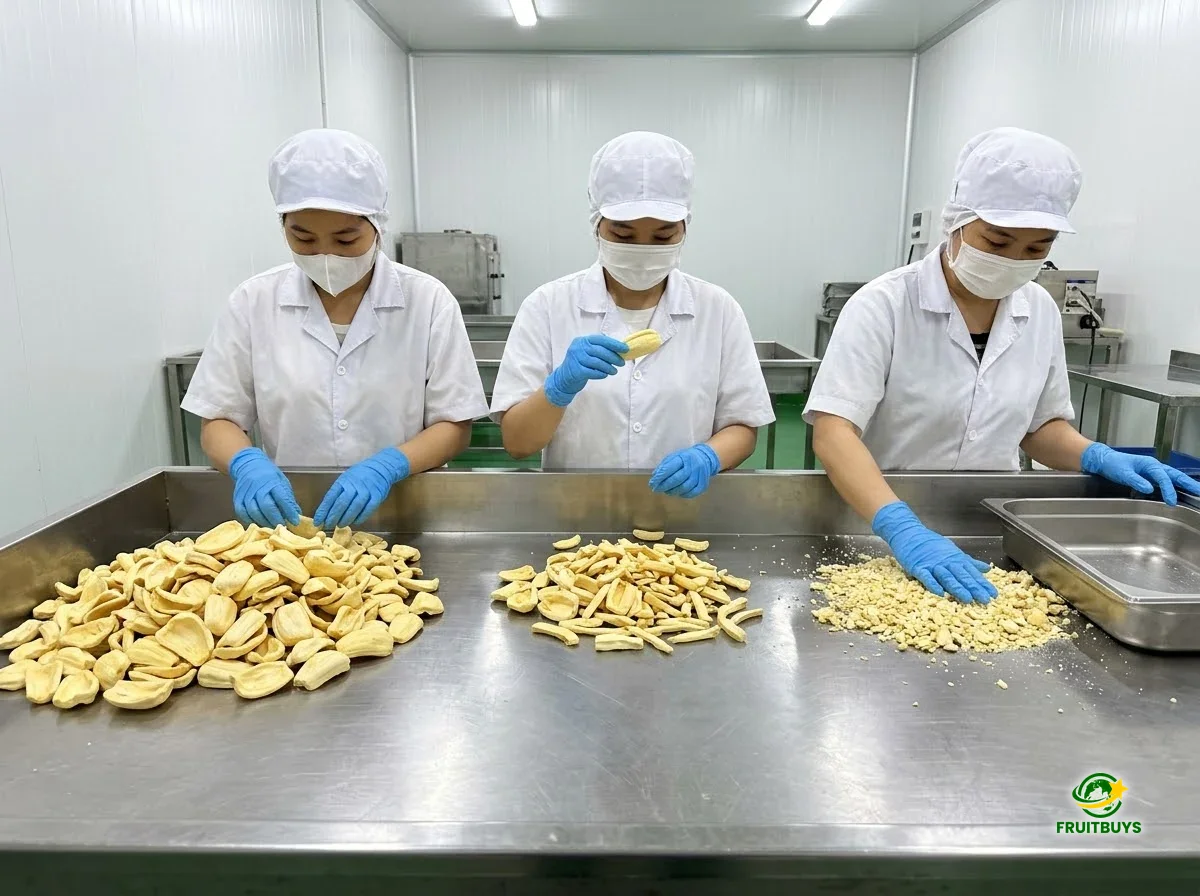
The safe limits for moisture and water activity are set out in what moisture and water activity freeze-dried jackfruit should have.
How do I check a supplier’s ratio and quote?
Put every quote through the same three checkpoints before you look at the price.
| Checkpoint | What suppliers state | Operational reality check |
|---|---|---|
| 1. Starting point | Bulbs or whole fruit | If a vendor quotes 12 : 1 from whole fruit, ask how they reach a recovery of 40% or more. Normal recovery rarely exceeds 34%. |
| 2. Final moisture | ≤3%, ≤5% or ≤7% | Product at 7% moisture saves the processor energy and fruit, but it is 4% less fruit than product at 3%, and it softens faster in storage. |
| 3. Grade | Whole bulbs, slices or dice | Whole intact bulbs need slower drying and lose more in sorting. Dice cost less to make. Make sure both quotes are for the grade you will actually buy. |
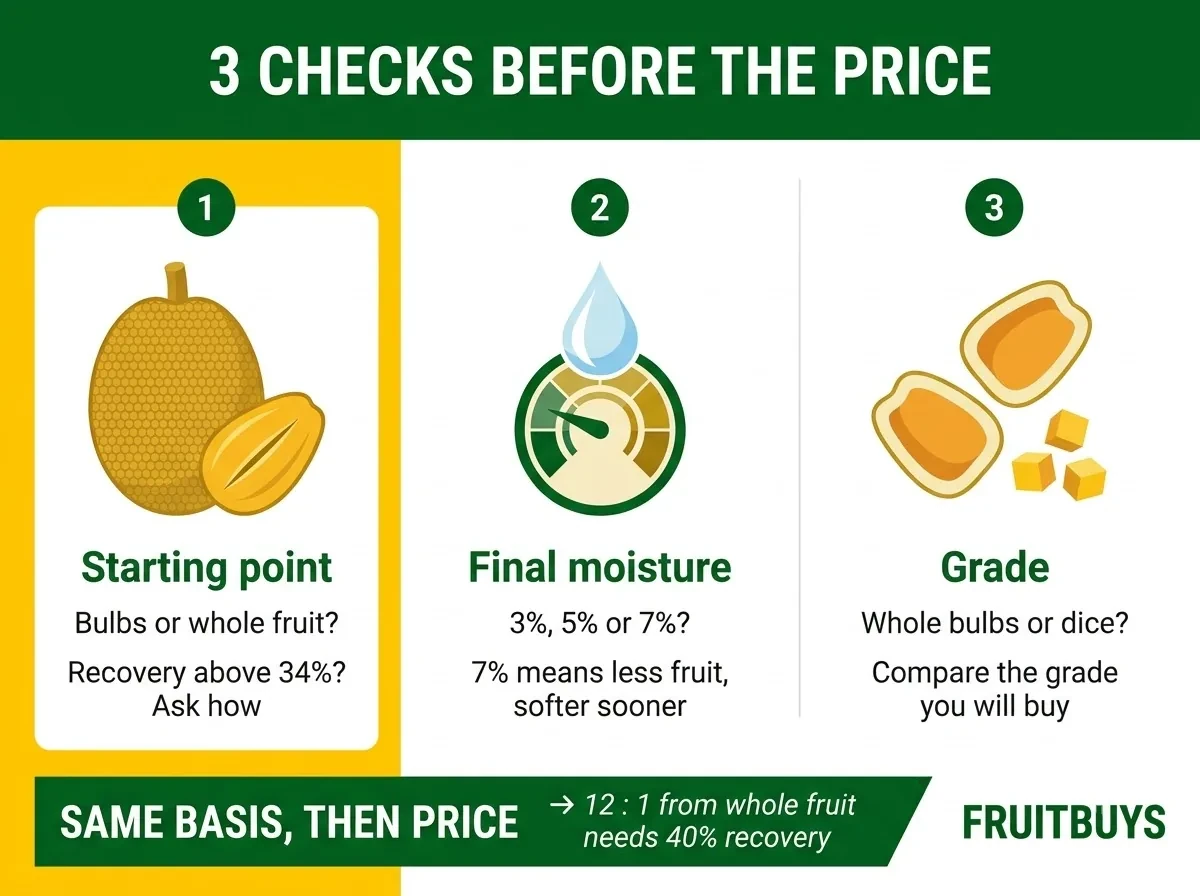
If a quote is lower and all three checkpoints match, ask what the supplier does differently. There may be a real answer, such as different fruit, a different cut or a dry-season harvest. If there is no clear answer, test the sample before you trust the price.
What does a usable kilogram really cost once it lands?
The price per kilogram on a quote is only the start. What matters to your margin is the cost of each kilogram you can actually use after freight, duty, clearance and breakage.
Landed cost per usable kg = (product cost + freight + duty + clearance and testing) ÷ (kg shipped × usable share)
The usable share is what is left after fines your line or pack cannot use. Two choices move it, together with freight per kilogram: the cut you buy and the way the container is loaded.
| Loading scenario (20 ft) | Net kg shipped | Freight per kg | Usable share | Freight per usable kg |
|---|---|---|---|---|
| Dice, 10 kg cartons, floor-loaded | about 5,500 kg | about USD 0.36 | about 96% (fines ≤3–5%) | about USD 0.38 |
| Whole bulbs, 7 kg cartons, floor-loaded | about 3,850 kg | about USD 0.52 | about 93.5% (fines ≤5–8%) | about USD 0.56 |
| Dice, 10 kg cartons, palletized (10 pallets) | about 3,200 kg | about USD 0.63 | about 96% | about USD 0.65 |
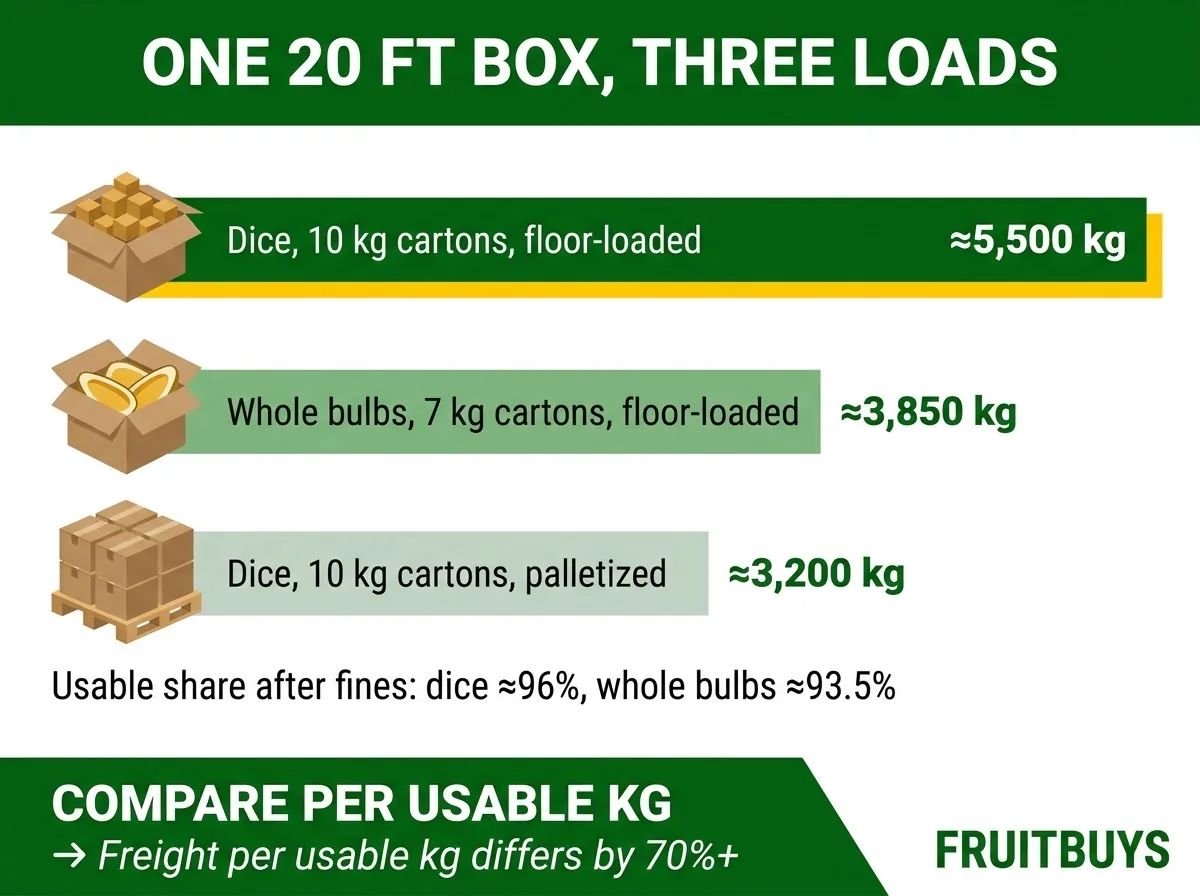
Freight is shown at an example rate of USD 2,000 per 20 ft container, for comparison only. Insert your own quote.
The same container can carry freight per usable kilogram from about USD 0.38 to USD 0.65, a difference of more than 70%, before the product price changes at all. Three practical consequences follow:
- Whole bulbs cost more twice: once in the conversion ratio, and again in freight and breakage.
- Pallets belong in 40 ft high-cubes. In a 20 ft container, palletizing raises freight per kilogram most; see how bulk freeze-dried jackfruit is packed and loaded.
- Duty can work in your favour. Into the EU, freeze-dried jackfruit enters at 0% duty: the third-country rate on CN 0813 40 65 is already zero. The documents are in freeze-dried jackfruit HS code and import documents.
What this means for you: compare suppliers on landed cost per usable kilogram, not on the price line. A cheaper quote in a light carton with a loose fines limit can cost more by the time it reaches your line.
When does the ratio matter less?
- Small retail runs. At a few hundred kilograms, packaging, design and freight often outweigh the raw material difference.
- Low inclusion rates. Where fruit is 5% of the recipe cost, a 20% change in fruit cost moves the recipe cost by about 1%.
- When the pack shows whole golden bulbs. You pay for the sorting loss whichever supplier you choose. The question is only whether the supplier tells you so.
Benchmark your quote with us
Send us the ratio, starting point, moisture and grade from the quotes you hold. We will show you how our offer compares on the same basis, without asking for the other supplier’s name.
Email [email protected] · WhatsApp Export +84 919 739 589
FAQ
How much fresh jackfruit makes 1 kg of freeze-dried jackfruit?
About 15–18 kg of whole fruit, or 5–6 kg of deseeded bulbs, for an export-grade whole-piece product.
What is the edible yield of a jackfruit?
Usually 28–34% clean bulbs after removing rind, core, rags and seeds. It depends on variety, fruit size and season.
Why is the real ratio higher than the theoretical one?
Ripeness sorting, trimming, breakage and seasonal water content. Theory gives about 3.65–3.8 kg of bulbs per kilogram; production needs 5–6 kg.
Does the season change the price of freeze-dried jackfruit?
It can. Rainy-season fruit holds more water, so it takes more fruit to make each kilogram.
Is a lower conversion ratio always better?
Only if the starting point, moisture and grade are the same. A low ratio can mean more water, more fines or rags in the product.
How do I calculate landed cost for freeze-dried jackfruit?
Add product cost, freight, duty, clearance and testing, then divide by the kilograms you can actually use after fines. Carton weight, cut and loading plan change the result as much as the product price.
How can I lower the cost of freeze-dried jackfruit?
Buy pieces or dice instead of whole bulbs, accept a sensible fines limit, avoid over-drying, and use a heavier carton fill.
About the author. Udo Nguyen is CEO of FruitBuys Vietnam. He coordinates freeze-dried fruit sourcing, qualified partner facilities and export documentation for importers, food manufacturers and private-label brands.