
Which freeze-dried jackfruit formats work in food manufacturing?
Freeze-dried jackfruit comes in five standard formats, and the right one depends on what the fruit must do in your product: be seen, survive a moist base, or dissolve. The format sets your breakage, your moisture risk and your cost per kilogram. How it compares with air-dried fruit and chips is in the bulk buying guide.
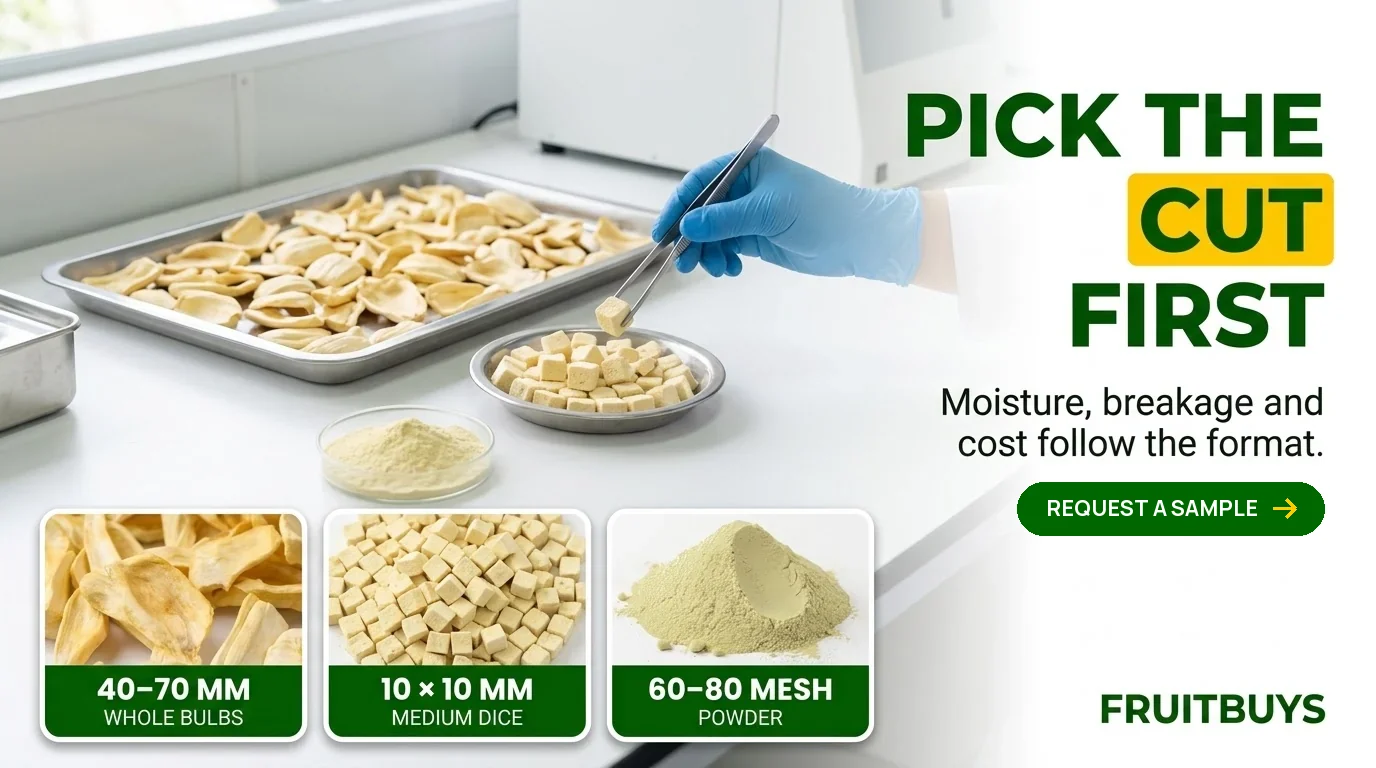
The five formats:
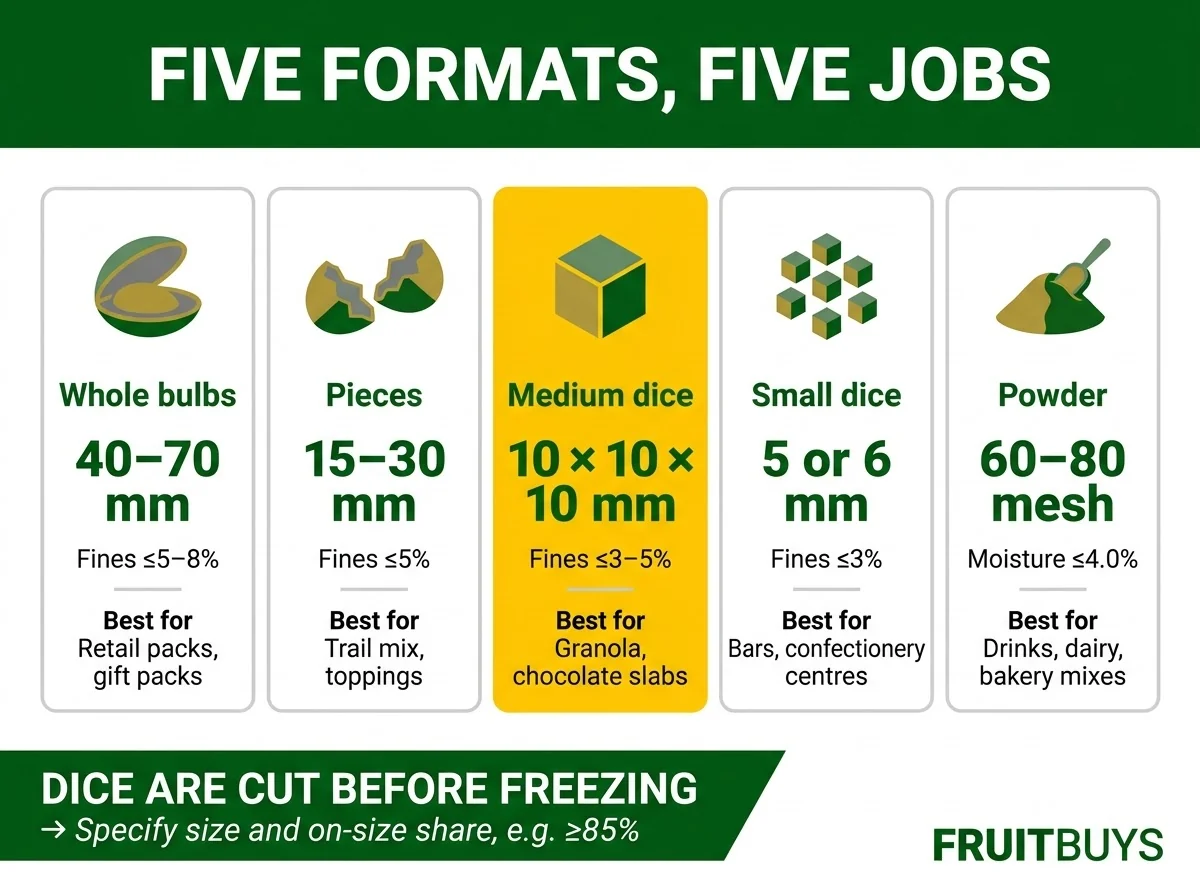
- whole bulbs (40–70 mm) for retail snack packs;
- pieces (15–30 mm) for snack blends and toppings;
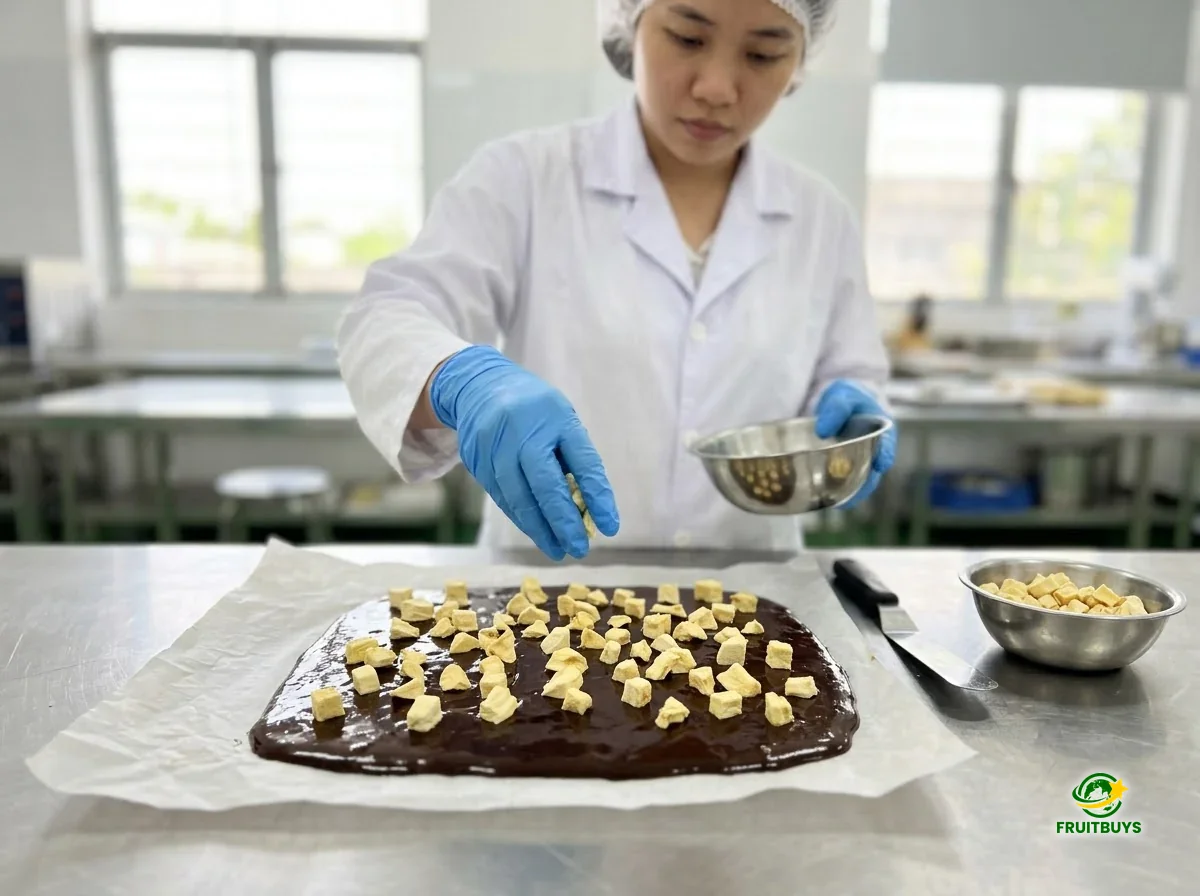
- medium dice (10 × 10 × 10 mm) for granola, muesli and chocolate slabs;
- small dice (5 × 5 × 5 or 6 × 6 × 6 mm) for bars and confectionery centres;
- powder (60–80 mesh) for drinks, dairy and bakery mixes.
The format decides three things on your line: how the fruit survives moisture in your recipe, how much breaks in your hoppers, and what you pay per kilogram.
Jackfruit is more demanding than most freeze-dried fruit. Ripe Vietnamese jackfruit reaches 18–24° Brix, and those concentrated sugars make the dry pieces strongly hygroscopic. They come off the dryers at FruitBuys partner facilities at water activity 0.18–0.25, and on an open line in humid air they start to feel sticky within about 30 minutes. Every format choice below works around that fact.
How do whole bulbs, pieces and dice differ in practice?
| Format | Factory cut specification | Fines limit (through 3 mm sieve) | Best for | Operational trade-off |
|---|---|---|---|---|
| Whole bulbs | Intact sorted bulbs, about 40–70 mm | ≤5–8% | Retail pouches, gift packs, whole-bulb toppings | Highest cost per kg; most fragile in transit |
| Pieces | Halved or broken bulbs, about 15–30 mm | ≤5% | Trail mix, bakery toppings, snack clusters | Irregular look; agree a minimum piece size |
| Medium dice | Mechanical cube cut, 10 × 10 × 10 mm | ≤3–5% | Muesli, toasted granola, large chocolate slabs | Stable on the line; fruit stays recognisable |
| Small dice | Mechanical cube cut, 5 × 5 × 5 mm or 6 × 6 × 6 mm | ≤3% | Energy and protein bars, confectionery centres | Largest surface per gram; picks up moisture fastest on open lines |
| Powder | Milled dried fruit, 60–80 mesh, 100% jackfruit | Not applicable (moisture ≤4.0%) | Instant drinks, dairy, bakery mixes, sweet seasonings | Highly hygroscopic; needs a sealed liner and fast batch sealing |
Three manufacturing rules sit behind this specification.
- Shape drives cost. Whole bulbs need longer drying cycles for their dense centres and lose more in sorting. If the fruit disappears inside a breakfast blend or a bar, whole bulbs spend budget on something your consumer never sees. How much fresh jackfruit makes 1 kg of freeze-dried shows where that cost comes from.
- Dice are cut before freezing, not crushed after drying. FruitBuys dices fresh bulbs mechanically before freezing. Pre-cut dice keep clean edges, uniform geometry and firm structure. Crushing dried bulbs after the dryer produces jagged fragments, dust and more sorting waste.
- Lock the cut and its tolerance. Specify both the nominal size and the on-size share, for example 10 × 10 mm with at least 85% on size. An undefined “dice” leads to mixed lots that clog automatic dosing hoppers.
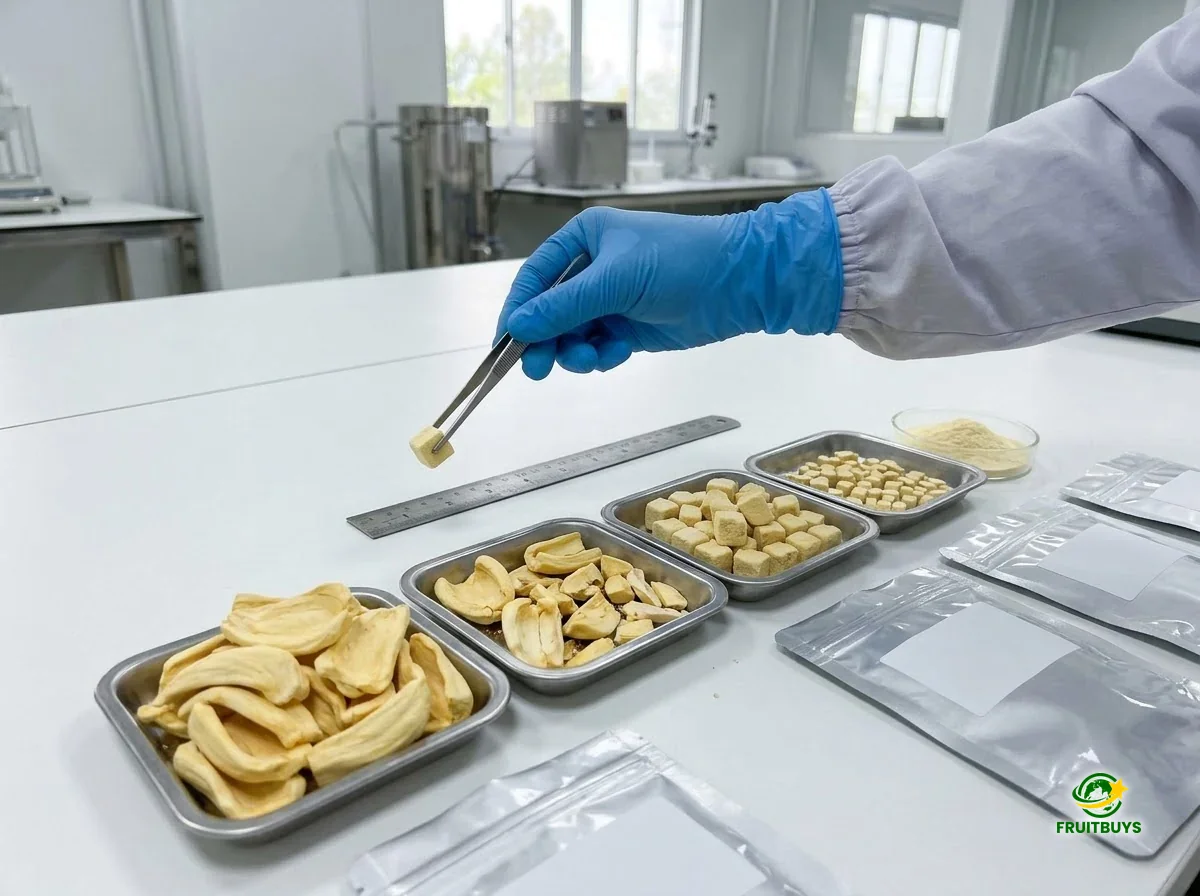
Custom cuts for a specific R&D brief are possible; send the target size with your sample request.
Will freeze-dried jackfruit stay crunchy in your formulation?
It stays crunchy only if the product around it is about as dry as the fruit. In a mixed food, water moves from the component with higher water activity to the one with lower water activity until both are equal. Jackfruit at aw 0.18–0.25 will always be the driest component, so it will take water from anything wetter.
| Application | Surrounding base | How jackfruit behaves | Formulation action |
|---|---|---|---|
| Breakfast cereal, granola | Very dry (aw <0.30) | Stays crisp through shelf life in barrier pouches | Use 10 mm dice; seal with a silica gel desiccant sachet; keep the packing area at or below 40% RH |
| Chocolate and confectionery | Fat-continuous, no free water | Excellent crunch; fat shields the fruit | Ideal for dice and pieces; keep chocolate mass below 35 °C when blending in |
| Nut and seed trail mixes | Variable (aw 0.30–0.50) | Draws moisture from under-dried nuts and softens | Measure the aw of every nut and seed; bring the whole mix below 0.35 |
| Energy and cereal bars | Moist binder (aw 0.45–0.65) | Absorbs binder water within 48–72 hours: the fruit turns leathery and the syrup binder turns hard and brittle | Spray dice with a cocoa butter or vegetable fat barrier, lower binder aw to 0.35–0.38 with glycerin or polyols, or accept a chewy texture |
| Yogurt, oatmeal, desserts | Wet (aw >0.85) | Rehydrates into soft pulp in 3–5 minutes | Pack in a split-top lid or separate sachet; add at consumption |
| Bread and cookies | Wet dough plus oven heat | Surface pieces scorch; inside pieces turn soggy | Add after baking as a topping, or use powder in fillings |
| Dry beverage blends | Dry powder | Pieces float and rehydrate unevenly | Use 80–100 mesh powder |
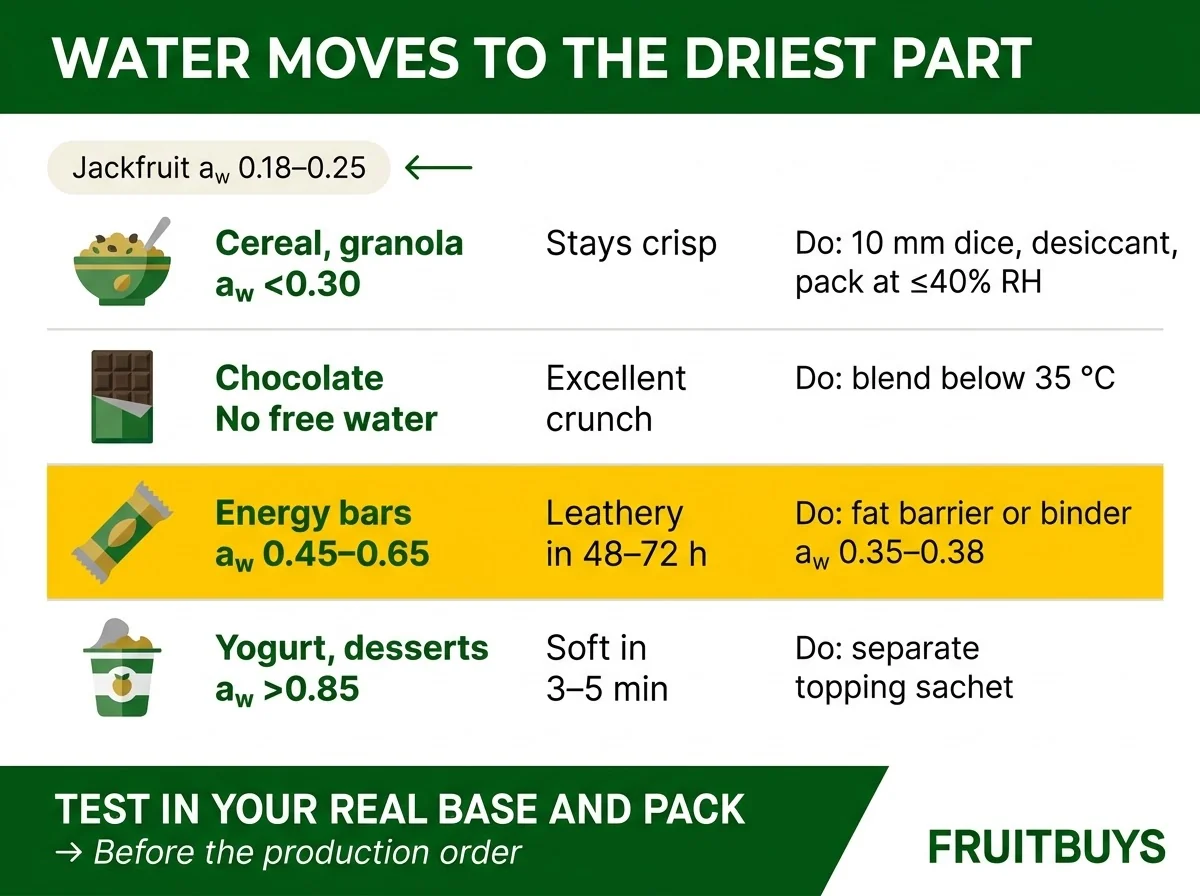
The bar case costs manufacturers most. The fruit and the binder both fail at the same time, and it shows only after the product has left the plant.
What this means for you: before a production order, run a shelf test with the fruit inside your real base and pack, for at least the first weeks of shelf life. Ask for the sample in the exact cut you plan to use.
How much breakage should you expect, and how do you control it?
Freeze-dried fruit is porous and brittle. Every step adds wear: container handling at sea, carton tipping at your plant, hoppers and auger feeders.
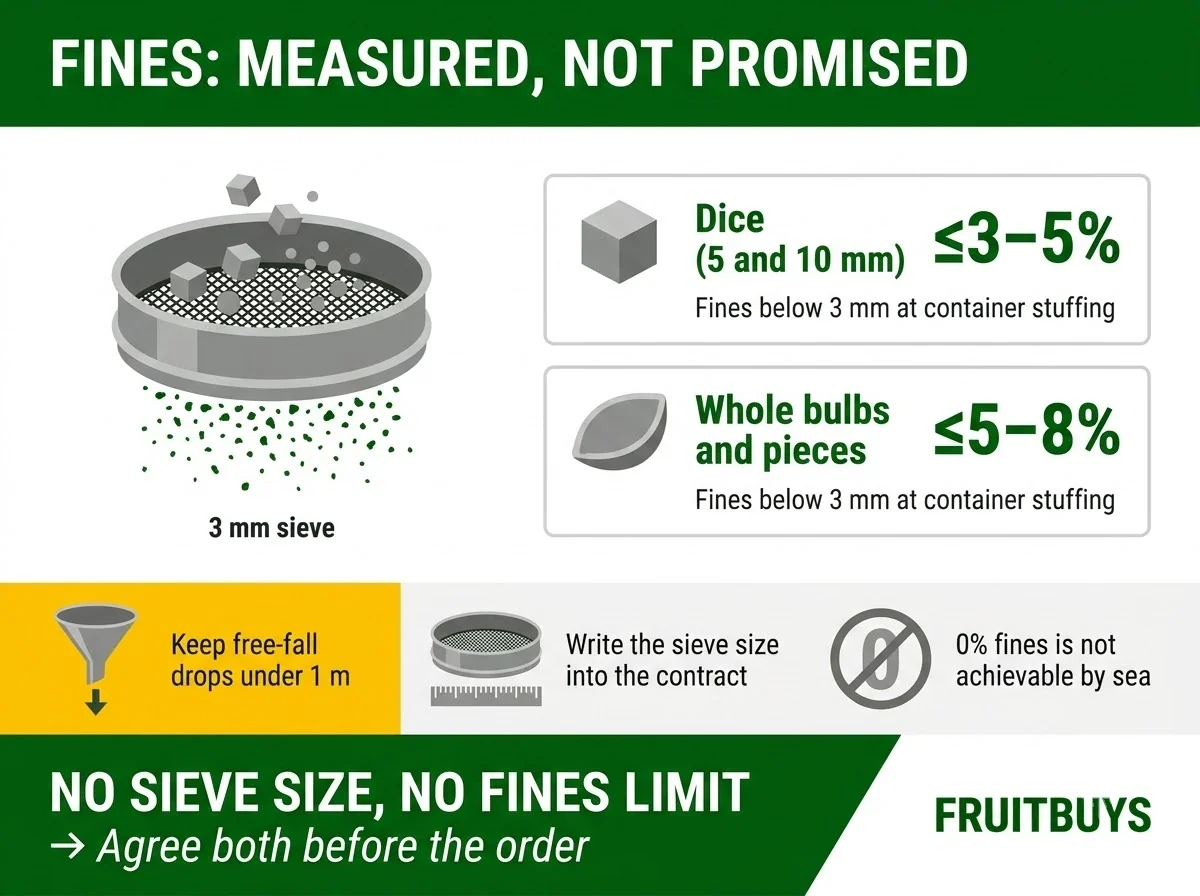
FruitBuys measures release fines with a standard 3 mm sieve:
- Pre-cut dice (5 mm and 10 mm): fines below 3 mm are held at ≤3–5% at container stuffing.
- Whole bulbs and large pieces: fines below 3 mm are held at ≤5–8%, which allows for transit vibration.
The zero-fines myth. A 0% fines demand is not achievable for freeze-dried fruit shipped across an ocean. A supplier who promises it either adds 20–30% to the price to pay for repeated manual screening, or does not measure. The opposite risk is just as real. A contract without a sieve size can deliver a carton with 15% crumbs at the bottom.
On your own line: keep free-fall drops short. Dropping freeze-dried jackfruit dice more than about 1 metre into a filling funnel can double the fines in your finished packs. Carton fill weight matters too; see how bulk freeze-dried jackfruit is packed and loaded.
When should you switch to freeze-dried jackfruit powder?
Switch when the fruit has to disperse rather than be seen. Typical uses:
- instant drinks and smoothie mixes;
- dairy and frozen desserts;
- bakery creams and fillings;
- sweet seasonings and confectionery blends.
Powder also solves the moisture problem in wet recipes, because it is meant to dissolve.
Pure jackfruit powder is high in natural sugar, so it cakes quickly if it is exposed. Specify:
- 60–80 mesh as standard, 80–100 mesh for beverages;
- moisture ≤4.0%, water activity ≤0.30;
- 4 × 5 kg barrier bags with desiccant per 20 kg carton.
Handle opened bags as a single-use batch. What to lock into a powder specification is covered in what to specify before buying freeze-dried jackfruit powder; the full data sheet is on the freeze-dried jackfruit powder page.
Does freeze-dried jackfruit carry latex residue or off-flavours?
Not when the fruit is trimmed properly. Fresh jackfruit carries a sticky white latex in the rind, the central core and the rags between bulbs. Careless separation smears that latex onto the bulbs.
At FruitBuys, bulbs are separated cleanly from the core and rags. Latex does not dissolve in water, so it is stripped dry at the core before the bulbs get a quick sanitizing rinse and immediate surface drying ahead of tray freezing.
This matters more for freeze-dried fruit than for any other format. Air-drying and frying use heat that can mask poor trimming; freeze-drying does not.
A simple R&D check: a properly handled sample melts cleanly on the tongue, sweet, with no film. If a sample leaves an astringent, sticky or gummy film, the raw fruit was poorly trimmed. That applies to any supplier’s sample, including ours.
The aroma itself is clear and tropical. It is part of the appeal, but it can dominate a mild recipe, so start trials at a low inclusion rate.
When is freeze-dried jackfruit the wrong ingredient?
- The fruit sits in a moist base for its whole shelf life and neither a fat barrier nor a lower-aw binder is an option. Soft-dried fruit holds its chew there; FruitBuys supplies unsweetened soft-dried jackfruit on request.
- You need a neutral flavour. Jackfruit’s aroma is distinctive.
- You need a savoury, meat-like texture. That is young jackfruit, a different product; FruitBuys supplies young jackfruit for savoury and plant-based lines as a custom project order.
For supplier selection and how freeze-dried compares with air-dried and chips, see the freeze-dried jackfruit buyer guide. Release limits for moisture, water activity and microbiology are in what moisture and water activity freeze-dried jackfruit should have.
Request a trial sample in your cut
Tell us your application, base, target cut and line conditions. We will send a sample in that exact format, with its fines result, so your trial reflects what production will deliver.
Email [email protected] · WhatsApp Export +84 919 739 589
FAQ
What dice sizes are available for freeze-dried jackfruit?
Small dice of 5 × 5 × 5 mm or 6 × 6 × 6 mm, and medium dice of 10 × 10 × 10 mm, cut before freezing. Custom cuts are possible on request.
What fines level is normal for freeze-dried jackfruit?
Through a 3 mm sieve: up to 3–5% for dice and up to 5–8% for whole bulbs and pieces at container stuffing.
Can I use freeze-dried jackfruit in cereal bars?
Yes, with a fat barrier on the fruit or a binder below aw 0.35–0.38. Otherwise the fruit absorbs binder moisture within 48–72 hours.
Can I put freeze-dried jackfruit in yogurt?
Only as a separate topping. Mixed into yogurt, it softens within 3–5 minutes.
What mesh size is freeze-dried jackfruit powder?
60–80 mesh as standard and 80–100 mesh for beverages, 100% jackfruit, at 4.0% moisture or less.
Why does my sample feel gummy?
Poorly trimmed fruit carries latex from the core and rags. Properly prepared freeze-dried jackfruit melts cleanly without a film.
About the author. Udo Nguyen is CEO of FruitBuys Vietnam. He coordinates freeze-dried fruit sourcing, qualified partner facilities and export documentation for importers, food manufacturers and private-label brands.