How Do I Buy Freeze-Dried Durian Powder Without Clumping, the Wrong Mesh or the Wrong Duty?
Freeze-dried durian powder is durian flesh (Durio zibethinus) that has been frozen, dried under vacuum and milled to a fine powder. Buy it on four lines of the purchase order: the mesh, the composition, the water activity of the finished powder and the pack it ships in. A fifth line, the customs code, decides what you pay at the border.
Beverage, dairy, bakery and premix buyers choose powder because durian then dissolves or disperses instead of sitting in the product as pieces. It is also the most moisture-sensitive format in the range, and it is classified and taxed differently from pieces. This page is the hub for powder: it answers the buying questions and points to the guide that covers each check in depth.
Does freeze-dried durian powder clump, and why?
Yes, when it takes up moisture, and durian powder takes it up faster than most. Milling turns a few large pieces into millions of small particles, so the surface that meets humid air is many times larger than in the same weight of pieces. Durian flesh is also fatty, at roughly 9–15 g per 100 g of dried product, so once a little water is absorbed the particles turn tacky and bind together.
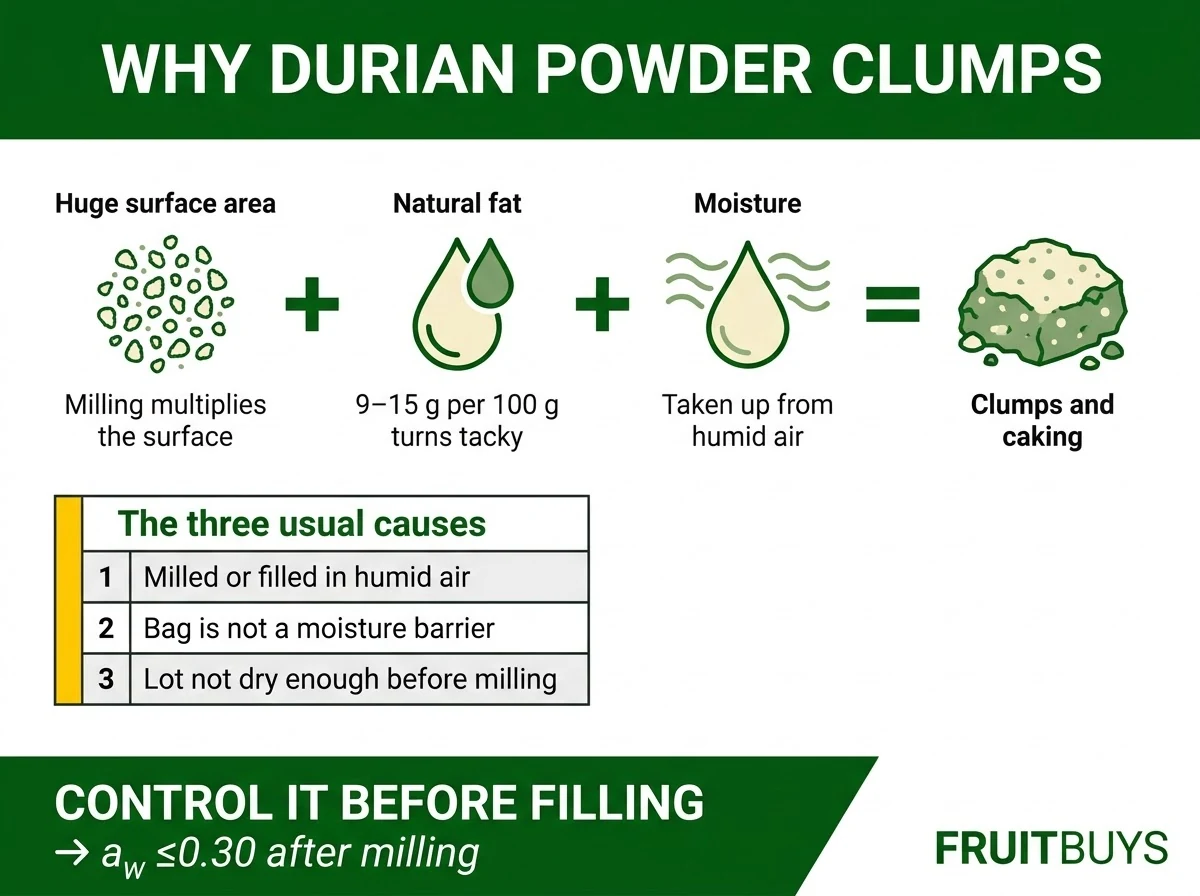
For a buyer this appears as a block in the bag, lumps in the hopper and uneven dosing. A powder that clumps in a dosing line costs production time before it costs product. The cause is nearly always one of three: the powder was milled or filled in humid air, the bag was not a true moisture barrier, or the lot was not dry enough before milling. The moisture and water-activity limits that protect pieces apply to powder as the starting point, and they are explained in why freeze-dried durian turns soft.
Which mesh should I order?
Order the coarsest powder your process accepts, because the finer the powder, the sooner it clumps.
| Application | Mesh | Why |
|---|---|---|
| Bakery filling, mooncake, dry premix, ice cream ribbon | 60–80 mesh (250–177 µm) | Flows better, clumps less, still disperses in a wet or fatty base |
| Ice cream and yogurt base | 80 mesh (177 µm) | Disperses in cold milk without a gritty feel |
| Beverage, smoothie, instant drink | 100–120 mesh (149–125 µm) | Dissolves and colours faster, needs the tightest pack |
For a first order, start at 80 mesh and move finer only if a trial shows grit in the finished product. Ask for the sieve result of the lot, not only the mesh named on the bag, and test the powder in your own recipe before you commit to a larger volume.
What should the powder specification say?
Write these lines into the purchase order, and have the supplier confirm each one on the certificate of analysis for the powder lot itself.
| Line | What to specify | Why it matters to you |
|---|---|---|
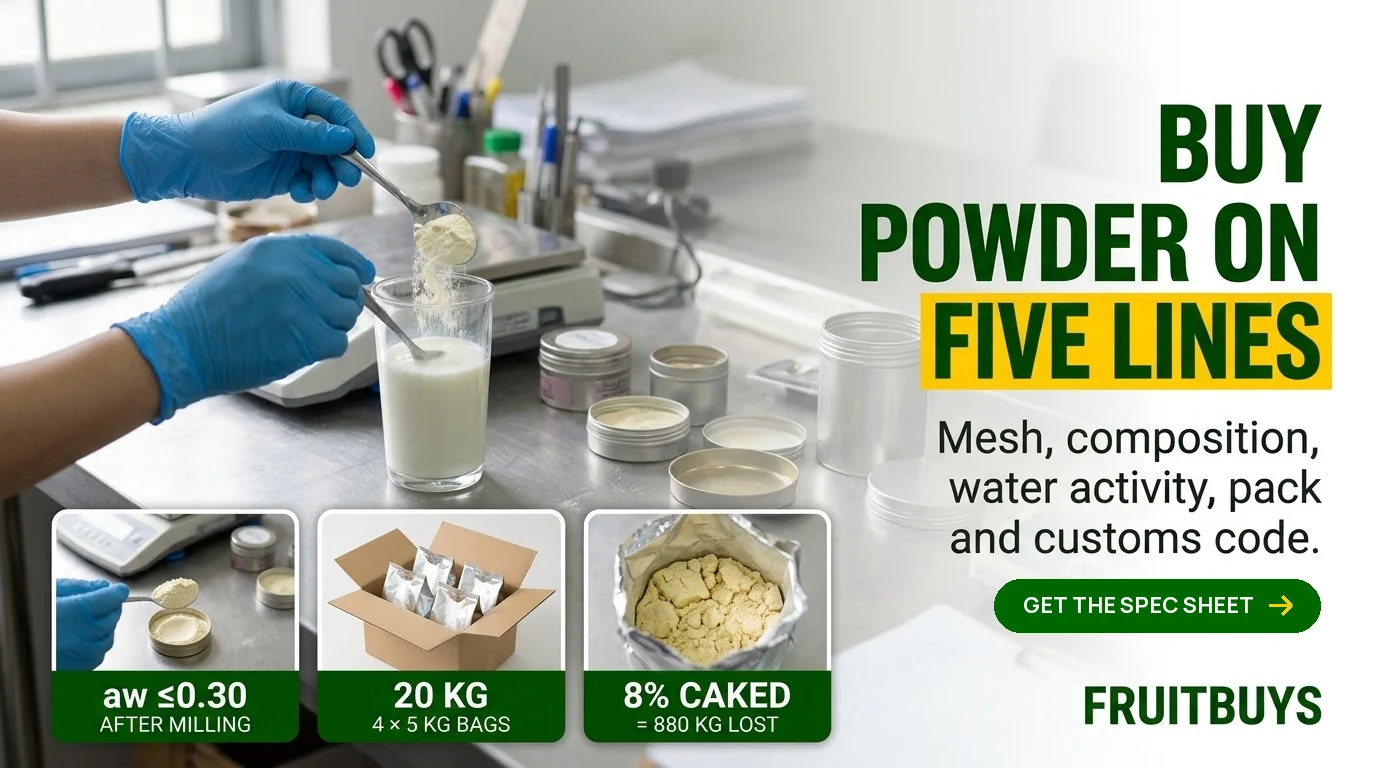
| Water activity | ≤0.30 at 25 °C, measured after milling and before filling. In FruitBuys powder production the result is typically 0.15–0.28 | A lot that passed as pieces can fail as powder if milling took place in damp air |
| Moisture | Loss on drying of 5% or less. Typical moisture in FruitBuys powder production is 3.2–4.5% | Moisture alone does not release a lot; it is read together with water activity |
| Particle size | For 80 mesh, at least 95% of the powder passes an 80-mesh sieve (177 µm) | The mesh named on a bag means little without the share that passes |
| Composition | 100% durian, or the named additive and its percentage | It decides your label, your clean-label claim and, in some markets, your customs code |
| Packing | Inner barrier bags, bags per carton and net weight per carton | The bag is the only protection between the plant and your warehouse |
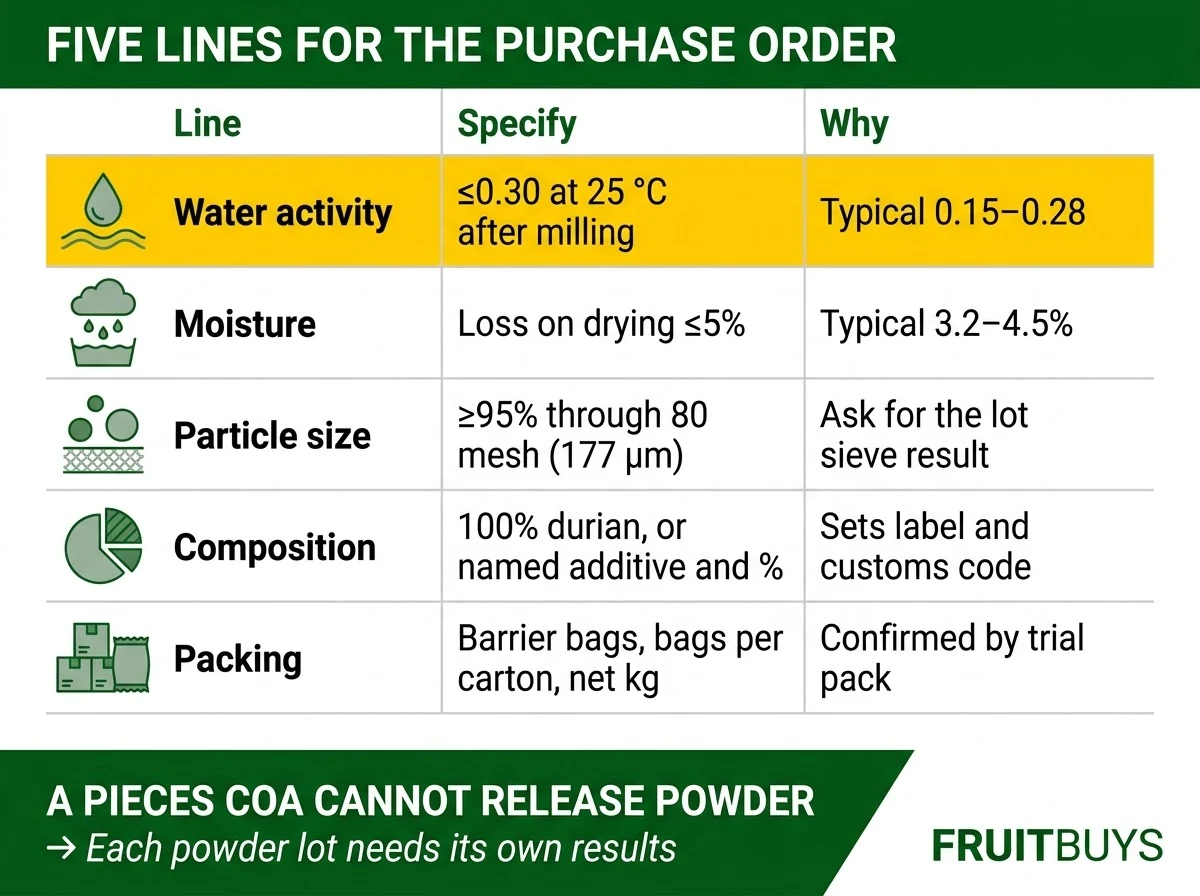
A certificate for pieces cannot release a lot of powder, or the reverse. Powder is a separate product with its own test results and should be qualified as one, using the sample-to-bulk logic in how to qualify a freeze-dried durian lot. The typical figures above are what FruitBuys sees in production, not guaranteed values: each lot is released on its own certificate.
Should the powder be 100% durian or carry an anti-caking agent?
Choose pure when your label or customer requires one ingredient, and accept that the water-activity limit and the bag then do all the work. Choose a permitted anti-caking agent, named in the specification with its percentage, when flow matters more than a short ingredient list.
The usual agent is silicon dioxide (E551). The legal ceiling is 10,000 mg/kg (1%) for foods in dried powdered form in the European Union, and 2% by weight in the United States under 21 CFR 172.480. A working dose is normally well below the ceiling and is set by a flow test on the actual powder, not by a rule. FruitBuys supplies powder as 100% durian by default, with a grade containing silicon dioxide up to 1% available on request.
The trade-off is plain. Pure powder has a one-word ingredient list and the strongest flavour per gram, with no margin for humidity. A grade with a flow agent is easier to handle, but it is no longer “100% durian” and the additive must be declared on the label of your finished product. Some powders on the market also carry maltodextrin or other carriers to make drying possible; those are not the same product, and price comparisons mean nothing until the composition line matches. Put the composition into the specification and the lot certificate, and treat any difference as a rejection reason.
What is the carton, and how much fits in a container?
FruitBuys packs powder at 20 kg net per carton, in four sealed bags of 5 kg each, in a 58 × 28 × 34 cm five-ply carton. Four smaller bags mean that opening one bag exposes only 5 kg to room air, which matters more for powder than for pieces.
For 80 mesh powder that is 20 kg in a 55.2 litre carton, a packed density of about 0.36 g/cm³ or more. A finer or fluffier grade can fill the carton before it reaches 20 kg, so for any other mesh ask for the trial-pack weight before you plan the container. A 20 ft container carries 550 cartons, which is 11,000 kg at 20 kg per carton, and the freight per kilogram is the container rate divided by that figure. By air, the carton’s volumetric weight is 9.2 kg against 20 kg actual, so air freight is charged on actual weight. The container and pack planning that applies to every format is in freeze-dried durian packaging and shelf life.
There is no fixed minimum order quantity for powder, and quantities are quoted per order. For a first order, a single pallet or less is enough to test flow and dissolving in your own line before you commit to a container.
Why is powder classified and taxed differently from pieces?
Because customs treats powder of fruit as a different product from dried fruit. Freeze-dried durian pieces go under heading 0813.40, and in the United States the general duty is 2.5%. Powder and flour made from Chapter 8 fruit go under heading 1106.30. A US Customs and Border Protection ruling on a freeze-dried, milled fruit powder (N360833, May 2026) made this point: the Chapter 8 notes exclude fruit powder, and heading 1106 covers it, at a general rate of 9.6% for the subheading assigned there.
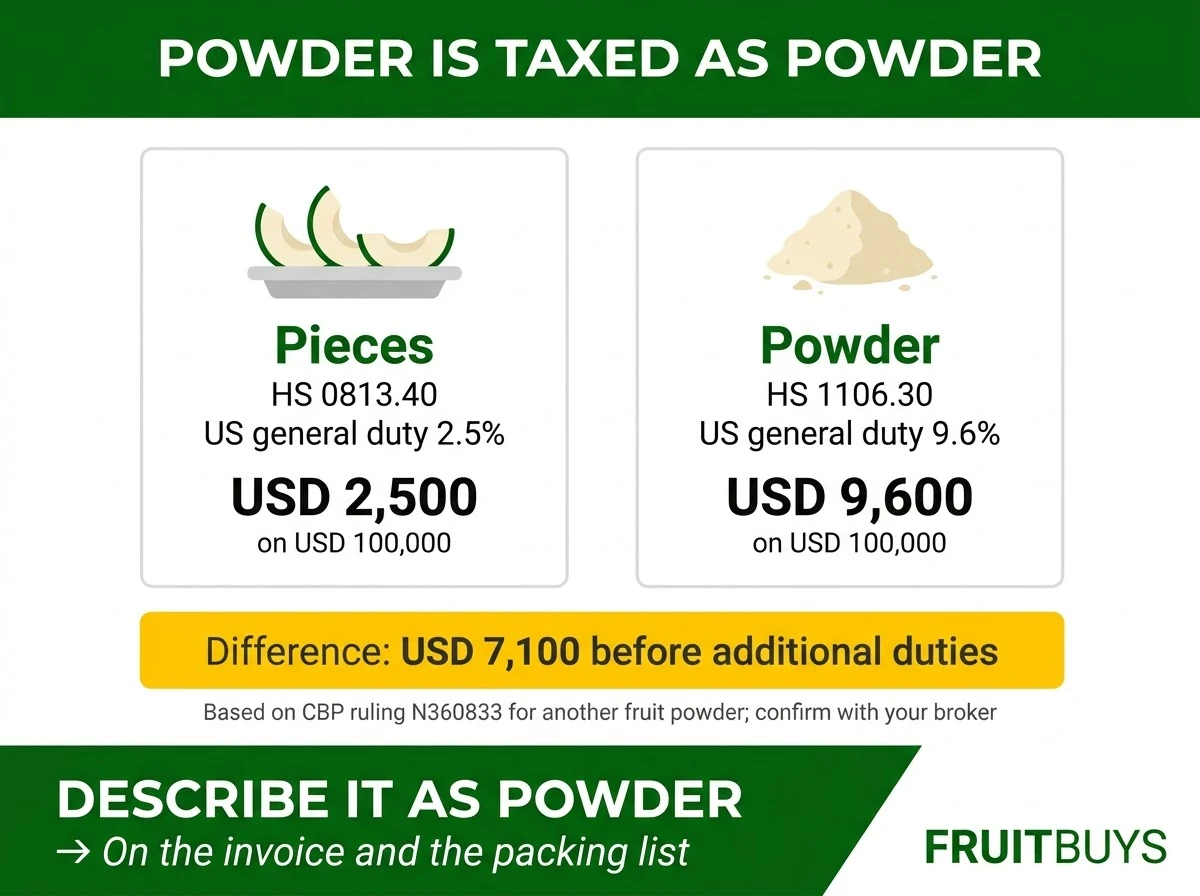
On USD 100,000 of declared value that is about USD 9,600 for powder against USD 2,500 for pieces, a difference of USD 7,100 before any additional duties in force. The ruling concerned another fruit, so it shows how CBP reasons rather than how it will rule on durian. Ask your customs broker to confirm the subheading and rate for your destination before the price is agreed, and describe the goods as powder on the invoice and packing list. The full document set is in freeze-dried durian export documents.
What does it cost if the powder arrives caked?
The loss is the weight of the lot multiplied by the share that cannot be used. Take a full 20 ft container of 11,000 kg: if 8% is caked beyond use, the loss is 11,000 × 0.08 = 880 kg of powder, plus the line time spent finding out. The same 8% on a 500 kg trial lot is 40 kg, which is why the first order of a powder should be small.
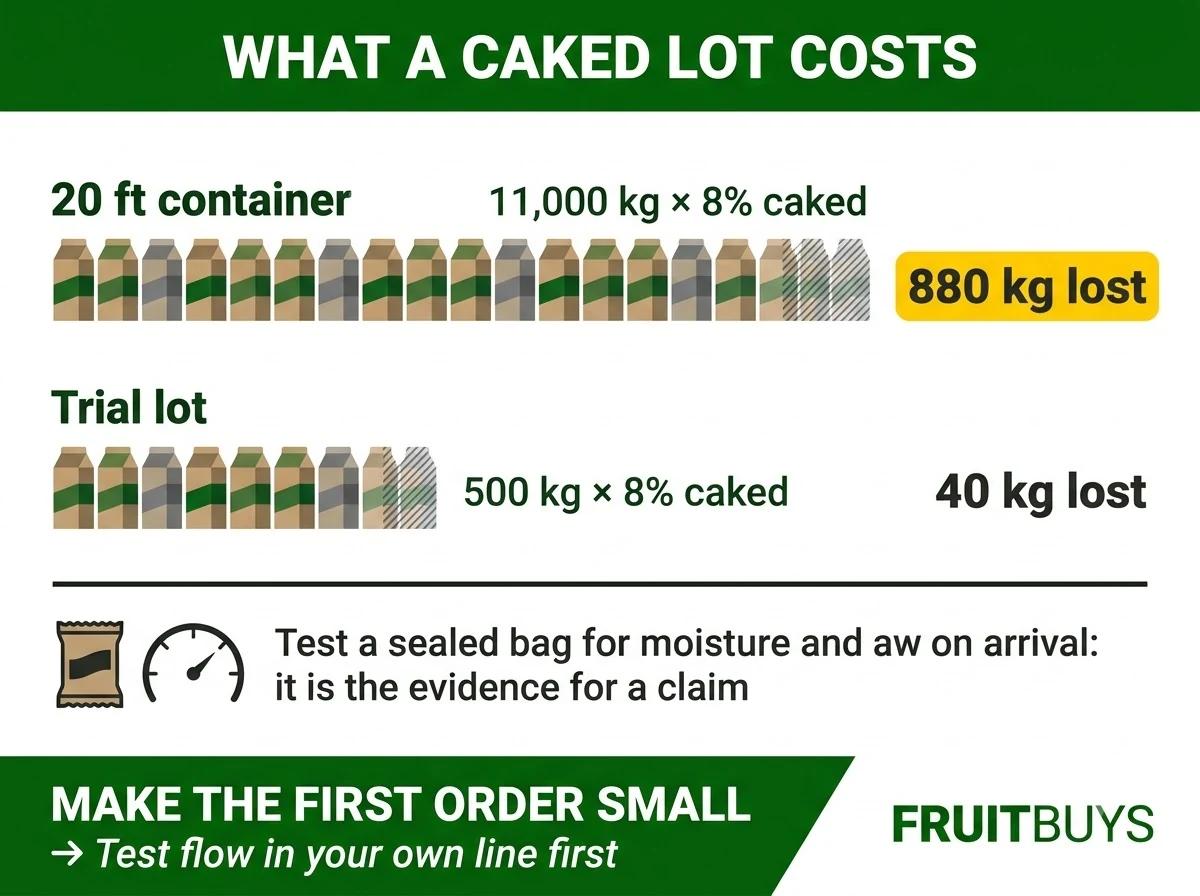
A sealed-bag sample tested for moisture and water activity on arrival is the evidence for a claim. Without that test there is no objective basis for returning a lot.
What should I ask the supplier for?
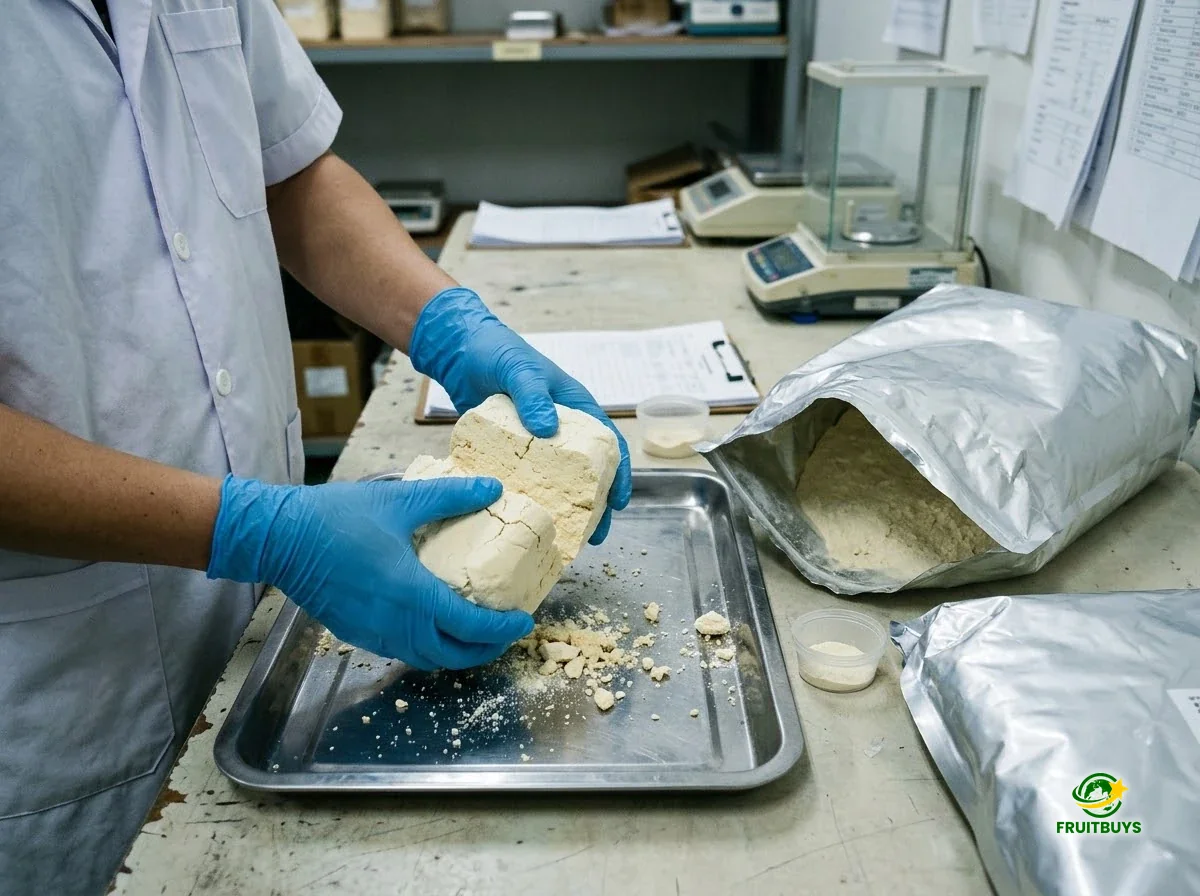
- A certificate for the powder lot itself, with moisture and water activity measured after milling and filling. A certificate for pieces cannot release a powder lot, as set out in sample-to-bulk consistency.
- The mesh range and the sieve result for the lot.
- A written composition: durian only, or the named additive and its percentage.
- The bag structure, the bags per carton and the net weight per carton, confirmed by a trial pack.
- Microbiology, cadmium and lead, pesticide residues and Auramine O for the powder lot, on the same panel as for pieces. Milling does not add contaminants, but limits are applied to fresh-equivalent weight, as explained in cadmium and Auramine O in Vietnamese durian.
- A sample of the cultivar and drying cycle you will receive in bulk, since both change the durian character left in the powder.
Where powder does not fit
Powder is the wrong choice when the durian must be seen or chewed, as in a snack, a chocolate inclusion or a topping: pieces or granules do that job, and cubes, bites, slices or powder compares the formats. It is weaker than frozen pulp when durian has to dominate a base such as ice cream and you already run a frozen chain. And it is the wrong first order for a buyer who has not yet tested it in the real production line.
Related guides and the product page
- Freeze-dried durian buyer checklist: the full qualification sequence for any format.
- Moisture and water activity: the limits that stop a powder from clumping.
- Sample-to-bulk consistency: how to approve a powder lot against a sample.
- Formats: cubes, bites, slices, granules or powder for your application.
- Export documents: HS code, labels and the lot document set.
- Packaging and shelf life: foil pouches, vacuum and desiccant packing, and container planning.
- Cadmium and Auramine O: contaminant tests to require on every lot.
- Freeze-dried durian powder product page: the powder SKU, specification and sample request.
If you are planning a beverage, dairy or bakery product with freeze-dried durian powder, FruitBuys can go through the mesh, composition and packing lines with you before the order is placed. Discuss your freeze-dried durian powder requirements.
Frequently asked questions
Is freeze-dried durian powder the same as spray-dried powder?
No. Spray drying removes far more aroma and usually needs a carrier such as maltodextrin. Freeze-dried powder is made from the dried flesh and can be 100% durian. Compare the composition line before you compare anything else.
What mesh size should I order?
For a first order, 80 mesh. Use 60–80 mesh for bakery and dry premixes, and 100–120 mesh for drinks. Test the powder in your own recipe before scaling up.
Can I use the certificate for pieces on a powder lot?
No. Powder needs its own moisture and water activity results, measured after milling.
Is the duty the same as for pieces?
Not in the United States, and possibly not elsewhere. Powder of fruit is classified under 1106.30 and pieces under 0813.40. Confirm the code and rate with your broker.
Is there a minimum order for powder?
There is no fixed minimum. Start with a trial quantity and move to a container once the powder works in your line.