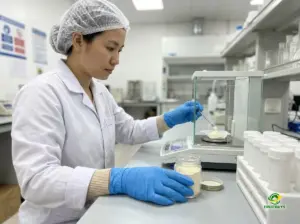
Is There Cadmium in Vietnamese Durian?
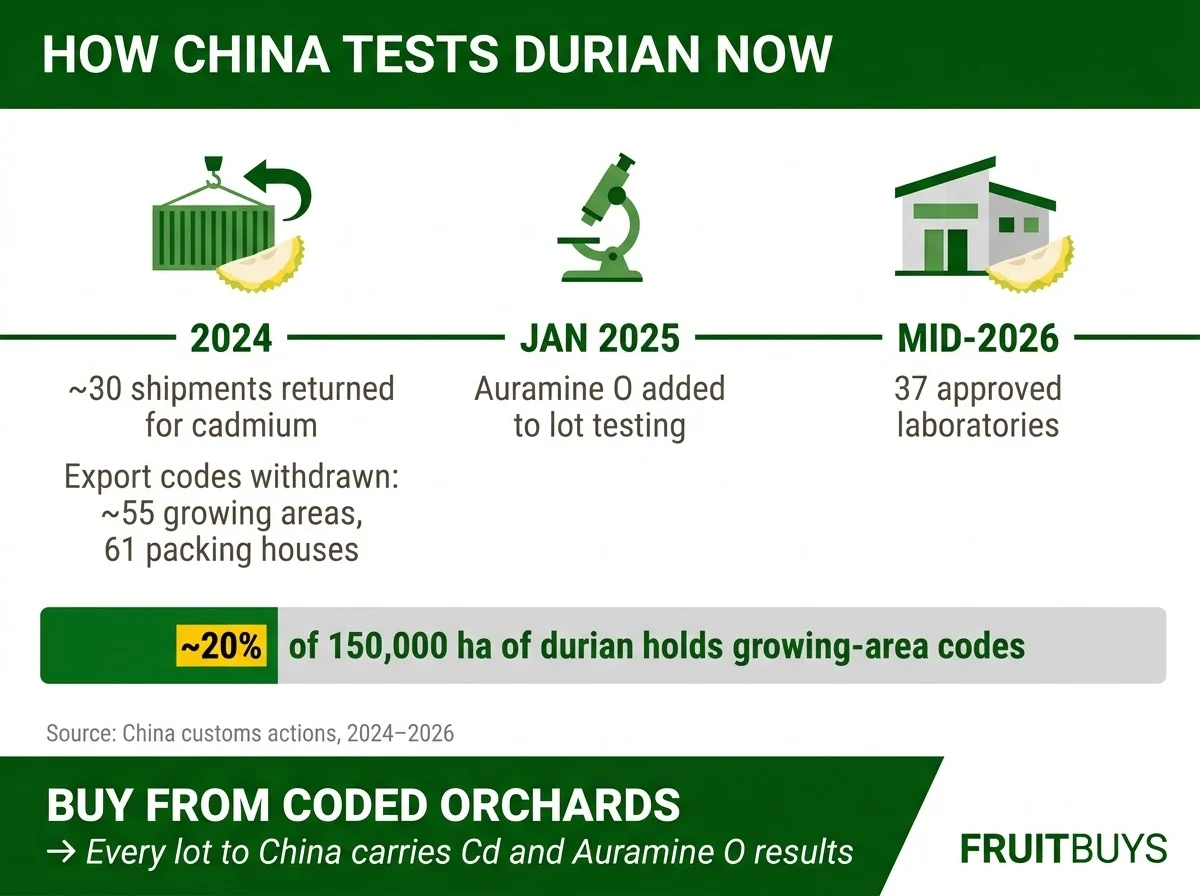
Some Vietnamese durian has exceeded cadmium limits, and the trade has been rebuilt around testing because of it. Cadmium is a heavy metal that durian trees take up from soil, water and fertiliser. In 2024 China returned about 30 shipments of Vietnamese durian over cadmium and withdrew the export codes of roughly 55 growing areas and 61 packing houses. Since the start of 2025, virtually every lot of durian entering China from Vietnam and Thailand must carry laboratory results for both cadmium and Auramine O, a banned industrial yellow dye.
For a buyer of freeze-dried durian, the answer is therefore not “Vietnamese durian is unsafe” but “Vietnamese durian is safe to buy when the orchard is known and the lot is tested”. Most fruit passes. The risk sits with lots that cannot be traced to a registered orchard or that arrive without a result for the exact lot.
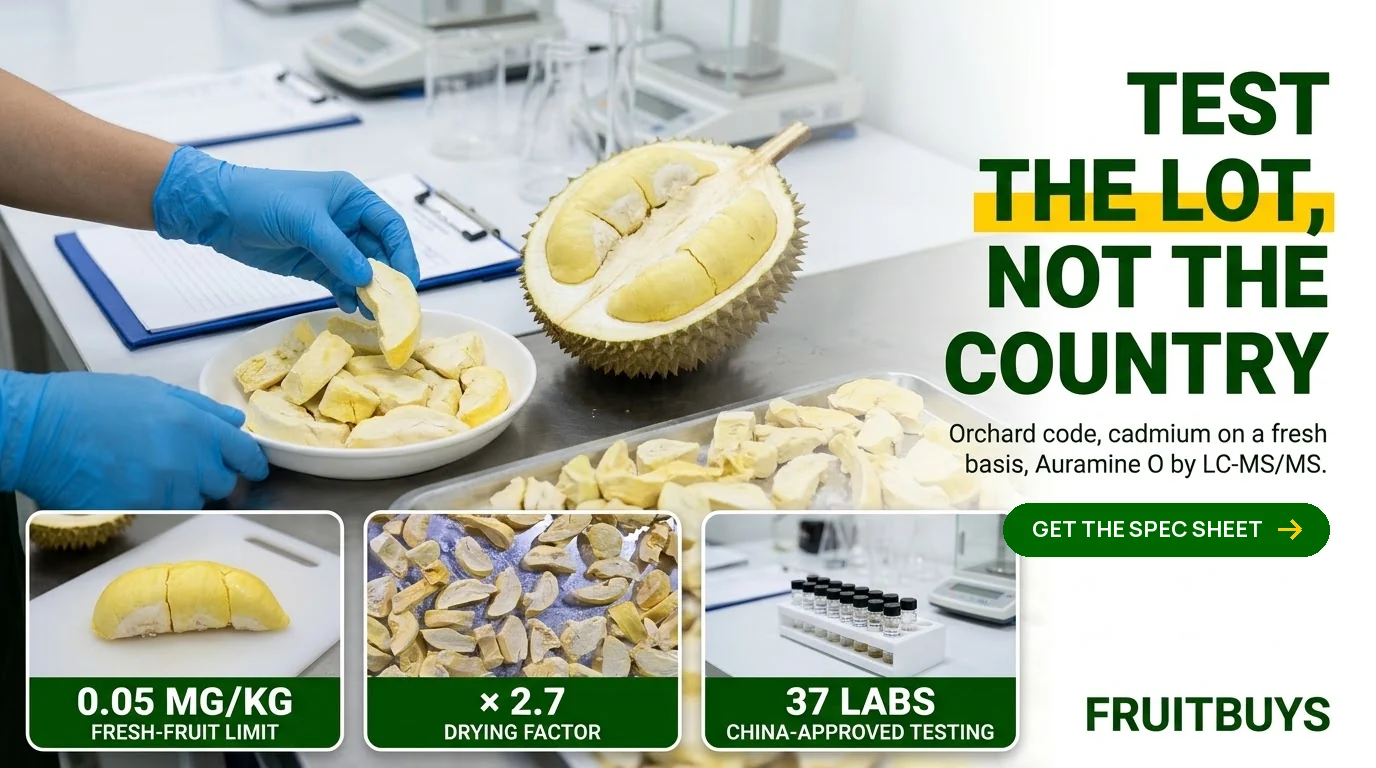
What happened with cadmium and Chinese border testing?
China’s customs authority began finding cadmium above its limit in Vietnamese durian in 2024 and responded with lot-by-lot testing at approved laboratories. Growing areas and packing houses linked to failed lots lost their export codes, and the testing requirement expanded in January 2025 to include Auramine O after the dye was found in Thai durian late in 2024. Thailand faced the same measures: more than 64 tonnes of Thai durian were returned for Auramine O, and exporters and GAP orchards linked to cadmium findings were suspended.
The practical result is a trade that runs on paperwork. By mid-2026, 37 laboratories were approved by Chinese customs to test durian and jackfruit for cadmium and Auramine O, and at peak season those laboratories become a bottleneck. Only about 20% of Vietnam’s roughly 150,000 hectares of durian hold the growing-area codes export requires.
These rules apply to fresh durian shipped to China. They matter to a freeze-dried buyer in Europe or the United States for a simple reason: the raw fruit going into your product comes from the same orchards, and a supplier who sources from coded, tested orchards for the Chinese fresh trade has already done most of the work you need.
Where does cadmium in durian come from, and can processing remove it?
It comes from the growing environment, and processing cannot take it out. The main pathways investigated in Vietnam are soil, irrigation water and fertiliser, particularly phosphate fertilisers that carry cadmium as an impurity. Acidic soil makes cadmium more available to the tree; raising soil pH above about 6.5 with lime and supplying zinc, which competes with cadmium for uptake, both reduce what reaches the fruit.
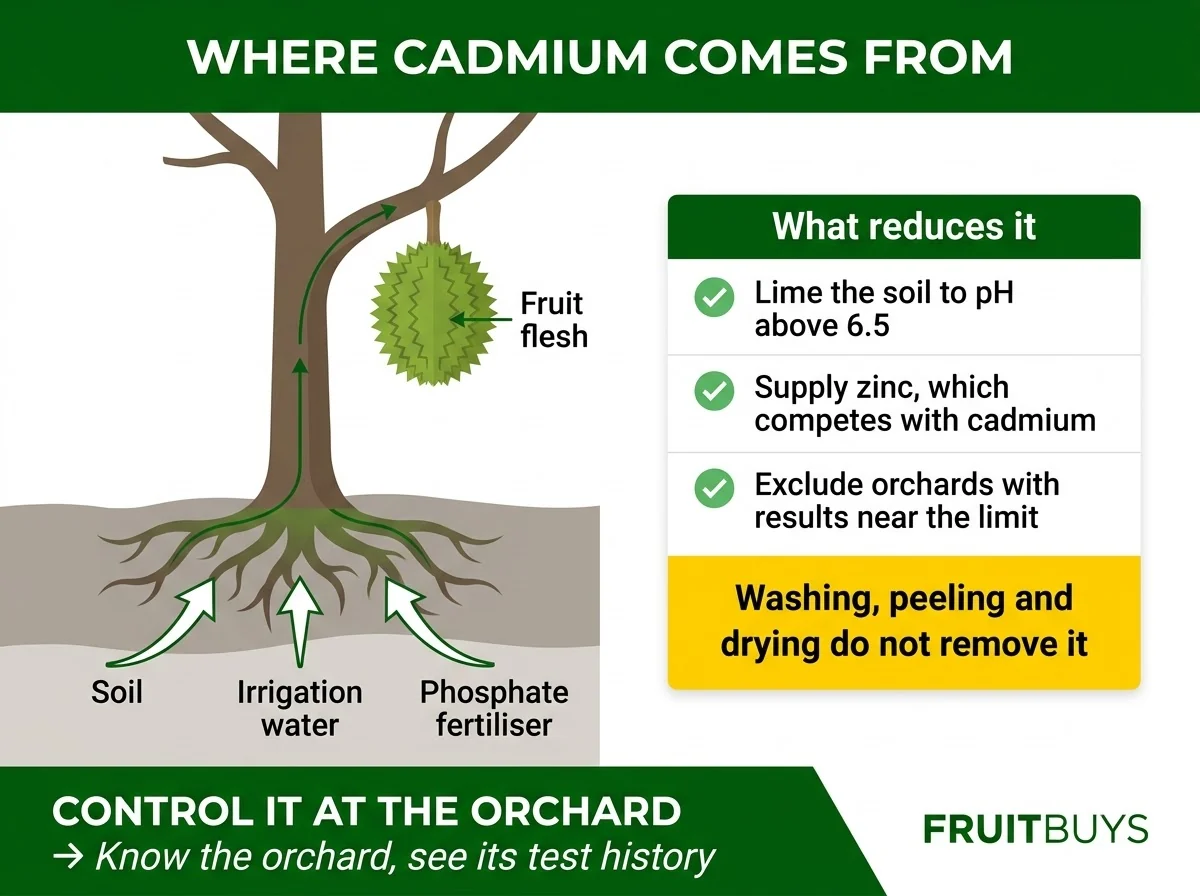
Once cadmium is in the flesh, washing, peeling and drying do not remove it. Control happens at the orchard, and a buyer’s leverage is to know which orchard supplied the fruit and to see its test history. Orchards with a record of results near the limit should be excluded from supply for export products.
Does freeze-drying concentrate cadmium?
Yes, by the same factor that water is removed. Drying takes water out and leaves the cadmium behind, so the concentration per kilogram rises. At about 65% moisture in fresh flesh and 4% in the finished product, each kilogram of freeze-dried durian carries the solids of about 2.7 kg of fresh flesh, and therefore about 2.7 times its cadmium concentration.
The limit for cadmium in fresh fruit is 0.05 mg/kg in both China (GB 2762) and the European Union (the EU contaminant limits regulation). Both systems apply the fresh-fruit limit to dried products through a concentration factor rather than setting a separate number. In the EU, Article 3 of Regulation 2023/915 requires the food business operator to supply that factor when the authority asks for it.
A worked example shows why this matters:
- Fresh flesh tests at 0.04 mg/kg, inside the 0.05 limit.
- The freeze-dried product tests at about 0.11 mg/kg (0.04 × 2.7).
- Divided by the 2.7 factor, the product corresponds to 0.04 mg/kg fresh, and is compliant.
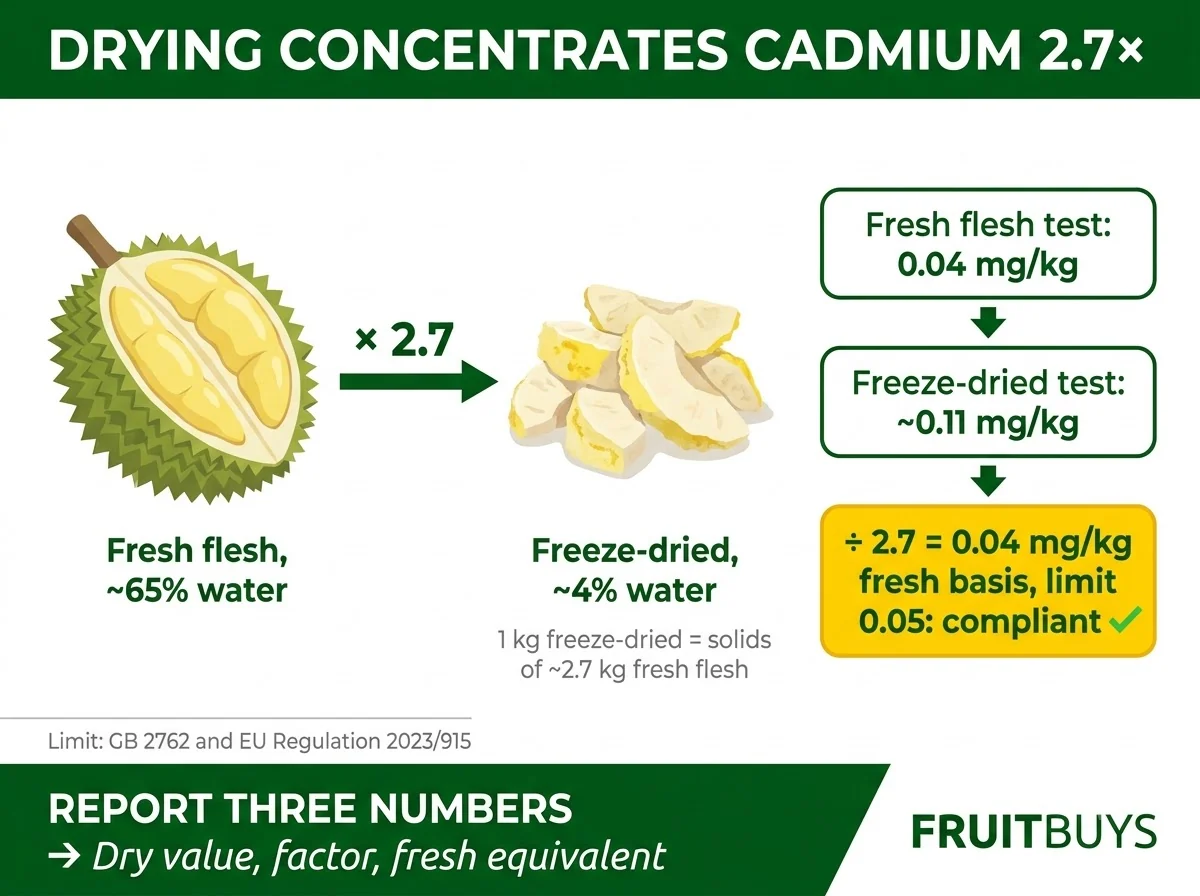
The danger is a laboratory report that shows 0.11 mg/kg with no basis stated. A customer’s QA team, or an authority, reading that figure against the 0.05 fresh-fruit limit will see a result more than twice the limit. Every heavy-metal result on freeze-dried durian should therefore state the dry-product value, the concentration factor used and the fresh-equivalent value.
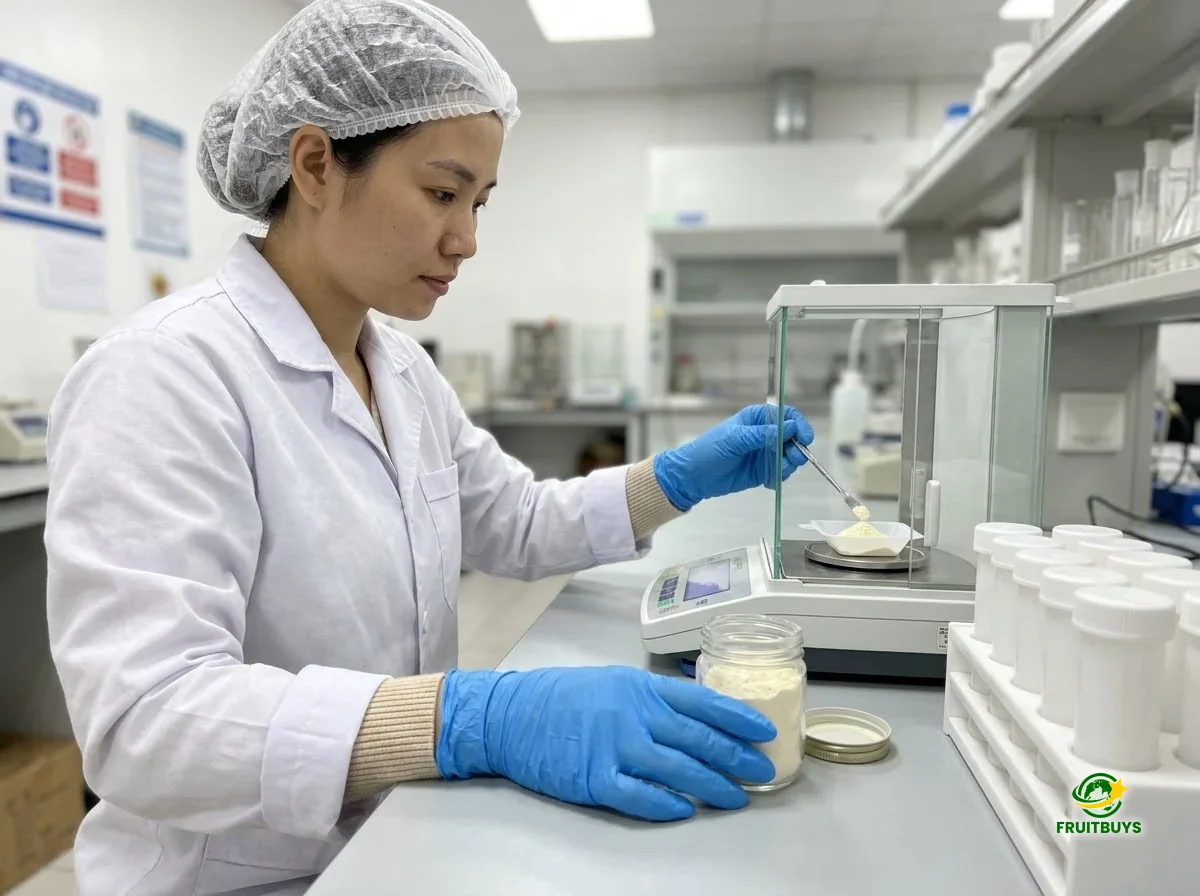
The factor is the fresh-to-dry weight ratio, around 2.7, not the 4–5 kg of flesh used per kilogram of first-grade product. Trimming and broken pieces remove flesh without concentrating anything; only the removal of water does.
What is Auramine O and how do you prove it is absent?
Auramine O (also called Basic Yellow 2) is a synthetic industrial dye, classified by the International Agency for Research on Cancer as possibly carcinogenic to humans (Group 2B). It is not permitted in food in China, the EU, the United States or Japan. It has been found in durian because it gives flesh a brighter, riper yellow colour.
There is no tolerance: any detection is a violation. Proof of absence is a laboratory result for the lot, by LC-MS/MS following the Chinese method BJS 202204, reported as not detected with the limit of detection stated. Rapid test kits are useful for screening incoming fruit, but they do not replace a laboratory result on the COA.
The controls a supplier should be able to show you are simple:
- no colourants of any kind in the preparation area
- fresh fruit bought only from coded orchards, with abnormally bright or staining flesh rejected
- a laboratory Auramine O result for each lot of raw material or finished product
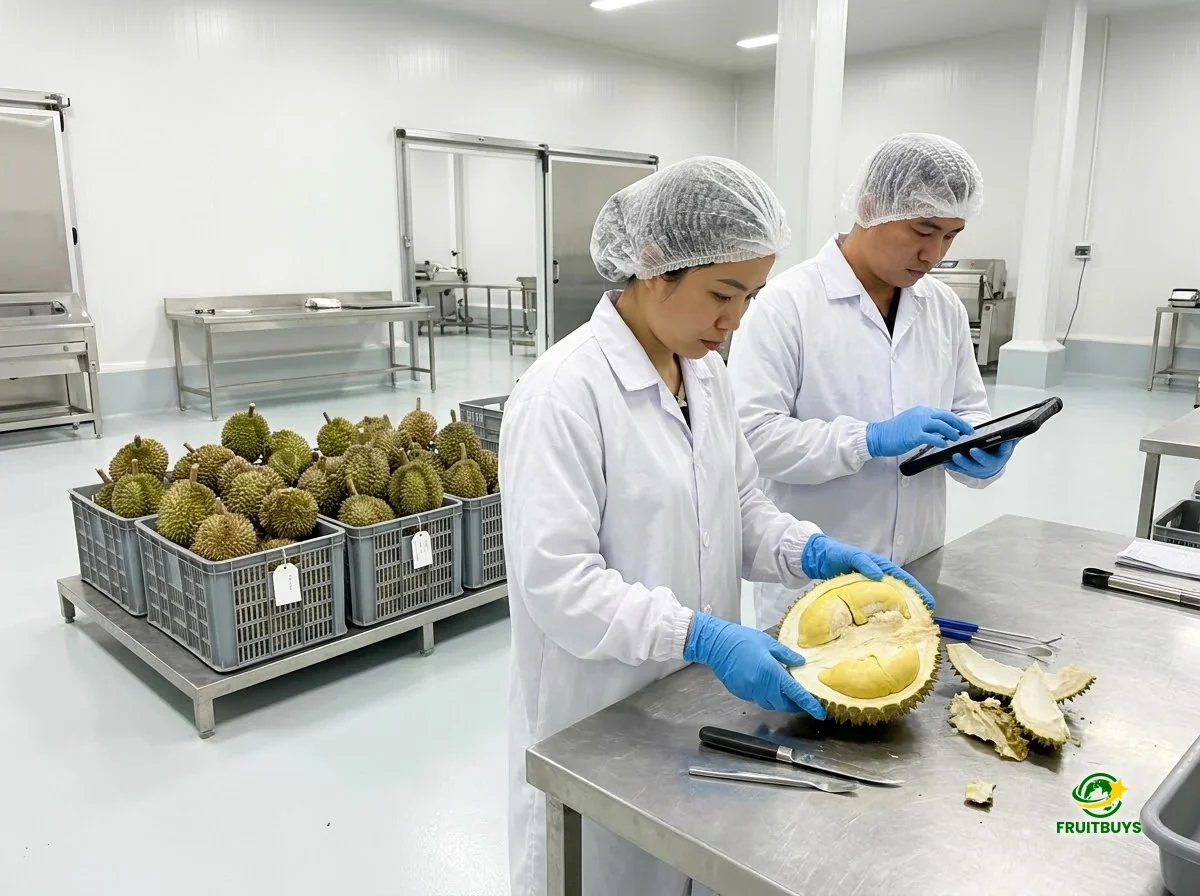
- retained samples of both fresh flesh and finished product for each lot
What should the contract say about cadmium and Auramine O?
Both are market-specific tests, not part of the basic lot COA. For a full container, FruitBuys coordinates them with an ISO/IEC 17025 laboratory in Vietnam before stuffing as part of export release; allow 3–5 working days. Their cost is paid by the buyer or supported by both sides depending on volume. On trial and LCL orders they are arranged at net laboratory cost, credited back in full against the first full container.
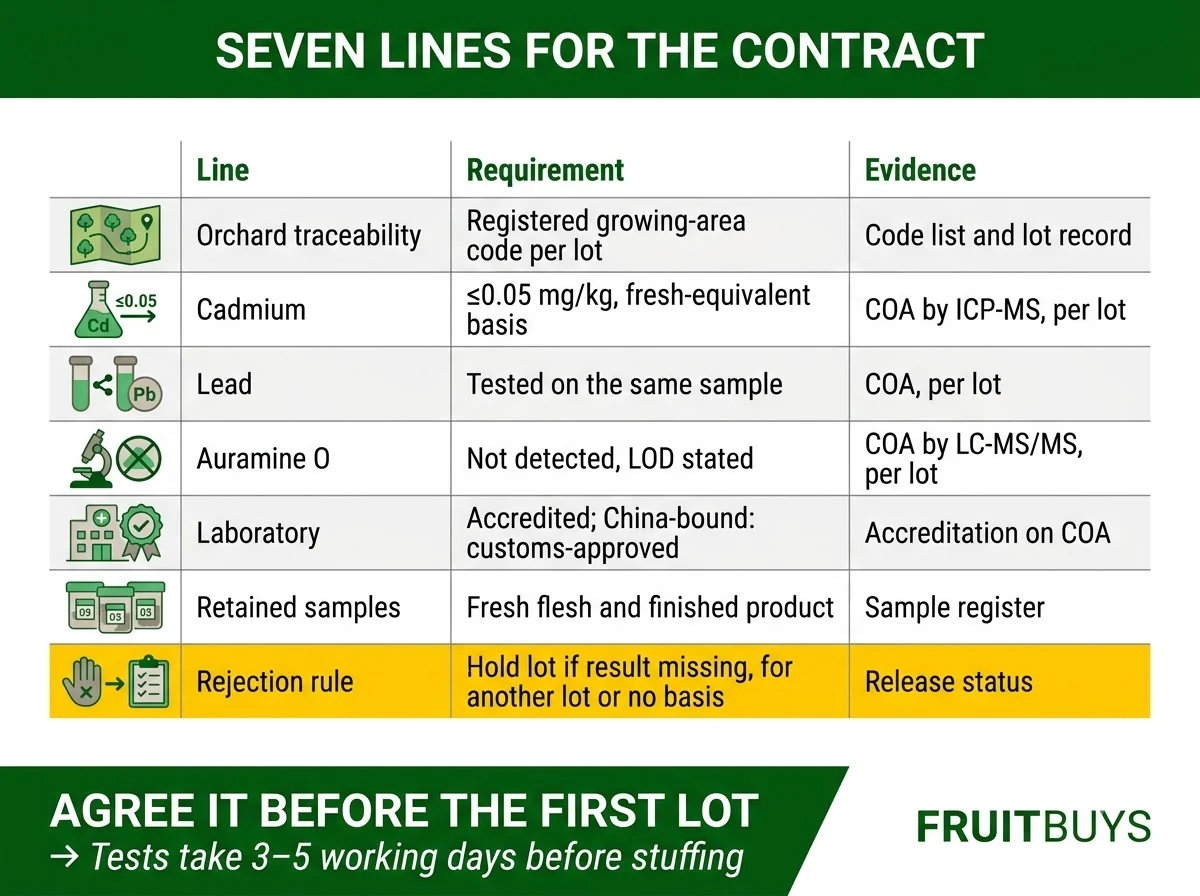
Put both tests in the specification, with basis, method and evidence, so that responsibility is clear before the first shipment.
| Line | Requirement | Evidence |
|---|---|---|
| Orchard traceability | Fruit from registered growing-area codes; code recorded per lot | Code list and lot record |
| Cadmium | ≤0.05 mg/kg on a fresh-equivalent basis; dry value, concentration factor and fresh equivalent all reported | COA by ICP-MS, per lot |
| Lead | Tested alongside cadmium on the same sample | COA, per lot |
| Auramine O | Not detected, limit of detection stated | COA by LC-MS/MS, per lot |
| Laboratory | Accredited laboratory; for China-bound fruit, one approved by Chinese customs | Accreditation named on COA |
| Retained samples | Fresh flesh and finished product kept for each lot | Sample register |
| Rejection rule | Lot is held if either result is missing, is for another lot, or states no basis | Release status |
Pesticide residues and import rules are separate controls, covered in freeze-dried durian export documents. The moisture, water-activity and microbiological lines of the same specification are set out in why freeze-dried durian turns soft.
When should you walk away from a supplier?
When the supplier cannot name the orchard codes behind a lot, or offers a heavy-metal or dye result that belongs to another lot, another product or another season. A low price does not compensate for either gap: one failed lot on a 20 ft container is 5,500 kg of product held, returned or destroyed, and a recall carries your brand’s name, not the supplier’s.
This is one step of a wider supplier check: the full sequence, from format to contaminants to shipment, is in the freeze-dried durian buyer checklist. Powder lots follow the same test panel, with the powder-specific lines in freeze-dried durian powder.
Frequently asked questions
Is freeze-dried durian from Vietnam safe to buy?
Yes, when it comes from registered orchards and each lot carries cadmium and Auramine O results from an accredited laboratory. The failures seen at the Chinese border involved a small share of lots, not the whole supply.
Why is the cadmium figure on my freeze-dried durian COA higher than 0.05 mg/kg?
Because drying concentrates cadmium about 2.7 times. Ask for the fresh-equivalent value and the concentration factor; the product is judged against the fresh-fruit limit through that factor.
Does the EU test freeze-dried durian for cadmium at the border?
The EU’s increased border checks on Vietnamese durian cover fresh fruit and pesticide residues. Cadmium limits still apply to freeze-dried durian on the market, and the importer must be able to show compliance.
Build the test clause into your next order
If you are qualifying a freeze-dried durian supplier, FruitBuys can review your specification with you and set out the traceability and laboratory evidence each lot should carry. Discuss your freeze-dried durian testing requirements.