Should you switch from frozen soursop pulp to freeze-dried?
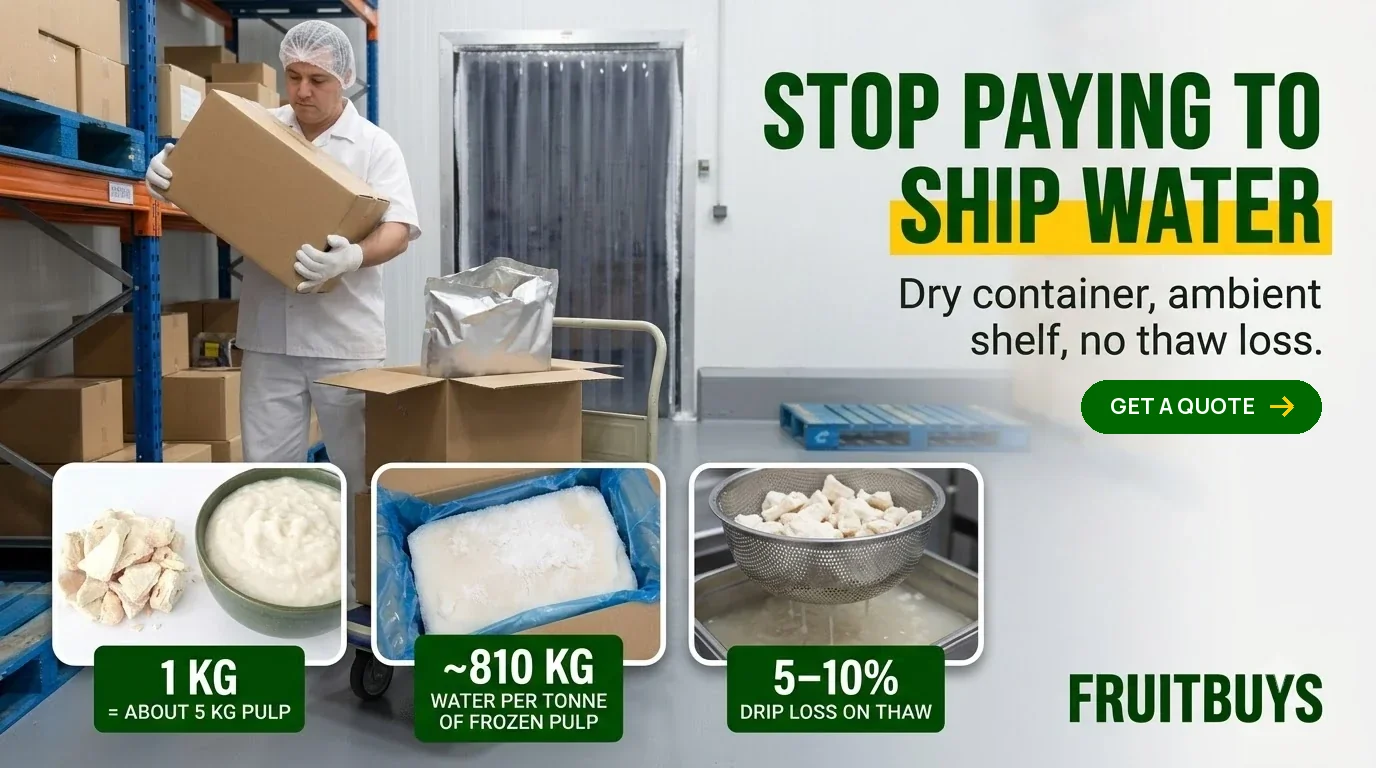
If your soursop goes into dry mixes, drinks made to order, snacks or ice cream, you are probably paying to ship and store water. Frozen guanábana pulp is about 81% water, travels at −18 °C and sits in a freezer until it is thawed. One kilogram of freeze-dried soursop carries the solids of about 5 kg of that pulp, ships in a dry container and stores on an ambient shelf. For a juice plant that runs liquid pulp through a pasteuriser every day, frozen pulp can still be the right buy. For most other lines, the numbers below are worth running before you renew your frozen-pulp contract.
Where does guanábana come from when you buy in the US or EU?
Mostly frozen, because fresh soursop barely travels. The fruit softens within days of harvest, and fresh imports into the US are tightly limited: fresh soursop from Mexico was only approved in 2024, on condition of quarantine irradiation, and moves mainly by air into Miami, with an expected starting volume of around 200 tonnes a year under the APHIS import decision. That leaves most ingredient buyers with frozen pulp in pails or blocks.
Freeze-dried soursop is a processed food. It needs no quarantine irradiation, ships by sea in an ordinary dry container from Vietnam, and keeps 12 months at ≤25 °C and RH ≤60%, or 18–24 months in cool storage at ≤18 °C and RH ≤50%. That changes where you can sell guanábana and how much stock you can hold without a freezer.
What are you actually paying for in a tonne of frozen pulp?
Roughly 810 kg of water, plus the cold chain around it. Every kilogram of frozen pulp has to be frozen at origin, shipped in a reefer, kept at −18 °C at the port, in your warehouse and at your plant, and then thawed before use. Each step costs power and space, and each step is a point where the load can be lost: a reefer that loses power at a transshipment port, or a freezer door left open over a weekend, can write off the whole lot.
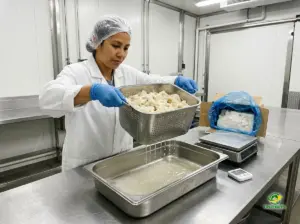
Then comes the thaw. Frozen pulp pieces typically lose 5–10% of their weight as drip when they thaw. In a juice line that liquid goes into the tank and is used. In a dry mix, a bakery filling or a yogurt base it has to be drained or reformulated around, so it becomes waste or extra water you did not want. To find your own figure, weigh a frozen block, thaw it in the chiller, let it drain for 30 minutes, and weigh it again.
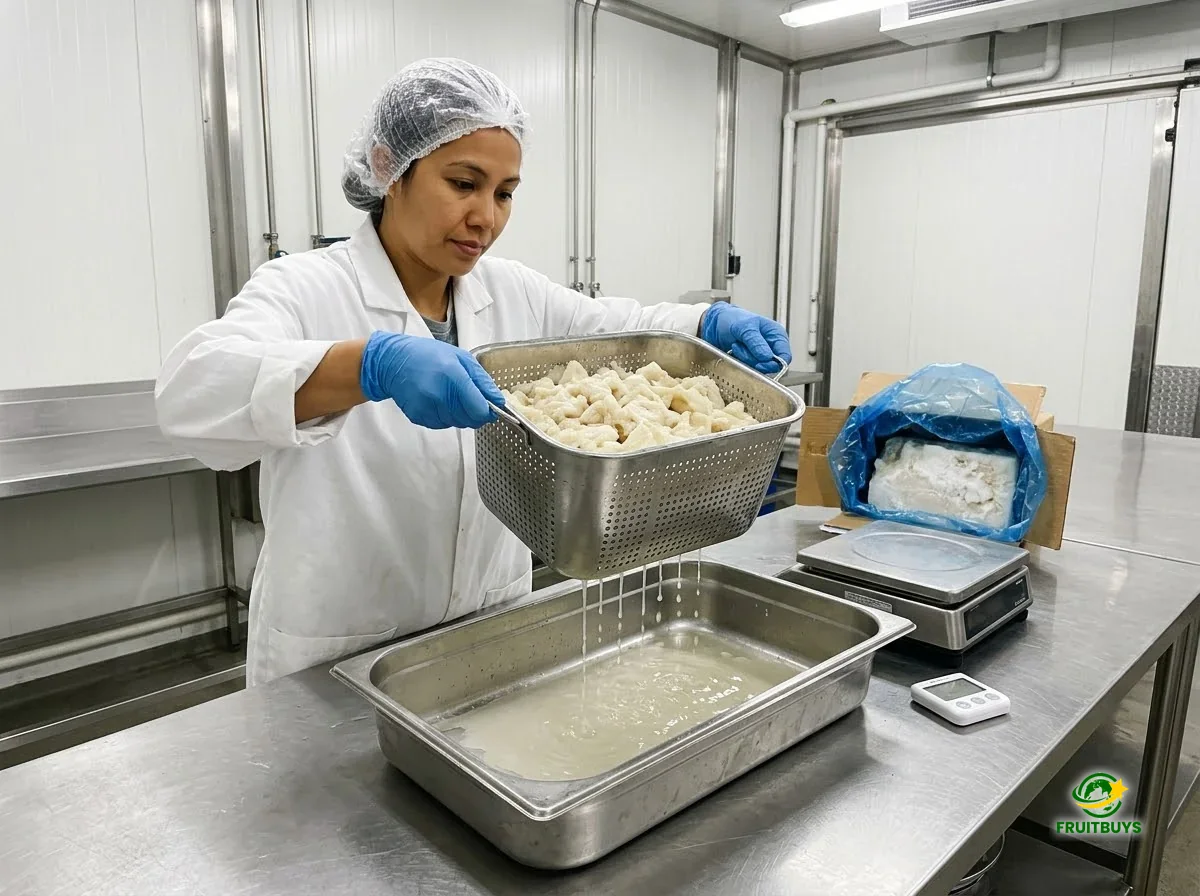
Freeze-dried pulp removes most of that chain. The water stays in Vietnam, the product ships and stores dry, and nothing drips in your plant.
How do frozen pulp and freeze-dried compare for one tonne of pulp?
Here is the same tonne of soursop pulp, bought three ways:
| Per 1 tonne of pulp equivalent | Frozen pulp | Freeze-dried pulp pieces | Freeze-dried powder |
|---|---|---|---|
| Weight you ship | 1,000 kg | About 200 kg | About 200 kg |
| Of which water | About 810 kg | Under 10 kg (moisture ≤5%) | Under 10 kg (moisture ≤5%) |
| Cartons (58 × 28 × 34 cm) | Pails or blocks, by supplier | About 25–29 cartons at 7–8 kg | About 10–11 cartons at 18–20 kg |
| Container | Reefer at −18 °C | Standard dry container | Standard dry container |
| Storage at your site | Freezer | Ambient, dry | Ambient, dry |
| Loss before use | Typically 5–10% drip on thawed pieces | None; open one batch bag at a time | None; open one batch bag at a time |
| Shelf life | Frozen only | 12 months at ≤25 °C; 18–24 months at ≤18 °C | 12 months at ≤25 °C; 18–24 months at ≤18 °C |
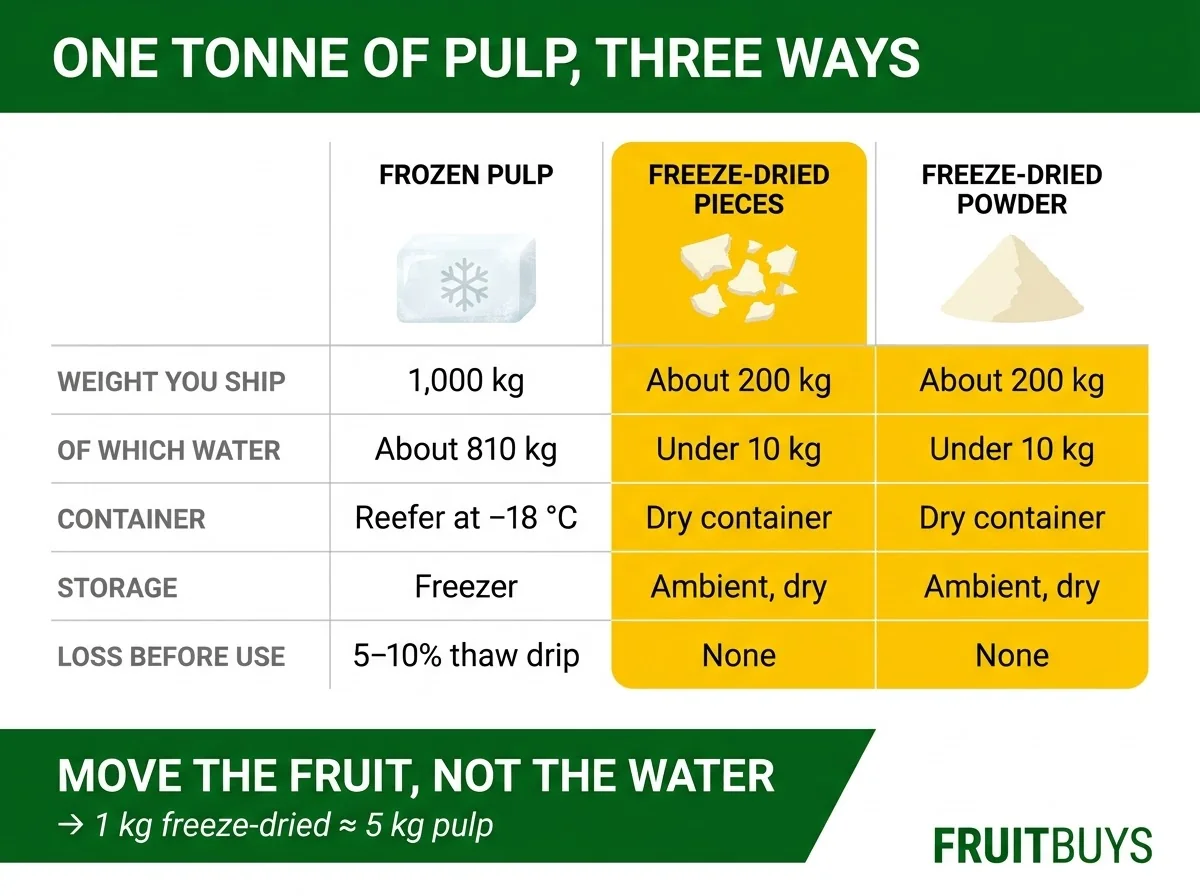
At container scale the gap gets larger. A 20 ft dry container of freeze-dried pieces holds 3.9–4.4 t, the pulp solids of about 19.5–22 t of frozen pulp. The same container filled with powder holds 9.9–11 t, roughly 50–55 t of pulp equivalent, and a 40 ft HC of powder planned at 20–21 t carries the pulp of around 100 t. You are moving the fruit, not the water, and you store it on racking instead of in a freezer.
Will it taste and behave like the pulp you use now?
Close enough for most lines, with one difference you should plan for. Freeze-drying works at low temperature, so the sweet-sour soursop aroma and the natural white-cream colour come through; nothing is cooked or caramelised. To use it like pulp, rehydrate about 1 part freeze-dried pulp with 5–6 parts water and stir: you get a creamy, purée-like texture you can portion like thawed pulp.
The difference is that you now control the water. In a smoothie or batido you add the powder straight to milk or water at 5–10 g per 250–350 ml. In ice cream or yogurt, 3–8% powder brings flavour without carrying extra water into the mix. In granola, cereal or snack packs you use crumble or whole pulp pieces dry, which frozen pulp cannot do at all. Format by application is in which freeze-dried soursop format fits your line.
When is frozen pulp still the better buy?
When your line uses liquid pulp every day and already runs on a cold chain. A juice or nectar plant with freezer capacity, a pasteuriser and a steady weekly draw turns frozen pulp straight into product, and the drip goes into the tank. If your frozen pulp also comes from a nearby origin on a short reefer route, the freight gap narrows.
Freeze-dried earns its place in the other cases: dry-blend lines, drinks made to order at a counter, snacks and inclusions, desserts that cannot take extra water, and markets where cold storage is expensive or unreliable. Many buyers run both, keeping frozen pulp for the juice line and moving everything else to freeze-dried soursop powder, which frees freezer space for products that truly need it.
How do you compare the real cost per kilogram of usable pulp?
Put both options on the same basis: cost per kilogram of pulp you can actually use. Fill in your own numbers.
Frozen pulp
Cost per kg usable pulp = (pulp price per kg + reefer freight per kg + cold storage per kg for the months you hold it + duty per kg) ÷ (1 − thaw loss %)
Freeze-dried
Cost per kg pulp equivalent = (freeze-dried price per kg + dry freight per kg + duty per kg) ÷ 5
The divisor of 5 is the pulp equivalence: one kilogram of freeze-dried soursop carries the solids of about five kilograms of pulp. As a hypothetical example for the arithmetic only, a freeze-dried price of USD 20 per kg divides to USD 4 per kg of pulp equivalent before freight and duty; the freight and storage lines then decide the comparison, because you are shipping about one-fifth of the weight and storing it without a freezer. For duty, the US MFN reference rate is 2.5% for freeze-dried pieces and 9.6% for powder; your customs broker confirms the total duty on the entry.
Two lines buyers often leave out of the frozen side: the freezer space the pulp occupies while it waits, and the labour and time spent thawing and draining it. Add both before you decide. Container and freight per kilogram by format are in how much freeze-dried soursop fits in a 20 ft container.
How do you test the switch without risking a production run?
Run both side by side on one batch of your own product. FruitBuys prepares a sample in 3–5 working days: two sealed foil pouches, one for your kitchen trial and one kept sealed for your lab. Rehydrate one portion 1 to 5–6 next to your thawed pulp and compare taste, colour and body. Make your product with each, at the same dose of pulp solids. Weigh your frozen pulp’s drip with the 30-minute test.
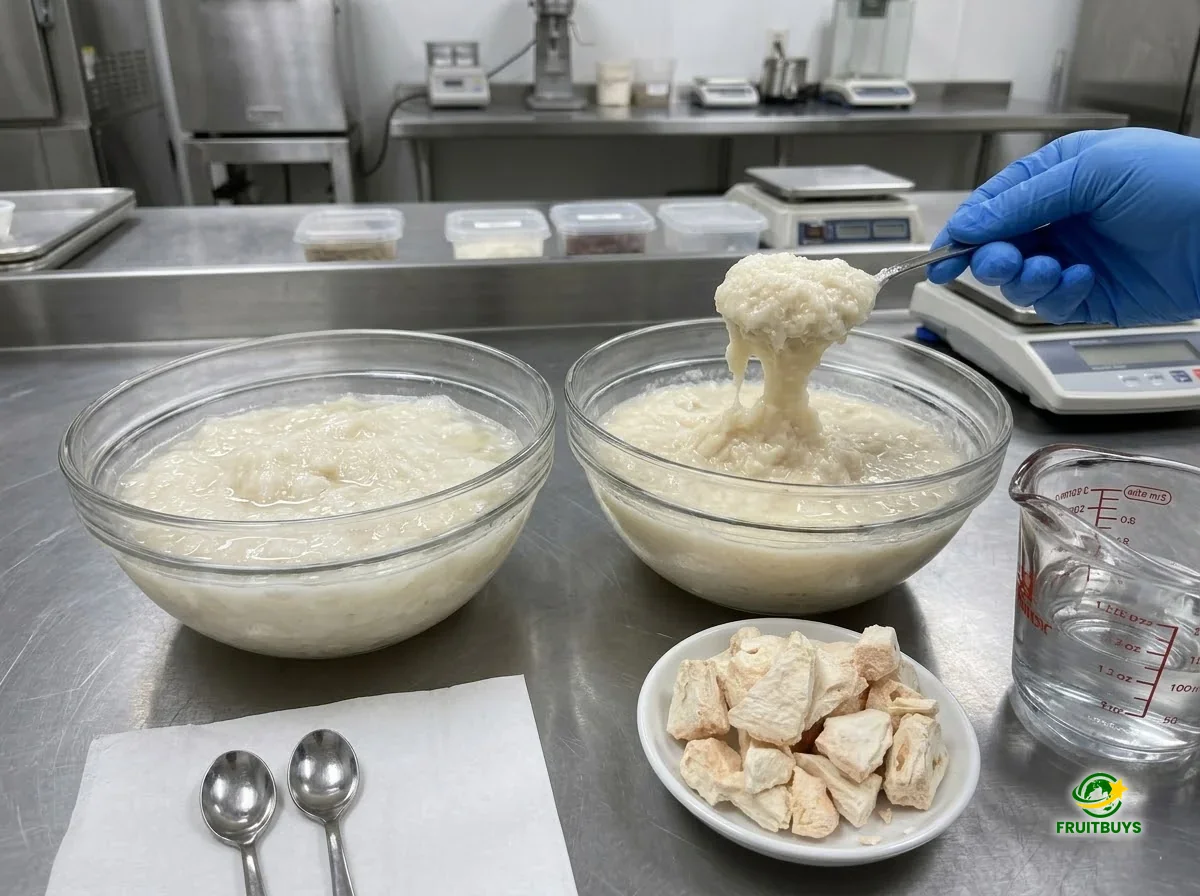
If the result holds, start with a 50–100 kg trial order by air or LCL, or share a pallet or container with other FruitBuys freeze-dried lines, before you commit a full container. FruitBuys releases each lot against a COA for moisture, water activity and microbiology, so the trial lot and the container that follows are judged on the same limits.
Ready to run the comparison?
Tell us which product you make with frozen soursop pulp now, your monthly volume and your destination port. We send a matched sample of freeze-dried pieces or powder, with the specification and a dose suggestion for your recipe.
FAQ
Does freeze-dried soursop taste like fresh pulp?
Yes, closely. Freeze-drying runs at low temperature, so the sweet-sour aroma and the white-cream colour stay; rehydrated 1 to 5–6 with water it becomes a creamy, purée-like pulp.
Can I make soursop juice from freeze-dried?
Yes. Blend 5–10 g of powder into 250–350 ml of water or milk, or rehydrate pieces 1 to 5–6 and blend. The drink is cloudy and creamy, like a fresh batido.
How much frozen pulp does 1 kg of freeze-dried replace?
About 5 kg of pulp by solids. The water comes back when you rehydrate or blend it.
Is freeze-dried soursop more expensive than frozen pulp?
Per kilogram on the invoice, yes; per kilogram of usable pulp, often not, once freight on water, cold storage and thaw loss are counted. Use the formula above with your own numbers.
Can fresh soursop be imported into the US instead?
Only on limited routes: fresh fruit from Mexico was approved in 2024 with quarantine irradiation and moves mainly by air. Freeze-dried soursop is a processed food and ships by sea in a dry container.
How long does freeze-dried soursop keep once delivered?
12 months at ≤25 °C and RH ≤60%, or 18–24 months in cool storage at ≤18 °C and RH ≤50%, in the unopened foil bag with desiccant.