
Freeze-Dried Durian Cubes, Bites, Slices and Powder
Freeze-dried durian format selection looks simple until the buyer scales the sample into bulk. Cubes, bites, slices and powder do not behave the same in drying, packing, breakage, moisture exposure, label development or food application. A retail snack buyer needs visible pieces and low broken content. A chocolate or bakery buyer may prefer smaller pieces. A powder buyer needs mesh, carrier declaration and flow behavior.
The wrong format does not only affect appearance, it changes the approval standard. This guide is for importers, distributors, R&D developers, QA managers and private label buyers who need to select freeze-dried durian format before sample approval. FruitBuys treats format as a locked specification linked to Quality Control, Documentation, packaging and sample-to-bulk release.
Format Is a Product Specification, Not a Visual Preference
Freeze-dried durian format defines how the product is cut, dried, packed, tested and approved.
Cubes, bites, slices and powder carry different risks for moisture, Aw, breakage, packaging and food application.
Buyers should define the format before requesting the sample, not after reviewing a good-looking tray.
A supplier can send one attractive sample and call it freeze-dried durian. That does not tell the buyer whether the bulk lot will arrive as snack-grade bites, irregular pieces, fragile slices, powder or mixed grade. Format needs measurable criteria.
Freeze-drying research shows that process conditions influence physical properties such as structure, porosity, color and texture in food materials. That matters because the product’s cut size and geometry affect drying behavior and final fragility. (Agris FAO)
For freeze-dried durian, the product brief should define:
| Specification Field | Buyer Reason |
|---|---|
| Format name | Prevents vague “pieces” approval |
| Dimensions or mesh | Controls drying, packing and application |
| Tolerance | Prevents bulk variation |
| Broken-piece allowance | Protects retail appearance or application consistency |
| Fines allowance | Controls powdering and pack quality |
| Moisture target | Supports drying endpoint review |
| Aw target | Supports stability review |
| Packaging condition | Protects crispness after drying |
| Retained sample | Supports sample-to-bulk comparison |
Format selection should connect to how freeze-dried durian is processed, freeze-dried durian moisture and Aw and sample-to-bulk consistency for freeze-dried durian.
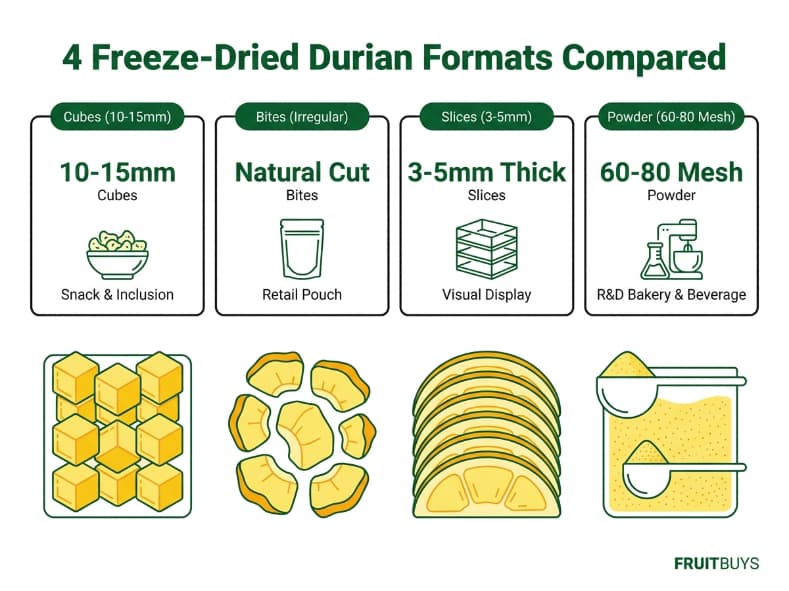
Freeze-Dried Durian Cubes
Freeze-dried durian cubes suit buyers who need a controlled, compact inclusion format. Cubes can work for snack pouches, chocolate inclusion, cereal mixes, bakery decoration and small-pack private label. Their strength is visual control. Their risk is center drying and edge breakage.
A cube must be defined by size and tolerance. “Cube” should not mean any block-shaped piece. If the cube is too large, the center may dry differently from the surface. If it is too small, the product can generate more fragments during unloading, filling and transport.
Buyers should define:
| Cube Control | Required Detail |
|---|---|
| Nominal size | Length × width × height |
| Tolerance | Acceptable range |
| Edge condition | Intact, chipped or naturally irregular |
| Broken-piece limit | Maximum percentage |
| Moisture | Target and COA result |
| Aw | Target and COA result |
| Packaging | Inner barrier and carton protection |
Cubes are useful when the buyer needs repeatable presentation. They become risky when the supplier cannot measure dimensions or separate conforming cubes from broken pieces. For yield and grade split, link to fresh-to-dry durian conversion. For bulk release, link to freeze-dried durian COA and laboratory testing.
Freeze-Dried Durian Bites
Freeze-dried durian bites suit direct snack applications because they preserve a natural eating shape without forcing strict geometry. Bites can look more natural than cubes and can carry strong sensory identity in retail pouches. Their risk is irregularity.
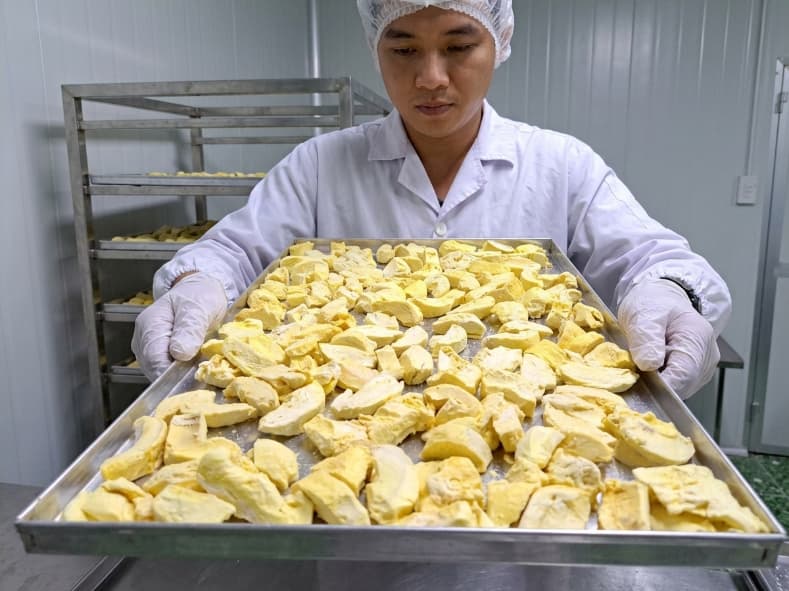
A buyer should not approve bites only from a photo. Bite size affects mouthfeel, filling consistency, carton protection and visible broken percentage. A wide size range can make the same pouch feel inconsistent from pack to pack.
A bite specification should include:
- Minimum piece size
- Maximum piece size
- Target piece-weight range where useful
- Broken-piece allowance
- Fines allowance
- Color acceptance range
- Aroma and taste description
- Moisture and Aw target
- Packaging configuration
- Retained sample code
Bites need strong sample-to-bulk discipline. The supplier can hand-select the best pieces for a small sample, while bulk production produces more uneven grades. The buyer must lock the retained sample and bulk comparison rule through approved sample and bulk release. Bites also fit private label pouches when the buyer defines pack size, visible grade, lot coding and label file. That path connects to freeze-dried durian private label.
Freeze-Dried Durian Slices
Slices create the strongest visual format. They show product identity quickly and suit retail snack packs, gifting concepts, sampling packs and premium visual merchandising contexts, but do not use “premium” as a supplier claim. Their operational risk is high fragility.
Slices need thickness control. Thin slices can break at the edges. Thick slices can dry unevenly. Curved natural flesh can create non-uniform geometry. If the buyer does not define slice thickness and broken-slice allowance, disputes will follow bulk production.
A slice specification should cover:
| Slice Field | Buyer Purpose |
|---|---|
| Thickness range | Controls drying and bite texture |
| Length or piece range | Controls pack presentation |
| Partial-slice allowance | Prevents visual-grade disputes |
| Edge breakage limit | Protects retail appearance |
| Moisture and Aw | Confirms technical release |
| Packaging protection | Reduces transport damage |
| Carton stacking rule | Controls compression risk |
Slices need packaging discipline because the product can break during weighing, filling, sealing, carton stacking and transport. Buyers should connect this article to freeze-dried durian packaging and shelf-life controls and freeze-dried durian carton and container planning.
Freeze-Dried Durian Powder
Freeze-dried durian powder is not just crushed durian pieces.
Powder needs mesh, carrier status, bulk density, clumping review, nutrition logic, microbiology scope and application testing.
Buyers should define whether they need pure fruit powder or a formulated powder before requesting a sample.
Powder shifts the buyer’s decision from visual grade to functionality. It can serve bakery, confectionery, ice cream, beverage powder, dessert mix, fillings, coatings and flavor systems. But powder also creates the most documentation risk because the ingredient statement may change if the powder uses a carrier, anti-caking agent or blending aid.
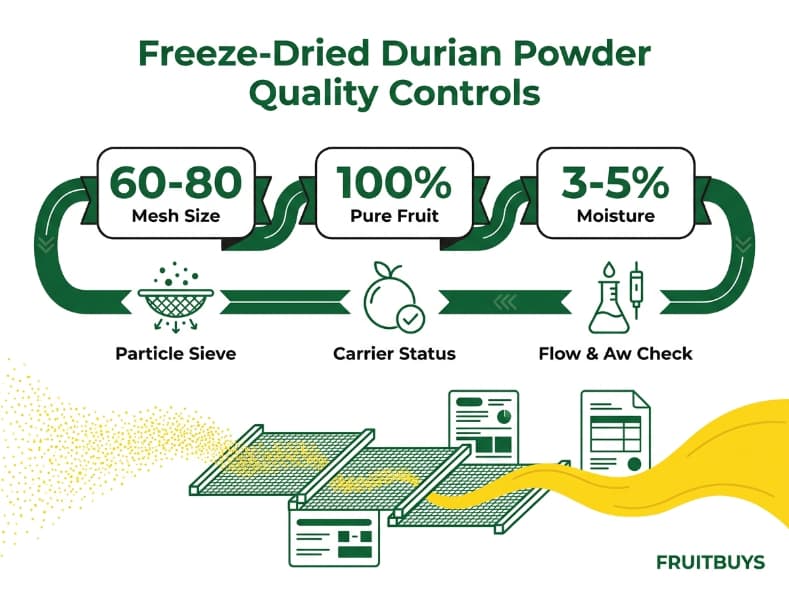
A freeze-dried durian powder brief should define:
| Powder Control | Required Buyer Decision |
|---|---|
| Pure fruit or formulated powder | Ingredient and label impact |
| Mesh size | Application and mouthfeel |
| Sieve distribution | Batch consistency |
| Carrier declaration | Label and buyer specification |
| Bulk density | Filling and dosing behavior |
| Clumping tendency | Storage and application risk |
| Aroma strength | R&D performance |
| Moisture and Aw | Stability control |
| Microbiology | Ingredient safety review |
| Nutrition file | Label and formulation review |
The buyer should never assume powder contains only durian because the sample smells like durian. Appearance and aroma do not prove formula. The ingredient statement and product specification must state the composition. For nutrition and label development, link to freeze-dried durian Nutrition Facts development.
For lab evidence, link to durian laboratory testing requirements. Category navigation can support the buyer’s powder path through the FruitBuys dried fruit powder range: https://fruitbuys.com/product-category/dried-fruit-powder
Broken Pieces Are Not Automatically Waste
Broken pieces can be a controlled ingredient grade. They become a problem only when the buyer expected whole snack pieces. This distinction protects both buyer and supplier.
Snack buyers may reject broken pieces because the final consumer sees the product. Food manufacturers may welcome them when size, moisture, Aw and microbiology meet the application. Chocolate, bakery, cereal, ice cream and dessert systems can often use small pieces or granules more efficiently than large snack pieces.
A clear grade split should separate:
Grade A pieces
+ small pieces
+ broken pieces
+ fines
+ powder-grade material
+ rejected material
Without this split, the buyer cannot evaluate yield, application fit or sample-to-bulk consistency. A supplier may count broken pieces as usable output. A retail buyer may count them as defect. Both can be logical under different briefs. For use-case selection, link to freeze-dried durian food applications. For conversion logic, link to fresh-to-dry durian yield calculation.
Moisture and Aw by Format
Moisture and Aw must follow the format. A powder, a cube and a slice can share the same target range but behave differently in storage and application. FDA explains that water activity relates to available water, not simply total water, and that Aw can be affected by temperature conditions (U.S. Food and Drug Administration).
ISO 18787:2017 also establishes principles and requirements for determining water activity of food products within a 0 to 1 measurement range (ISO). The current working target for FruitBuys freeze-dried durian is:
| Parameter | Working Target | Buyer Handling |
|---|---|---|
| Moisture | 3–5% | Confirm by lot COA |
| Aw | <0.30 | Confirm by lot COA |
| Microbiology | Buyer and destination specific | Confirm by lab panel |
| Packaging | Format specific | Confirm by packaging file |
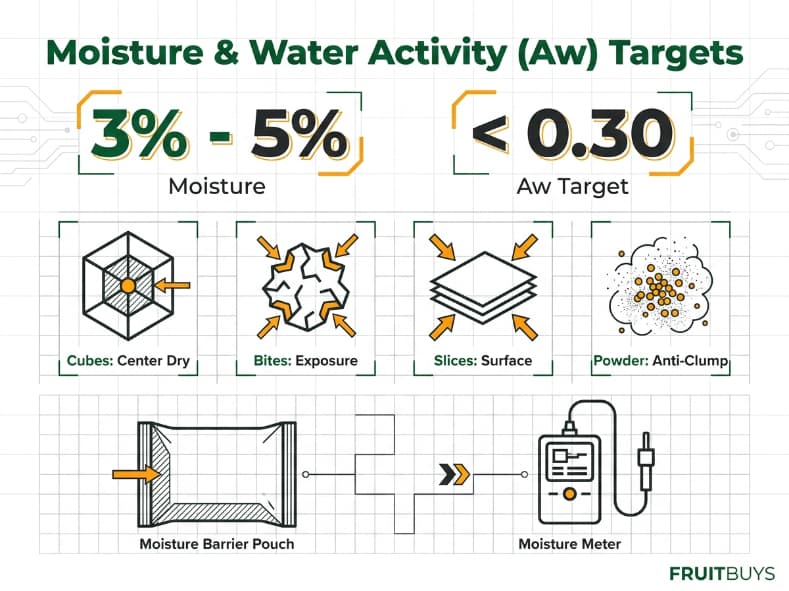
Format affects how the buyer should interpret those numbers:
| Format | Moisture / Aw Risk |
|---|---|
| Cubes | Center drying and size variability |
| Bites | Irregular piece shape and uneven exposure |
| Slices | Edge breakage and high surface exposure |
| Powder | Clumping and rapid moisture pickup after opening |
The full technical article is freeze-dried durian moisture and Aw. Do not approve any format from texture alone.
Packaging Needs by Format
Packaging must match product fragility and moisture sensitivity. Freeze-dried durian cannot rely on “dry product” status after packing. The pack must protect the condition created by drying. FDA’s draft guidance for low-moisture ready-to-eat foods focuses on sanitation programs and corrective actions because low-moisture foods still need preventive controls and contamination discipline (U.S. Food and Drug Administration).
This same logic applies to handling and packing discipline: the dry product still needs protection after the dryer.
| Format | Packaging Priority | Main Failure |
|---|---|---|
| Cubes | Cushioning and barrier | Chipped edges, moisture pickup |
| Bites | Retail pack consistency | Uneven pack appearance |
| Slices | Mechanical protection | Edge breakage and crushed slices |
| Powder | Moisture barrier and flow control | Clumping and aroma loss |
| Broken pieces | Size control and bag integrity | Excess fines and application inconsistency |
A packaging file should define:
- Inner bag or retail pouch structure
- Pack size
- Seal requirement
- Carton size
- Fill method
- Headspace behavior
- Storage condition
- Breakage control
- Shelf-life support status
For the detailed stability path, read freeze-dried durian packaging and shelf-life controls. For loading impact, read freeze-dried durian carton and container planning.
Format Selection by Buyer Application
Format should follow the application, not the supplier’s easiest output. Buyers who skip this step often receive a product that meets a generic specification but fails inside the real use case.
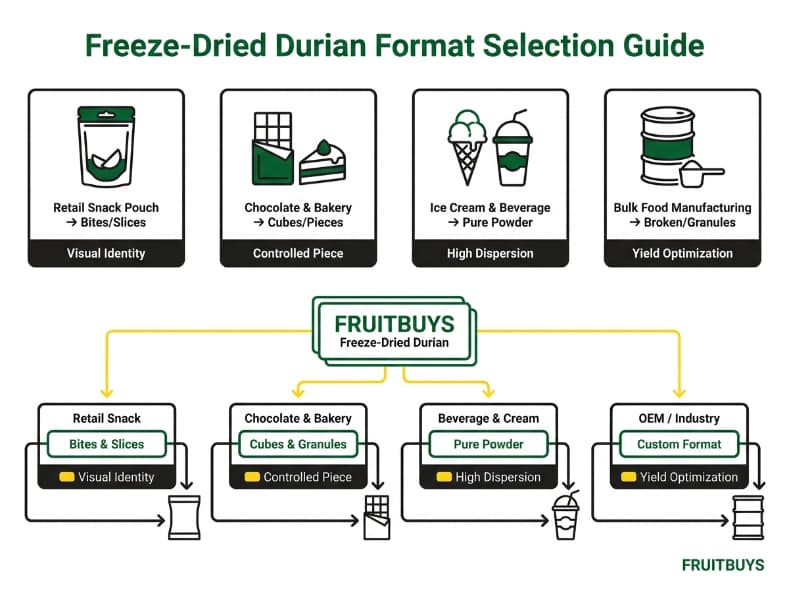
| Buyer Application | Recommended Format Direction | Reason |
|---|---|---|
| Retail snack pouch | Bites or slices | Strong visual identity and direct eating |
| Mixed tropical snack pack | Bites, cubes or small pieces | Better SKU integration |
| Chocolate inclusion | Small cubes or broken pieces | Controlled particle presence |
| Bakery topping | Broken pieces or granules | More even distribution |
| Bakery filling | Powder or granules | Flavor integration |
| Ice cream | Powder or small pieces | Controlled dispersion or inclusion |
| Beverage premix | Powder | Easier formulation route |
| Cereal and granola | Bites or broken pieces | Visible inclusion with controlled breakage |
| Dessert decoration | Slices or cubes | Visual presentation |
| Food manufacturing ingredient | Powder, granules or broken pieces | Application flexibility |
For the deeper R&D route, link to freeze-dried durian food applications. For private label format selection, link to durian OEM product development.
Sample Approval for Each Format
A format sample must become a measurable reference before bulk production.
The buyer should approve dimensions, sensory profile, moisture, Aw, broken-piece allowance, packaging condition and retained sample code.
Without those records, bulk comparison becomes subjective.
Each format needs a different approval file.
Cubes approval file
- Nominal dimensions
- Size tolerance
- Color
- Aroma
- Moisture
- Aw
- Broken-cube limit
- Packaging
Bites approval file
- Size range
- Piece-weight range where useful
- Color and aroma
- Texture
- Broken-piece allowance
- Retained sample
Slices approval file
- Thickness
- Partial-slice tolerance
- Edge breakage limit
- Visual-grade standard
- Packaging protection
Powder approval file
- Mesh
- Sieve distribution
- Carrier status
- Bulk density
- Clumping review
- Microbiology
- Nutrition file where required
The buyer should not approve a bulk lot from a memory of a good sample. Use sample-to-bulk consistency for freeze-dried durian as the approval gate.
Application Mapping
| Buyer Type | Application | Required Format | Proof Needed | FruitBuys Delivery |
|---|---|---|---|---|
| Importer | Retail snack pouch | Bites or slices | Size tolerance, moisture, Aw, COA, packaging file | Quality Control and lot-based Documentation |
| Distributor | Tropical freeze-dried fruit range | Bites, cubes or mixed pieces | Format consistency, broken-piece limit, packing file | Export-ready product release |
| QA manager | Supplier approval | Any format | Specification, COA, retained sample and certificate scope | Documentation review and release control |
| R&D developer | Bakery, chocolate or dairy application | Broken pieces, granules or powder | Particle size, Aw, ingredient statement, application trial | Application-aligned sample route |
| Private label buyer | Branded consumer pouch | Cubes or bites | Pack sample, seal review, label file, COA | OEM/Private Label Delivery |
| Ingredient buyer | Manufacturing input | Powder or granules | Mesh, carrier declaration, microbiology, bulk density | Product specification and test file |
Highest-Risk Decision: Approving Format Without Tolerance
The highest-risk mistake is approving “bites”, “slices” or “powder” without measurable limits. The buyer assumes one visual standard. The supplier ships another. Both sides then argue from memory, not specification.
A vague format brief creates predictable failures:
- Cubes arrive with high chipped edges
- Bites arrive with wide size variation
- Slices arrive as partial fragments
- Powder arrives with an undeclared carrier
- Broken pieces exceed the retail tolerance
- Moisture and Aw results do not match the approved sample
- Packaging does not protect the selected format
- Bulk lot does not match the retained sample
The buyer should hold approval when the specification lacks:
- Format definition
- Size range or mesh
- Tolerance
- Broken-piece limit
- Fines limit
- Moisture and Aw targets
- Packaging requirement
- Retained sample
- COA requirement
- Application statement
The risk article that closes this gap is approved sample and bulk release. The checklist article is freeze-dried durian buyer checklist.
Why FruitBuys Delivers This
FruitBuys supplies freeze-dried durian as one export-ready product under an Integrated Product Supply Model. Format selection sits inside that model because the buyer does not need loose “durian pieces.” The buyer needs the right format, locked to the right application, specification, packaging and release file.
FruitBuys applies Quality Control by aligning dimensions, mesh, broken-piece allowance, moisture, Aw, sensory criteria and retained sample comparison. FruitBuys applies Raw Material Sourcing Governance by matching cultivar, maturity direction and flesh suitability to the chosen format. FruitBuys applies Documentation by connecting the format specification, COA, ingredient statement, packaging file and lot identity.
For branded products, FruitBuys applies OEM/Private Label Delivery through pack-size selection, label inputs, coding, artwork data and retail format control. For trial buyers, FruitBuys applies MOQ Flexibility/Market Trial Support where operationally feasible so the buyer can test cubes, bites, slices or powder before scaling. For shipment readiness, FruitBuys applies Export Logistics Coordination through carton planning, pack protection and document handover.
The format is not cosmetic. It is the product route.
Buyer Checklist
Before approving freeze-dried durian format, request:
- Target application
- Approved cultivar or cultivar range
- Format name: cubes, bites, slices, broken pieces, granules or powder
- Dimensions or mesh
- Size tolerance
- Broken-piece allowance
- Fines allowance
- Powder carrier declaration
- Bulk density for powder where needed
- Moisture target
- Aw target
- Microbiology panel
- Sensory criteria
- Packaging configuration
- Seal and carton protection
- Retained sample
- COA requirement
- Shelf-life support status
- Bulk comparison rule
- Label implications for private label
If the supplier cannot define the format, the buyer should not approve the sample as a production reference.
Summary
Freeze-dried durian formats include cubes, bites, slices and powder, and each format requires different controls for dimensions, texture, moisture, Aw, broken pieces, packaging and application. Cubes and bites suit snack and inclusion use, slices support visual retail presentation, and powder supports bakery, beverage, dessert and formulation work when mesh, carrier status and clumping behavior are controlled.
FruitBuys manages format selection through Quality Control, Raw Material Sourcing Governance, Documentation, OEM/Private Label Delivery and Export Logistics Coordination.
FAQ
Which freeze-dried durian format is best for retail snacks?
Bites and slices usually fit retail snack pouches because they show visible product identity. Buyers still need size tolerance, broken-piece limits, moisture, Aw and packaging evidence.
When should buyers choose cubes?
Choose cubes when the application needs more consistent geometry, small-piece inclusion or controlled presentation. Define dimensions and tolerance before sample approval.
When should buyers choose slices?
Choose slices when visual presentation matters. Check thickness, partial-slice allowance, edge breakage and packaging protection before bulk release.
When should buyers choose powder?
Choose powder for bakery, beverage, dessert, ice cream or formulation work. Confirm mesh, carrier status, bulk density, microbiology and nutrition data where needed.
Are broken pieces acceptable?
They are acceptable only when the buyer’s application allows them. Retail snack buyers may restrict broken content, while food manufacturers may use broken pieces as ingredient-grade material.
Do all formats use the same moisture and Aw target?
They may share the same target range, but they behave differently. Buyers should review moisture, Aw, packaging and sample-to-bulk consistency by format.
Which related article should follow this one?
Read freeze-dried durian food applications next for R&D use, or freeze-dried durian packaging and shelf-life controls for stability risk.
Conclusion
Submit the application brief after selecting cubes, bites, slices or powder and defining the required size tolerance, moisture, Aw, packaging condition and lot-release evidence.
References
- Dorota Nowak and Ewa Jakubczyk. “The Freeze-Drying of Foods: The Characteristic of the Process Course and the Effect of Its Parameters on the Physical Properties of Food Materials.” Foods, 2020. (Agris FAO)
- U.S. Food and Drug Administration. “Water Activity (aw) in Foods.” Inspection Technical Guide. (U.S. Food and Drug Administration)
- International Organization for Standardization. “ISO 18787:2017 Foodstuffs: Determination of water activity.” 2017. (ISO)
- U.S. Food and Drug Administration. “Draft Guidance for Industry: Establishing Sanitation Programs for Low-Moisture Ready-to-Eat Human Foods and Taking Corrective Actions Following a Pathogen Contamination Event.” January 2025. (U.S. Food and Drug Administration)