Freeze-Dried Durian Sample-to-Bulk Consistency Controls
A freeze-dried durian sample can win approval in one meeting and still fail the buyer in bulk production. The sample may come from a smaller batch, cleaner grade, different cultivar, tighter hand selection or stronger packaging control than the lot shipped later. That gap creates disputes around aroma, color, crispness, broken pieces, powder behavior, shelf-life support and document matching.
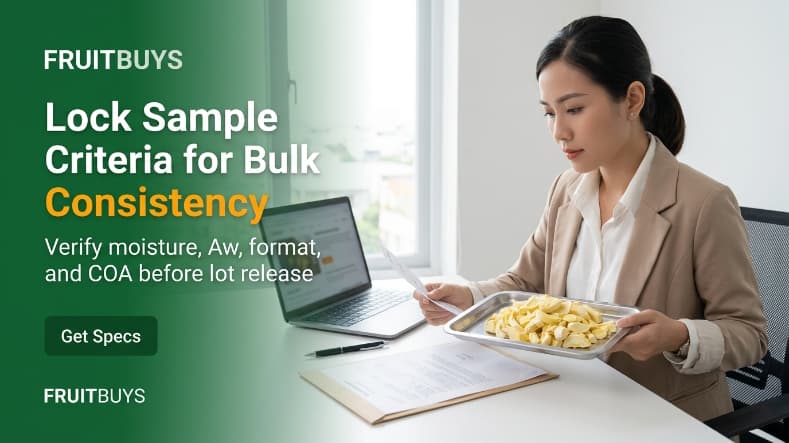
A sample becomes useful only when the buyer turns it into a measurable release standard. This guide is for importers, distributors, QA teams, procurement managers, R&D developers and private label buyers who need the approved sample to match the bulk lot. FruitBuys controls this risk by connecting raw-material definition, product specification, moisture, Aw, COA, packaging, retained samples and final release review under one accountable product supply relationship.
A Good Sample Does Not Define the Bulk Product
A good sample shows what the buyer may approve, but it does not automatically define the future bulk lot.
The sample must become a controlled reference with measurable limits for cultivar, format, moisture, Aw, breakage, packaging and documents.
Buyers should not release bulk freeze-dried durian until the lot matches the approved specification and retained sample record.
Sample approval often creates false certainty. The buyer sees clean pieces, strong durian aroma and a crisp bite. The buyer assumes the supplier can repeat the same result at scale. That assumption fails when the supplier never locked the measurable criteria behind the sample.
Freeze-dried durian creates a high consistency burden because the product is fragile, aromatic and moisture-sensitive. A slight difference in flesh maturity, piece thickness, drying endpoint or post-drying exposure can change the final eating experience.
FDA’s water activity guidance explains that Aw relates to available water and product stability, not simply total water content, which means buyers must control moisture and Aw separately when evaluating dry foods (U.S. Food and Drug Administration). The first internal path should connect sample approval to how freeze-dried durian is processed and fresh-to-dry durian conversion.
What the Approved Sample Must Record
A sample without records is a sensory sample. A sample with records becomes a release reference.
The approved sample file should include:
| Sample Field | Required Record | Buyer Risk Controlled |
|---|---|---|
| Product name | Freeze-dried durian | Wrong product or unclear identity |
| Cultivar | Ri6, Monthong/DONA or other declared type | Aroma and texture mismatch |
| Starting material | Whole fruit, seeded aril, clean flesh or trimmed flesh | False yield comparison |
| Format | Cubes, bites, slices, broken pieces or powder | Wrong application fit |
| Piece size | Dimensions, weight range or mesh | Bulk visual or functional mismatch |
| Moisture target | 3–5% target, COA needed | Crispness and yield distortion |
| Aw target | <0.30 target, COA needed | Stability-control gap |
| Broken-piece limit | Maximum percentage or grade rule | Retail appearance dispute |
| Fines limit | Maximum percentage or powder definition | Packing and application problem |
| Sensory standard | Color, aroma, taste and texture notes | Subjective rejection |
| Packaging | Inner bag, pouch, carton and seal condition | Moisture pickup and breakage |
| Retained sample code | Physical or sealed reference sample | Dispute resolution |
| Approval date | Buyer and supplier confirmation | Scope control |
For format definition, link to freeze-dried durian cubes, bites, slices and powder. For cultivar control, link to Ri6 vs Monthong freeze-dried durian.

Specification Fields That Prevent Disputes
A specification protects the buyer because it turns subjective approval into release criteria. It does not need decorative language. It needs control fields.
The freeze-dried durian specification should lock:
- Cultivar or approved cultivar range
- Ingredient statement
- Product format
- Size tolerance or mesh
- Moisture target
- Aw target
- Broken-piece allowance
- Fines or powder-grade allowance
- Sensory acceptance range
- Foreign matter rule
- Microbiology panel
- Contaminant panel where required
- Packaging configuration
- Storage condition
- Lot documentation package
Codex General Principles of Food Hygiene provides a broad hygiene and HACCP framework, but it does not replace product-level limits for a specific freeze-dried durian lot. Buyers still need measurable acceptance criteria for the product under approval (U.S. Food and Drug Administration).
FruitBuys should not release bulk goods against vague phrases such as “good quality”, “golden color” or “crispy texture”. The lot either matches the approved criteria or it does not.

Moisture and Aw Consistency
Moisture and Aw are separate sample-to-bulk controls.
A bulk lot can look similar to the sample while showing a different water condition after drying or packing.
Buyers should compare sample and bulk with numeric COA results, not with texture impressions alone.
The buyer’s approved sample should carry moisture and Aw targets. The bulk lot should then show matching release evidence. FDA’s water activity guidance identifies Aw as a stability-related property and notes that measurement conditions matter. ISO 18787:2017 establishes principles and requirements for determining water activity in food products within a 0 to 1 range. (U.S. Food and Drug Administration)
FruitBuys should treat moisture and Aw as a paired control:
| Control | Sample Stage | Bulk Stage |
|---|---|---|
| Moisture | Target range recorded | COA result reviewed |
| Aw | Target limit recorded | COA result reviewed |
| Sampling point | Defined | Matched or explained |
| Packaging condition | Recorded | Matched or verified |
| Retained sample | Sealed and coded | Compared before release |
The relevant technical article is freeze-dried durian moisture and Aw. If the buyer does not lock these values at sample stage, bulk release becomes guesswork in a lab coat.
Format and Breakage Consistency
Freeze-dried durian breaks easily because its structure becomes porous and brittle after drying. That fragility does not make broken pieces acceptable by default. The buyer’s application decides the allowable grade split.
Retail snack buyers may require intact bites or slices. Food manufacturers may accept broken pieces, granules or powder if the particle size and microbiology meet the application. Private label buyers may need visual uniformity because the consumer sees the product through the pack or in marketing material.

The approved sample should define:
- Minimum and maximum piece size
- Slice thickness
- Cube dimensions
- Bite size range
- Powder mesh
- Broken-piece limit
- Fines limit
- Defect categories
- Color range
- Aroma intensity range
- Pack-fill behavior
The buyer should not accept “same as sample” unless the supplier also stores a retained sample and defines measurable inspection rules. “Same as sample” without a retained reference is a doorway with no hinges. Link this section to durian format and breakage specifications and freeze-dried durian carton and container planning.
Cultivar and Raw-Material Consistency
Cultivar consistency starts before processing. A bulk lot can fail sample expectations if the supplier shifts from one cultivar to another or changes maturity criteria without notice. Durian aroma, color, texture, dry matter and drying behavior can change across cultivar and harvest condition.
FruitBuys should control raw material through:
- Declared cultivar
- Approved cultivar alternatives, if allowed
- Maturity direction
- Raw-material inspection
- Clean-flesh definition
- Trimming rule
- Defect rejection
- Lot traceability

A buyer who approves a Ri6 sample should not receive a mixed cultivar bulk lot unless the specification allows it. A buyer who approves a Monthong/DONA sample should not receive an undefined cultivar statement. The problem is not only flavor.
It affects yield, drying behavior, breakage and application performance. Use Ri6 vs Monthong freeze-dried durian for cultivar selection and fresh-to-dry durian conversion for raw-material yield control.
COA and Lot-Release Evidence
The bulk lot needs its own evidence. An old COA, a certificate logo or a process photo cannot release a new lot.
A proper release file should include:
| Release Evidence | Purpose |
|---|---|
| Product specification | Defines approved limits |
| Approved sample record | Defines reference product |
| Bulk COA | Shows lot-specific results |
| Moisture result | Confirms drying endpoint |
| Aw result | Confirms water-availability condition |
| Microbiology report | Confirms agreed organism panel |
| Packaging record | Confirms protection system |
| Retained sample | Supports comparison |
| Packing list | Connects carton count and lot identity |
| Traceability record | Connects raw material and finished product |
FDA’s 2025 draft guidance for low-moisture ready-to-eat foods focuses on sanitation programs and corrective actions for pathogen contamination because low-moisture foods still need contamination prevention and verification discipline. (U.S. Food and Drug Administration)
The buyer should review freeze-dried durian COA and laboratory testing before signing bulk approval. If the COA does not show method, result, unit, limit and lot identity, it does not control the decision.
Packaging Consistency
A bulk lot can pass moisture and Aw at the dryer exit and still fail after packaging if the pack does not protect the product. Freeze-dried durian needs packaging that controls moisture exposure, oxygen exposure, aroma transfer and mechanical breakage.

The approved sample file should capture:
- Inner bag or pouch type
- Pack size
- Seal condition
- Carton size
- Headspace or fill behavior
- Storage instruction
- Desiccant or absorber use where applicable
- Retail or bulk configuration
- Shelf-life support status
Do not assume the bulk product matches the sample if the packaging changes. A 20 g sample pouch, a 100 g retail pouch and a 1 kg inner bulk bag do not expose the product to the same handling or headspace condition.
Powder also carries different clumping and flow risks from bites or slices. Link to freeze-dried durian packaging and shelf-life controls and freeze-dried durian private label.
The Bulk Comparison Gate
The highest-risk approval error is releasing bulk freeze-dried durian from memory of the sample.
Bulk comparison must use the retained sample, COA, packaging file, visual inspection and agreed acceptance limits.
If the lot lacks this comparison, the buyer should hold release until the evidence matches the approved specification.
The bulk comparison gate protects both buyer and supplier. It prevents vague disputes after the product has moved into cartons, documents or shipment scheduling.
FruitBuys should run the comparison before release:
Approved sample
→ retained reference
→ bulk sample draw
→ visual and sensory comparison
→ moisture and Aw review
→ microbiology and agreed lab panel
→ packaging inspection
→ lot document check
→ release decision
This gate must occur before the buyer commits the product to retail launch, ingredient production or private label packing. The buyer should not wait until arrival inspection to discover the gap. Arrival rejection consumes time, shelf-life and inventory planning space.
The next qualification article is how to qualify freeze-dried durian. The final checklist sits at freeze-dried durian buyer checklist.
Application Mapping
| Buyer Type | Application | Required Format | Proof Needed | FruitBuys Delivery |
|---|---|---|---|---|
| Importer | Retail snack pouch | Bites or slices | Retained sample, COA, moisture, Aw, broken-piece limit | Quality Control and lot-based Documentation |
| Distributor | Tropical snack assortment | Bites, slices or mixed pieces | Bulk comparison, carton condition, format tolerance | Export-ready product release |
| QA manager | Supplier and lot approval | Any format | Specification, lab report, retained sample and certificate scope | Documentation review and release gate |
| R&D developer | Chocolate, bakery or dairy inclusion | Broken pieces, granules or powder | Particle size, Aw, ingredient statement, application trial | Application-aligned sample control |
| Private label buyer | Branded consumer pouch | Cubes or bites | Pack sample, label file, COA, seal and bulk comparison | OEM/Private Label Delivery |
| Ingredient buyer | Manufacturing input | Powder or granules | Mesh, carrier declaration, microbiology and bulk density | Specification and lot evidence package |
When the Buyer Should Hold or Reject a Lot
The buyer should hold release when the lot shows any of these gaps:
- Cultivar differs from approved sample
- Format does not match the specification
- Piece size falls outside tolerance
- Broken-piece percentage exceeds the approved limit
- Moisture result is missing
- Aw result is missing
- Microbiology report is missing where required
- Packaging differs from approved sample
- Seal condition does not match approval
- Bulk aroma differs materially from retained sample
- Lot number does not match packing documents
- Certificate scope does not support the claimed system
- COA says “pass” without numeric limits
- Powder contains an undeclared carrier
- Shelf-life target lacks packaging support
Hold means the buyer asks for correction, replacement, rework, downgrade or additional evidence before release. It does not mean the buyer debates from taste memory. Taste memory is not a QC system.
Why FruitBuys Delivers This
FruitBuys supplies freeze-dried durian through an Integrated Product Supply Model. Sample-to-bulk consistency sits at the center of that model because buyers need the bulk product to match the approved sample, the approved specification and the required document set.
FruitBuys applies Raw Material Sourcing Governance by aligning cultivar, maturity direction and clean-flesh suitability before production. FruitBuys applies Quality Control by comparing format, moisture, Aw, sensory criteria, broken pieces and retained samples before release. FruitBuys applies Documentation by tying COA, laboratory reports, traceability, packing file and certificate scope to the actual lot.
For private label buyers, FruitBuys applies OEM/Private Label Delivery by aligning the approved product with pouch format, label inputs, coding and pack review. For export readiness, FruitBuys applies Export Logistics Coordination through carton planning, document handover and shipment-readiness checks. The approved sample is not a souvenir. It is the control object.
Buyer Checklist
Before approving bulk freeze-dried durian, request:
- Approved sample record
- Sealed retained sample
- Cultivar declaration
- Starting-material definition
- Product format and size tolerance
- Moisture target and bulk COA result
- Aw target and bulk COA result
- Microbiology panel and result
- Contaminant panel where required
- Broken-piece allowance
- Fines or powder-grade allowance
- Ingredient statement
- Carrier declaration for powder
- Packaging specification
- Seal and pack review
- Storage instruction
- Lot traceability
- Packing list alignment
- Certificate scope review
- Final bulk comparison record
No retained sample, no reliable comparison. No lot COA, no technical release.
Summary
Freeze-dried durian sample-to-bulk consistency requires a controlled approved sample, measurable specification, retained reference sample, lot-specific COA, packaging verification and final bulk comparison. Moisture and Aw must be verified separately because they control different product conditions.
Low Aw does not replace microbiology testing. FruitBuys manages sample-to-bulk consistency through Raw Material Sourcing Governance, Quality Control, Documentation, OEM/Private Label Delivery and Export Logistics Coordination.
FAQ
What does sample-to-bulk consistency mean for freeze-dried durian?
It means the bulk lot matches the approved sample in cultivar, format, size, moisture, Aw, sensory profile, breakage, packaging and documents.
Can a buyer approve bulk production from a good sample?
No. The buyer must convert the sample into a controlled reference with specification limits, retained sample, COA requirements and release criteria.
Why does freeze-dried durian change between sample and bulk?
It can change because of cultivar, maturity, cut size, drying endpoint, post-drying exposure, packaging, broken-piece control or lot handling.
What is the most important bulk-release document?
The COA is central, but it must connect to the specification, retained sample, packaging file and lot identity.
Does Aw below 0.30 guarantee bulk consistency?
No. Aw below 0.30 supports stability control, but bulk consistency also needs moisture, format, sensory, packaging, microbiology and documentation checks.
What should private label buyers check?
They should check product format, pack sample, seal condition, label inputs, lot coding, COA, retained sample and bulk comparison before approval.
Which article should follow this one?
Read freeze-dried durian buyer checklist for the approval gate, or freeze-dried durian packaging and shelf-life controls for stability protection.
Conclusion
Request the sample-to-bulk control sheet after approving the reference sample, measurable specification, retained sample rule and lot-release evidence.
References
- U.S. Food and Drug Administration. “Water Activity (aw) in Foods.” Inspection Technical Guide, content current as of 2014. (U.S. Food and Drug Administration)
- International Organization for Standardization. “ISO 18787:2017 Foodstuffs: Determination of water activity.” 2017. (ISO)
- U.S. Food and Drug Administration. “Draft Guidance for Industry: Establishing Sanitation Programs for Low-Moisture Ready-to-Eat Human Foods and Taking Corrective Actions Following a Pathogen Contamination Event.” January 2025 draft guidance. (U.S. Food and Drug Administration)
- Codex Alimentarius, FAO/WHO. “General Principles of Food Hygiene CXC 1-1969.” Current Codex publication listing. (U.S. Food and Drug Administration)